


An ApoB test gives you a direct count of the artery-clogging particles floating around in your bloodstream, offering a far more accurate and insightful look at your cardiovascular risk than a standard cholesterol test.
For anyone serious about longevity, this isn't just another health metric to track; it's a vital piece of the puzzle for building a long-term health strategy. The key difference is that it's about counting the number of potential threats to your arteries, not just guessing at their total weight. This direct count empowers you to take precise, proactive steps to protect your cardiovascular system for decades to come.
Why Apo B Testing Is the New Gold Standard for Heart Health

To understand the power of an ApoB test for longevity, think of your bloodstream as a busy motorway. The standard LDL cholesterol (LDL-C) test is like trying to measure the total weight of all the cargo being carried by the lorries on that motorway. It gives you a rough idea of the traffic, but you're missing the most important detail.
An ApoB test, on the other hand, isn't concerned with the cargo's weight. Instead, it counts the exact number of lorries on the road.
Why is this so crucial for your health and longevity? Because it's the sheer number of lorries—each one a potential threat—that causes the "traffic jams" in your arteries, leading to plaque buildup. Too many lorries, even small ones with light loads, dramatically increase the risk of a blockage over your lifetime. An ApoB test gives you this precise vehicle count, offering a far more accurate measure of your long-term cardiovascular risk.
The Science Behind the Count
Here’s the clever bit. Every single one of these potentially harmful, plaque-causing particles in your blood has exactly one Apolipoprotein B (ApoB) protein stuck to its surface. These particles include the well-known LDL cholesterol but also other troublemakers like VLDL and IDL.
So, by measuring your ApoB level, you are literally counting the total number of atherogenic (plaque-forming) particles circulating in your body. This is a huge leap forward from traditional tests, which can only estimate the amount of cholesterol packed inside. For anyone serious about extending their healthspan, this direct measurement takes the guesswork out of assessing one of the biggest risks to long-term health.
An ApoB test directly quantifies the number of particles that can kick-start and accelerate atherosclerosis. This makes it a superior predictor of future cardiovascular events, empowering you to take proactive steps long before problems arise.
Why This Matters for Peak Performers
In the UK, Apolipoprotein B (ApoB) testing is becoming an essential tool for assessing cardiovascular risk, especially for business professionals and athletes who demand precise health insights to match their high-performance lifestyles and longevity goals.
According to the North Bristol NHS Trust, ApoB reference ranges are meticulously age and sex-specific:
- Males (12-60 years): 0.49-1.73 g/L
- Females (12-60 years): 0.53-1.82 g/L
- Males (over 60): 0.54-1.63 g/L
- Females (over 60): 0.64-1.82 g/L
This granularity allows for a highly personalised risk assessment. For driven individuals focused on longevity, knowing your precise particle count is non-negotiable. It's the key to building a strategy that supports lifelong cardiovascular wellness and helps you maintain peak performance, connecting an advanced diagnostic directly to the goal of maximising your healthy years.
Why ApoB Tells a Truer Story Than Standard Cholesterol Tests
To really understand why ApoB testing is a game-changer for longevity, we need to lift the bonnet on the standard cholesterol test. For decades, the entire conversation has revolved around LDL-C, the so-called ‘bad cholesterol’. But here’s the problem: that number is often just a calculated guess, not a direct measurement.
This estimate can be dangerously misleading. It measures the amount of cholesterol being carried inside LDL particles, but it completely misses the detail that matters most for your long-term health: the actual number of particles floating around in your bloodstream, ready to cause trouble over many years.
The Blind Spot in LDL-C Calculation
A standard lipid panel doesn’t actually measure LDL-C directly. It’s calculated using a formula based on your total cholesterol, HDL-C (‘good cholesterol’), and triglycerides. For many people, this works well enough, but it has a massive blind spot when it comes to long-term risk planning.
This calculation can fall flat, especially for high-performers, athletes, or anyone dealing with metabolic issues like insulin resistance. In these situations, the estimated LDL-C can look perfectly fine—or even low—while the number of artery-clogging particles is alarmingly high, silently increasing your risk over time.
This hidden danger has a name: discordance.
Discordance is what happens when your calculated LDL-C suggests you’re low-risk, but an ApoB test reveals a high number of atherogenic (plaque-forming) particles. Relying solely on the standard test could give you a false sense of security, while the real threat to your long-term cardiovascular health flies completely under the radar.
This is precisely why anyone serious about health optimisation needs to shift their focus from an estimated weight (LDL-C) to a precise head-count (ApoB). It’s non-negotiable for true longevity planning.
Counting the Real Culprits with ApoB
Picture this. Person A has a ‘normal’ LDL-C reading, but their individual LDL particles are small and dense. Person B has the exact same LDL-C reading, but their particles are large and fluffy. A standard test would see them as having identical risk.
An ApoB test, however, reveals the truth critical for longevity. Person A would have a much higher ApoB level because it takes far more of those small, dense particles to carry the same total amount of cholesterol. It’s this higher particle number that dramatically increases the odds of one getting lodged in an artery wall and kicking off the process of plaque formation.
ApoB gives you the full picture by counting every single potentially harmful particle—not just LDL, but also VLDL and IDL. This makes it a far more reliable indicator of your true cardiovascular risk, giving you the power to act before a problem ever develops.
Digging deeper, the ApoB:APOA1 ratio has been shown to be an even more potent predictor of heart attack or stroke risk. Recommended cut-offs are ≥0.9 for men and ≥0.8 for women. Yet, a 2021 survey of UK lipid clinics found that while 81% had access to this type of testing, a staggering 52% ordered 250 or fewer tests per year, showing just how underused these vital diagnostics are for proactive health.
ApoB vs LDL-C vs Non-HDL Cholesterol: A Head-to-Head Comparison
To make this crystal clear, let’s put these key markers side-by-side. Understanding what each one actually tells you is the first step towards using your health data to make smarter decisions for a longer, healthier life.
| Metric | ApoB (Apolipoprotein B) | LDL-C (Low-Density Lipoprotein Cholesterol) | Non-HDL Cholesterol |
|---|---|---|---|
| What It Measures | The total number of all potentially artery-clogging lipoprotein particles (LDL, VLDL, etc.). | An estimate of the total cholesterol contained within LDL particles. | A calculation of all 'bad' cholesterol types (Total Cholesterol minus HDL-C). |
| Key Advantage | A direct, precise count of the particles that cause atherosclerosis. The best single marker for risk. | Widely available and familiar, but can be misleading due to its estimated nature. | Better than LDL-C alone as it includes other harmful particles, but still measures cholesterol amount, not particle number. |
| Longevity Insight | Provides the most accurate picture of your long-term cardiovascular risk, allowing for proactive and aggressive management to extend healthspan. | Can create a false sense of security, especially in cases of discordance (normal LDL-C but high ApoB). | A good secondary marker, but ApoB remains the superior predictor for long-term health planning. |
While LDL-C and non-HDL-C have their place, ApoB gives you the unvarnished truth about your risk. For anyone focused on longevity, it's the number that truly counts.
How to Interpret Your Apo B Test Results for Optimal Longevity
Getting your ApoB test results back is one thing; truly understanding what that number means for your long-term health is where the real power lies. This isn't just about getting a "high" or "low" score. Interpreting your ApoB level requires looking at it through the lens of your personal health goals, especially if you're aiming for maximum longevity.
Think of your ApoB result as a direct count of every single potentially plaque-forming particle floating in your bloodstream. A lower number is always better. It means fewer "lorries" on your arterial motorway, which dramatically reduces the chances of a "crash" that leads to dangerous plaque build-up over your lifetime. When you look at your report, you're getting a dynamic preview of your future cardiovascular health.
Decoding the Numbers: From Standard to Optimal
To turn your ApoB level into a concrete longevity plan, we need to place it into risk categories. While general guidelines are a good starting point, people serious about longevity often aim for much more aggressive targets than what's considered "acceptable" for the average person. This proactive strategy is designed to minimise cardiovascular risk over many decades.
Here’s a clear guide to understanding what your ApoB number means for your cardiovascular risk and long-term health goals.
Interpreting Your ApoB Level: Risk Categories and Longevity Targets
The table below breaks down what different ApoB levels generally mean, helping you see exactly where you stand and what your next actionable steps should be to enhance your healthspan.
| ApoB Level (g/L) | Risk Category | Recommended Action & Longevity Focus |
|---|---|---|
| < 0.65 g/L | Optimal / Longevity Target | This is the gold standard for anyone serious about maximising their healthspan. Your focus here is on maintaining this elite status through consistent, optimised nutrition, exercise, and lifestyle habits to preserve long-term cardiovascular resilience. |
| 0.65 - 0.80 g/L | Low Risk | You're in a fantastic position. Use this as a strong baseline for lifelong health. A regular check-in every 1-2 years is a smart way to ensure you stay on track and maintain this low-risk profile as you age. |
| 0.80 - 1.0 g/L | Borderline Risk | Think of this as a crucial early warning. It's a clear signal to be proactive now to prevent future issues. This is the perfect time to implement targeted diet and exercise changes to push your ApoB firmly into the optimal longevity zone. |
| > 1.0 g/L | Elevated Risk | A result over 1.0 g/L demands an immediate and clear action plan. It's time to speak with a healthcare professional to create a strategy, which may involve significant lifestyle shifts and possibly medical intervention to protect your future health. |
By understanding your number, you can take informed, decisive action rather than guessing about your health.
The Critical Concept of Discordance
One of the most important aspects of interpreting your results is discordance. This happens when your traditional LDL-C ("bad cholesterol") number looks perfectly normal or even low, but your ApoB level is high. If you were only looking at the standard LDL-C test, you’d get a dangerously false sense of security.
Discordance is the ultimate proof of ApoB's superiority. It uncovers a hidden risk that standard tests completely miss by revealing a high number of small, dense, and highly aggressive particles. For longevity, if your LDL-C and ApoB results ever tell different stories, always trust ApoB—it’s giving you the true picture of your particle burden.
This mismatch is especially common in people with metabolic issues like insulin resistance, but it can affect anyone. Spotting discordance with an ApoB test can be a game-changing moment, allowing you to tackle a major risk factor that would have otherwise gone completely unnoticed for years.
This illustration clearly shows how ApoB stacks up against other lipid markers, highlighting why it’s the most accurate tool we have for assessing long-term risk.
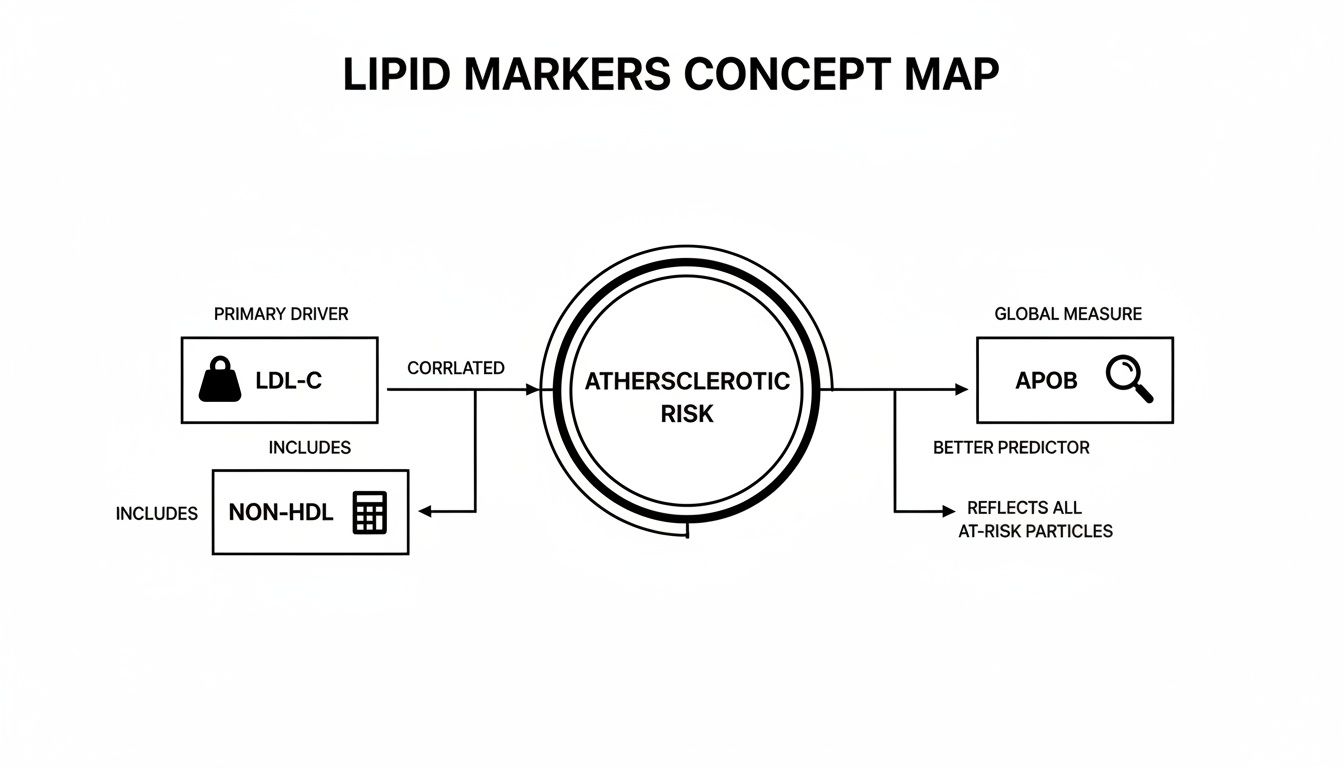
As you can see, while LDL-C measures the weight of cholesterol and Non-HDL gives you a calculated sum, ApoB provides a direct particle count. This simple but powerful difference gives you the clearest possible view of your cardiovascular risk, empowering you to move from just having data to building a personalised strategy for a long and healthy life.
Actionable Strategies to Lower Your ApoB Levels
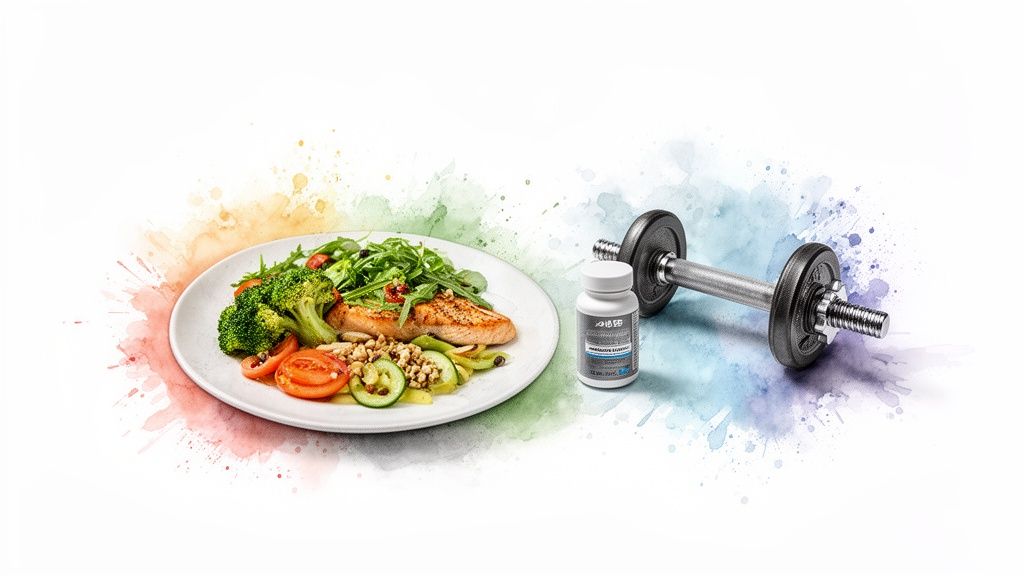
Knowing your ApoB number is the first step. The real power comes from acting on that knowledge to take control of your cardiovascular future. Optimising for longevity isn't a passive activity; it demands a targeted, evidence-based strategy.
Bringing down elevated ApoB levels is an achievable goal, and one that pays huge dividends for your long-term health and vitality. This isn't about short-term fixes; it's about making smart, sustainable changes to your nutrition, exercise, and lifestyle that directly reduce the number of plaque-forming particles in your blood, setting you up for a healthier future.
Nutrition: Your Primary Lever for ApoB Reduction
When it comes to lowering ApoB, your diet is by far the most powerful tool in your arsenal. The objective is straightforward: reduce the intake of foods that promote the creation of ApoB particles and increase the intake of foods that help clear them out.
Start by being ruthless with saturated and trans fats. You’ll find these lurking in fatty cuts of meat, full-fat dairy, butter, and many highly processed foods. These unhealthy fats are a direct signal to your liver to ramp up production of ApoB-carrying particles.
On the flip side, you want to strategically boost your intake of soluble fibre. Think of it as a sponge that mops up cholesterol in your gut, stopping it from ever reaching your bloodstream.
Your nutritional game plan for longevity boils down to two key moves: starve the production of new ApoB particles by cutting saturated fat, and actively help your body remove existing cholesterol by eating more soluble fibre.
Here are a few simple but powerful food swaps to get you started:
- Swap butter for avocado or olive oil: This simple change replaces saturated fat with heart-healthy monounsaturated fats.
- Swap red meat for oily fish like salmon: You’ll get less saturated fat while gaining a fantastic source of anti-inflammatory omega-3 fatty acids.
- Swap refined grains for oats, barley, and quinoa: These are packed with the soluble fibre your body needs to block cholesterol absorption.
- Add legumes, nuts, and seeds daily: Think beans, lentils, almonds, and chia seeds. Weaving these into your meals provides a serious boost of fibre and healthy fats.
These consistent dietary choices are a direct investment in your long-term cardiovascular health.
Smart Exercise for Cardiovascular Excellence
While nutrition does the heavy lifting, a well-planned exercise routine provides critical support for lowering ApoB and enhancing longevity. The secret is to combine both aerobic and resistance training to create a powerful synergistic effect on your heart health.
Aerobic exercise—like brisk walking, running, swimming, or cycling—improves how efficiently your body metabolises fat. Aim for at least 150 minutes of this kind of moderate-intensity activity every week. It helps lower levels of ApoB lipoproteins and strengthens overall heart function.
Resistance training is just as crucial for long-term health. Building and maintaining muscle improves your metabolic health and insulin sensitivity, which in turn helps regulate your lipid levels. Try to fit in two or three strength sessions a week, focusing on big compound movements that work multiple muscle groups at once.
It's also worth remembering that a holistic approach can pay dividends. For instance, incorporating techniques for improving blood circulation naturally can offer complementary benefits to your core plan.
Advanced Lifestyle and Supplement Strategies
For those truly committed to optimising their healthspan, mastering nutrition and exercise is the foundation. To take it to the next level, you need to fine-tune other lifestyle factors and consider targeted supplements.
1. Prioritise Sleep Optimisation
A chronic lack of quality sleep puts immense stress on the body, disrupting hormones and increasing inflammation, both of which can negatively impact your lipid profile. Make 7-9 hours of high-quality, uninterrupted sleep a non-negotiable part of your longevity strategy. This is when your body repairs itself.
2. Master Stress Management
Constant high stress floods your body with cortisol, a hormone that can disrupt your metabolism and contribute to higher ApoB over time. Find a daily stress-reduction practice that you can stick with, such as mindfulness meditation, deep-breathing exercises, or simply making time for a relaxing hobby. Consistency is key to mitigating the long-term damage of chronic stress.
3. Consider Targeted Supplements
Supplements can't replace a healthy lifestyle, but a few can offer extra support for lowering ApoB and protecting your heart.
- Psyllium Husk: This is a fantastic and easy source of soluble fibre. Just add it to water or a smoothie to help block cholesterol absorption.
- Omega-3 Fatty Acids: If you don't eat oily fish a couple of times a week, a high-quality fish oil or algae-based omega-3 supplement can help lower triglycerides and fight inflammation.
- NMN (Nicotinamide Mononucleotide): As a precursor to NAD+—a vital molecule for cellular energy and repair—NMN is gaining attention for its potential to support metabolic health and healthy ageing.
By weaving these nutritional, physical, and lifestyle strategies together, you create a powerful, multi-pronged attack on high ApoB, building a more resilient cardiovascular system for a long and vibrant life.
How to Proactively Get an Apo B Test
Knowing about Apo B testing is one thing; actually getting the test is the next crucial step in taking real control of your health. If you’re serious about longevity, you can’t afford to wait for a health problem to appear. A proactive approach is essential for anyone building a long-term health strategy.
While the NHS is fantastic, Apo B tests are generally reserved for specialist cardiac clinics and are not part of a routine health check. This makes it tough for a healthy individual to access this key data point. This is where modern health services come in, cutting through the red tape and putting you in charge of your own health information.
The Modern Route to Essential Health Data
For busy professionals and athletes, time is a precious resource. The traditional model of getting a referral and waiting weeks for an appointment simply doesn't work when you need information now to fine-tune your health and longevity plan. Newer services are designed to eliminate that friction.
The process is refreshingly simple and built around your convenience. It sidesteps the need for a GP referral for a specialist test, letting you order the exact biomarkers you need to build your longevity strategy. This direct access is a genuine shift in how we can manage our own health.
How the Process Works Step by Step
Getting an Apo B test is now as straightforward as ordering any other professional service. The entire experience is designed around your schedule, ensuring it causes minimal disruption to your packed calendar.
Here’s a quick look at how it typically works:
- Book Your Test Online: You can choose and buy the specific blood tests you want, like an advanced lipid panel that includes ApoB.
- Schedule a Phlebotomist: A trained professional comes directly to your home or office at a time that works for you. This means no travel and no waiting rooms—it's incredibly efficient.
- Receive Your Results Digitally: Your blood sample is couriered to a UKAS-accredited lab. In just a few days, your results are sent securely to an app on your phone, complete with a doctor’s review.
This approach means you go from making a decision to having actionable data in your hands in a matter of days, not months.
The real power of modern testing services is empowerment. You get direct access to vital health data like your ApoB level, which lets you shift from a reactive to a proactive mindset and make truly informed decisions about your long-term wellness.
For anyone ready to get a precise count of their atherogenic particles, you can book an Apolipoprotein B test directly and get the clear, actionable insights needed to build a robust cardiovascular health plan. It’s all about owning your health data and using it to stay ahead of potential issues, so you can perform at your peak for years to come.
Answering Your Apo B Testing Questions
Once you decide to make Apo B testing part of your health strategy, a few practical questions usually pop up. It's one thing to understand the science, but another to know the logistics. Here are some straightforward answers to the most common queries, so you can move forward with confidence.
How Often Should I Get My Apo B Levels Checked?
The right testing schedule depends on your current levels and your longevity goals. Think of it as tuning a high-performance engine; the more you need to optimise, the more frequently you check the data.
If your levels are already in the optimal zone (ideally below 0.65 g/L) and you have no other major risk factors, a baseline test followed by a re-check every 2-3 years is a solid plan. This cadence is perfect for monitoring long-term trends and ensuring you stay in that low-risk zone for longevity.
However, if your ApoB is borderline or high, or you're actively implementing lifestyle changes, you'll want a tighter feedback loop. Re-testing every 6-12 months allows you to see if your strategies are working and make adjustments. For anyone serious about health optimisation, an annual test should be a non-negotiable part of their yearly health review.
Do I Need to Fast for an Apo B Blood Test?
Yes, it’s best to fast for 9-12 hours before the blood draw. While your ApoB level itself doesn't shift much after a meal, the test is almost always done as part of a complete lipid panel.
This panel measures other things, like triglycerides, which are incredibly sensitive to what you've recently eaten or drunk. A meal just before your test can send your triglyceride levels soaring temporarily, which can obscure the interpretation of your overall results.
To get the most accurate picture of your entire lipid profile, fasting is the gold standard. It creates a clean, consistent baseline, making it possible to compare your results properly over time and giving you solid data to guide your health decisions. You'll always get specific instructions before your test to make sure everything goes smoothly.
Following this simple rule ensures the insights you get are precise, actionable, and truly reflect your underlying cardiovascular health.
Can Diet and Exercise Alone Lower High ApoB?
For many people, absolutely. A well-designed lifestyle plan can bring about a remarkable drop in ApoB levels. The combination of a diet low in saturated fats and high in soluble fibre, paired with a smart, consistent exercise routine, is a powerful weapon against high particle numbers. This is always the first line of defence and the cornerstone of a longevity strategy.
It’s important to remember, though, that genetics play a huge part in setting your baseline ApoB. Some people are just genetically wired to produce more of these harmful particles. For them, even the most disciplined diet and workout regimen might not be enough to hit the aggressive longevity targets (like getting below 0.65 g/L) that offer the best long-term protection.
This is where Apo B testing really shows its value. It's the first step in understanding your personal biology. If your numbers stay stubbornly high despite your best efforts, it’s a clear signal that it might be time to talk to your doctor about other options to help you reach your goals.
Is Apo B Testing Part of a Standard Health Check?
No, and this is a crucial detail for anyone taking charge of their health. An Apo B test isn't included in a routine NHS health check or the standard cholesterol panel your GP would order for a general check-up.
It’s considered a more advanced, specialised test. In the traditional healthcare system, it's typically ordered by cardiologists for patients who are already known to be at high risk or who have a history of heart disease.
This is exactly why services that let you order your own tests are so important for people focused on prevention and longevity. Waiting until there’s a clinical problem to get this data is a reactive approach. For high-performers, athletes, and anyone who wants to maximise their healthspan, proactive testing puts you in the driver’s seat, letting you get ahead of potential issues long before they become a problem.
Ready to look beyond standard metrics and get a true measure of your cardiovascular risk? With Lola, you can book a convenient at-home phlebotomy appointment for your Apo B test and receive your results, complete with a doctor's review, directly on our app. Take the first step towards a data-driven longevity strategy by visiting https://lolahealth.com today.