


Taking your cholesterol test at home is a smart, strategic move for anyone serious about their long-term health. It provides crucial data on your lipid levels without the hassle of a clinic visit, putting you in direct control of your longevity. For busy professionals and dedicated athletes, this transforms a reactive health check into a proactive strategy for optimising both current performance and future vitality.
Why Cholesterol Is a Silent Threat to Your Longevity
If you're driven to perform at your best, you know that success is a long game. But there’s a silent factor that can operate behind the scenes, undermining your healthspan and future potential: high cholesterol. Because it has no obvious symptoms, elevated lipid levels can quietly compromise your cardiovascular health, creating a hidden drag on your vitality that can impact you for decades to come.
This isn't just a concern for later in life. The demands of high-stress careers and intensive training schedules can have a real impact on your cholesterol right now. Chronic stress, for instance, can set off hormonal changes that lead to higher levels of LDL ("bad") cholesterol, while some diets popular in athletic circles can also throw your lipid profile out of balance, setting the stage for future health issues.
The Hidden Impact on Your Future Self
Ignoring your cholesterol is like building a long-term financial plan without knowing your current assets. Your body might seem to be running perfectly until critical, cumulative damage is already done. For a business leader, this could manifest over time as a decline in cognitive stamina or resilience. For an athlete, it might mean a shorter career due to slower recovery times or a gradual decline in endurance.
This is precisely why proactive monitoring is so crucial for longevity. Gaining real, actionable insight into your cardiovascular health is the first step toward taking control of your healthspan.
By reframing cholesterol management from a passive health check to a key performance indicator for longevity, you unlock a new level of control over your future. It's about making informed, data-driven decisions that sustain not just your lifespan, but your healthspan.
Taking Control with At-Home Cholesterol Testing
For many high performers, the biggest obstacle is time. Finding a slot for a traditional clinic appointment is often a non-starter. This is particularly concerning in the UK, where cardiovascular diseases remain a leading cause of premature death. In fact, an analysis of over 24,000 anonymised home blood tests revealed that a staggering 52% of UK adults had total cholesterol levels above the recommended threshold.
This statistic highlights just how vital accessible health data is for long-term planning. At-home cholesterol testing gives you the power to stop guessing and start building a strategy for a longer, healthier life.
Just as a physical imbalance like high cholesterol can silently undermine you, overlooked aspects of mental well-being can also hold you back. Unlocking Performance with Sports Mental Health Strategies is essential for a holistic approach to a long and healthy life. By making regular monitoring a part of your routine, you can build a complete picture of your internal health. This allows for precise, targeted adjustments to your nutrition, training, and lifestyle—a direct strategy for boosting your vitality today and securing a healthier future.
Understanding Your At Home Testing Options
When you decide to take a closer look at your cardiovascular health as part of a longevity plan, the world of at home cholesterol testing can seem a bit crowded. It all comes down to two main approaches: do-it-yourself (DIY) fingerprick kits and professional at-home services where a phlebotomist visits you. Understanding the differences is key to ensuring the data you collect is reliable enough to build a long-term health strategy upon.
At a minimum, any decent cholesterol test should give you a standard lipid panel. Think of this as the four essential markers that offer a snapshot of your metabolic health.
- Total Cholesterol: This is the overall measure of all the cholesterol floating around in your blood.
- LDL (Low-Density Lipoprotein): Often called the "bad" cholesterol, high levels can contribute to plaque building up in your arteries over your lifetime.
- HDL (High-Density Lipoprotein): Known as the "good" cholesterol, this one helps clear out excess cholesterol, protecting your arteries.
- Triglycerides: A type of fat in your blood that your body uses for energy. When levels are consistently high, it can raise your long-term risk of heart disease.
Knowing these numbers is the starting point, but the quality of that data makes all the difference.
The Snapshot vs. The High-Resolution Portrait
Let's use an analogy. A DIY fingerprick kit is like taking a quick snapshot on your phone. It’s convenient and gives you a general idea of the scene. For a basic, once-in-a-while check, it might suffice.
A professional venous blood draw, on the other hand, is like commissioning a high-resolution portrait. It captures every fine detail with incredible clarity and accuracy, giving you the complete, nuanced picture you need to make important decisions about your long-term health.
This isn’t just a turn of phrase; it reflects very real differences in the quality and reliability of the health data you receive. If you'd like to explore this further, our guide on what at-home blood testing involves provides more context.
The point of proactive health monitoring isn't just to get a number—it's to get a reliable number. For anyone serious about longevity, precision is non-negotiable. Small inaccuracies can lead to flawed interpretations and wasted effort in your health strategy.
To help you decide, here’s a straightforward comparison of the two main methods for at-home cholesterol testing.
Comparing At Home Cholesterol Testing Methods
This table breaks down the key differences between doing it yourself and having a professional collect your sample.
| Feature | DIY Fingerprick Kits | Professional At-Home Venipuncture |
|---|---|---|
| Sample Collection | Self-administered prick of the finger to collect a few drops. | Blood drawn from a vein in your arm by a trained phlebotomist. |
| Sample Volume | Very small, often just a few drops of capillary blood. | Larger volume of venous blood, ideal for lab analysis. |
| Accuracy & Reliability | Prone to user error, contamination, and sample degradation. | Clinical-grade accuracy, with minimal risk of error. |
| Comprehensiveness | May only measure total cholesterol or a limited panel. | Provides a full, detailed lipid panel and other biomarkers. |
| Best For | Quick, general check-ins where absolute precision isn't vital. | Anyone needing reliable data for a serious longevity strategy. |
Ultimately, the right method depends entirely on what you plan to do with the results.
A Closer Look at DIY Fingerprick Kits
DIY kits are easy to find and seem simple enough. You get a little lancet to prick your finger, squeeze out a few drops of blood onto a test strip or into a tiny vial, and then either get a result from a small device or post the sample to a lab.
But that convenience comes with some big caveats. The tiny blood sample is very vulnerable to contamination or breaking down before it's analysed. There's also a high chance of human error—not getting enough blood, applying it to the strip wrong, or even things like temperature can throw the results off. While some kits are certainly better than others, they often give an incomplete picture, which is not ideal for long-term planning.
The Gold Standard: Professional Venipuncture
By contrast, professional at-home venipuncture brings the clinic to you. A trained phlebotomist collects a blood sample straight from a vein in your arm, the same way it’s done at your GP’s office. This method provides a much larger, higher-quality sample, which is exactly what’s needed for a comprehensive and accurate analysis in a certified lab.
The advantages are pretty clear for anyone focused on longevity:
- Minimal risk of user error: The sample is collected by a professional who follows strict medical protocols.
- Superior sample quality: A venous draw provides plenty of clean, stable blood for a full, detailed lipid panel.
- Clinical-grade accuracy: Your sample is analysed in the same UKAS-accredited labs the NHS uses, so you can trust the results to guide your long-term health decisions.
For anyone pursuing a data-driven health strategy, the precision you get from a venous sample is non-negotiable. It removes the guesswork and gives you a solid foundation for making meaningful changes to your lifestyle, diet, or training. To see how this works in practice, you can look into services like ours or advanced at-home testing options like Athelas to understand the landscape. Choosing the right method is your first real step towards truly optimising your healthspan.
From Your Front Door to Actionable Health Insights: The Modern Testing Journey
Forget everything you know about inconvenient clinic appointments and long waiting times. Modern health monitoring isn't about fitting your life around the healthcare system; it's about making vital health checks fit seamlessly into your life. This is especially true for at-home cholesterol testing, which transforms a once-clunky process into a straightforward experience that puts actionable longevity data in your hands.
The whole journey is built for clarity and convenience, removing the hurdles that so often stop busy people from keeping a close eye on their long-term cardiovascular health. It's a clear, step-by-step path that takes you from initial curiosity to concrete, actionable insights for your longevity strategy.
The UK's at-home testing market is booming, largely because people are demanding more convenient ways to monitor their health. Market analysis reveals a major shift away from traditional clinic visits, favouring services that slot into busy schedules without causing disruption. This trend highlights a growing desire for reliable, accessible health data that puts you in the driver's seat of your own longevity. You can discover more about this market shift from Grand View Research.
Booking and Professional Sample Collection
The first step is refreshingly simple: you book your test online. No more phone queues or stuffy waiting rooms. You just pick a time and place that works for you—whether that’s at home before your first meeting of the day or at the office between projects. This immediately cuts out the travel and waiting that used to make health checks a logistical nightmare.
Once your appointment is set, a trained and vetted phlebotomist arrives at your chosen time. This isn't a DIY approximation of a clinical procedure; it is the real thing, delivered with maximum convenience. The phlebotomist takes a venous blood sample from your arm—the gold standard for accuracy—which ensures a high-quality sample without the potential errors that can come with self-administered fingerprick tests. The whole thing is quick, professional, and comfortable, often taking just a few minutes.
This infographic shows the core steps involved in many at-home testing services, from collecting the sample to getting your results.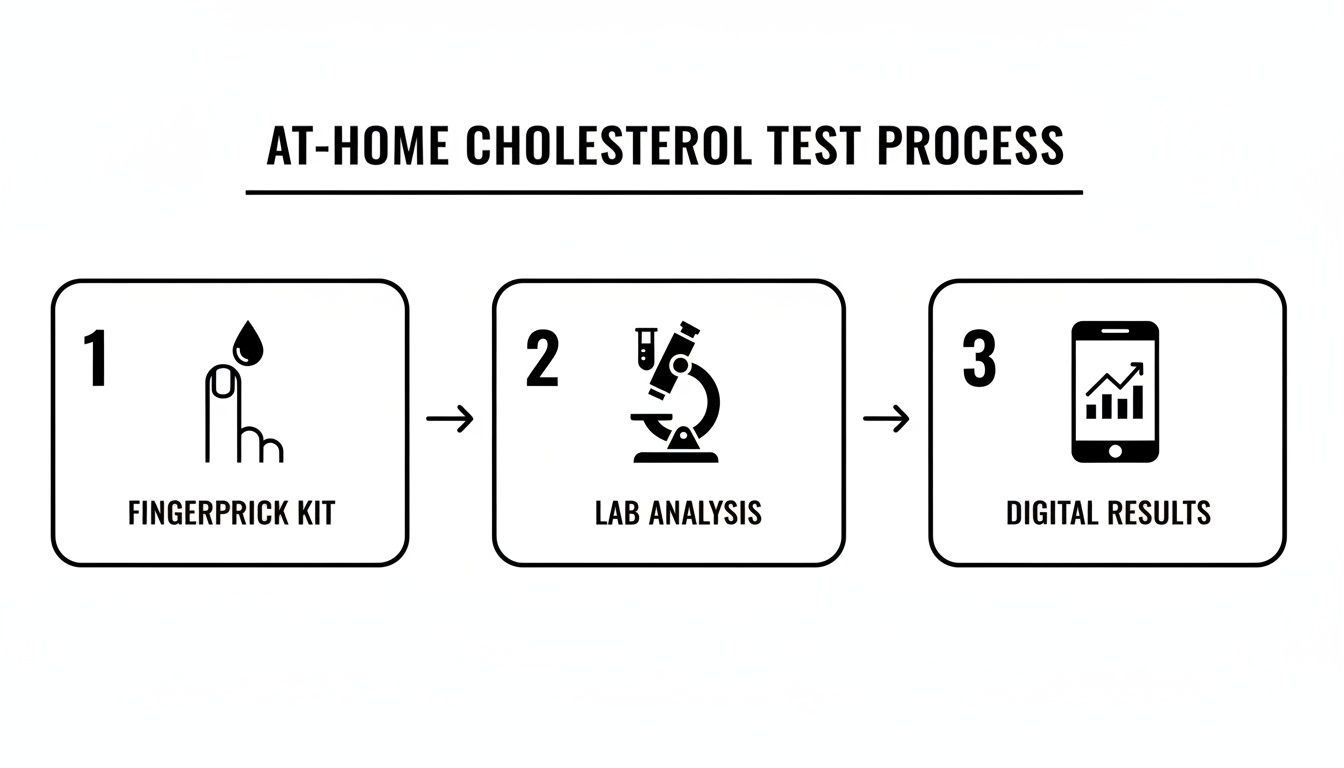
The journey from a simple blood draw to digital results makes it easier than ever to understand and act on your own health data.
Behind the Scenes at a Certified Lab
After the phlebotomist leaves with your sample, the real science begins. It's securely couriered to a UKAS-accredited laboratory for analysis. These are the very same labs the NHS trusts, meaning your results are handled with the highest possible standards of clinical precision and reliability.
Inside the lab, specialists analyse your blood to create a full lipid panel, which measures key markers like:
- Total Cholesterol
- LDL ('bad') Cholesterol
- HDL ('good') Cholesterol
- Triglycerides
This controlled, professional environment means that variables like temperature, handling, and equipment calibration are all managed perfectly. This gives you data you can actually trust to make important decisions about your long-term health.
The true value of a premium at-home test isn’t just the convenience. It’s the powerful combination of that convenience with uncompromising, clinical-grade accuracy. It’s about getting data that’s not just interesting, but genuinely reliable for building a longevity plan.
From Raw Data to a Personalised Longevity Plan
The final—and most important—step is getting and understanding your results. A few days after your sample is collected, your data is delivered securely through a digital platform, like a mobile app. But you aren't just handed a list of confusing numbers and left to figure it out alone.
This is where raw data is transformed into actionable insight. Your results come with a review from a qualified doctor who explains what each marker means for your personal health and longevity goals. This expert interpretation turns clinical figures into a clear story about your cardiovascular health, pointing out both your strengths and opportunities for improvement.
This doctor-led review is the crucial link to building a real longevity plan. It gives you the personalised context you need to make specific, targeted changes to your diet, exercise, and lifestyle. In the end, it turns a simple blood test into a powerful tool for your long-term performance and well-being.
Why Precision Is Non-Negotiable for Your Longevity
For business leaders and dedicated athletes, optimisation is a core principle. You spend your time fine-tuning strategies and analysing data to find an edge. The phrase "good enough" simply isn't in your vocabulary. So why would you settle for it when it comes to the most important project you'll ever manage: your long-term health?
When we're talking about something as critical as your cardiovascular health—the engine that powers your entire life—precision is everything. An approximate cholesterol reading can be dangerously misleading. It might hide an underlying risk that accumulates over decades or, just as frustratingly, lead you to make lifestyle changes you don't even need.
This is precisely why we advocate for venous blood draws. The data you get is on another level, offering the granular detail needed to properly understand your lipid profile and how it directly impacts your healthspan.
For the Driven Professional: Cognitive Function and a Longer Career
If you're an executive making high-stakes decisions, your cognitive stamina is your most valuable asset. What you might not realise is how directly your cholesterol levels influence its longevity. Your brain is packed with cholesterol, which it needs to build and maintain synapses—the very connections that form the basis of memory and learning.
An imbalanced lipid profile can slowly interfere with this complex neural wiring. It's not a sudden drop-off but a gradual erosion of your peak cognitive function over years. Think of it like static on a clear radio frequency; the signal is still there, but it's fuzzy and takes more effort to understand.
In the boardroom, mental sharpness and resilience are your superpowers. Precise cholesterol data helps protect them for the long haul by ensuring your cardiovascular system is running smoothly, delivering the oxygen and nutrients your brain demands to thrive for decades.
Accurate at home cholesterol testing gives you the power to manage this proactively. By knowing your exact LDL, HDL, and triglyceride numbers, you can make targeted adjustments to your diet and lifestyle that specifically support brain health, helping you stay sharp and perform at your peak for years to come.
For the Dedicated Athlete: Extending Your Performance Window
For any serious athlete, a career is a finely tuned machine built on training, nutrition, and recovery. Cholesterol is a fundamental component of that machine. It’s the precursor to essential hormones like testosterone and cortisol, which govern everything from muscle growth and repair to your energy levels and stress response.
An inaccurate or incomplete cholesterol test leaves you flying blind on your long-term prospects. Imagine an endurance athlete following a ketogenic diet. They need to know exactly how their body is responding. Are their lipids optimised for peak performance, or is their diet creating a hidden cardiovascular risk that could shorten their competitive years?
This is where precise data becomes a game-changer for longevity.
- Hormonal Health: Accurate lipid results ensure you have the raw materials needed for robust hormone production, which is critical for adapting to training and recovering effectively over a long career.
- Energy Utilisation: Your triglyceride levels offer a clear window into how efficiently your body is using fat for fuel—a vital metric for sustainable endurance.
- Inflammation Control: The ratio of different lipid particles can signal underlying inflammation that might be accelerating wear and tear. To go deeper, you can explore the significance of specific biomarkers in our guide to the ApoB test and its role in assessing cardiovascular risk.
Take a cyclist preparing for a long career. A vague cholesterol reading might give them a false sense of security, while a precise, venous-level test could reveal an imbalanced LDL-to-HDL ratio that needs attention. This insight allows for specific, targeted tweaks—like adding more soluble fibre or omega-3s—that directly support both their immediate performance and long-term health. For any high performer, precision isn't a luxury; it's a strategic necessity for a long and successful career.
Turning Your Cholesterol Data into a Longevity Strategy
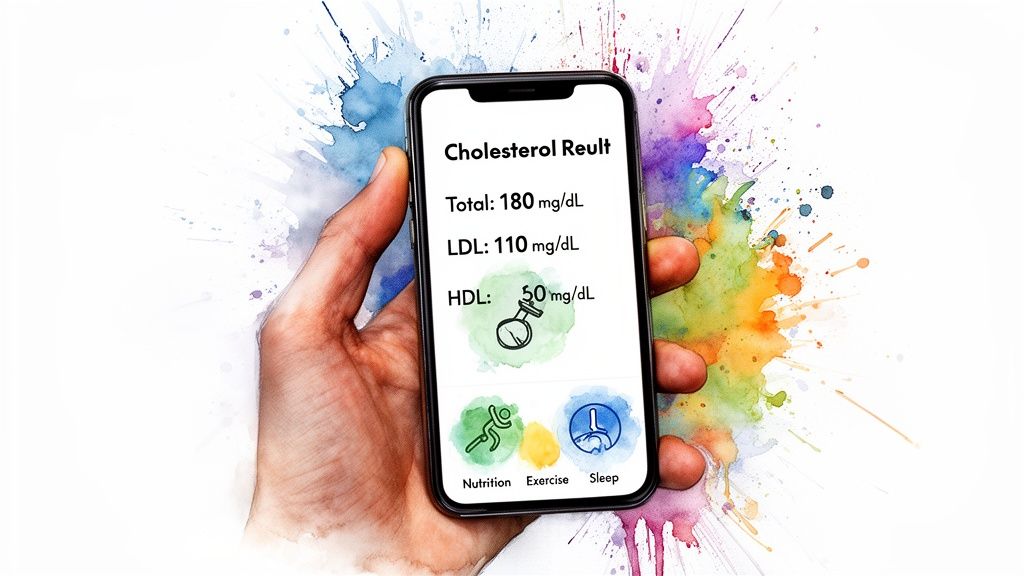
Getting your results from an at home cholesterol test isn't the finish line; it’s the starting block for a healthier future. For high performers, this data is the raw material you need to build a powerful, personalised longevity strategy. The aim here is to move past generic advice and create a sustainable system that enhances your healthspan, boosts performance, and builds resilience for the long haul.
It all starts with understanding that your lipid panel is a dynamic reflection of your lifestyle, not a fixed verdict. Think of it as a set of variables you can directly influence through targeted, intelligent action. The recent rise in at-home testing shows a crucial cultural shift towards proactive health management, with millions in the UK living with heart conditions linked to unmanaged cholesterol. People are realising that accessible testing empowers them to take control before a small issue becomes a critical one. For a deeper dive into this trend, you can explore more insights into the cholesterol test market on Future Market Insights.
The Four Pillars of Cholesterol Optimisation
Imagine your longevity plan is a structure built on four core pillars. By making consistent, small improvements across these areas, you can bring about meaningful and lasting change to your lipid profile and overall cardiovascular health.
- Targeted Nutrition: This is about getting specific, moving beyond vague statements like "eat healthy" to foods that actively improve your lipid profile.
- Strategic Exercise: It’s more than just being active; it’s about training specifically for cardiovascular efficiency and metabolic health.
- Stress and Cortisol Management: We need to address the silent hormonal factors that impact your lipids and accelerate aging.
- Advanced Supplementation: This involves using targeted compounds to support your body’s metabolic machinery where diet falls short.
This framework helps you build a well-rounded approach that tackles cholesterol from multiple angles, dramatically increasing your chances of success.
Your cholesterol numbers aren't just for your doctor; they are key performance indicators for your longevity. Treating them with the same strategic focus you apply to your career or training is the essence of a data-driven life.
Pillar 1: Targeted Nutrition
Your diet is arguably the most powerful lever you have for managing cholesterol. The real wins come from integrating a few high-impact foods into your existing routine.
- Soluble Fibre Powerhouses: Start incorporating foods like oats, barley, apples, and beans. Soluble fibre acts like a sponge, binding to cholesterol in your gut and helping to remove it from your body. A simple swap, like having porridge for breakfast, can make a real difference to your LDL levels over time.
- Omega-3 Rich Foods: Fatty fish like salmon and mackerel, along with walnuts and flaxseeds, are fantastic sources of omega-3s. These healthy fats are proven to lower triglycerides and reduce the inflammation that contributes to arterial aging.
- Plant Sterols and Stanols: You can find these in fortified foods like certain yoghurts and margarines. They are structurally similar to cholesterol and work by blocking its absorption from your food.
To get a clearer picture of what good numbers look like, have a look at our guide on understanding the cholesterol level chart in the UK.
Pillar 2: Strategic Exercise
While any exercise is good, certain types are particularly effective for optimising your lipid profile for the long term.
You should aim for a balanced routine that includes both aerobic exercise and resistance training. Aerobic activities like running, cycling, or swimming are fantastic for raising HDL ("good") cholesterol. At the same time, resistance training improves your overall metabolic health and muscle mass, making your body better at clearing fats from the bloodstream as you age. A solid weekly routine might look like three 30-minute cardio sessions and two full-body strength workouts.
Pillar 3: Stress Management
Chronic stress is a hidden saboteur of cardiovascular health and a known accelerator of the aging process. It triggers the release of cortisol, a hormone that, over time, can lead to increased triglycerides and LDL cholesterol.
This is why integrating stress management techniques is non-negotiable for any serious longevity plan. It doesn't have to be complicated—it could be a daily 10-minute meditation practice, deep breathing exercises, or simply ensuring you get enough quality sleep. By managing your cortisol levels, you are directly supporting a healthier lipid profile and slowing down a key aging pathway.
Creating Your Feedback Loop
The real power of this strategy comes from creating a continuous feedback loop. Use your initial at-home cholesterol test results to set your baseline. Then, implement your targeted changes across the pillars for a set period—let’s say, three to six months.
After that, take a follow-up test. This is where you see precisely what’s working and what isn’t, allowing you to fine-tune your approach. This iterative process of testing, acting, and re-testing transforms your health management from guesswork into a precise, optimised system for lifelong vitality.
Your Questions Answered: At-Home Cholesterol Testing
If you're considering adding at-home cholesterol testing to your health toolkit, it's natural to have a few questions. For high performers, making informed decisions is second nature, so this section is all about giving you clear, straightforward answers. I want to demystify the whole process, so you can feel confident that this simple step can be a powerful tool in your pursuit of long-term health and vitality.
Think of this as the final briefing before you commit to a smarter, more proactive way of managing your wellbeing for the long haul.
How Often Should I Get My Cholesterol Checked?
There’s no one-size-fits-all answer here; the right frequency depends on your personal health goals and your starting point. Your testing schedule should be a dynamic part of your longevity strategy, adapting as you gather more data and tweak your lifestyle.
A good way to think about it is to categorise your needs:
- Getting a Baseline: If you're new to tracking your health metrics, a single test is your essential starting point. This initial data gives you the foundation to build your entire longevity strategy on.
- Monitoring and Optimising: For those with borderline results or who are actively working to improve their numbers, testing every three to six months is ideal. This creates a powerful feedback loop, showing you in black and white what’s working so you can fine-tune your approach for long-term success.
- Performance Longevity for Athletes: If you’re an athlete dialling in your nutrition, you might test more often. This is especially true when making big dietary shifts, like moving to a ketogenic diet, to ensure your lipid profile stays in a healthy range while you push your physical limits.
Regular, strategic testing takes your health out of the realm of guesswork and turns it into a precise, data-driven science for a longer, healthier life.
Is a Professional Home Blood Draw a Hassle?
Many people picture a home blood draw being complicated, but the reality is refreshingly simple and stress-free. A professional at-home venipuncture is designed from the ground up for convenience, bringing a clinical-grade service right to your doorstep.
When the trained phlebotomist arrives, they set up a sterile environment and perform the blood draw exactly as they would in a GP’s surgery. The whole thing is quick, usually taking just a few minutes. It's a world away from the hassle of travelling to a clinic, sitting in a waiting room, and then rushing back to your day.
The experience is best described as professional, efficient, and discreet. It simply removes the logistical hurdles that stop people from regularly monitoring their health, making it a sustainable practice for even the busiest schedules.
Ultimately, the process is far easier than a standard clinic visit, happening on your own terms, in your own home.
Can I Actually Trust These Results for Long-Term Decisions?
This is probably the most important question of all, and the answer comes down to how the sample is collected and analysed. There's a huge difference in reliability between a DIY fingerprick test and a venous blood sample analysed in a certified laboratory.
Fingerprick kits are prone to a whole host of problems, from user error during collection and sample contamination to the sample itself degrading. While they might be okay for a very rough check-in, their results often lack the precision you need to make serious, long-term health decisions.
In contrast, a venous blood sample, taken by a phlebotomist and processed in a UKAS-accredited lab, provides clinical-grade data. These are the very same labs and standards used by the NHS. When you combine that level of accuracy with a review from a qualified doctor, you get a reliable foundation for your longevity strategy. You can confidently use this information to guide your decisions on nutrition, your exercise regime, and your overall healthspan.
What Do HDL and LDL Numbers Actually Mean for My Longevity?
You don't need a medical degree to understand your cholesterol numbers. A simple analogy can make the roles of HDL and LDL—often called 'good' and 'bad' cholesterol—crystal clear for your long-term health.
Imagine your arteries are busy motorways that need to last a lifetime.
- LDL (Low-Density Lipoprotein) is like a fleet of delivery lorries. They’re essential for carrying cholesterol to cells. The problem is, if you have too many lorries, they can cause "traffic jams" and "breakdowns," leading to plaque building up on the artery walls over many years.
- HDL (High-Density Lipoprotein) acts as the motorway maintenance crew. These are the recovery trucks that pick up excess cholesterol and take it back to the liver to be safely removed, keeping the roads clear and smooth for longer.
While the individual numbers are important, modern longevity science puts a much greater emphasis on the ratio between your different lipids. A healthy balance—plenty of maintenance crew relative to the delivery lorries—is a far better indicator of your long-term cardiovascular risk than any single number on its own. It's this more nuanced view that allows you to build a truly effective strategy for your long-term heart health.
Ready to move from guessing to knowing? With Lola, you can get a complete, doctor-reviewed analysis of your cardiovascular health without ever leaving your home. Our professional phlebotomy service and NHS-standard lab analysis provide the precise, actionable data you need to build a powerful longevity strategy. Take the first step towards data-driven health and book your at-home cholesterol test today.