


Imagine having a personal map to your body’s inner workings—a guide to help you navigate the path towards a longer, healthier life. This is the new reality of proactive health management, and it’s being driven by at home hormone tests. These kits provide actionable insights based on your unique biology, empowering you to stop following generic wellness advice and start building a personalised longevity strategy.
Your Personal Roadmap to a Longer Healthspan
The modern approach to longevity is evolving. It’s not just about adding more years to your life; it’s about adding more life to your years. This concept, known as 'healthspan', is about maintaining peak physical and cognitive function for as long as possible. Instead of waiting for symptoms of age-related decline, you can get ahead of the curve by understanding and optimising your hormonal baseline. At-home hormone tests are a foundational tool in this proactive approach.
Think of it like planning a long road trip. You wouldn't set off without a map or GPS, would you? Your hormones are your body’s internal navigation system, directing everything from your energy levels and mood to your metabolism and resilience. Monitoring them provides the critical data you need to steer your health journey towards a longer, more vital life.
From Reactive Care to Proactive Optimisation
For a long time, healthcare has been reactive. You feel unwell, you visit a doctor, you get a treatment. That model is essential, of course, but it often means we’re only dealing with problems after they’ve already set in. A proactive longevity strategy, built around regular biomarker monitoring, lets you spot subtle downward trends and make targeted adjustments long before they become significant health issues.
This shift in thinking is really starting to take hold. People want access to their own health data, and that demand is fuelling some serious market growth.
The UK self-testing market, which includes at-home hormone tests, was worth USD 568.7 million in 2024. It's expected to grow by nearly 8% each year, reaching almost USD 888.3 million by 2030. This clearly shows a powerful trend: people are taking direct ownership of their personal health information.
Building Your Personalised Longevity Plan
Understanding your unique hormonal profile is the first actionable step in creating a longevity plan that is truly personalised. This information allows you to make targeted, effective decisions about your lifestyle, nutrition, and supplementation to optimise your healthspan.
Here’s what that looks like in practice:
- Informed Supplement Use: Stop guessing which supplements, like NMN or resveratrol, might support your ageing process. Instead, base your choices on biological data, targeting specific pathways revealed by your hormone levels.
- Targeted Lifestyle Changes: See the direct impact of changes to your diet, a new exercise routine, or stress management techniques on your key health markers. This creates a powerful feedback loop for continuous optimisation.
- Early Detection: Spotting downward trends in vital hormones like DHEA or testosterone early gives you the chance to address potential age-related decline before it starts affecting your quality of life.
The wider endocrine testing market in the UK hit around USD 438.9 million in 2023, and it's set to keep growing strongly. This reflects a growing understanding that hormone health is fundamental to our overall vitality and long-term well-being. You can dive deeper into the endocrine testing market trends in the UK to see how this field is evolving.
Decoding the Key Hormones for Longevity
To truly take charge of your healthspan, you need to understand the language your body speaks. Hormones are its chemical messengers, and listening to them through regular testing gives you a direct line to your internal operating system. Knowing what these biomarkers mean is the key to unlocking actionable insights for your longevity goals.
Before we dive into specifics, it's helpful to get a grasp on what these messengers actually are. For a bit of background on one of the major classes, you can explore what a peptide hormone is and see how these crucial signals get the job done. This foundational knowledge really helps put your own test results into a much clearer context.
The Vitality and Stress Axis
Think of your daily energy and long-term ageing as a delicate balancing act between two crucial hormones: DHEA and cortisol. One builds you up, while the other helps you react to threats. When they're in harmony, you thrive. When they're not, the ageing process can accelerate.
DHEA (Dehydroepiandrosterone) is often called the ‘vitality hormone’, and for good reason. Your adrenal glands produce it, and your body uses it as a raw material to create other key hormones like testosterone and oestrogen. Healthy DHEA levels are tied to better energy, mental sharpness, and a robust immune system, making it a critical biomarker for healthy ageing. An actionable insight from tracking DHEA is identifying a decline early, which can prompt lifestyle changes like stress reduction or targeted supplementation to support adrenal health.
On the other side of the scale is Cortisol, your body's built-in alarm system. It’s released when you’re stressed, triggering the classic 'fight or flight' response. While that's great for surviving immediate danger, the relentless stress of modern life can leave cortisol levels chronically high, which accelerates the ageing process. Over time, it can break down muscle, wreck your sleep, and cloud your thinking. Monitoring cortisol provides direct feedback on the effectiveness of your stress management techniques, such as meditation or improved sleep hygiene.
Your Metabolic Engine: Thyroid Hormones
Your thyroid gland is like the metabolic engine for your entire body. It dictates everything from your cellular energy production to your body weight. At-home hormone tests can give you a clear look under the bonnet by measuring a few key markers.
- TSH (Thyroid-Stimulating Hormone): This hormone comes from your brain’s pituitary gland and essentially tells your thyroid to get to work. If your TSH is high, it can be a sign of an underactive thyroid (hypothyroidism), which often shows up as fatigue and weight gain, sabotaging your healthspan goals.
- Free T4 (Thyroxine): This is the main hormone your thyroid produces. It travels through your bloodstream before being converted into the more potent T3.
- Free T3 (Triiodothyronine): This is the active form that gets into your cells and directly revs up your metabolism. Low levels can leave you with brain fog, zero energy, and constantly feeling cold.
Keeping an eye on this trio gives you a comprehensive view of your metabolic health—a true cornerstone of longevity. An efficient metabolism is absolutely vital for maintaining your energy and a healthy body composition as you get older.
This infographic shows how at-home hormone tests fit into a cycle of improving your personal healthspan, from the initial test all the way to optimisation.
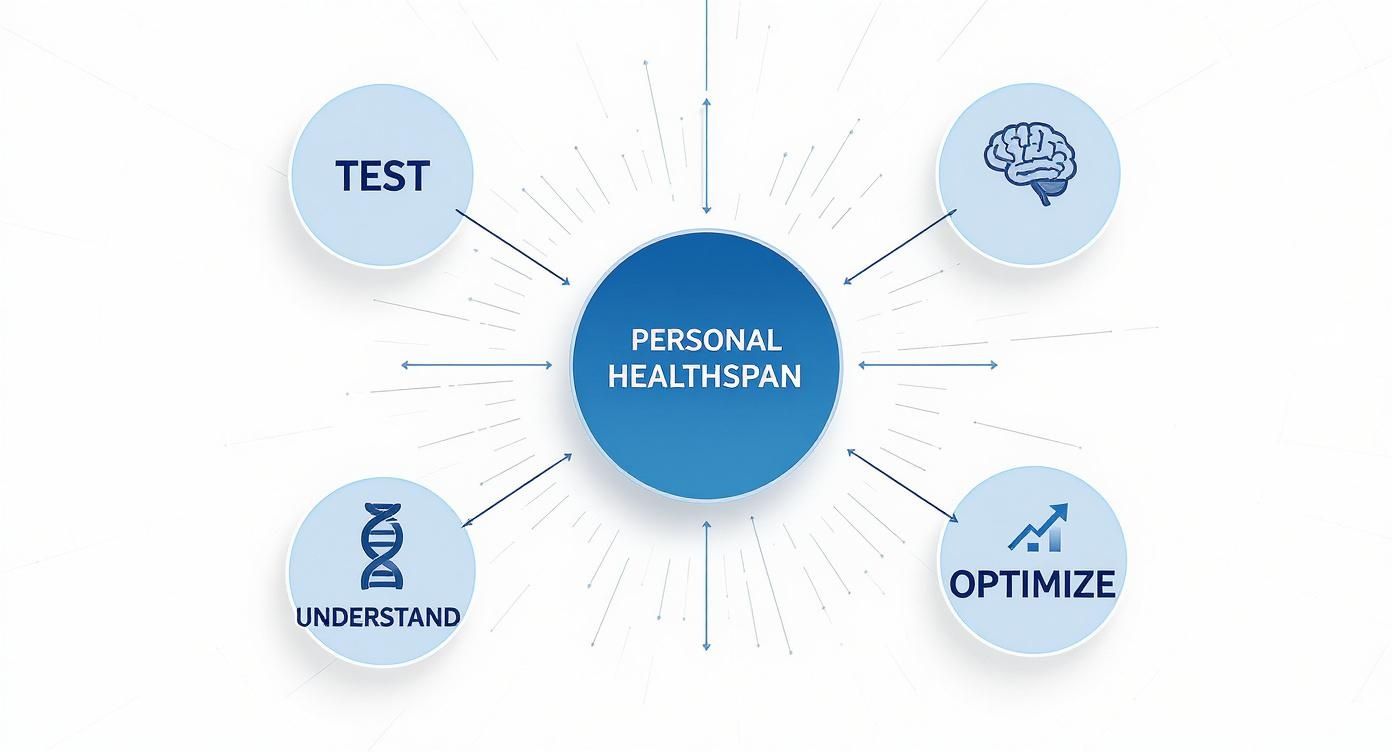
It highlights a powerful feedback loop: you test your biomarkers, you understand what the data is telling you, and then you optimise your lifestyle to boost your long-term health. Simple, but incredibly effective.
Hormones are the body’s chemical messengers, and understanding their balance is central to managing your health and extending your vitality. The following table summarises some of the most important hormones to monitor.
Key Hormones and Their Role in Longevity
| Hormone | Primary Function | Importance for Longevity |
|---|---|---|
| DHEA | Precursor to sex hormones; manages stress response. | Supports energy, cognitive function, and immune health. Declines with age. |
| Cortisol | Manages stress, metabolism, and inflammation. | Chronically high levels can accelerate ageing, break down muscle, and impair sleep. |
| Testosterone | Key for muscle mass, bone density, and libido (in both sexes). | Maintaining healthy levels supports vitality, strength, and cognitive sharpness. |
| Oestrogen | Regulates the menstrual cycle; protects bone and heart health. | Crucial for women's bone density post-menopause; impacts mood and skin health. |
| TSH, Free T4, Free T3 | Regulates the body’s entire metabolism. | An efficient metabolism is vital for energy, weight management, and cellular health. |
By tracking these key players, you gain a clearer picture of your body's internal state, allowing for more precise interventions to support a long and healthy life.
Key Sex Hormones for Men and Women
While important for everyone, some sex hormones play a particularly dominant role in the long-term health of men and women. If you're serious about longevity, you need to understand how they work.
For men, Testosterone is a primary driver of vitality. It's what keeps your muscle mass up, your bones strong, and your mind sharp. Levels naturally dip with age, but tracking them allows you to be proactive in supporting healthy production through smart lifestyle and nutrition choices, like resistance training and ensuring adequate zinc intake.
For women, it's the intricate dance between Oestrogen and Progesterone that governs everything from mood and menstrual cycles to bone health.
Oestrogen is absolutely vital for maintaining bone density, and the sharp drop during menopause is a major reason for the increased risk of osteoporosis. Progesterone, meanwhile, is key for regulating cycles and supporting uterine health.
Monitoring these hormones empowers women to navigate the changes of perimenopause and menopause with data-driven insight. It provides the information needed for targeted strategies to manage symptoms and protect their health for the long run. By getting to know these key players, you can start turning the signals from your body—and your at-home hormone tests—into a powerful tool for a longer, healthier life.
The Science Behind Accurate At-Home Testing
Can you really trust the results from an at-home hormone test? It’s a completely fair question, and probably the biggest one people have when they start looking into taking control of their health this way. The good news is, when you choose the right provider, the results can be just as reliable as any test you’d get at your GP’s surgery. The key is understanding what makes a test accurate.
It all begins with how your sample is collected. You'll generally come across two main methods, and each has its place depending on what you need to find out. Getting this first step right is crucial for painting a clear and reliable picture of your hormonal health.

Collection Methods: Finger-Prick vs. Venipuncture
The most common method you'll see is the finger-prick test. You use a tiny lancet to prick your fingertip and squeeze a few drops of blood into a collection vial. Its main advantage is pure convenience—you can do it yourself, whenever and wherever suits you.
But that small sample size can sometimes be a drawback. If you’re running a comprehensive panel of tests, or looking for hormones that are present in very low concentrations, you often need more blood to get the most precise analysis.
That’s where at-home venipuncture steps in. A trained phlebotomist comes directly to your home to perform a proper venous blood draw, exactly like you’d have in a clinic. This method gives you a larger, higher-quality sample, which has long been considered the gold standard in diagnostics. For anyone serious about tracking their biomarkers for longevity, venipuncture delivers the highest possible degree of accuracy. You can dive deeper into the details in our guide on https://lolahealth.com/blogs/longevity/what-is-at-home-blood-testing.
The Non-Negotiable Role of Accredited Labs
The quality of your sample is only one part of the equation. Where that sample ends up for analysis is just as critical, which is why lab accreditation is non-negotiable. Here in the UK, the gold standard to look for is UKAS (United Kingdom Accreditation Service) accreditation.
A UKAS-accredited lab follows the exact same stringent quality and competency standards as the labs used by the NHS. This guarantees your sample is processed with the highest level of scientific rigour, making the results dependable and clinically valid.
Choosing a service that partners with these labs takes all the guesswork out of the quality. And if you're interested in the bigger picture, you can learn more about the infrastructure supporting accurate medical testing.
Despite the growing popularity of these tests—with the UK market projected to hit £660 million by 2030—it’s important to know that not all services are created equal. Research has flagged that many commercial tests come with unclear instructions and lack proper regulatory oversight, which can lead to people misinterpreting their results. That’s why it is so important to choose a provider who is absolutely committed to using accredited labs and providing proper clinical oversight.
How to Prepare for Your Test
Finally, to get the most accurate snapshot of your health, a little preparation goes a long way. What you do in the hours leading up to your test can have a surprisingly big impact on your results.
Just run through this simple checklist to make sure your sample is perfect:
- Check for Fasting Requirements: Some tests, especially for metabolic markers, require you to fast for 8-12 hours before collection. That means nothing to eat or drink except water.
- Mind the Timing: Your hormones fluctuate naturally throughout the day. Cortisol, for instance, peaks in the morning. Always follow the specific timing instructions in your kit—they’re designed to capture the most meaningful reading.
- Stay Hydrated: Drinking plenty of water is a simple but effective tip. Good hydration makes a blood draw much smoother and helps you get a good quality sample, especially for finger-prick tests.
- Avoid Strenuous Exercise: An intense workout can temporarily throw some of your hormone levels out of whack. It's best to skip any heavy gym sessions for 24 hours before you collect your sample.
Turning Your Test Results into Action
Getting a report packed with numbers and graphs can feel a bit like being handed a car manual when all you want to do is drive. It’s one thing to get your data from an at-home hormone test; it's another thing entirely to know what it means for you and what to do next. This is where we move from just collecting data to actually using it to build a longer, healthier life.
The first step is to shift your mindset away from a simple "pass or fail" view. Just because a number falls inside the standard ‘normal’ range doesn’t automatically mean it’s the right level for your personal health goals. This distinction is what separates basic health monitoring from a genuine strategy for extending your healthspan.
Normal vs. Optimal Ranges
Think of standard lab ranges like the national speed limit on a motorway. They're broad guidelines designed to keep the general population out of immediate danger. If you’re way outside that range, it flags a potential problem that needs looking into. Simple as that.
An optimal range, on the other hand, is more like the perfect gear and speed for your specific car to get the best fuel efficiency and performance on a long journey. It's a much narrower, more personalised target that’s linked to peak vitality, sharp cognitive function, and long-term well-being. Aiming for your optimal levels isn’t about avoiding illness—it's about proactively chasing excellence.
For example, a man’s testosterone level might be technically ‘normal’ but still sit at the very bottom of the range for his age, leaving him feeling sluggish and unmotivated. An actionable insight here would be to implement lifestyle changes like resistance training and optimising sleep to naturally boost levels towards the optimal end of the range.
This is exactly why getting professional guidance is so crucial. A doctor can interpret your results within the bigger context of your life—your age, symptoms, lifestyle, and goals—to help you figure out where you really stand.
The Power of Trend Analysis
A single hormone test gives you a valuable snapshot of your health in one specific moment. But the real magic for longevity happens when you start tracking your results over months and years. This is what we call trend analysis.
Imagine trying to understand the climate of a city by only looking at one day's weather forecast. It’s helpful, but it hardly tells the whole story. Tracking your biomarkers over time is like watching the seasons change; it reveals patterns, shows the direction you’re headed, and helps you see the real-world impact of your diet and lifestyle choices.
- See what actually works: Did that new supplement routine or diet change really move the needle on your key biomarkers? Trend data gives you the objective truth.
- Catch problems early: A slow, gradual dip in a crucial hormone like DHEA can be spotted and addressed long before it drops to a level that causes symptoms you can feel.
- Personalise your health plan: You start to learn what your unique ‘optimal’ feels like and can make small, precise adjustments to stay there, constantly fine-tuning your strategy.
By watching these trends, you build a dynamic, living health story that allows for genuinely proactive management. To get more comfortable with your reports, have a look at our detailed guide where we have blood test results explained for UK readers.
When a Doctor Review Is Essential
Interpreting lab results properly requires years of clinical expertise. Without it, it’s all too easy to fall down the rabbit hole of self-diagnosis, which can lead to needless anxiety or, even worse, making unsafe decisions about supplements or lifestyle changes. This is why any reputable testing service should include a mandatory doctor review with every single test.
A clinician does far more than just read the numbers. They connect the dots between different biomarkers, cross-reference your results with your personal health history, and translate all that complex data into clear, safe, and actionable advice. They provide the essential context that turns a page of numbers into a genuine plan for your health.
Think of this professional oversight as your safety net. They have the experience to distinguish between a minor fluctuation and a genuine red flag that needs a closer look.
Knowing When to See Your GP
At-home hormone tests are fantastic tools for screening and optimisation, but they are not a substitute for your GP. A huge part of using them responsibly is knowing when it's time to take your results to your doctor.
You should always book an appointment with your GP if:
- The service’s own doctor recommends it: If our clinical review flags a significant concern, the first piece of advice will almost always be to consult your GP.
- A result is way out of range: Any result marked as critically high or low needs to be discussed with your doctor for proper diagnostic testing.
- You have persistent symptoms: If you’re feeling unwell and your symptoms don't seem to match your test results, or they just won’t go away, it’s time for a professional, in-person evaluation.
This collaborative approach ensures you get the full benefit of at-home testing while staying safely grounded within the established healthcare system.
How to Use Hormone Data for Peak Performance
Getting the raw numbers from an at-home hormone test is just the first step. The real magic happens when you turn that data into a genuine competitive edge in your life and career. For anyone pushing their limits, whether in the boardroom or on the track, hormone data creates a powerful feedback loop to fine-tune your energy, resilience, and long-term health.
This is especially true for busy professionals wrestling with high-stress environments. Chronic stress isn't just a mental state; it's a physical one, driven by the hormone cortisol. When cortisol stays high for too long, it can lead straight to burnout, brain fog, and a pervasive sense of fatigue that directly impacts your healthspan.
By regularly tracking your cortisol levels, you gain an actionable insight into the real-time impact of your workload. Seeing a high morning cortisol can prompt you to prioritise stress-management techniques—like meditation or a walk in nature—before you hit a wall. Suddenly, managing stress becomes a precise, data-driven strategy for longevity.

Sharpening Your Cognitive Edge
For professionals, mental sharpness is everything. Think of your thyroid hormones as the body's accelerator pedal; they influence everything from energy levels to how quickly you think. Even slight dips in thyroid function, while still technically in the ‘normal’ range, can show up as sluggish thinking and trouble concentrating.
Keeping an eye on your thyroid stimulating hormone (TSH) and active hormones like Free T3 gives you a much clearer picture of your metabolic health. With that knowledge, you can make targeted tweaks to your diet and lifestyle to support your thyroid, making sure your brain is firing on all cylinders when you need it most.
The Athlete’s Blueprint for Performance and Recovery
Athletes are always walking a tightrope between pushing hard enough and tipping over into overtraining. The testosterone-to-cortisol (T:C) ratio is one of the best biomarkers for tracking this delicate balance. Testosterone is anabolic (it builds tissue), while cortisol is catabolic (it breaks tissue down).
A healthy T:C ratio shows your body is adapting well to the stress of training. But if your testosterone starts to fall while cortisol creeps up, that’s a huge red flag for overtraining. It signals an increased risk of injury and illness. Tracking this ratio gives athletes and coaches the hard data needed to make smart decisions about training intensity and recovery. For a deeper dive into this, check out our guide on how to use blood tests for fitness.
This proactive mindset is becoming more common, especially as technology makes health data easier to access. The UK’s at-home testing market has grown significantly since the pandemic, particularly among women wanting personalised health insights. In fact, the women's health diagnostics market in the UK is projected to hit around $1.3 billion by 2030, fuelled by a desire for more control over conditions like PCOS and menstrual health. It’s a clear shift towards people taking charge of their own health.
Ultimately, using at-home hormone tests is about moving from guesswork to precision. It gives you the objective feedback you need to sustain high performance, avoid burnout, and build a solid foundation of health that will support your ambitions for years to come.
Picking the Right At-Home Hormone Test
With at-home hormone tests popping up everywhere, it’s become surprisingly tricky to figure out which service you can actually trust. Making a smart choice here is vital. The quality of the service you pick directly affects how reliable your results are and, ultimately, how useful they'll be for your health and longevity goals. This isn't just about downloading a sleek app; it's about finding a partner who is serious about clinical standards.
Think of it like doing your homework before making any important investment in your health. The best providers are completely open about their methods and standards, which gives you the confidence you need in the entire process.
What to Look For in a Top-Tier Service
When you're comparing your options, a few core features really separate the great services from the mediocre ones. These are the things that ensure you’re getting genuinely useful health information, not just a page of numbers that leaves you confused.
Here’s what a high-quality service must offer:
- UKAS-Accredited Laboratories: This is the absolute deal-breaker. A UKAS accreditation means your sample is handled and analysed to the very same rigorous standards the NHS uses. It’s your guarantee of clinical accuracy.
- Mandatory Clinical Review: Let’s be honest, raw lab data without an expert to explain it can be pretty useless, or worse, cause needless anxiety. A mandatory review of your results by a qualified doctor is essential. They translate the numbers into safe, personalised advice you can actually act on.
- Convenient and Secure App-Based Tracking: A good, user-friendly app is key for making sense of it all. It should let you easily see your results, watch how your biomarkers change over time, and securely access your health data whenever you need it.
Why the Collection Method Is a Game-Changer
Beyond the lab and the app, the way your sample is collected really matters. Finger-prick tests are certainly convenient, but when it comes to getting the most accurate and comprehensive picture, most health professionals agree that a proper venous blood draw is the gold standard.
A venous blood draw, taken by a trained phlebotomist, provides a much larger and cleaner blood sample. This drastically reduces the risk of the sample being contaminated or damaged (a process called haemolysis), which is crucial for getting the most precise analysis of your biomarkers.
Services that offer at-home phlebotomy bring this clinical-grade standard right to your doorstep. It’s the perfect blend of accuracy and convenience. This is the best option for anyone who is serious about using precise data to guide their long-term health, giving you the power to make confident decisions based on the most reliable information you can get.
Got Questions About At-Home Hormone Tests? We’ve Got Answers.
Diving into the world of at-home hormone testing for the first time? It's natural to have a few questions. Getting straight answers is the best way to feel confident about using these powerful tools to build your personal longevity strategy. Let's tackle some of the most common queries we hear.
Are These Tests as Accurate as the Ones from My GP?
In a word, yes—as long as you choose a service that partners with properly accredited laboratories. When a provider uses UKAS-accredited labs, your sample is analysed to the very same clinical standards as any test you’d get through the NHS. The real difference is simply in how and where the sample is collected.
For the highest level of accuracy, you want a service that offers at-home phlebotomy. This is where a trained professional takes a venous blood draw from your arm, just like in a clinic. It's the gold standard because it provides a larger, cleaner sample, which is crucial for getting precise and dependable results.
How Often Should I Test to Track My Longevity Goals?
A great way to start is with a comprehensive panel that gives you a detailed snapshot of your current health. Think of this as establishing your personal baseline. From there, re-testing every 6 to 12 months works well for most people. It creates a steady rhythm for monitoring long-term trends and making sure you’re staying on course.
That said, if you're making big changes to your lifestyle—maybe you've started a new diet, a targeted supplement routine, or a different training programme—you might want to check in more often. Testing every 3 to 4 months can give you brilliant feedback on how your body is actually responding to the changes you're making.
What if My Results Show Something Seriously Wrong?
This is a critical point. A good service will never leave you to figure out alarming results on your own. They have a solid clinical safety net built in. If any of your biomarkers come back at a critical or significantly abnormal level, a doctor from the service will contact you directly.
This clinical oversight isn't just a nice-to-have; it's essential. The doctor will walk you through the findings, explain what they mean in plain English, and advise on the right next steps. Usually, this means speaking with your own GP for further investigation. It ensures you get responsible, immediate advice right when you need it most.
Ready to swap guesswork for a health strategy driven by your own data? With Lola, you get the precision of at-home phlebotomy, analysis in top UKAS-accredited labs, and a doctor’s review with every test—all managed seamlessly through our app. Start your journey to a longer healthspan today.