


A full body health check-up is a set of proactive medical tests that gives you a detailed snapshot of your current health. It's about moving beyond simply reacting to symptoms when they appear. Instead, it offers a deep look at your body's key systems to spot potential risks early and provide actionable insights to help you build a strategy for a long, high-performing life.
Going Beyond the Annual Physical for Health Optimisation
Imagine trying to win a race without knowing what’s going on under the bonnet. The traditional "if it isn't broken, don't fix it" approach to health is a bit like that - you're basically waiting for a warning light to flash on the dashboard before you take any action. A full body health check-up turns this old-fashioned thinking on its head. It’s all about fine-tuning your body like a high-performance machine, using real data to make smart decisions that extend not just your lifespan, but your healthspan.
This shift from simply treating illness to actively optimising your health is the key to longevity. The goal isn't just to avoid getting sick; it's to build a stronger, more resilient, and more energetic version of yourself for decades to come. And the first step, always, is understanding your unique biology.
From Reactive to Proactive Health
For decades, the annual physical was our main health benchmark. It's still a useful tool, but it often gives a very limited picture, focusing on obvious signs of illness rather than the subtle biological clues that point to future problems. Modern health screening digs much deeper, revealing the powerful insights hidden right there in your blood that are important for a longevity-focused strategy.
By proactively measuring key biomarkers, you can identify subtle imbalances and address them before they escalate into chronic conditions. This data-driven approach is the cornerstone of modern longevity science.
This process puts you firmly in the driver's seat of your own health. It gives you a clear roadmap based on what your body needs, not just generic advice meant for everyone. You can learn more by exploring this detailed health screening checklist with 8 key items, which breaks down what a truly thorough assessment should cover.
The Power of Data in Longevity
Think of your health data as your personal performance dashboard. A CEO tracks key metrics to drive business growth, and you can do the same with your biological data to drive health improvements. This allows for incredibly targeted changes, whether through diet, exercise, or supplementation, creating a direct path to a longer, healthier life.
Taking this proactive, longevity-focused approach has clear advantages:
- Early Detection: Spot potential issues like inflammation, hormonal imbalances, or vitamin deficiencies long before they impact your quality of life.
- Personalised Strategy: Move beyond one-size-fits-all health advice and create a longevity plan tailored specifically to your genetics and lifestyle.
- Healthspan Optimisation: Use your data to boost cognitive function, improve physical endurance, and build resilience to stress, enhancing your vitality as you age.
To really understand what it means to go beyond the old-school annual physical, have a look at this complete guide to a full health check. It outlines what these comprehensive assessments involve and the real-world benefits they deliver. Knowledge like this is the foundation for building a solid plan for a better, healthier future.
So, What Is a Full Body Health Check Up, Really?
Forget the quick blood pressure cuff and stethoscope check-up of the past. A modern, truly detailed full body health check up is more like a deep biological audit. It’s not just about spotting problems; it’s about understanding your unique internal landscape so you can keep everything running optimally for decades. Think of it as creating a high-resolution map of your body, revealing the subtle shifts that happen long before symptoms ever surface.
This proactive approach is the cornerstone of longevity. The numbers are quite sobering: in 2020, over 22% of all deaths in Great Britain were considered avoidable, which translates to more than 153,000 people. Many of these tragedies were linked to conditions that could have been caught much earlier with the right kind of screening. For those in their 40s and 50s, advanced scans can even pinpoint up to 92-95% of preventable causes of death - a testament to the power of a deep-dive health analysis. You can learn more about how different age groups benefit from these screenings.
This concept map really brings it home, showing how connecting your personal biology with hard data is the key to revealing both longevity and performance.
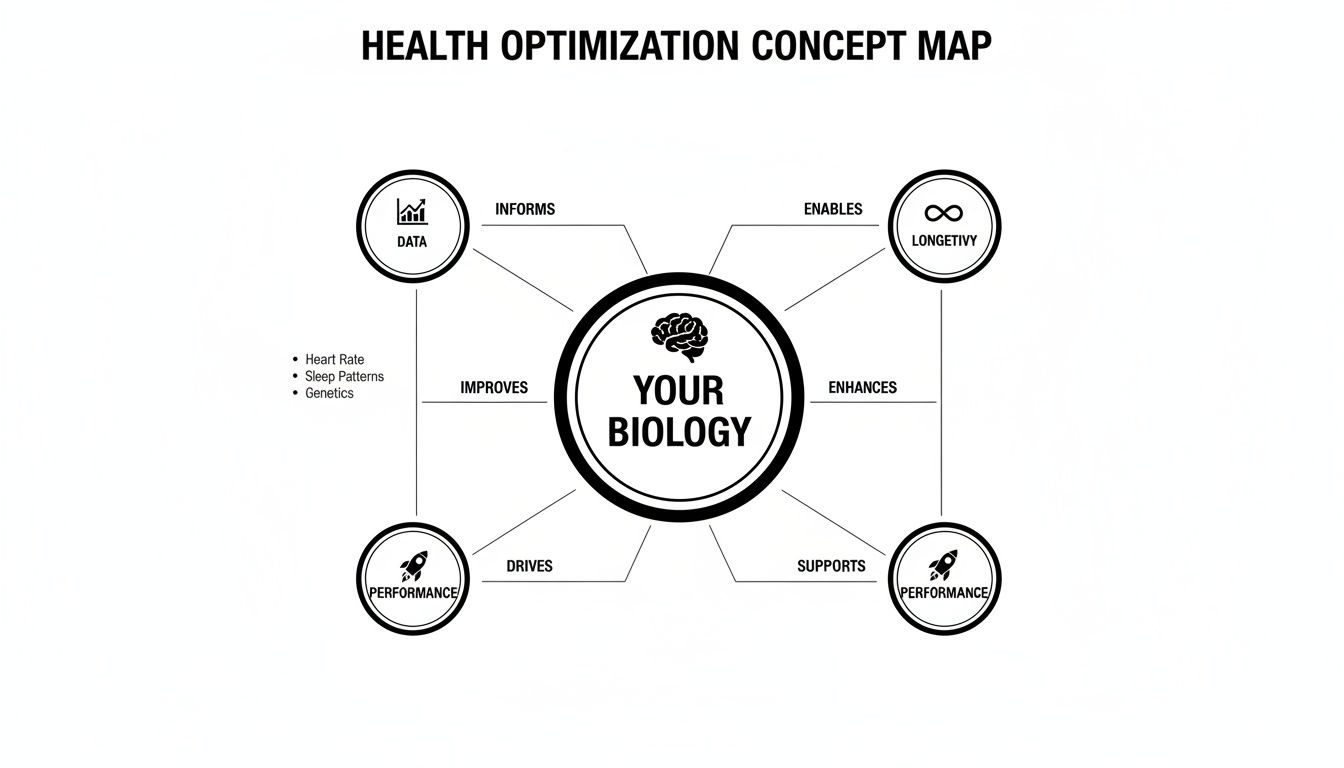
As you can see, your biology is the central hub. When you feed it precise data, you gain the ability to actively steer your health toward a longer, more vibrant future.
The Core Panels: Building a 360-Degree View
To build this detailed health picture, we need to analyse several core biological systems through specific test panels. Each one tells a piece of your health story, and when you put them all together, you get the full narrative needed for a powerful longevity strategy.
A proper analysis starts with a breakdown of key biomarkers. Think of these as the fundamental data points that give us the first, important insights into your internal health.
Key Biomarkers in a Full Body Health Check Up
This table outlines the essential test panels, what they measure, and why they are so critical for both long-term health and immediate performance.
| Test Panel Category | Key Markers Measured | Why It Matters for Longevity |
|---|---|---|
| Complete Blood Count (CBC) | Red Blood Cells, White Blood Cells, Platelets, Haemoglobin | Provides a snapshot of your immune system, oxygen-carrying capacity, and overall energy levels. Early detection of anaemia or infection. |
| Metabolic Health | Glucose, HbA1c, Electrolytes | Assesses your body's energy processing and risk of metabolic syndrome or diabetes. important for stable energy and cognitive function. |
| Lipid & Heart Health | Total Cholesterol, LDL, HDL, Triglycerides | Measures your cardiovascular risk profile, guiding strategies to prevent heart disease, a leading cause of premature mortality. |
| Liver & Kidney Function | ALT, AST, GGT, Creatinine, eGFR | Checks the health of your body's primary filtration and detoxification systems. Poor function can have system-wide negative effects. |
| Inflammation | High-Sensitivity C-Reactive Protein (hs-CRP) | Detects chronic, low-grade inflammation, a silent driver of nearly all age-related diseases from heart conditions to cognitive decline. |
| Hormone Balance | Testosterone, DHEA-S, TSH, Free T4 (Thyroid) | Hormones govern energy, mood, muscle mass, and metabolism. Optimising them is key to maintaining vitality as you age. |
| Key Vitamins & Minerals | Vitamin D, Active B12, Ferritin (Iron) | Uncovers deficiencies that directly lead to fatigue, brain fog, and poor recovery, impacting both daily performance and long-term resilience. |
These panels work together to create a cohesive and deeply personalised picture of your health, moving far beyond what a standard check-up can offer.
Advanced Markers for Peak Performance and Longevity
While those foundational panels are essential, a check-up geared towards genuine optimisation goes deeper. This is where we examine the specific markers that directly influence your long-term healthspan and your ability to perform at your peak.
A modern full body health check up moves beyond disease detection to provide actionable insights for health optimisation. It's about decoding your biology to build a proactive strategy for a longer, higher-quality life.
These advanced tests give you the granular detail needed to make truly personalised improvements.
- Lipid Panel: This isn't just about "good" vs. "bad" cholesterol. A detailed lipid panel looks at particle sizes and ratios to give you a much more accurate picture of your cardiovascular risk, allowing for precise dietary tweaks to protect your heart.
- Inflammation Markers: We look for things like high-sensitivity C-reactive protein (hs-CRP). This measures the kind of chronic, low-grade inflammation that silently drives many age-related diseases. Keeping this number low is a core pillar of any serious longevity strategy.
- Hormone Levels: For both men and women, hormones like testosterone and thyroid-stimulating hormone (TSH) are absolute game-changers for energy, mood, metabolism, and maintaining muscle. Getting these levels right is fundamental to feeling your best as you age.
Tailoring Insights for High Achievers
For busy professionals and dedicated athletes, certain markers offer an even greater competitive edge. For instance, testing key vitamin and mineral levels, like Vitamin D, B12, and iron, can uncover the root cause of persistent fatigue, brain fog, or slow recovery.
For those pushing their physical limits, sports-specific markers like creatine kinase can provide invaluable data on muscle damage and recovery optimisation. By weaving all these data points together, you get a holistic and, most importantly, actionable blueprint for building a more resilient, energetic, and longer-lasting you.
Why High Performers Prioritise Proactive Health Screening
For ambitious professionals and dedicated athletes, peak performance isn’t a happy accident - it’s a deliberate strategy. Treating your health as something you only fix when it breaks is like trying to run a multi-million-pound business without ever glancing at the balance sheet. The best in their field know that to keep their competitive edge, they have to manage their internal health with the same focus they apply to their external goals.
A full body health check up is the ultimate tool for this proactive approach. It gives you the hard data you need to stop guessing and start knowing. It turns health management from a passive hope into an active, data-driven mission to achieve excellence and longevity. This isn't just about dodging illness; it's about revealing a higher gear in everything you do.
The CEO Mindset for Personal Health
Think about a CEO battling brain fog during a important negotiation, or a founder whose energy plummets every afternoon. These aren't just minor frustrations; they’re genuine threats to their performance. In business, key performance indicators (KPIs) are tracked obsessively to measure growth and pinpoint weaknesses. A proactive health screening does exactly the same for your biology.
By measuring key health metrics, from hormone levels to inflammatory markers, you get a clear, objective look at your internal operating system. This data lets you make targeted adjustments that directly boost cognitive function, stress resilience, and all-day energy.
It’s all about connecting the dots. That nagging fatigue could be a hidden vitamin deficiency. Your struggle to focus might be linked to a subtle thyroid imbalance. Without the data, you’re just patching up symptoms. With it, you can tackle the root cause and fine-tune your system for high-stakes performance and long-term vitality.
The Athlete’s Edge in a Competitive World
For any athlete, the line between success and failure is razor-thin. Hitting a personal best or bouncing back from a brutal training block demands a body firing on all cylinders. The paradox is that the very training that builds strength can also create silent problems: chronic inflammation, nutritional shortfalls, or the first signs of overtraining.
A thorough blood analysis works like an early warning system, flagging hidden issues before they can derail your season or lead to injury.
- Overtraining Detection: Markers like creatine kinase can signal excessive muscle breakdown, telling you it’s time to adjust your training load and avoid burnout.
- Nutritional Gaps: Finding out you’re low on iron or Vitamin D can explain why you’ve hit a performance plateau and points to a precise supplement strategy.
- Inflammation Control: Keeping an eye on hs-CRP helps you manage the low-grade inflammation that slows down recovery and impacts your long-term joint health.
This level of insight takes an athlete from a one-size-fits-all training plan to a bio-individualised strategy, making sure every ounce of effort translates into better results and a longer athletic career.
A Critical Tool for Long-Term Success
At the end of the day, making a full body health check up a priority is a strategic investment in your most valuable asset: you. In the UK, cardiovascular disease (CVD) is still a major health threat, causing 25% of all deaths. While public health initiatives are in place, they often don’t offer the detailed, frequent insights that high performers need. Private screenings fill this critical gap, spotting things like elevated cholesterol or early diabetes markers long before they can sideline a career or compromise a lifetime of hard work. You can find more information about how proactive checks contribute to public health goals. By taking control of your health data, you’re not just preventing future problems - you are actively building the foundation for sustained success and a longer, more vibrant life.
How to Get Actionable Insights From Your Health Data
Understanding what's really going on inside your body shouldn't feel like a chore or a source of stress. The whole point of a modern full body health check up is to make the entire experience smooth and genuinely useful—from booking the test to actually knowing what to do with the results. It's about taking the guesswork out of your health and building a solid longevity strategy.
The process is designed to fit around your life, not the other way around. You can book an appointment online in minutes, picking a slot that works for your schedule. No more long waits or administrative headaches; just proactive health management that feels effortless.
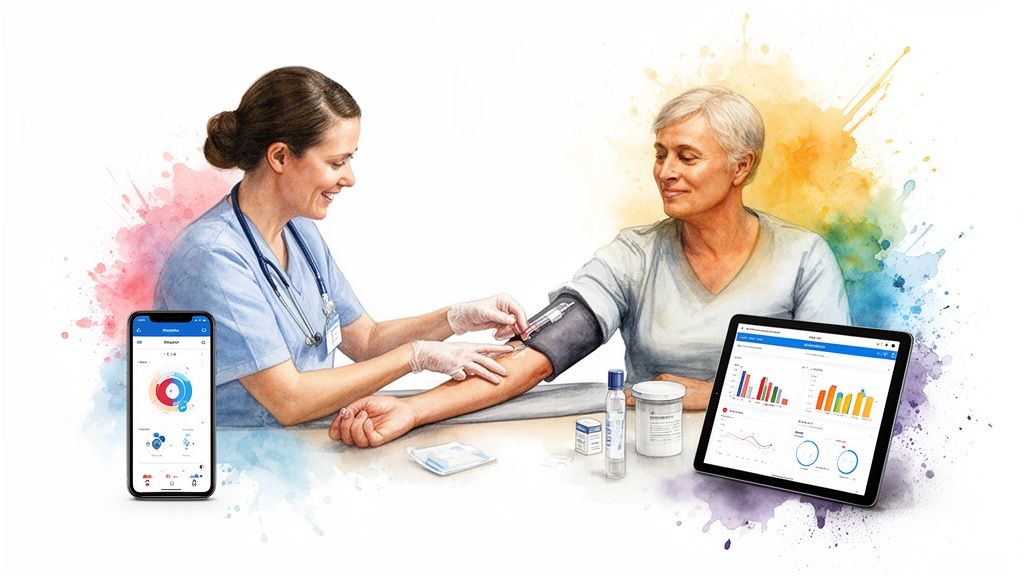
Professional Sample Collection On Your Terms
To get reliable results, you need a high-quality sample. It’s as simple as that. That's why appointments are carried out by professional phlebotomists, specialists trained in drawing blood, who can come to your home or see you at a partner clinic.
This flexibility makes the whole thing comfortable and incredibly efficient. The sample is taken via venipuncture, a standard blood draw from a vein, which is the gold standard for accuracy. It has a 99.8% success rate in providing a usable sample for the lab. And speaking of labs, every sample is analysed in the same UKAS-accredited facilities trusted by the NHS, so you can be sure of the quality.
From Raw Data to a Clear Story
Let's be honest: getting a report filled with medical jargon and numbers is more confusing than helpful. The real power of a modern health screening is its ability to turn that complex data into simple, meaningful insights you can actually act on.
Your results are delivered straight to a user-friendly app, available on both iOS and Android. This isn't just a static PDF; it's a dynamic dashboard for your health.
- Visual Trends: You can watch your biomarkers change over time, which makes it easy to spot patterns and see if your new habits are actually making a difference.
- Clear Explanations: Each result comes with context. We explain what the marker means and show you where your levels fall on the optimal scale.
- Easy Access: You can download your results as a PDF or CSV file whenever you want. It’s your data, and you should be able to take it with you.
This approach puts you firmly in the driver's seat, transforming what used to be intimidating medical information into a useful measure for self-improvement.
The goal isn't just to hand you data; it's to provide you with a clear narrative about your health. The included doctor's review connects the dots, explaining what your results mean for you personally and suggesting the next steps.
This personalised review from a qualified doctor is what really unlocks the value of your health check. It gives your numbers context, answers your questions, and helps you figure out where to focus your energy for the biggest impact on your long-term health and performance. If you want to look more closely at what the numbers mean, our guide on how blood test results are explained in the UK is a great resource.
Of course, a truly complete picture sometimes requires looking beyond standard blood panels. For many people, for example, understanding fertility testing results is a important piece of their overall health puzzle. By simplifying the entire journey, sophisticated health monitoring becomes an accessible and essential part of your longevity toolkit.
Turning Your Health Data Into a Longevity Action Plan
Getting your results back from a full body health check up is just the first step. The real magic happens when you turn that raw data into a concrete, personal strategy for a longer, healthier life. This is where the numbers on a screen become your roadmap to feeling and performing your best, putting you firmly in the driver's seat of your own health.
Think of it like a business getting a detailed market report. The report itself is just information; its true value is in the smart decisions it fuels. In the same way, your health data, with a doctor's expert eye to guide you, becomes the blueprint for building a more resilient, energetic, and long-lasting you. It’s all about connecting the dots between your biomarkers and your daily life.

From Biomarkers to Actionable Steps
Sitting down with a medical professional to go over your results is essential. They’re the ones who can translate complex biomarkers into a clear story about your health, pinpointing what you’re doing right and where there’s room for improvement. This is where your longevity action plan really begins to take shape, built on targeted, evidence-based steps.
Let's look at a few real-world examples of how this plays out:
- Elevated hs-CRP (Inflammation): If your results show high levels of this inflammatory marker, your plan might zero in on your diet. This could mean bringing in more omega-3-rich foods like salmon and walnuts, cutting back on processed sugars, and maybe even adding specific anti-inflammatory supplements like curcumin.
- Low Vitamin D: A classic issue for many in the UK, low Vitamin D can affect everything from your mood and immune system to bone strength. The fix here is straightforward: a personalised supplement plan to get your levels into the sweet spot, with a follow-up test booked in to make sure it’s working.
- Suboptimal Cholesterol Ratios: Instead of a vague "eat less fat" warning, a detailed lipid panel can lead to much more specific advice. For instance, you might be encouraged to increase soluble fibre from oats and psyllium husk or switch your cooking oils to ones higher in monounsaturated fats.
Every data point informs a specific, manageable change. This targeted approach is so much more effective than generic health advice because it’s built around your unique biology.
Building Your Dynamic Longevity Strategy
Your health isn't static, so your plan shouldn't be either. A key part of a solid longevity strategy is understanding that it's a dynamic cycle: test, adjust, and re-test. This creates a powerful feedback loop that keeps you moving in the right direction.
Your first full body health check up establishes your baseline—a detailed snapshot of where you are today. Subsequent tests allow you to measure progress, refine your approach, and stay ahead of your biological ageing.
This proactive cycle is important. Say you've spent three months on a new nutrition and supplement regimen. You can then re-test specific markers to see the real-world impact of your efforts. Have your hs-CRP levels dropped? Are your Vitamin D levels now in the optimal zone? This data-driven proof is incredibly motivating and ensures your plan stays effective. You can look more closely at this process with our guide to a biomarker monitoring workflow.
The Role of Proactive Screening in Public Health
While the NHS Health Check programme in England offers a vital service aimed at preventing major conditions like heart disease and diabetes, its scope and frequency can be limited. Proactive private screening helps to fill this important gap. In fact, data from large-scale studies shows that about 2% of wide-ranging scans flag potentially serious abnormalities, with one in three of those being confirmed as serious upon follow-up. This really underscores the value of regular, detailed checks for catching issues early on.
By taking control of your health data, you’re not just investing in your own future. You're also contributing to a wider culture of preventative health that reduces the long-term strain on our healthcare system. And that’s the ultimate goal: creating a plan that doesn't just add years to your life, but adds life to your years.
Got Questions About Full Body Health Check Ups?
It’s completely normal to have a few questions before diving in, even when you know how valuable a proactive health strategy can be. A full body health check up is a big step towards taking charge of your long-term wellness, and feeling confident about the process is everything. Here, we’ll tackle the most common queries with clear, straightforward answers to help you get started.
Think of this as the final once-over before you set off along the way. We’ll clear up any lingering doubts so you feel fully prepared to turn your biological data into a powerful plan for a longer, healthier life.
How Often Should I Get a Full Body Health Check Up?
For a longevity-focused strategy, the right frequency depends on your age, lifestyle, and health goals. The aim is to create a rhythm of testing that establishes a clear baseline and then tracks your biological age over time, turning data into actionable insights for optimisation.
For healthy adults under 40, a complete check every one to two years is a solid starting point for building a long-term health picture and catching any subtle changes early.
For anyone over 40, or for individuals actively pursuing health optimisation, an annual check-up is the gold standard. This frequency allows you to monitor biological shifts closely, measure the impact of your lifestyle adjustments, and refine your longevity strategy with precision. Your initial results and doctor’s review will provide the most personalised advice on a schedule that’s right for you.
Are At-Home Blood Tests as Accurate as Clinic Tests?
This is a great question, and one we hear a lot. The short answer is: yes, absolutely. What makes a blood test accurate isn't where the sample is taken, but how it's taken and where it's analysed.
Modern at-home services don't cut corners. They use professional phlebotomists, the same trained specialists you'd find in a hospital, to perform a venipuncture blood draw. This is the gold standard. So, whether that happens in your living room or at a local clinic, the quality of the sample collection is identical.
The convenience of an at-home test doesn't mean you sacrifice accuracy. Your sample is collected by a pro and sent to the exact same UKAS-accredited laboratories that the healthcare system relies on. You get results you can trust, without the hassle.
What Is NMN and How Does It Relate to My Results?
You might have heard of NMN (Nicotinamide Mononucleotide), as it’s a big topic in longevity science right now. In simple terms, NMN is a precursor to another important molecule called NAD+ (Nicotinamide Adenine Dinucleotide). NAD+ is like the spark plug in every single one of your cells, essential for everything from generating energy to repairing your DNA.
The catch is that our NAD+ levels naturally drop as we get older, and this decline is linked to many of the classic signs of ageing. A full body health check up gives you a wide-angle view of your cellular health, looking at markers for things like inflammation and metabolic function. If your results suggest your cellular engines could use a bit more support, a supplement like NMN might be something to consider as part of a wider strategy, alongside a healthy diet and lifestyle.
Why Choose a Private Service Over a Free NHS Health Check?
The NHS Health Check is a fantastic and vital public health service, offered every five years to those aged 40-74 to screen for major conditions like heart disease and diabetes. It's designed for broad-strokes prevention. A private full body health check up, however, is built for a different purpose: detailed, personal optimisation.
Here’s a quick rundown of the main differences:
- Comprehensiveness: Private tests go much deeper, analysing a far wider range of biomarkers. We're talking hormones, key vitamin and mineral levels, and advanced inflammatory markers that a standard check just doesn't cover.
- Frequency and Accessibility: You’re in control. You can book a private check-up at any age and as often as you feel is necessary, moving from a five-year interval to proactive, annual tracking.
- Convenience and Speed: The whole experience is designed around your life. With options for at-home phlebotomy and fast digital results, you get the insights you need quickly, so you can act on them right away.
- Personalised Review: A private service always comes with a doctor's review of your results. They’ll help you understand what the numbers mean for you and your lifestyle, creating a truly actionable plan for improvement.
Ultimately, choosing a private service isn't about replacing the NHS; it’s about going a step further. It’s for anyone who wants to move beyond just preventing disease and start actively building a data-driven strategy for peak performance and a long, vibrant life.
Ready to move from guessing to knowing? Lola provides the tools you need to build your personalised longevity plan. Our full at-home and in-clinic blood tests are analysed in NHS-standard labs, with results and a doctor's review delivered straight to your app. Take the first step and explore our full body health analysis today at https://lolahealth.com.
Test This Biomarker at Home
This biomarker is included in our ALT Test and Liver & Kidney Function — results in 2-3 working days with GP-reviewed insights.
At-Home Blood Testing
Check your levels from home
Professional phlebotomist visit. Doctor-reviewed results in 2-5 days. Track your health with comprehensive blood panels.
→45-70 biomarkers tested · Venous blood draw · From £130