


Checking your insulin resistance isn't just about managing your risk of diabetes—it's about unlocking a longer, healthier life. The process involves a couple of simple blood tests that measure your fasting glucose and fasting insulin. From these, a crucial score called HOMA-IR can be calculated, giving you a clear, data-driven picture of how efficiently your body is managing energy at a cellular level. While you might notice some early warning signs at home, these lab tests provide the definitive insights you need to optimise your health for the long run.
Why Checking Insulin Resistance Is Key to Longevity
Insulin resistance is a common, yet often invisible, factor that can silently accelerate the ageing process. Getting a handle on it is one of the most powerful actions you can take for your long-term health and longevity.
Think of your body's insulin system like a sophisticated communication network. In a healthy state, a small amount of insulin sends a clear signal to your cells to absorb glucose for energy. With insulin resistance, that signal becomes muffled. Your pancreas has to 'shout' louder, pumping out more and more insulin to get the same job done.
This constant high-insulin state, known as hyperinsulinemia, doesn't just exhaust your pancreas over time. It's a key driver of metabolic dysfunction that can quietly compromise your healthspan. The fallout goes well beyond just the risk of type 2 diabetes.
The Silent Impact on Your Healthspan
When your cells stop listening to insulin properly, it can trigger a state of low-grade, chronic inflammation throughout your body. This simmering inflammation is a well-known accelerator of ageing and is connected to a host of age-related conditions, from cardiovascular disease to cognitive decline.
This is why managing your insulin sensitivity is a cornerstone of extending your healthspan—the number of years you live in vibrant health, not just your lifespan. This isn't just a concern for those with a family history of diabetes; it’s for anyone serious about optimising their metabolic function for a longer, more energetic life. Understanding how to check your insulin resistance is the very first step on that journey.
"Recognising and addressing insulin resistance early is about more than just preventing diabetes. It's about preserving cellular health, maintaining energy levels, and building a foundation for vitality well into your later years."
The scale of this is staggering. Recent data suggests that around 54% of UK adults have at least one marker of insulin resistance. That means more than half the population is operating with suboptimal metabolic function, and most don't even know it. The problem gets worse with age, jumping from 28% in those aged 18-34 to a massive 71% in adults over 65.
By learning to spot the signs and getting the right tests, you can switch from being reactive to proactive about your biological age. This guide cuts through the jargon to give you the practical knowledge you need to assess and optimise your metabolic health for longevity.
For a deeper dive into this topic, you can explore our detailed article on understanding why you should monitor metabolic health.
Recognising the Early Warning Signs at Home

Long before a blood test confirms it, your body often sends subtle signals that your metabolic health is declining. The trick is learning to listen. This isn't about one isolated symptom, but about spotting a pattern of small, nagging issues that could point towards your insulin sensitivity taking a hit.
One of the most telling clues is the classic post-meal energy crash, particularly after eating carbohydrates. You know the feeling: you feel productive in the morning, but by early afternoon, you’re hit with a wave of fatigue so strong you’re desperate for a coffee or a biscuit. That’s your body working overtime, pumping out excess insulin to handle a glucose spike, which then leads to that all-too-familiar slump.
Physical Markers and Cravings
It's not just about how you feel; your body can show physical signs. Perhaps you’ve noticed that despite sticking to a good diet and exercise routine, you’re battling stubborn fat that just won't shift from your midsection. This visceral fat isn't just an aesthetic issue; it's metabolically active and can actively worsen insulin resistance, creating a challenging cycle.
Then there are the cravings. These aren't just a simple hankering for chocolate. These are intense, urgent demands for sugary or starchy foods—your body's reaction to the blood sugar rollercoaster, creating a vicious cycle where you crave the very foods fueling the problem.
You should also look at your skin. The appearance of small, fleshy growths called skin tags is a common sign. Another indicator is the development of dark, velvety patches of skin, known medically as acanthosis nigricans. These tend to appear in body folds, like on the back of your neck, in your armpits, or around your groin.
Recognising these patterns is an act of self-awareness. It’s connecting the dots between how you feel—tired, craving sugar, and foggy—and what your body is physically showing you. Each sign is a data point for your longevity strategy.
Connecting the Dots for a Longevity Mindset
Catching these early warnings is fundamental to maximising your healthspan. Think of each sign as a prompt from your body to investigate your metabolic health more deeply.
Here’s a quick checklist of what to watch for:
- Persistent Post-Meal Slumps: Do you feel overwhelmingly tired 1-2 hours after a carb-heavy meal?
- Intense Sugar Cravings: Are you fighting a constant need for sweet snacks, especially in the afternoon?
- Stubborn Belly Fat: Is it a real struggle to lose weight around your waist, even when you're doing everything right?
- Skin Changes: Have you noticed new skin tags or those darkened patches of skin?
Figuring out how to check your own insulin resistance truly starts here, with this self-assessment. If you've ticked a few boxes and want to dig deeper, our guide on at-home health testing is the perfect next step for monitoring these markers from home.
Your Guide to Clinical Blood Tests
While home observation provides clues, a blood test gives you the definitive, data-driven answer needed to truly understand your metabolic health. It's the gold standard for checking insulin resistance, moving beyond guesswork to measure what’s happening at a cellular level. These tests provide the concrete numbers that paint an undeniable picture, allowing you to track progress and make informed decisions for your longevity.
The Key Markers to Look At
The most important markers for assessing insulin sensitivity are your Fasting Glucose and Fasting Insulin levels.
Your fasting glucose measures the amount of sugar in your blood after an overnight fast. It’s a snapshot of your baseline blood sugar control.
Fasting insulin, however, reveals how hard your pancreas is working to maintain that baseline. High insulin levels, even if your glucose appears normal, are a classic early red flag for insulin resistance. It shows your body is quietly overcompensating—a crucial insight for anyone focused on proactive health.
Another key test is HbA1c (glycated haemoglobin). This provides a longer-term view, reflecting your average blood sugar levels over the past two to three months. It’s like comparing a single photo (fasting glucose) to a time-lapse video of your blood sugar management.
The Power of the HOMA-IR Score
The real magic for longevity planning happens when we combine your fasting glucose and insulin to calculate your HOMA-IR score. HOMA-IR (Homeostatic Model Assessment for Insulin Resistance) is a powerful calculation that estimates how well your insulin is working. It distills complex biology into a single, actionable number that quantifies your level of insulin sensitivity.
This is the formula used to calculate your HOMA-IR score, which your doctor or a service like Lola can easily determine for you.
This calculation multiplies your fasting insulin and glucose, then divides the result by a constant. The final score helps quantify how efficiently your body is responding to insulin.
Simply put, a higher HOMA-IR score means your body needs to pump out more insulin to keep your blood sugar in check, signalling greater resistance. A score above 2.0 is a strong indicator that it's time to take action, while optimal levels for longevity are generally considered to be below 1.5.
Here in the UK, diagnostic evaluations often rely heavily on these tests. The HOMA-IR index is a primary clinical tool, with values typically above 2.5 suggesting significant insulin resistance. This is especially relevant when you consider that, according to 2024 NHS data, the prevalence of type 2 diabetes among adults is now 7.0%. It’s a stark reminder of the widespread impact of these underlying metabolic issues. You can discover the latest government statistics on diabetes trends for more context.
Getting to grips with these blood markers is crucial. Many are included in routine check-ups. For a complete overview of what's measured in standard blood work, check out our guide on what is a comprehensive metabolic panel. Armed with this knowledge, you can have a more informed discussion with your doctor or feel confident choosing a private testing service.
Making Sense of Your Results
Getting your lab report back is a great start, but the real power comes from translating those numbers into an actionable strategy for your long-term health. Let’s walk through how to interpret your results not just for avoiding disease, but for achieving optimal longevity.
Seeing these figures isn’t about being alarmed; it’s about collecting vital intelligence. Think of it as a detailed report on your body's energy management system, giving you the power to make smarter, more informed decisions that will pay dividends for decades to come.
What Are Optimal Ranges for Longevity?
When it comes to long-term health, the standard "normal" ranges on a lab report often aren't the whole story. For genuine metabolic optimisation and longevity, the goal is to have levels that show your body is exceptionally responsive to insulin, not just scraping by to avoid a pre-diabetes label.
Even markers that are slightly elevated within the "normal" range are an early warning sign—and an opportunity. They allow you to make positive lifestyle changes before a minor inefficiency snowballs into a more serious health concern. This proactive mindset is the essence of building a long, healthy life.
This infographic gives a great overview of the key tests used to check for insulin resistance.
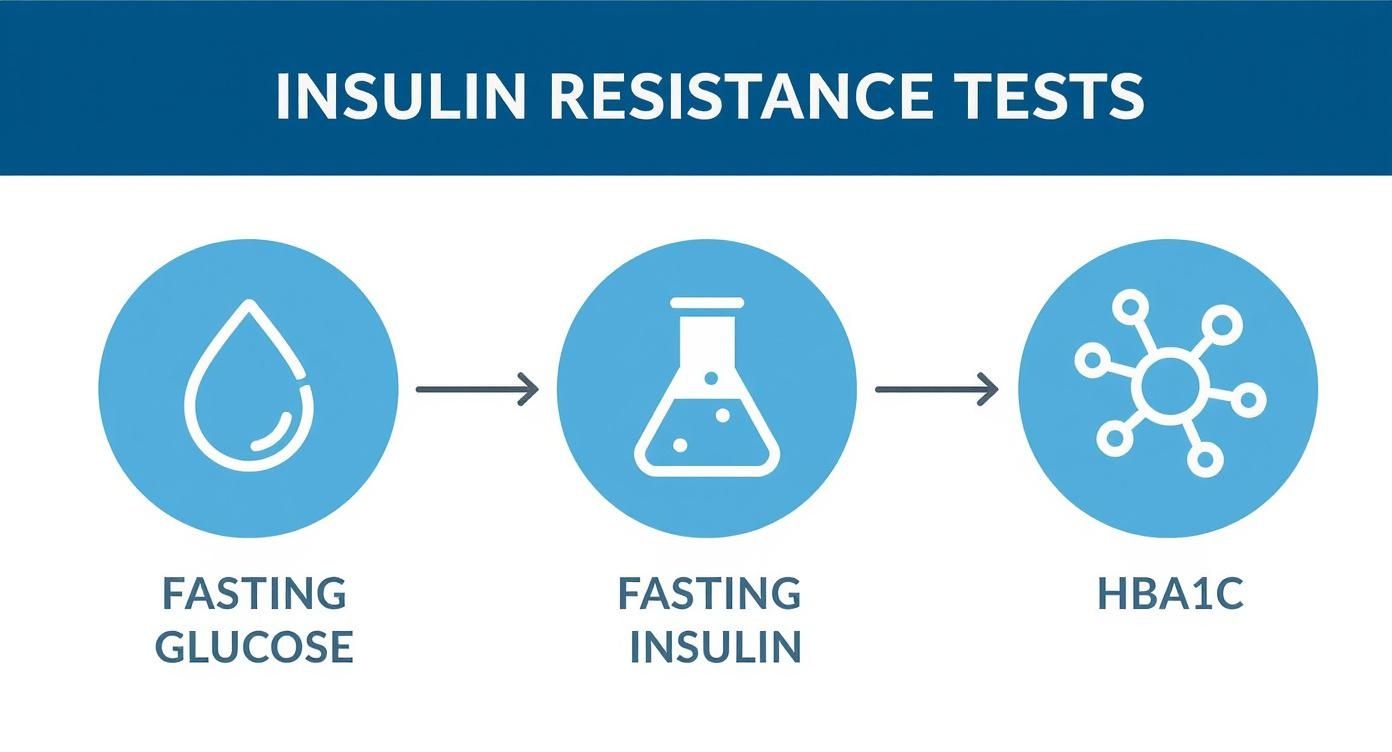
As you can see, Fasting Glucose, Fasting Insulin, and HbA1c each provide a unique piece of the metabolic puzzle. It’s when you put them all together that a comprehensive picture of your insulin sensitivity really emerges.
Think of these biomarkers as your personal metabolic dashboard. Low, stable numbers indicate your body is running efficiently. Rising numbers are an early warning light, telling you it's time for a tune-up before you break down.
The table below provides a simple comparison to help you understand where your results fall on the spectrum, from optimal to high-risk. Remember, this knowledge is the first step toward taking control of your biological age.
Insulin Resistance Markers: Optimal vs High-Risk Levels
This table helps you decipher what your numbers are really telling you about your cellular health, comparing standard clinical guidelines with the more ambitious targets for optimal longevity.
| Biomarker | Optimal Range (for Longevity) | Indicates Insulin Resistance |
|---|---|---|
| Fasting Glucose | < 5.0 mmol/L | > 5.6 mmol/L |
| Fasting Insulin | < 5 mIU/L | > 10 mIU/L |
| HbA1c | < 5.4% (36 mmol/mol) | > 5.7% (39 mmol/mol) |
| HOMA-IR | < 1.0 | > 1.9 |
Understanding these ranges is crucial. Aiming for the "Optimal" column is a proactive strategy for maintaining excellent health for years to come, whereas numbers creeping into the "Indicates Insulin Resistance" column are a clear signal that it's time to take action.
Actionable Steps to Improve Insulin Sensitivity

Discovering you have signs of insulin resistance is a powerful turning point. It's not a final diagnosis, but rather a crucial piece of data that empowers you to take control of your metabolic future and your healthspan. The best part? Your body has a remarkable capacity to heal. Your cells can regain their sensitivity to insulin, and it doesn't require drastic, unsustainable measures.
Let's move beyond vague advice like 'eat better' and focus on specific, evidence-backed lifestyle shifts that truly move the needle on longevity. Think of these as small, consistent investments in your health that will compound over time, yielding major returns for your long-term wellbeing.
Rethink Your Plate and Your Movement
The two most powerful levers for improving insulin sensitivity are what you eat and how you move. It starts with a simple mindset shift: move away from restriction and focus on what you can add to your diet to promote stable blood sugar.
Build every meal around protein and fibre. Protein enhances satiety, while fibre slows down glucose absorption. This combination prevents the sharp blood sugar spikes that force your pancreas to work overtime, giving your metabolic system a much-needed break.
Next, make movement non-negotiable, especially after meals. A simple 10-minute walk post-meal encourages your muscles to act like sponges, soaking up excess glucose from your blood and reducing the immediate demand for insulin. This is a simple yet profound longevity habit.
Your muscles are your greatest ally in this process. Strength training is a true game-changer because muscle is the primary site for glucose disposal. The more lean muscle you build, the more 'storage space' you create for glucose, dramatically improving your insulin sensitivity and protecting your metabolic health as you age.
Optimise Your Recovery and Resilience
The path to metabolic health extends beyond the kitchen and the gym. Two of the most overlooked yet critical factors are sleep and stress management. These pillars directly regulate the hormones that control your body's response to insulin.
Chronic stress floods your system with cortisol, a hormone that directly interferes with insulin's ability to do its job. It's essential to find practical, everyday ways to manage this. It doesn't have to be complicated:
- Try a daily mindfulness or breathing practice.
- Spend time in nature.
- Practice setting boundaries to protect your energy.
Equally important is consistent, high-quality sleep. Research shows insulin sensitivity can be impaired after just a single night of poor sleep. Aim for 7-9 hours a night to allow your body’s hormonal systems to reset and function optimally. For instance, ensuring adequate levels of key minerals, sometimes with the help of certain magnesium supplements, can play a significant role in improving both sleep quality and insulin function.
Here in the UK, these proactive steps are more important than ever. By 2025, it's projected that around one-third of UK adults will have some degree of insulin resistance. The risk climbs as we get older, affecting about 33% of those aged 40-59 and jumping to nearly 50% in adults over 60, often due to age-related muscle loss and hormonal changes. Understanding the full picture is key, and these statistics underscore just how vital it is to take action for your lifelong health.
Common Questions About Insulin Resistance
https://www.youtube.com/embed/US4iYX7cvUs
Getting to grips with metabolic health can feel overwhelming, and it’s normal to have questions as you dig deeper. When you start exploring how to check for insulin resistance, you’ll naturally want to know the practical ins and outs for your longevity journey.
Let's tackle some of the most common queries. My goal here is to give you clear, straightforward answers that cut through the noise and help you feel more confident about your next steps, whether that’s chatting with your GP or starting to implement a few new lifestyle habits.
How Often Should I Get Tested?
This depends entirely on your individual situation and your health goals. If your initial results are optimal and you feel well, checking in annually is a fantastic proactive strategy to monitor your metabolic health over time.
However, if your HOMA-IR score is higher than you’d like, or if you're actively making lifestyle changes, more frequent testing can be a powerful motivational tool. Re-testing every 3 to 6 months provides concrete feedback on your progress. It’s incredibly rewarding to see your numbers improve, confirming your hard work is paying off and helping you build lasting habits.
Can Insulin Resistance Be Reversed?
Absolutely. For the vast majority of people, insulin resistance isn't a permanent state. Think of it as a condition your body is currently in—one that can be changed with consistent effort. With the right strategies, your cells can regain their sensitivity to insulin.
The key is realising that reversing insulin resistance is about building sustainable habits for a lifetime of health, not seeking a quick fix. Every positive change you make to your diet, exercise, sleep, and stress management directly improves how well your cells respond to insulin's signals, investing in your future self.
What Matters More: Diet or Exercise?
This is a classic question, but the truth is, they are two sides of the same coin and are most powerful when combined. You can’t out-train a poor diet, but you also can’t achieve optimal metabolic health without regular movement.
Diet is the foundation; it controls the glucose load your body has to manage. Exercise, especially strength training, makes your muscles more efficient at using that glucose. For long-term health and longevity, you need both. My advice is to start small and stay consistent in both areas—that’s what creates the biggest impact over time.
Do Supplements Actually Help?
Certain supplements can support your efforts, but they should always be viewed as exactly that: a support system. They are helpers, not heroes, and can never replace a solid foundation of nutrition and movement.
A few compounds and minerals have been studied for their potential role in metabolic health:
- Magnesium: This essential mineral is involved in hundreds of bodily processes, including glucose metabolism.
- Berberine: Research suggests it can be quite effective at helping improve insulin sensitivity.
- Inositol: This compound may support healthy insulin signalling, particularly for certain groups.
Before starting any new supplement, it’s crucial to speak with your doctor or a qualified healthcare professional. They can review your personal health data and help you decide if a supplement is a safe and sensible choice for your longevity plan.
Ready to get a clear, data-driven picture of your metabolic health? Lola provides professional, at-home blood testing with a full doctor's review, giving you the insights you need to take control of your long-term wellbeing. Start your journey today at https://lolahealth.com.