


If you’re serious about increasing your VO2 max for longevity, the secret lies in a smart, consistent mix of high-intensity interval training (HIIT) and steady endurance work. This combination drives the cardiovascular adaptations that make your body more efficient at using oxygen - the cornerstone of both elite performance and a long, healthy life.
Your Blueprint for Enhanced Longevity and Performance
Thinking about how to boost your VO2 max is no longer just for athletes; it's a direct investment in your healthspan. While the term sounds complex, VO2 max is simply the maximum rate your body can take in and use oxygen during intense exercise. Think of it as a powerful marker for your body’s overall resilience and one of the strongest predictors of longevity we have.
Improving this metric isn’t just about being able to run faster or cycle longer. It has a real, tangible impact on your quality of life as you age.
- Boosts Daily Energy: A more efficient oxygen system means everyday tasks feel easier, preserving your vitality and independence for years to come.
- Enhances Cognitive Function: Your brain is a huge oxygen consumer. Better cardiovascular fitness directly supports sharper focus, memory, and long-term brain health.
- Strengthens Disease Defence: A high VO2 max is strongly linked to a lower risk of chronic, age-related diseases, from cardiovascular conditions to metabolic disorders.
The Longevity Link
The connection between VO2 max and lifespan is incredibly compelling. In the UK, just meeting the recommended 150 minutes of weekly activity can lift your cardiorespiratory fitness by 10–20%. For a sedentary professional, that could mean a 3–5 ml·kg⁻¹·min⁻¹ bump in their score.
Here's why that matters for your future: every 3.5 ml·kg⁻¹·min⁻¹ improvement is linked to an 11% reduction in all-cause mortality. This makes it one of the most impactful health metrics you can actively control for a longer life. If you want to look at the numbers, you can read the full UK study on fitness and mortality to see the data for yourself.
To get you started, here’s a quick overview of the key areas we’ll be covering. Think of these as the fundamental pillars for building a higher VO2 max for life.
| VO2 Max Improvement Pillars at a Glance | | :--- | :--- | :--- | | Pillar | Objective | Key Action | | Targeted Training | Stimulate cardiovascular and mitochondrial adaptations for healthspan. | A structured mix of HIIT and Zone 2 endurance training. | | Strategic Nutrition | Fuel performance and support cellular energy and repair. | Optimise macronutrients and consider supplements for cellular health. | | Intelligent Recovery | Allow the body to adapt, repair, and build resilience. | Prioritise quality sleep and active recovery techniques. |
Each of these pillars is important. Get them right, and you'll see meaningful, lasting improvements in your health and vitality.
This guide cuts through the noise, providing a clear roadmap built on three core pillars: targeted training, strategic nutrition, and intelligent recovery.
By focusing on these areas, you can turn VO2 max from an abstract number into a practical tool for building a healthier, more vibrant future. The actionable advice that follows will give you a clear path to get there.
Setting Your Starting Line: Precision Baseline Testing
To genuinely boost your VO2 max, you first need to know where you're starting from. Jumping into a training plan without a solid baseline is like trying to navigate without a map - you might move, but you won't know if it's in the right direction. Pinpointing your starting VO2 max is the essential first step, turning your efforts from guesswork into a focused, data-driven strategy for longevity.
This isn't just about getting a single number from your smartwatch. It’s about building a complete picture of your body's aerobic engine by looking at both performance metrics and the physiological data that drives them. This is how you uncover your unique limitations and track real, objective progress toward a healthier future.
Lab Coats vs. Running Tracks: Choosing Your Test
The most precise way to measure VO2 max is in a lab. It usually involves running on a treadmill or cycling on a stationary bike while wearing a mask that analyses your oxygen intake and carbon dioxide output. While this is the clinical gold standard, it's often expensive and not exactly convenient for most people.
Luckily, there are several practical field tests that give a very reliable estimate of your cardiorespiratory fitness. They're accessible, require minimal gear, and are perfect for establishing a baseline you can test again and again.
- The Cooper Test: A true classic. You simply run as far as you possibly can in 12 minutes. A formula then uses that distance to estimate your VO2 max. All you need is a track and a timer.
- The 1.5-Mile Run Test: Similar idea, but this time you're running a set distance - 1.5 miles - as fast as you can. Your finish time is plugged into a calculation to get your estimated VO2 max.
- The Rockport Walk Test: This is a brilliant option if you're just starting out or can't run. The goal is to walk one mile as fast as you can. Your time, combined with your heart rate at the end, gives you the data needed for the estimate.
Whichever test you land on, the trick is to be consistent. Do the same test, under similar conditions (think same time of day, similar food beforehand), every 6-8 weeks. That’s how you’ll know if your efforts are translating into better fitness and a lower biological age.
Looking Under the Hood: Beyond Performance Numbers
While a field test gives you a great snapshot of your performance, it doesn’t tell the whole story. Your aerobic potential is massively influenced by what's happening inside your body. A key limiter for your VO2 max is simply how well your blood can transport oxygen to your muscles. This is where getting more precise data can be a real significant advantage for your long-term health.
You can follow the most elite training plan in the world, but if underlying physiological factors are holding you back, you’ll eventually hit a wall. Your blood chemistry is the missing piece of the longevity puzzle.
Modern at-home blood tests offer a powerful, convenient way to see the biomarkers that directly impact your aerobic capacity. Instead of wondering why you’ve plateaued, you get concrete data about your body’s internal systems, allowing you to address weaknesses before they become chronic issues.
What Your Biomarkers Can Tell You
Key biomarkers offer incredible insight into how well your body can support high-level aerobic performance and long-term wellness. Understanding them can open up new ways to improve that training alone just can't touch.
For example, low iron levels, even if you’re not officially anaemic, can hinder the production of haemoglobin - the protein in red blood cells that ferries oxygen around. If your haemoglobin is suboptimal, your muscles are starved of the oxygen they need to perform, no matter how hard you train. In the same way, things like chronic inflammation can mess with your recovery and adaptation, accelerating aging and putting the brakes on your progress.
When you combine performance data from a field test with physiological data from a blood test, you get the complete picture. To dig deeper into this strategy, check out our guide on how to use blood tests for fitness. It's this integrated approach that helps you move beyond just training harder and help you to start training smarter for a longer, healthier life.
The Core Training Protocols for Boosting VO2 Max
Alright, this is where the theory ends and the real work begins. You’ve got your baseline numbers, so now it’s all about applying the right kind of stress to force your body to adapt and improve its resilience.
To really move the needle on your VO2 max, you need a two-pronged attack. You have to push the absolute peak of your cardiovascular system while also building the deep, underlying endurance of your aerobic engine. This isn't just about logging mindless hours on the treadmill; it's a strategic game of balancing two very different training intensities, both vital for longevity.
The most effective way to do this is by adopting what’s known as a polarised training model. Simply put, you’ll spend most of your time training at a very low intensity to build a massive aerobic foundation. Then, you’ll sprinkle in a few short, incredibly sharp bursts of high-intensity work to raise your performance ceiling. This combination is the fastest, most proven path to improving how your body takes in, transports, and uses oxygen.
Pushing Your Peak with High-Intensity Interval Training
High-Intensity Interval Training (HIIT) is your silver bullet for directly boosting VO2 max. These workouts are all about short, all-out efforts that push your heart and lungs to their absolute limit, followed by brief recovery periods. This repeated shock to the system is what forces your heart to grow stronger, allowing it to pump more oxygen-rich blood with every single beat - a key adaptation for lifelong cardiovascular health.
But not all HIIT is created equal. To get the biggest bang for your buck, the structure of your intervals really matters. While any intense burst helps, years of research point to a few specific protocols that are absolute gold for VO2 max development. One of the most studied and validated is the 4x4 minute interval session.
Here’s how you can put this powerful workout into practice:
- Warm-up: Always start with 10-15 minutes of easy jogging or cycling to get your muscles and cardiovascular system ready.
- Work Interval: Go hard for 4 minutes. Whether you're running, cycling, or rowing, the intensity should get your heart rate up to 90-95% of its maximum. It should feel incredibly tough - you'll barely be able to gasp out a word or two.
- Recovery Interval: Follow that up with 3-4 minutes of active recovery. Think slow walking or very light pedalling. This gives your heart rate just enough time to drop before you go again.
- Repeat: Knock out four of these work/recovery cycles in total.
- Cool-down: Finish with 5-10 minutes of easy activity to let your body wind down properly.
This protocol is so effective because the four-minute duration is just long enough to force your body to hit its maximum oxygen uptake and hold it there, creating an undeniable signal for it to adapt.
The real magic of HIIT isn't just the intensity; it’s the repeatability. The recovery periods let you accumulate far more total time at your peak aerobic capacity than you could ever manage with one continuous, all-out effort.
For a busy professional, just one or two of these sessions a week is often enough to drive significant gains without risking burnout. If you're a more seasoned athlete, you can progressively add more intervals or nudge the intensity up over time.
This simple workflow shows how everything connects: you test, you analyse the data, and then you build a smart training plan using protocols just like this one.
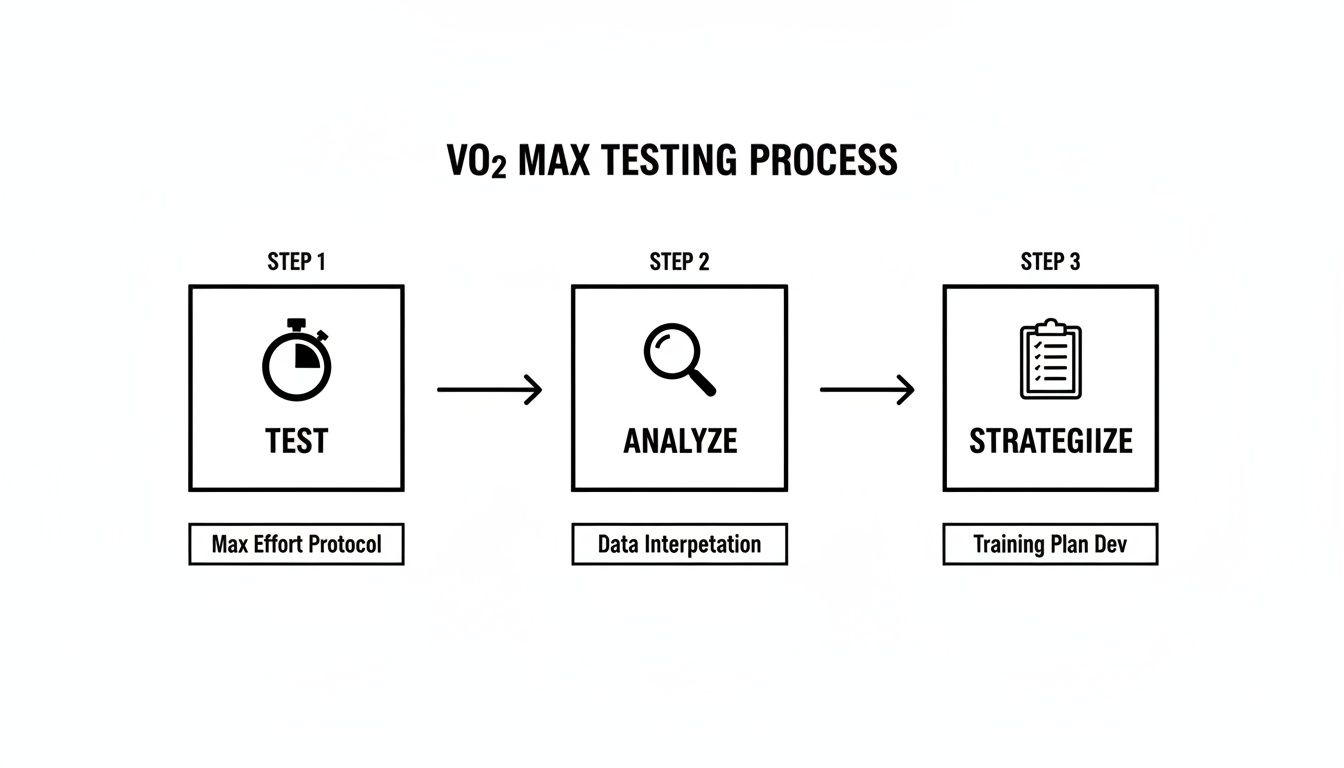
The key takeaway here is that your training plan should be a direct response to your current fitness level. That’s how you ensure every ounce of effort is targeted and effective.
Building Your Aerobic Engine with Zone 2 Training
While HIIT is busy raising your performance ceiling, Zone 2 training is what builds the massive foundation underneath it. This is your low-and-slow, sustainable-intensity work, often called a "conversational pace", where your body becomes incredibly efficient at using fat for fuel and builds cellular resilience.
It won't feel hard, but don't be fooled. Its impact on your aerobic fitness and long-term health is immense.
Zone 2 work directly targets the mitochondria, the tiny power plants inside your cells. By spending a lot of time in this zone, you encourage your body to build more mitochondria and make the existing ones work better. More (and more efficient) mitochondria mean you can produce more energy aerobically, which delays fatigue and is a cornerstone of metabolic health and longevity.
This type of training should form the bulk of your schedule, making up around 80% of your total weekly training time.
- What it feels like: You should be able to hold a full conversation without gasping for breath. Your heart rate will typically be around 60-70% of your maximum.
- Duration: Aim for sessions lasting anywhere from 45 to 90 minutes. If you're more advanced, you can push this even longer. The key is consistency, so three to four sessions a week is a solid target.
- How to do it: Any steady, sustained activity works. Jogging, cycling, swimming, or even a brisk walk on an incline are all fantastic options.
Think of Zone 2 training as the bedrock of your fitness. It builds the aerobic capacity that supports all your high-intensity efforts, and it's absolutely important for long-term health - all while being easy on the body and actually helping you recover.
Creating a Balanced Weekly Schedule
So, how do you put all this together? A smart weekly schedule integrates both high and low intensities without leading to overtraining. Your guiding principles should always be consistency and progressive overload - gradually making things a little more challenging over time.
Here's a sample weekly training plan that gives you a practical look at how to structure your week. This can easily be adapted whether you're just starting or you're already quite fit.
Sample Weekly Training Split for VO2 Max Improvement
This table lays out a practical week, blending HIIT for peak performance, Zone 2 for building a deep aerobic base, and essential strength work for lifelong function.
| Day | Primary Session | Focus | Notes |
|---|---|---|---|
| Monday | Rest or Active Recovery | Recovery | A light walk or some stretching is perfect. |
| Tuesday | HIIT Session (4x4) | High-Intensity | Your key VO2 max stimulus for the week. Give it your all. |
| Wednesday | Zone 2 Endurance | Aerobic Base | 45-60 minutes of steady cycling or jogging. |
| Thursday | Strength Training | Muscular Support | Focus on your legs and core (we'll cover this later). |
| Friday | Zone 2 Endurance | Aerobic Base | Another 45-60 minutes. Focus on maintaining a steady pace. |
| Saturday | Long Zone 2 Session | Endurance | 75-90+ minutes. This is a huge engine-building session. |
| Sunday | Rest or Active Recovery | Recovery | Another light walk or some gentle, restorative activity. |
This structure provides the powerful high-intensity stimulus you need to elevate your VO2 max while dedicating plenty of time to building a strong aerobic base that will support you for years to come. By smartly combining these protocols, you create a sustainable system for levelling up both your performance and your health.
Fuelling Your Engine with Strategic Nutrition
All the intense training in the world won't get you far if you're not giving your body the right fuel. Think of it this way: your workouts are the architect’s plans for a bigger, better aerobic engine, but your diet is the high-quality brick and mortar you need to actually build it for life.
It’s about more than just "eating healthy." To seriously move the needle on your VO2 max and support your long-term health, we need to get specific. We're talking about a nutritional strategy that directly supports the intense demands you're placing on your body - one that builds better blood, manages inflammation, and helps your cells churn out energy more efficiently.
Build Better Blood with Iron
One of the most direct ways your diet impacts VO2 max is through your blood. Specifically, through a protein called haemoglobin. This is the iron-rich workhorse in your red blood cells that grabs oxygen from your lungs and ferries it to your muscles. If you're low on iron, your body can't make enough haemoglobin. It's that simple.
This creates a major bottleneck in your oxygen delivery system. You can be as fit as a fiddle, but if you can't get enough oxygen to your muscles, your performance will hit a wall. Even a minor iron deficiency, not just full-blown anaemia, can put a ceiling on your potential.
- Haem Iron: This is the most easily absorbed form, found in animal products. Make lean red meat, poultry, and fish a regular part of your diet.
- Non-Haem Iron: You'll find this in plant-based foods. Load up on lentils, spinach, tofu, and fortified cereals.
- Boost Absorption: Here’s a simple trick - pair your iron-rich foods with vitamin C. A squeeze of lemon on a spinach salad or some bell peppers with your lentil soup can dramatically improve how much iron your body actually absorbs.
Getting a blood test to check your ferritin levels (your body's iron storage) is a smart move. It gives you a clear picture of where you stand and helps you make targeted adjustments instead of just guessing.
Timing Your Fuel for Peak Performance and Recovery
What you eat, and when, around your workouts makes a huge difference. Get the timing right, and you’ll find you can push harder during sessions and bounce back faster afterwards.
For those tough 4x4 interval sessions, you need readily available energy. Try to have some easily digestible carbs 30-60 minutes before you start. A banana or a small bowl of porridge is perfect for topping off your glycogen stores so you can hit those high intensities.
Once the hard work is done, the clock starts on recovery. Aim to get a mix of protein and carbs in within 60-90 minutes of finishing. This combination works to replenish your energy stores and kick-start the muscle repair process. A protein shake with a banana or some Greek yoghurt with berries are both great, easy options.
A Look at NMN and Cellular Energy
Beyond the basics of carbs, protein, and iron, cutting-edge longevity science is looking deeper - right down to our cellular health. A key player here is a molecule called Nicotinamide Adenine Dinucleotide (NAD+), a vital coenzyme that’s involved in hundreds of metabolic processes, including how your mitochondria produce energy.
The catch is that our NAD+ levels naturally drop as we get older, which is a big reason why energy and physical function can decline. This has led to a lot of research into NAD+ precursors - compounds our bodies can use to make more NAD+.
One of the most-studied precursors is Nicotinamide Mononucleotide (NMN). The idea is that by supplementing with NMN, you can support your body's natural NAD+ production, which in turn helps your mitochondria work more efficiently.
While the research is still developing, the connection is logical: better mitochondrial function means your body gets more efficient at producing energy from oxygen. That’s the very foundation of a high VO2 max and a cornerstone of healthy aging.
This isn’t about replacing hard work or a solid diet. Instead, it’s a forward-thinking strategy that targets your aerobic capacity from the inside out, supporting the cellular machinery that powers every single workout. If you're interested in how different compounds can support your training, you can dive deeper in our guide to the best supplements for endurance.
Ultimately, a smart nutrition plan for boosting VO2 max is all about combined effect. You combine iron-rich foods to build your oxygen transport system, smart nutrient timing to fuel your workouts and speed up recovery, and targeted supplementation to support your health at a cellular level. It’s a powerful combination for both immediate performance gains and lifelong vitality.
Mastering Recovery: The Untapped Potential in Sleep and Strength

Those brutal interval sessions and long, grinding endurance efforts are only half the story. The real, lasting improvements to your VO2 max aren't actually made during the workout itself. They're forged in the hours and days that follow.
Peak fitness is built during rest. Two of the most powerful, yet frequently neglected, tools in your arsenal are quality sleep and smart strength training. These aren't just nice-to-haves; they are the absolute foundation for adaptation. Without them, you’re just repeatedly breaking your body down without ever giving it the chance to rebuild stronger.
The Science of Sleep for Cardiovascular Gains
Think of sleep as your body's dedicated repair and regeneration shift. While you're in deep sleep, your system gets busy releasing critical hormones like human growth hormone (HGH), which is essential for mending the microscopic muscle damage caused by training. This is the biological process that allows your heart, lungs, and muscles to adapt and come back more powerful.
When you consistently get 7-9 hours of quality sleep, you create the ideal environment for this recovery to happen. On the flip side, skimping on sleep sends your cortisol levels soaring. This stress hormone actively sabotages recovery, slows progress, and can contribute to chronic health issues over time.
To make the most of your nights, you need to be intentional about your sleep hygiene:
- Stick to a Schedule: Try to go to bed and wake up around the same time every day - even on weekends. This helps to regulate your body's internal clock, or circadian rhythm.
- Create a Rest Sanctuary: Your bedroom should be cool, dark, and quiet. Blackout curtains and a lower room temperature can make a surprising difference to your sleep quality.
- Power Down Screens: The blue light emitted by phones and laptops can mess with the production of melatonin, the very hormone that tells your body it's time to sleep. Put them away an hour before bed.
Strength Training: The Unsung Hero of Endurance
So many people chasing a higher VO2 max make the mistake of focusing solely on cardio. This is a huge oversight. A well-designed strength training routine acts as a powerful force multiplier for your endurance, boosting both your performance and your resilience against age-related decline.
One of the biggest benefits is an improvement in your running economy—a fancy term for how much energy you use at a given pace. When your legs and core are stronger, each stride or pedal stroke becomes more efficient. You waste less energy, which means you can sustain a higher intensity for much longer before fatigue crashes the party.
Think of it like this: a stronger chassis allows you to get more out of the same engine. Strength work builds that strong chassis, making you a more efficient and injury-resistant athlete for life.
This newfound efficiency allows you to push harder during those important VO2 max intervals, which is where the real gains come from. Plus, stronger muscles, tendons, and ligaments dramatically lower your risk of the common overuse injuries that can completely derail your progress.
Building a Supportive Strength Routine
The goal here isn't to train like a powerlifter. You're building functional strength to support your aerobic engine and maintain muscle mass, a key factor in healthy aging.
Here’s what a simple, effective routine could look like, focusing on the key muscle groups for any endurance athlete:
- Goblet Squats: 3 sets of 8-10 reps. A fantastic all-rounder for building strength in your quads, glutes, and core.
- Romanian Deadlifts: 3 sets of 8-10 reps. These specifically target your hamstrings and glutes, which are your primary power drivers.
- Plank Variations: 3 sets, holding for 45-60 seconds. A strong, stable core is the bedrock of all efficient movement.
- Calf Raises: 3 sets of 15-20 reps. Strengthens the lower legs to handle the repeated impact and push-off from running.
Try to schedule your strength sessions on days away from your high-intensity training to make sure you're fresh enough to give both your full effort.
For a deeper look at optimising your entire recovery process, our detailed guide explains how to recover faster from workouts. For those looking at more advanced strategies, some athletes even explore how tools like hyperbaric chambers for athletes can provide an extra edge in recovery and performance.
Tracking Progress and Making Smart Adjustments
Training without tracking is just guessing. If you're serious about making real, long-term improvements to your performance and healthspan, you need a way to measure what matters. This is how you move from just working out to training with purpose.
in the end, you want to become your own best coach, making intelligent tweaks based on real feedback. Your training shouldn't be a rigid prescription you follow blindly; it should be a living, breathing system that adapts as you do. The secret lies in connecting what you do with the results you get.
Marrying Performance Metrics with Physiological Data
Let's start with the basics: log the key numbers from your workouts. It doesn't have to be overly complex. For your interval sessions, note the pace or power output you held for each effort. On your Zone 2 days, keep a close eye on your heart rate to make sure you're truly in that easy, aerobic zone.
As you build this log, you’ll start to see patterns emerge. Maybe you'll notice your heart rate during a Zone 2 run is 5 bpm lower at the same pace it was a month ago. That’s not just a feeling; it’s a hard number showing your cardiovascular system is becoming more efficient. It’s a clear win for your longevity.
The real magic happens when you layer your training data on top of your physiological data. Sure, it’s great to see your interval pace improve. But it’s a completely different level of insight when you see that pace improve after fixing a borderline iron deficiency revealed in a blood test.
This is why bringing regular blood analysis into the picture is so powerful. You can draw a direct line from correcting a biomarker, like ferritin or haemoglobin, to a tangible performance gain. It lets you fine-tune your nutrition and recovery strategies with incredible precision, ensuring your internal engine is firing on all cylinders for years to come. A great way to keep all this information organised is by following an ultimate gym journal guide.
The Feedback Loop for Longevity
Think of it as a constant feedback loop: Train -> Measure -> Analyse -> Adjust.
If you feel like you’ve hit a wall and your numbers haven't budged for a few weeks, the answer isn't always to just "push harder." That's often a recipe for burnout. Instead, look at your data. Are you getting enough sleep? Are your iron levels where they need to be? This methodical approach ensures every adjustment you make is a smart one, moving you closer to a higher VO2 max and a longer, healthier life.
Your VO2 Max Questions, Answered
Let's dig into some of the most common questions I hear about improving VO2 max. The goal here isn't just a quick fix, but building a solid foundation for long-term health and performance.
How Quickly Can I Really Improve My VO2 Max?
This is probably the number one question people ask, and the honest answer is: it depends on where you're starting from.
If you're coming off the couch, you're in for a rewarding ride. It's not uncommon to see a 10-20% jump in your VO2 max within the first two or three months of dedicated training. That initial period is incredibly motivating because your body adapts so readily.
For those who are already pretty fit, the journey is one of marginal gains. You'll be fighting for every percentage point, so seeing a 3-5% improvement over that same period is a massive win. For everyone, the non-negotiable ingredient is consistency.
What’s a Good VO2 Max to Aim for Longevity?
There isn't a single magic number that applies to everyone, but the research is crystal clear on this: you want to be in the 'High' or 'Superior' fitness bracket for your age and sex. Hitting this level is strongly linked to a lower risk of pretty much every chronic disease and a longer, healthier life.
But here’s the most powerful insight from all the data: the biggest leap in health benefits comes from simply getting out of the 'Low' fitness category. Moving from 'Low' to 'Average' can fundamentally change your long-term health trajectory.
Should I Do HIIT or Long, Slow Runs?
It's a classic debate, but the best approach isn't a case of "either/or"—it's "both/and." To really move the needle on your VO2 max for the long haul, you need a polarised training plan.
Here's how to think about it:
- High-Intensity Interval Training (HIIT) is your sharp tool. Those really tough 3-to-5-minute intervals are what directly push your heart and lungs to adapt and get stronger. This is how you raise your performance ceiling.
- Zone 2 endurance training is your foundation. These longer, easier sessions build your aerobic base, improve mitochondrial function, and enhance your body's ability to use fat for fuel. This work supports your high-intensity days and boosts your overall metabolic health.
By combining the two, you’re not just chasing a number. You’re building a truly resilient and efficient aerobic engine that serves you both in performance and in life.
Ready to stop guessing and start measuring what truly matters for your healthspan? With at-home blood testing from Lola, you can get a precise look at the biomarkers that directly impact your aerobic potential. Discover your baseline today.
At-Home Blood Testing
Check your levels from home
Professional phlebotomist visit. Doctor-reviewed results in 2-5 days. Track your health with comprehensive blood panels.
→45-70 biomarkers tested · Venous blood draw · From £130