


A clinically accurate liver function test at home isn't just about collecting data; it’s about getting a clear, proactive look under the bonnet of your body's metabolic engine. This simple blood test, done from the comfort of your own home, measures important liver enzymes and proteins. It's a useful measure for optimizing your health, fine-tuning your lifestyle, and building a strong strategy for a long and healthy life.
Your Liver’s Critical Role in Longevity

When people talk about longevity, the conversation often leans towards heart health or brain function. But truthfully, your liver is the silent workhorse, the unsung hero managing your long-term vitality. This incredible organ juggles over 500 critical functions, from breaking down nutrients and building essential proteins to clearing harmful substances out of your system. Its performance directly impacts your daily energy, metabolic efficiency, and how well your body ages.
Think of it as your body's central processing plant. It takes everything you consume, food, drinks, supplements, medications, and decides what to do with it. It either converts it into fuel, stores it for later, or packages it up for removal. A healthy liver means stable blood sugar, efficient fat processing, and the right amount of key proteins like albumin, which keeps your fluid balance in check.
The catch? The liver is remarkably tough and often won't send up a flare until problems are well underway. That’s why a proactive approach is a cornerstone of any serious longevity strategy, moving beyond just lifespan to focus on healthspan.
Early Warnings and Proactive Monitoring
Small changes in your liver markers can be the earliest signs of trouble, flagging up metabolic stress or nutritional gaps long before you’d ever feel them. For example, even a slight but consistent rise in the enzyme Alanine Aminotransferase (ALT) could be a quiet hint that your liver is under strain - perhaps from your diet, a demanding training schedule, or even environmental factors.
By keeping an eye on these trends, you get the chance to step in early. Instead of waiting for a problem to declare itself, you can make precise, informed adjustments to your lifestyle. Maybe your results point towards needing more antioxidant-rich foods, dialling back on alcohol, or re-evaluating your supplement stack. This is the essence of data-driven longevity.
This is what modern longevity strategy is all about. It shifts health management from being reactive (treating illness once it appears) to being preventative (optimising wellness every day). A routine liver function test at home isn’t just for diagnosing disease; it’s a performance indicator for your overall health.
By tracking your liver markers over time, you gain a dynamic view of your internal health. This isn't about looking for what's wrong; it's about understanding what's right and finding opportunities for continuous improvement.
The Liver and Cellular Health
To really grasp why these home tests are so valuable for longevity, it helps to understand the basics of cellular health. Your liver's immense capabilities all come down to the health of its individual cells, known as hepatocytes. When these cells are in top form, your whole body benefits. But when they're under stress, their diminished capacity creates a ripple effect throughout your system, accelerating the aging process.
For busy professionals and dedicated athletes, peak liver function is non-negotiable. Sustained energy, sharp mental clarity, and fast recovery all trace back to this vital organ. Using an at-home testing service gives you the hard data you need to support your liver, boost your performance, and add more healthy, active years to your life.
At Home Liver Testing Options in the UK
When it comes to getting a liver test in the UK, you're essentially looking at two different routes. You’ve got the fantastic clinical care provided by the NHS, and then there's the newer landscape of private, at-home health monitoring. Knowing how they differ is important for anyone building a personal longevity strategy.
The NHS is built to react to symptoms. If you walk into your GP's office with clear signs of liver trouble, think jaundice, abdominal pain, or extreme fatigue, they will absolutely run a liver function test (LFT). That’s what the system is designed for. What it isn't set up for is routine, proactive screening for someone who feels fine but wants to optimize for the future.
This creates a real gap for people who are actively trying to optimise their health and longevity.
The Proactive Health Gap
If you're a busy professional or an athlete, waiting for symptoms to appear just isn't an option. Your performance, energy, and long-term vitality rely on getting ahead of problems before they start. This is exactly where private services come into play, offering the proactive tools that you generally can't get through traditional healthcare channels.
These services let you access your own health data directly. Instead of needing a clinical reason to get checked, you can book a liver function test at home as part of your regular health MOT, just like tracking your sleep or nutrition. You can even explore a whole range of private blood tests available at home to get a more complete picture of your healthspan.
Understanding NHS vs Direct Access
It's worth being clear: the NHS doesn't offer a direct-to-you home LFT kit for general wellness screening. They did launch a targeted home testing programme for hepatitis C in May 2023, which is a brilliant initiative. However, getting a full liver panel to monitor your overall health still requires a GP's referral based on a clinical need.
So, for most of us in the UK, a formal LFT is usually triggered by a health concern, not a personal goal for health optimisation. You can read more about the NHS's targeted screening on their official site. This difference is why professional-grade at-home testing is becoming such a valuable tool for anyone on a longevity goals.
Think of a private at-home test not as a replacement for your GP, but as a powerful complementary tool. It gives you the data for lifestyle tweaks, while your GP is still your go-to for diagnosis and medical treatment.
By choosing a service like Lola, which uses qualified phlebotomists for a proper venous blood draw and sends samples to UKAS-accredited labs, you know the results are clinically accurate. This allows you to track subtle shifts in markers like ALT and GGT over time, turning that raw data into real, actionable insights for a healthier, longer life.
How to Get a Clinically Accurate Home Test
Getting reliable data on your liver's health from home is more straightforward than you might think, but let's be clear: accuracy is everything. A truly insightful liver function test at home isn't just about a quick finger prick. It’s about replicating the precision of a clinical setting in a way that provides data you can trust to build your longevity strategy.
The whole point is to move beyond guesswork and get a genuine understanding of what's going on inside. This is about using data you can trust to make smart, proactive decisions for your long-term health and performance.
This diagram shows the classic routes for liver testing in the UK, putting the traditional NHS path side-by-side with a modern at-home service.
The real takeaway here is the shift in control. We're moving from a reactive, symptom-driven process to a proactive approach where you're in the driver's seat of your own health monitoring.
Why Venous Blood Draws Are the Gold Standard
To get clinically accurate results, the first thing to look at is how the sample is collected. You'll find two main types of home blood tests: capillary (finger-prick) and venous (a blood draw from a vein). While finger-prick tests seem easy, they're unfortunately prone to issues that can skew the results.
Capillary blood is a mix of different fluids, and the sample can easily be contaminated with tissue fluid or damaged cells during collection. This can lead to unreliable readings for key liver enzymes like ALT and AST.
A venous blood draw, on the other hand, is the same method used by the NHS and in clinical trials for a reason. Performed by a trained phlebotomist, it provides a pure, high-quality blood sample straight from the source. This is absolutely essential for getting accurate, repeatable results that you can confidently track over time. It’s why services like Lola use this method exclusively - to ensure your longevity strategy is built on solid ground.
Preparing for Your At-Home Test
Your preparation is simple but can have a big impact on the quality of your results. Think of it like prepping for a big meeting or a workout; a little planning goes a long way.
Here are a few key things to do before your phlebotomist arrives:
- Check Fasting Requirements: Some tests, especially if you're getting a comprehensive metabolic panel alongside your liver markers, might need you to fast for 8-12 hours. This means water only. Always double-check the specific instructions for your test when you book.
- Stay Hydrated: This is an easy win for longevity. Drinking plenty of water in the 24 hours before your appointment makes your veins easier to find and helps the blood draw go smoothly and quickly.
- Time Your Workout: Strenuous exercise, particularly heavy resistance training, can temporarily spike liver enzymes like AST and ALT because of muscle breakdown. To avoid misreading these spikes as a liver issue, it's best to book your test on a rest day or at least 24-48 hours after an intense session.
Think of it this way: you want the test to reflect your baseline liver function, not the temporary stress of a heavy deadlift session. Giving your body time to recover ensures the data is a true picture of your liver's health.
For a deeper look at the nuances, we've put together a guide on the differences between at-home and clinic blood tests.
What to Expect During the Visit
The home phlebotomy experience is designed to be just as professional as a clinic visit, but without the hassle of travel and waiting rooms. When you book a service like Lola, you pick a time slot that suits you, and a certified phlebotomist comes to your home or office.
The appointment itself is surprisingly quick, often taking no more than 15-20 minutes from start to finish.
The phlebotomist arrives with a sterile kit, confirms your identity, and finds a suitable vein - usually in your arm. The blood draw itself is over in just a few minutes. Afterwards, your sample is securely packaged and sent straight to a UKAS-accredited laboratory for analysis. These are the same labs your GP uses, so you know your results are being processed to the highest clinical standards. The entire process is professional, discreet, and built around your schedule.
Decoding Your Liver Markers for Optimal Health
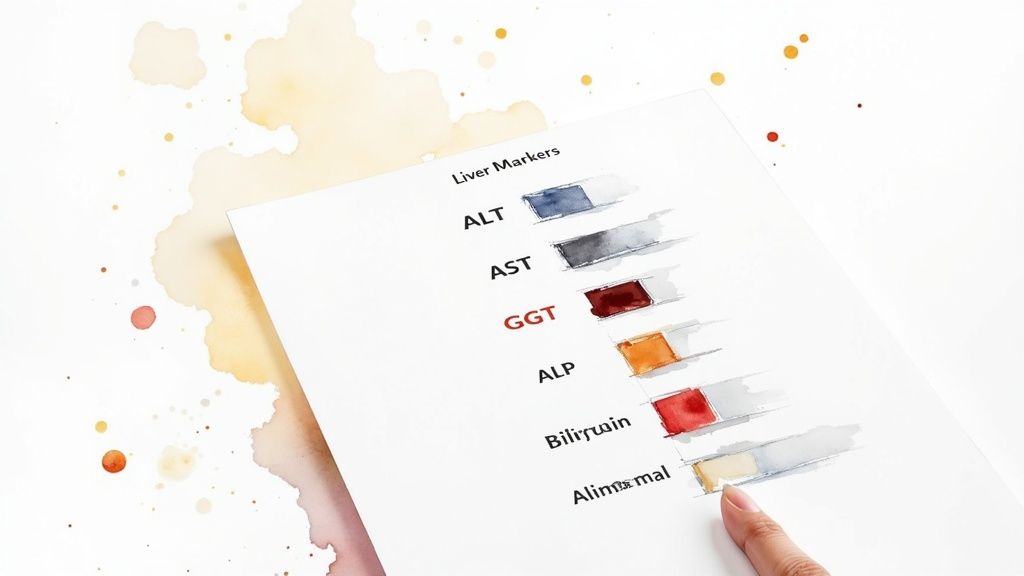
When you get your liver function test results, it's tempting to just scan for anything flagged as "abnormal." But the real value isn't in a simple pass/fail grade. For longevity, the goal is to shift from avoiding disease to actively pursuing optimal function. Those numbers tell a detailed story about your metabolic health, your nutritional status, and how well your body is handling the demands of a high-performance life.
To truly use this data, you need to look past the standard reference ranges. It's time to start thinking about what’s optimal for you.
A conventional "normal" range is designed to catch outright disease in the general public. But if you’re aiming for peak physical and mental performance, your goal isn't just to avoid illness—it's to function at your absolute best. The subtle shifts within those so-called normal ranges are where the most powerful insights are hiding.
Getting a liver function test at home provides the raw data. This is where we translate those numbers into actionable longevity insights.
The Key Players on Your Liver Panel
Your at-home test measures several key enzymes and proteins. Each one offers a different piece of the puzzle, and knowing what they do is the first step to understanding the bigger picture of your liver health. Let's break down the main markers you'll see.
When you look at your results, you'll see a handful of abbreviations. This quick table breaks down the most important ones, what they're actually measuring, and why they matter for your long-term performance goals.
Understanding Your Key Liver Health Markers
| Marker | What It Measures | Longevity & Performance Insight |
|---|---|---|
| Alanine Aminotransferase (ALT) | An enzyme primarily found in liver cells. | A highly specific indicator of liver cell stress or inflammation, important for tracking metabolic health. |
| Aspartate Aminotransferase (AST) | An enzyme found in the liver, heart, and muscles. | Can indicate liver strain but also reflects muscle breakdown from intense exercise, helping you balance training and recovery. |
| Alkaline Phosphatase (ALP) | An enzyme concentrated in the liver, bile ducts, and bones. | Elevated levels can point to issues with bile flow, impacting digestion and detoxification. |
| Gamma-Glutamyl Transferase (GGT) | A highly sensitive enzyme for liver health. | Often the first marker to react to alcohol consumption and oxidative stress, making it a key metric for lifestyle adjustments. |
| Bilirubin | A yellow pigment from red blood cell breakdown. | Measures how efficiently the liver is clearing waste, a fundamental process for cellular cleanup and long-term health. |
| Albumin | The main protein produced by the liver. | A key indicator of your liver's manufacturing capacity, plus your nutritional status and ability to repair tissue. |
Each marker gives you a clue, but the real story emerges when you look at them together, in the context of your own life.
Optimal vs. Normal: A important Distinction
A standard lab report might give a broad "normal" range for ALT, say 0 to 45 IU/L. If your result is 40 IU/L, you’ll be told you’re fine. But from a longevity perspective, that number might already be a quiet signal of low-grade inflammation or metabolic stress that needs your attention.
Many forward-thinking practitioners now aim for much tighter "optimal" ranges. For example, an optimal ALT for both men and women might be considered anything below 25 IU/L. A reading between 25 and 45 IU/L, while not clinically alarming, is an opportunity. It’s an early nudge to take a closer look at your diet, alcohol habits, or supplement routine.
This isn't just about preventing disease; it's about actively building strong health. Shifting from a "normal" to an "optimal" mindset means using your data to proactively guide your lifestyle for better long-term outcomes.
For a more granular breakdown of what your results mean, our guide on understanding liver function test results offers an even deeper analysis.
Context Is Everything: The Athlete and The Professional
Without context, the numbers on your report are meaningless. Your lifestyle is the lens that brings them into focus. A slightly elevated AST, for instance, means something completely different for a marathon runner than for a sedentary office worker.
Scenario for an Athlete
Imagine a dedicated endurance athlete who tests their liver 24 hours after a gruelling training session. Their results show a slightly elevated AST, but their ALT is perfect.
- The Conventional View: Might raise a minor, non-specific concern about liver stress.
- The Longevity View: This pattern is a classic sign of muscle breakdown from intense exercise, not a liver problem. Because AST is also found in muscle, a tough workout will cause it to leak into the blood. The normal ALT confirms the liver is likely fine. The actionable insight here isn't to panic about the liver, but to optimize recovery, nutrition, sleep, and hydration, to better support the training load and long-term athletic health.
Scenario for a Business Professional
Now, think of a busy executive. They work long hours, travel a lot, and often have a couple of drinks to unwind. Their results show GGT at the high end of normal and a slightly elevated ALT.
- The Conventional View: Technically "within normal limits," so no action required.
- The Longevity View: This is a clear signal of metabolic stress. The GGT is reflecting the liver's hard work processing alcohol and managing oxidative stress. The ALT bump points to early-stage liver cell irritation. The actionable insight is clear: experiment with reducing alcohol, prioritising sleep, and adding more antioxidant-rich foods to see if those markers start trending down. This proactive tweak could significantly improve their long-term health trajectory.
By looking at your data through the lens of your personal life, you transform a simple lab report into a personalised roadmap for optimising your health for years to come.
Using Your Results to Track Health Trends
Your first set of results from a liver function test at home gives you a fantastic baseline. Think of it as a high-definition snapshot of your liver at a single moment in time. But for longevity, the true power doesn't come from one picture, but from the story that unfolds over several. The most valuable, actionable insights are always found in the trends.
A one-off reading can easily be skewed by short-term factors. Maybe you had a tough workout the day before, enjoyed a rich meal, or were feeling under the weather. By testing every few months, you start to smooth out these little bumps and see your true baseline. This is how raw data becomes a useful measure, letting you make smart lifestyle changes and actually see the impact they’re having on your long-term health.
From Snapshot to Story
Let’s imagine your first test shows your Gamma-Glutamyl Transferase (GGT) is creeping towards the high end of the optimal range. GGT is a really sensitive marker for oxidative stress in the liver. It's not clinically alarming, but if you’re focused on performance and longevity, it’s a clear signal that there's room for improvement.
Suddenly, you have an actionable goal. You might decide to cut back on alcohol for the next three months, load up on antioxidant-rich foods like berries and leafy greens, and get serious about your sleep quality.
When you re-test, you’re not just getting another number back. You're getting direct feedback on your efforts. Seeing that GGT level drop by 15-20% is incredibly powerful—it’s concrete proof that your lifestyle adjustments are actively improving your cellular health. This is proactive longevity in action: make a change, measure the result, and refine your strategy based on your own body's data.
This process turns your health from something you passively hope for into an active system you can directly influence. You stop guessing and start using personal data to guide your decisions.
This ongoing approach is vital. As the British Liver Trust points out, a single test is just one piece of the puzzle. Results can fluctuate, and an isolated odd reading might mean nothing on its own. For more context, their insights on home testing for liver disease are well worth a read. Consistent monitoring is what helps you separate a temporary blip from a developing trend.
When to Take Action and When to See a GP
Tracking trends isn’t just about celebrating wins; it’s also a important safety net. Remember, an at-home test is a screening tool for optimisation, not a diagnostic one. Knowing when a trend warrants a chat with your GP is key to using this information responsibly.
Here’s a simple framework for action:
- You see positive changes. If markers like ALT or GGT are steadily improving after you've made lifestyle adjustments, that’s brilliant. Keep up the good work and continue monitoring to stay on track.
- Your results are stable and optimal. If your numbers are consistently great over several tests, that provides fantastic reassurance. It’s a good sign that your current lifestyle is supporting your long-term health goals.
- You notice a concerning trend. A slow but steady upward creep in a marker like ALT over two or three tests, even if it's still within the "normal" lab range, is your cue to pay attention. This is the time to be honest with yourself about your lifestyle and consider if you need professional guidance.
- You get a clinically abnormal result. If any single result comes back flagged as clinically high or low, don't wait for the next test. Book an appointment with your GP right away. They can interpret the result with your full medical history in mind and decide on the next steps, which will often involve an NHS test to confirm the finding.
Using the Lola app to visualise these patterns means you can walk into a conversation with your GP armed with clear, objective data. This makes for a far more productive discussion about your long-term health strategy.
Got Questions About At-Home Liver Tests? We Have Answers.
Taking charge of your health metrics is a smart move, especially when you're playing the long game with your performance and longevity. But naturally, the idea of an at-home liver test brings up a few questions. Let's walk through the common queries we hear from driven professionals and athletes just like you.
How Accurate Are These Tests, Really?
This is the big one, and rightly so. The accuracy of any test boils down to one thing: the quality of the sample.
-
Venous Blood Draw: This is the undisputed gold standard for reliable data. A trained phlebotomist drawing blood from your vein is exactly what happens at your GP's office. This is the method we use at Lola because it provides a pure, ample sample that delivers clinically accurate results from a UKAS-accredited lab. You can be confident in the data.
-
Finger-Prick (Capillary) Tests: These are convenient, but they fall short for a detailed liver panel. The tiny sample you get is a mixture of blood and other fluids, and it's prone to contamination or damage. For sensitive markers like ALT and AST, this can throw the numbers off, making it impossible to track the subtle changes that matter for longevity.
For anyone serious about precise health data, a venous draw is the only way to go.
Do I Need to Fast Before My Appointment?
Good question. For a standalone liver function test, you typically don’t need to fast.
However, if you're building a comprehensive longevity strategy, you'll probably bundle your liver panel with other tests that look at your metabolic health, like cholesterol or glucose. If those are included, then yes, you'll need to fast for 8-12 hours. You can still drink water, of course. Always double-check the instructions when you book so your results are spot on.
A Pro Tip For Longevity Tracking: I always book my at-home tests for first thing in the morning. It makes an overnight fast effortless, and being well-hydrated helps the phlebotomist find a vein easily. The whole process is quicker and smoother.
Can My Workout Skew My Liver Results?
Yes, absolutely. This is a critical point that athletes and active people often miss. Strenuous exercise, especially heavy lifting or a long run, causes micro-tears in your muscles. This is a normal part of getting stronger.
As your muscles repair, they release enzymes like AST (Aspartate Aminotransferase) into your blood. Since AST is also a key liver marker, a spike after a workout could be easily mistaken for liver stress. To get a true picture of your liver's health, schedule your test on a rest day, or at least 24-48 hours after a tough session. This ensures we're measuring your liver's baseline, not just your last workout.
How Often Should I Be Testing My Liver?
A single snapshot is useful, but the real power for longevity comes from seeing the trends over time.
- Get Your Baseline: Your first test is your starting point. It’s your personal benchmark.
- Track Your Progress: For most people focused on proactive health, testing every 3-6 months hits the sweet spot. It's frequent enough to see how lifestyle tweaks, like cutting back on alcohol or cleaning up your diet, are impacting your numbers.
This regular rhythm allows you to see what’s working and catch any downward trends early. It’s about making small course corrections long before they ever become big problems.
Ready to turn data into action? With Lola, a professional phlebotomist comes to you, giving you a clinically accurate liver function test without the hassle. Your results are delivered straight to your app, making it easy to track your progress. Book your at-home test with Lola Health today and start making informed decisions for a healthier, longer life.
Test This Biomarker at Home
This biomarker is included in our Liver & Kidney Function and Core Health 45 — results in 2-3 working days with GP-reviewed insights.
At-Home Blood Testing
Check your levels from home
Professional phlebotomist visit. Doctor-reviewed results in 2-5 days. Track your health with comprehensive blood panels.
→45-70 biomarkers tested · Venous blood draw · From £130