


When you get a thyroid test in the UK, the lab report will show your Thyroid-Stimulating Hormone (TSH) level. For most adults, the standard reference range falls somewhere between 0.4 and 4.5 mU/L (milli-units per litre). But here's the important insight for your long-term health: a number that's technically "in-range" isn't always the same as what’s optimal for maximising your healthspan and vitality.
Decoding Your TSH: The First Step to a Longer Healthspan

Think of TSH as the master signal from your brain to your thyroid gland. Your pituitary gland sends out TSH to prompt your thyroid into action, effectively setting the metabolic rate for your entire body. It's a critical control system for your long-term health.
If your TSH level is high, it’s a sign your brain is working hard to stimulate a sluggish thyroid. This often points towards an underactive thyroid, a condition known as hypothyroidism. Conversely, if your TSH is very low, it suggests your thyroid might be overactive, a sign of hyperthyroidism. This single biomarker is a key starting point for understanding your metabolic health, which directly impacts your energy, cognitive function, and how well you age.
Understanding the Numbers for Longevity
Getting familiar with the typical TSH ranges used in the UK is the first step towards taking control of your health for the long haul. While exact numbers vary between labs, having a general framework helps you interpret your results and plan for a healthier future.
To make things clearer, here’s a quick overview of what your TSH number might mean.
UK TSH Level Interpretation At a Glance
This table offers a simplified guide to understanding typical TSH levels for non-pregnant adults in the UK and their potential clinical meaning.
| TSH Level Range (mU/L) | General Interpretation | Potential Implication |
|---|---|---|
| > 4.5 | High TSH | Potentially Underactive Thyroid (Hypothyroidism) |
| 0.4 – 4.5 | "Normal" or In-Range | Generally considered within the standard NHS reference range |
| < 0.4 | Low TSH | Potentially Overactive Thyroid (Hyperthyroidism) |
While this table provides a great starting point, the real power lies in understanding the difference between "normal" and "optimal." This distinction is vital for anyone focused on optimising their healthspan.
A TSH result that falls within the standard UK reference range is a good sign, but it doesn't automatically mean your thyroid function is optimised for longevity. Many individuals experience symptoms of thyroid imbalance with levels that are technically normal, highlighting the importance of a personalised health strategy.
Let's take a real-world example. A TSH level of 4.2 mU/L would be classified as "normal" by most labs. However, many experts in preventative medicine and longevity argue that an optimal TSH for long-term health is much tighter, often closer to 0.5 to 2.5 mU/L. A result creeping toward the upper end of the standard range could be an early warning of a metabolic slowdown or subclinical hypothyroidism - a subtle imbalance that, over decades, can impact everything from your heart health to your cognitive sharpness.
Getting to grips with your TSH isn't just about managing a condition today; it's an actionable strategy for fine-tuning your body’s systems for a longer, more vibrant life. When you know your numbers and what they really mean for your future, you can have more productive conversations with your doctor and take proactive steps toward lasting health.
Why Your TSH Result Is More Than Just a Number
https://www.youtube.com/embed/D8eqHtEqyI4
Getting a lab report back that says your TSH levels are ‘normal’ might feel reassuring. But if you're focused on longevity, this is where the real work begins.
The concept of a single, standard TSH range in the UK is far from simple. It's a topic of ongoing debate among medical experts, and the outcome has direct consequences for your healthspan.
Understanding this debate is the first step in moving from passively accepting a lab result to actively managing your health for the long term. A number on a page is just a snapshot; it's not the full story of your body's potential for a long and healthy life.
The Problem with a Wider Range
For years, the UK has used a wider TSH reference range than many other countries. This means a TSH level that is considered fine here might be flagged for further investigation elsewhere.
The National Academy of Clinical Biochemistry (NACB), for instance, suggested a tighter TSH range of 0.4 to 2.5 mU/L back in 2002, based on data from truly healthy individuals. Yet, even today, some NHS trusts use much broader ranges, like 0.38 to 5.33 mU/L. That's a significant difference. You can find out more about the history of the UK's TSH reference range on tpauk.com.
So what does this wider net mean for your long-term health? It means that the early, subtle signs of a declining thyroid function can be missed. If you're struggling with persistent fatigue, brain fog, or weight gain, a TSH of 4.2 mU/L might be dismissed as "normal," leaving a low-grade metabolic issue to compound over years.
From Normal to Optimal: A Longevity Perspective
This is where shifting our thinking from what's merely "normal" to what's truly "optimal" becomes a powerful longevity tool. Just because your TSH level isn’t high enough to trigger a diagnosis doesn't mean it's supporting your peak performance or long-term vitality.
Think of your thyroid as the master controller for your body’s metabolic engine. A TSH level that's technically in-range but consistently at the high or low end is like running that engine slightly out of tune. It still functions, but over the years, that subtle inefficiency creates cumulative wear and tear on your systems.
An optimal TSH level isn't about meeting a lab's minimum standard. It's about finding the precise sweet spot where your body functions most efficiently, helping to protect you from age-related chronic issues down the line.
Aiming for your personal optimal level is a proactive health strategy. It validates that feeling 'off' even when your results are 'normal' is a genuine concern that impacts your future health. It help you to look beyond a single number and see the bigger picture of your symptoms, lifestyle, and longevity goals.
Why Your Symptoms Matter for Future Health
How you feel today is a important piece of data for your future wellbeing. If your TSH is technically normal but you feel persistently unwell, that’s a clear signal that something needs a closer look to prevent long-term problems.
This is often where we see subclinical thyroid dysfunction - a state where TSH is mildly elevated, but other thyroid hormones (T4 and T3) are still within the normal range. Even in this "subclinical" state, the long-term effects can be significant.
Over time, even slightly off-kilter TSH levels have been linked to:
- Cardiovascular Strain: Subclinical hypothyroidism can contribute to higher cholesterol and stiffer arteries, increasing long-term heart risk.
- Cognitive Decline: That frustrating 'brain fog' isn't just an inconvenience; it can have a cumulative impact on your cognitive resilience as you age.
- Metabolic Slowdown: An underperforming thyroid makes it much harder to manage weight and can increase the risk of insulin resistance over time.
By understanding the limitations of the standard normal TSH levels UK range, you can take control. You can have more informed conversations with your doctor, seek more comprehensive tests, and manage your health not just for today, but for an optimal, vibrant future.
The Hidden Factors That Influence Your TSH

Your Thyroid-Stimulating Hormone (TSH) level isn’t a fixed number. It's a dynamic biomarker, constantly responding to your body and environment. Understanding these fluctuations is key to accurately interpreting your results and making smart, proactive choices for your long-term health.
Relying on a single TSH result is like trying to understand a complex system from one data point - it simply doesn't give you the full picture. Everything from your age to the time of day can influence the reading, which makes context important for effective health planning.
How Your Body's Clock Affects TSH
One of the most overlooked factors is the natural daily rhythm of TSH, known as diurnal variation. Your TSH levels naturally peak overnight and in the early morning. They then gradually decline throughout the day, reaching their lowest point in the late afternoon.
What does this mean for you? A blood test at 8 am could yield a significantly different result from one at 4 pm. The most actionable insight here is to be consistent. Always have your TSH tested around the same time, ideally in the morning. This simple habit creates reliable data, allowing you to track trends over time and get a far more accurate view of your long-term thyroid function.
Age and Life Stages
Your optimal TSH levels are not static throughout your life. They evolve as your body's needs change.
- Ageing: It’s normal for TSH levels to slowly drift upwards as we get older. A TSH that’s optimal for a 30-year-old may be different for a 70-year-old. This subtle rise can be a natural part of ageing, but it's important to monitor it to ensure it doesn’t progress into a subclinical hypothyroid state that could accelerate age-related decline in energy and cognitive function.
- Pregnancy: This is a period of massive hormonal change, and the thyroid is central to it. During pregnancy, the "normal" TSH ranges are completely different and shift with each trimester. Levels are typically lower in the first trimester before rising, requiring close monitoring for the health of both mother and baby.
Understanding these life-stage adjustments helps you and your doctor interpret your normal TSH levels UK results correctly, preventing unnecessary concern or a missed opportunity for early intervention.
Your TSH is a sensitive barometer of your overall health. It reflects not just your thyroid's function but also the demands being placed on your entire system by factors like illness, stress, and medication.
Other Critical Influencers on Your TSH Reading
Beyond age and time of day, several other factors can affect your TSH levels. Being aware of them helps you time your tests for maximum accuracy and make sense of your results.
Recent Illness or Infection: When your body is fighting an infection, even a minor cold, your TSH levels can be temporarily suppressed. Testing while you're unwell can give a falsely low reading. For the most reliable data, wait until you are fully recovered before having your blood drawn.
Chronic Stress: Long-term stress disrupts the communication between your brain and adrenal glands (the HPA axis), which can dampen TSH production. The stress hormone cortisol can interfere with the thyroid's feedback loop, potentially masking an underlying issue that could impact your health over time.
Medications: A wide range of common medications can affect TSH levels.
- Corticosteroids like prednisolone can lower TSH.
- Certain psychiatric medications, particularly lithium, can raise TSH.
- Dopamine agonists and some seizure medications can also alter your results.
Always provide your doctor with a complete list of all medications and supplements you take before a thyroid test. This context is essential for an accurate interpretation. For those looking to take a proactive role in their health, options like convenient at-home hormone level testing can provide powerful insights into your body's unique patterns, helping you build a long-term health strategy.
How Your TSH Levels Shape Your Long-Term Health
Your thyroid might be a small gland, but it has an immense impact on your long-term health. Moving beyond the immediate symptoms of fatigue or anxiety, we see a powerful link between your TSH levels and your "healthspan" - the number of years you live in good, functional health. A subtle thyroid imbalance today can quietly lay the groundwork for major health challenges decades from now.
Think of your body's metabolism as a car engine. TSH is the foot on the accelerator. A TSH level that’s within the normal TSH levels UK range but isn’t optimal for you is like driving with the engine constantly running a bit too sluggishly or revving a little too high. The car still works, but this constant, subtle inefficiency causes cumulative wear and tear over thousands of miles.
This is precisely what happens in your body. This low-grade, chronic stress can slowly undermine your health, contributing to conditions that shorten both how long and how well you live. Optimising your TSH is one of the most powerful and actionable things you can do to preserve your vitality for decades to come.
Heart Health: The Engine Room
One of the most critical connections is between your TSH and your cardiovascular system. Your thyroid sets the pace for your heart, directly influencing heart rate, blood pressure, and cholesterol levels. Even a minor, long-term thyroid imbalance, what doctors call "subclinical" dysfunction, can have serious consequences for your heart health as you age.
If your TSH is even slightly elevated (subclinical hypothyroidism) over the long term, it can lead to:
- Rising Cholesterol: Your body becomes less efficient at clearing LDL ("bad") cholesterol, leading to plaque build-up in your arteries.
- Stiffer Arteries: Your blood vessels can lose their natural flexibility, forcing your heart to work harder to pump blood.
- Higher Blood Pressure: A sluggish metabolism driven by high TSH can contribute to a gradual but persistent rise in blood pressure.
Conversely, a persistently low TSH (subclinical hyperthyroidism) also poses a risk. It can increase the likelihood of developing atrial fibrillation, an irregular heart rhythm that is a major risk factor for stroke. Proactively maintaining your TSH in an optimal range is a key strategy for protecting your heart for the long haul.
Protecting Your Mind: Cognitive Sharpness
That feeling of 'brain fog' isn't just an annoyance - it can be an early warning sign from your thyroid with long-term implications. The brain is highly dependent on thyroid hormones, and your cognitive function can suffer when levels are not optimal.
Research clearly shows that even subclinical thyroid issues can impair memory, focus, and mental processing speed. Over many years, this can erode your brain's resilience and contribute to age-related cognitive decline.
Think of a TSH level consistently outside your optimal range as a source of chronic, low-grade stress on your brain. Prioritising your thyroid health isn't just about energy - it's a critical strategy for preserving your cognitive assets and staying sharp as you age.
For example, someone might have a TSH of 4.3 mU/L and be told it's "normal." Yet, they may struggle with word recall or concentration. These symptoms are sometimes dismissed as normal ageing but could be a sign of suboptimal thyroid function. Aiming for an optimal TSH, often below 2.5 mU/L, can help lift that fog and support long-term brain health.
The Foundations: Bone Density and Metabolism
Your thyroid’s influence extends to your body's foundational systems—your bones and your metabolic engine.
Bone Health: Thyroid hormone is a important regulator of bone remodelling. A consistently low TSH (indicating too much thyroid hormone) can accelerate bone loss. Over time, this can lead to osteopenia or osteoporosis, dramatically increasing your risk of fractures in later life. This is a critical consideration for longevity, particularly for post-menopausal women.
Metabolic Rate: Your TSH is the master controller of your metabolic rate. A chronically high TSH slows everything down, making it harder to manage weight and contributing to insulin resistance, a precursor to type 2 diabetes. By keeping your TSH levels optimal, you support an efficient metabolism, making it easier to maintain a healthy weight and stable energy, which are cornerstones of a long, healthy life.
When you start seeing your TSH not just as a number, but as a key lever for your long-term health, everything changes. You can shift from reacting to problems to proactively fine-tuning your body’s systems for a long, healthy, and active life.
How to Get Your Thyroid Tested in the UK
Knowing your TSH levels is a critical first step in safeguarding your long-term health, but how do you get tested? Understanding your options in the UK is the first move in taking an active role in your own wellbeing and longevity plan. The path you choose, whether through the NHS or a private service, can determine the depth of insights you receive.
Taking control of this process is about more than just getting a number; it’s about gathering the data you need to live a longer, healthier life. Let's walk through the practical steps.
The NHS Pathway
For most people, the journey begins with their GP. An NHS thyroid test is typically initiated in response to symptoms. If you present with persistent issues like fatigue, unexplained weight changes, or brain fog, your doctor may decide a TSH test is warranted.
The standard NHS process usually involves:
- GP Consultation: A discussion about your symptoms and medical history.
- Blood Test: A referral for a blood draw at a local clinic or hospital.
- Initial TSH Analysis: The lab will almost always test only your TSH level first. If that result falls outside the normal range, further tests like Free T4 may be ordered.
This system is designed to identify clear-cut thyroid disease. However, it's a reactive system, meaning tests are usually ordered only after significant symptoms appear. For anyone focused on longevity, waiting for problems to become obvious isn't an optimal strategy.
Private Thyroid Testing: A More Proactive Approach
For a more wide-ranging and forward-thinking assessment of your thyroid health, private testing is a powerful alternative. This route puts you in control, allowing you to be proactive without needing to justify a test with severe symptoms. It’s about gaining deeper insights to inform your longevity-focused health plan.
Private tests often provide a much fuller thyroid panel from the outset, giving you a richer dataset to work with.
A standard private panel often includes TSH, Free T4, and Free T3, which together paint a much clearer picture of hormone production and conversion. Many also test for thyroid antibodies (TPOAb and TgAb), which can reveal underlying autoimmune conditions like Hashimoto's disease, sometimes years before TSH levels are seriously affected.
This proactive approach helps you identify subtle imbalances and trends long before they become clinical problems, allowing for early lifestyle interventions. For a deeper look at the benefits, our guide on private blood tests in the UK offers a complete overview.
Convenient and complete Options
Modern health services have made private testing incredibly accessible. You no longer need a GP referral and can choose a method that fits your schedule.
At-Home and Clinic-Based Blood Draws: Companies like Lola offer professional venipuncture blood draws, which can be performed in the comfort of your own home or at a nearby clinic. A trained phlebotomist handles the collection, ensuring a high-quality sample.
UKAS-Accredited Labs: Your sample is analysed in the same UKAS-accredited laboratories used by the NHS, guaranteeing your results meet the highest standards of accuracy and reliability.
By choosing a full private test, you are gathering vital intelligence on your body's metabolic engine. This data allows you to track your normal TSH levels UK over time, make informed lifestyle changes, and have more productive conversations with your doctor—it’s an investment in a longer, healthier future.
Understanding Your Results and Planning Next Steps
Getting a lab report can be confusing. A page of numbers and acronyms isn't always helpful. Let's break down how to make sense of your thyroid results and turn that data into an actionable plan for your long-term health.
First, locate your TSH value. On any UK lab report, you’ll see your number next to a "reference range." This is the lab's definition of 'normal'. If your result falls outside this range, it will usually be flagged.
This decision tree visualises the journey from noticing symptoms to choosing the right testing pathway for your health needs.
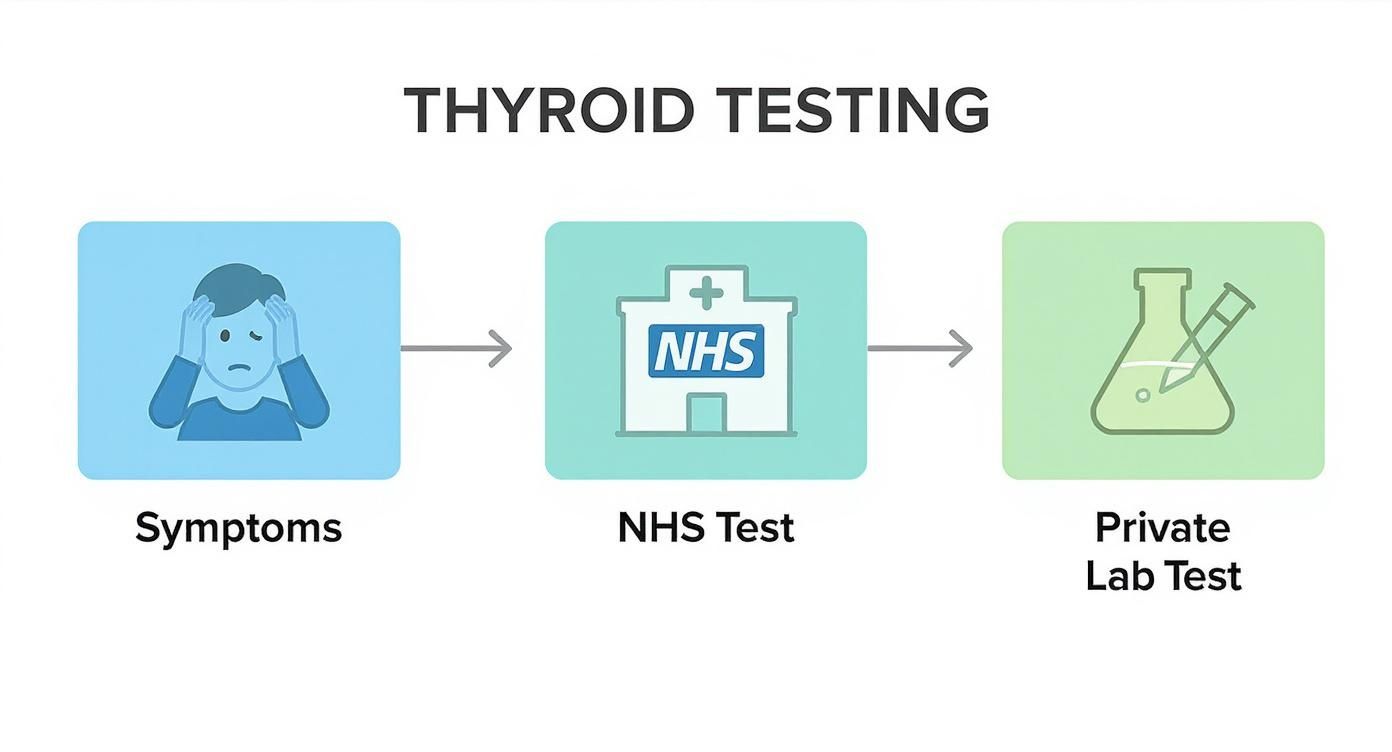
As the flowchart shows, whether you use the NHS or a private service like Lola, the goal is the same: to get clear, reliable data that informs your health strategy.
When Your TSH Is Out of Range
If your TSH level is flagged as high or low, your next step is clear: book an appointment with your GP. An out-of-range result is a signal that requires a professional medical conversation.
Your doctor will discuss your symptoms, review your medical history, and likely order further tests. This is not a final diagnosis but the start of an important investigation. Prepare for this conversation by noting your symptoms and questions.
When Your TSH Is In-Range but You Have Symptoms
This is where proactive health management comes in. Your TSH result is technically "normal," but you still feel fatigued, foggy, or just not your best. This is a common and frustrating situation.
A "normal" result isn't always the optimal result for you. If this is your situation, it’s time to take actionable steps. For more detail on interpreting your report, you can learn more about how to understand your blood test results in the UK.
Here are a few practical actions you can take:
- Track Your Symptoms: Keep a simple journal of your energy levels, mood, sleep, and physical changes. This provides valuable data to discuss with your doctor.
- Plan for Re-testing: A single test is a snapshot. Thyroid function can fluctuate. Consider re-testing in three to six months to establish a baseline and identify trends.
- Discuss Your Optimal Range: Have a conversation with your GP about what an optimal TSH level might look like for you. Many longevity-focused practitioners aim for a tighter range (e.g., 0.5-2.5 mU/L) than the standard lab reference.
The goal here is to move beyond passively accepting a "normal" lab result. By understanding your numbers and advocating for what feels right for your body, you shift from being a patient to being the CEO of your own long-term health.
Your Top Questions About TSH Levels Answered
We’ve explored how your thyroid health is fundamental to your long-term vitality. Now, let’s answer some of the most frequently asked questions about normal TSH levels in the UK and what they mean for your healthspan.
What Is the Optimal TSH Level for Most Adults?
While official NHS reference ranges are broad, many functional and preventative health experts advocate for a tighter, optimal range. They often suggest that an ideal TSH for most adults sits between 0.5 and 2.5 mU/L.
Why this tighter range? Because even if a TSH is technically 'normal' at 3.5 mU/L, some people experience symptoms like fatigue and brain fog once their level creeps above 2.5 mU/L. While not a one-size-fits-all number, it serves as a useful target for proactive health management. Your ideal level is best discussed with a doctor who can consider your full health picture.
Think of it as a longevity strategy. Keeping your TSH in this sweet spot helps ensure your metabolism is running efficiently, which is foundational for everything from heart health to cognitive sharpness as you age.
Maintaining a TSH below 2.5 mU/L isn't just about feeling good today; it's an actionable step to protect your body's systems from the subtle, cumulative stress that a suboptimal thyroid can cause over a lifetime.
Can I Have a Thyroid Problem if My TSH Is Normal?
Yes, absolutely. A 'normal' TSH result doesn't rule out an underlying thyroid issue, especially if you still feel unwell.
One reason is poor conversion of the inactive storage hormone (T4) into the active hormone (T3) that your cells use for energy. Your TSH can appear normal, but if this conversion is inefficient, you'll feel the effects.
Another possibility is an autoimmune condition like Hashimoto's disease, where your immune system attacks the thyroid gland. Antibodies can be present for years while your TSH remains in the normal range. This is why a detailed thyroid panel, including Free T4, Free T3, and antibodies, provides a far more detailed and actionable picture, helping you identify and address problems early.
How Often Should I Get My TSH Checked?
The NHS doesn't typically offer routine thyroid screening if you are asymptomatic. However, if you are on thyroid medication or have a diagnosed condition, your doctor will arrange regular tests.
For those taking a proactive approach to longevity, an annual check can be a smart strategy. It’s particularly valuable if you have risk factors or want to monitor your metabolic health over time. Regular tracking allows you to spot small shifts and make lifestyle adjustments before they become significant issues, keeping you in control of your health goals.
Ready to get a crystal-clear picture of your thyroid health and optimise it for a long, vibrant life? With Lola, you can book a professional blood draw at home or in a clinic at your convenience. We provide thorough thyroid panels analysed in UKAS-accredited labs, giving you the reliable data you need to take control. Visit https://lolahealth.com to start your journey.
Test This Biomarker at Home
This biomarker is included in our Thyroid & Hormonal Function and Core Health 45 — results in 2-3 working days with GP-reviewed insights.
At-Home Blood Testing
Check your levels from home
Professional phlebotomist visit. Doctor-reviewed results in 2-5 days. Track your health with comprehensive blood panels.
→45-70 biomarkers tested · Venous blood draw · From £130