


An oestrogen blood test measures the levels of oestrogen hormones in your bloodstream. Think of it as a vital snapshot of your hormonal health, providing critical data for your long-term wellness strategy.
For women, it's a cornerstone for understanding everything from fertility and menstrual cycles to the transition into menopause and beyond. For men, it sheds light on conditions linked to hormonal imbalances that affect long-term health. The test is simple, but the information it provides is powerful for taking proactive control of your healthspan - the number of years you live in good health.
Your Guide to Oestrogen and Long-Term Health
Imagine your hormones are an orchestra. For everything to sound right, every instrument must be in tune. Oestrogen is one of the lead violins. When its levels are optimised, your body runs in harmony. But if those levels drift too high or too low, the entire system can be thrown off-key, impacting not just how you feel today but your health for decades to come.
An oestrogen blood test provides a personal roadmap, showing you exactly how this important hormone is influencing your longevity. The actionable insights from this test allow you to move from reactive healthcare to a proactive strategy for a longer, healthier life.
Why Oestrogen Matters for a Longer, Healthier Life
Most people associate "oestrogen" with female reproduction. While central to fertility, its influence extends far further, impacting systems fundamental to a long and healthy life. By monitoring your levels, you can gain actionable insights into:
- Bone Density: Oestrogen is a key regulator of bone strength. The steep drop in oestrogen after menopause is a primary driver of osteoporosis, which makes bones brittle and increases fracture risk. An oestrogen test provides the data to create a targeted plan to protect your skeletal health as you age.
- Cardiovascular Wellness: This hormone helps maintain blood vessel flexibility and manage cholesterol, offering a protective effect for your heart. Monitoring it helps you understand and mitigate long-term cardiovascular risks.
- Cognitive Function: Stable oestrogen levels are strongly linked to brain health, supporting memory and cognitive sharpness. Tracking your levels provides insights into maintaining brain function for the long haul.
Getting a clear picture of your baseline oestrogen levels help you to make smarter, more informed decisions about your diet, lifestyle, and exercise routine. It’s about shifting from reactive healthcare to a proactive strategy for a longer, healthier life.
This knowledge directly shapes your lifestyle choices. For instance, knowing your hormonal status can help you choose the right exercises to build strength as you age. Guides on activities like Pilates for Women Over 50 show how this targeted approach works.
An oestrogen test is a vital piece of the longevity puzzle. To see how it fits into a complete health strategy, you can learn more by understanding the role of blood tests in women's health and start taking charge of your future.
What Your Oestrogen Blood Test Actually Measures
When you get an oestrogen test, you’re not just getting a single number. It's a detailed report on a family of hormones. The term "oestrogen" actually covers three main types, each with a specific job in your body.
Think of them as different keys, revealing processes vital for everything from reproduction to long-term wellness. Knowing which key your body is using, and in what quantity, is the first step to turning your results into an actionable health plan. A standard test will focus on one or more of these hormones, painting a clear picture of your internal health space.
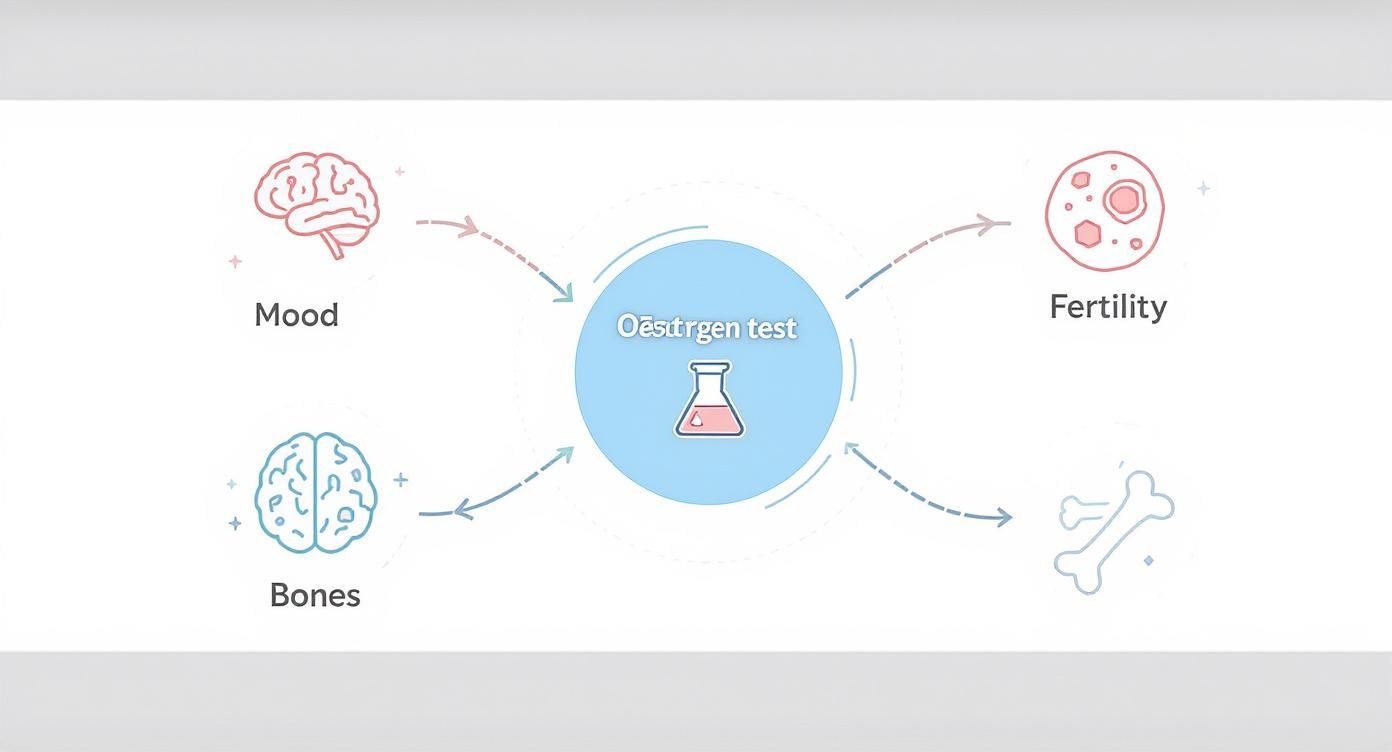
As you can see, this isn't just about periods and fertility. Oestrogen's reach extends to your mood, bone strength, and overall health, making it a powerful piece of data for your longevity toolkit.
The Three Main Types of Oestrogen and Their Functions
To get to grips with your results, you need to know who the main characters are. Your body calls on different types of oestrogen at different life stages, and their balance provides the context for action.
Let's meet the three main types.
| Type of Oestrogen | Primary Role | When It's Most Active |
|---|---|---|
| Oestradiol (E2) | The most powerful oestrogen, it regulates the menstrual cycle, supports fertility, and is a key protector of bone and heart health. | During your reproductive years (from puberty to perimenopause). |
| Oestrone (E1) | A weaker oestrogen that becomes the primary form after the reproductive years. Helps maintain tissues like skin and bones. | After menopause. |
| Oestriol (E3) | A very weak oestrogen that rises significantly only to support foetal growth and prepare the body for childbirth. | Exclusively during pregnancy. |
Each of these hormones tells a different story about your body's current state. By measuring them, an oestrogen test provides far more than a simple high or low number.
It reveals which hormonal 'keys' your body is currently using, offering a detailed blueprint for optimising your health strategy, whether you're focused on fertility, managing menopausal symptoms, or building a foundation for a longer, healthier life.
This level of detail is incredibly powerful. To see how this fits into the bigger picture of your hormonal health, it's worth exploring a comprehensive guide to the female hormone blood test. Understanding these nuances puts you in a much better position to have informed conversations with your doctor and take control of your long-term health.
Why Monitoring Oestrogen Is Key to Longevity
It’s one thing to learn about the different types of oestrogen, but it’s another to understand why you should monitor them for longevity. An oestrogen blood test isn't just a tool for troubleshooting immediate issues like irregular periods. It's a proactive step towards building a foundation for a longer, healthier life.
Think of balanced oestrogen as a quiet protector working behind the scenes. Its influence stretches far beyond reproduction, touching the very systems that define your healthspan - the number of years you live in good health. From keeping your bones strong to your mind sharp, stable oestrogen levels are fundamental.
A Cornerstone of Lifelong Wellness
An oestrogen blood test gives us important information for diagnosing and managing specific health conditions. It's a common step when investigating fertility, confirming perimenopause, or diagnosing conditions like Polycystic Ovary Syndrome (PCOS).
But its role in longevity is perhaps even more profound. By proactively monitoring your levels, you can catch subtle shifts long before they become bigger problems. This is about playing the long game with your health.
Tracking this key hormone gives you actionable insights into several pillars of longevity:
- Bone Density: Oestrogen is vital for maintaining strong bones. When levels drop, especially after menopause, bone loss can accelerate, leading to osteoporosis. Regular testing acts as an early warning system, giving you the data to protect your skeletal health.
- Cardiovascular Health: This hormone helps keep blood vessels flexible and positively affects cholesterol levels. Stable oestrogen is a significant advantage for your heart and circulatory system as you age.
- Cognitive Function: A growing body of research shows a clear link between balanced oestrogen and brain health. It supports memory and other cognitive functions, helping to keep your mind sharp for the long haul.
Beyond Women's Health: Oestrogen's Role in Men
While often seen as a "female" hormone, oestrogen is also important for men's health, just in smaller amounts. In men, oestradiol is essential for regulating libido, erectile function, and sperm production.
When this balance is off, it can cause significant issues. For men, tracking oestrogen can be just as important for longevity, ensuring that hormonal harmony is maintained for optimal healthspan.
Proactive hormone monitoring is a powerful strategy for anyone serious about optimising their long-term health. It shifts the focus from simply treating illness to actively cultivating wellness, giving you the data you need to build a more resilient body and mind.
Ultimately, an oestrogen blood test delivers more than just numbers. It gives you a deeper understanding of your body’s internal landscape, helping you to make informed decisions that support not just a longer life, but a more vibrant and healthy one.
How to Interpret Your Oestrogen Test Results
Getting your oestrogen results back is a great first step, but a page of numbers can feel baffling without context. Unlike a cholesterol reading, there’s no single "normal" number for oestrogen. What's optimal for you is a moving target, shifting with your age, sex, and for women, where you are in your monthly cycle.
Think of a single test result as one frame in a film. It gives you a vital snapshot, but it doesn't reveal the whole story. Real insight comes from spotting patterns over time, which is important for building a solid long-term health plan. Your results are your personal benchmark - a starting point for a deeper conversation about your health.
What Is a Normal Oestrogen Level
To figure out what's "normal," we look at specific reference ranges relevant to you. These ranges give your personal reading meaning.
- For Menstruating Women: Oestradiol levels follow a predictable rhythm. They are low at the start of your cycle (the follicular phase), surge to trigger ovulation, and then dip before your period. A reading of 50 pmol/L might be fine on day three but would be considered low on day thirteen.
- For Postmenopausal Women: After menopause, oestrogen levels settle at a much lower baseline - usually under 100 pmol/L. The goal here is ensuring levels are sufficient to protect bone and heart health without being unusually elevated.
- For Men: Healthy men need a small amount of oestradiol, typically between 40-115 pmol/L, to support everything from bone density to libido.
The best way to use your oestrogen blood test isn't to fixate on a single result. It's to track your levels over time. Consistent monitoring establishes your unique hormonal baseline, making it easier for you and your doctor to spot meaningful shifts that might affect your long-term wellbeing.
Understanding Variations and HRT
It’s important to know how much oestrogen levels can vary from person to person, especially for women in perimenopause or those using hormone replacement therapy (HRT).
For instance, a recent UK study at a menopause clinic found a massive range in oestradiol levels among women, from 55 pmol/L to over 2,000 pmol/L. This huge spectrum shows how much things like HRT dosage can influence results. You can explore the research on estradiol variability to better understand these individual differences.
This is precisely why a one-size-fits-all approach to hormones is obsolete. Your results are unique to you and provide the data needed for truly personalised care and longevity planning.
The Importance of Highly Sensitive Oestrogen Testing
You might think all oestrogen blood tests are the same, but the quality of the test can significantly impact your health decisions. The key factor is sensitivity.
Test sensitivity is its ability to accurately detect very small amounts of a hormone. This becomes critical when measuring oestrogen in people who naturally have low levels.
Most standard lab tests use a method called immunoassay. While common, it often struggles to give accurate readings at the lower end of the scale. For postmenopausal women or men, whose health depends on subtle oestrogen levels, this lack of precision can leave you flying blind.
Why Test Sensitivity Matters for Longevity
When a standard test encounters low oestrogen, it might report the level as "undetectable." This isn't just unhelpful; it creates a dangerous blind spot. Is your level just below the test's limit, or is it practically zero? This information is vital for making decisions about hormone replacement therapy or gauging your risk for conditions like osteoporosis.
This is a well-known scientific issue. A deep look at the UK Biobank study showed that common immunoassays failed to reliably detect oestradiol concentrations below 175 pmol/L. Considering the average level in the early follicular phase is around 150 pmol/L, this meant that roughly 20% of pre-menopausal women in the study had their levels incorrectly reported as undetectable. You can discover more about these oestradiol testing challenges in the original research.
Think of a highly sensitive oestrogen blood test as a high-resolution camera for your hormones. It captures the fine details that standard tests miss, giving you a much clearer and more accurate picture of what’s really going on inside.
For anyone serious about their long-term health and longevity, opting for a service that uses advanced, highly sensitive testing is non-negotiable. It ensures your health strategy is built on precise, reliable data. This is especially critical for:
- Postmenopausal Women: To accurately monitor very low oestrogen levels for managing symptoms and protecting bone and heart health.
- Men: To track the delicate balance of oestradiol, which plays a key role in libido, bone density, and cardiovascular wellness.
- Individuals on HRT: To fine-tune their treatment and ensure hormone levels stay within the optimal therapeutic window for maximum benefit and minimal risk.
in the end, better accuracy leads to better insights. And better insights help you to create more personalised, effective strategies for a longer, healthier life.
Where Personalised Hormone Health is Heading
The one-size-fits-all approach to wellness is obsolete. We are moving towards health strategies that are deeply individual, and advanced hormone testing is at the heart of this shift. The humble oestrogen blood test is evolving from a simple diagnostic tool into a powerful way to enhance your long-term health. It’s all about using precise data to make proactive decisions, rather than reacting to symptoms.
When we measure hormones with pinpoint accuracy, we reveal the ability to fine-tune our health strategies to our unique biology. This data-first approach means we can spot potential issues earlier and manage long-term health risks far more effectively—a huge leap forward in preventative medicine.
Data-Driven Preventative Care
We are already seeing incredible new uses for highly sensitive oestrogen tests in preventing serious health conditions. For instance, new research from Manchester University NHS Foundation Trust has shown how a sensitive oestradiol test can personalise breast cancer prevention for high-risk post-menopausal women.
The study revealed that around 25% of these women don't respond to a standard preventative drug because their oestrogen levels are already extremely low. By identifying these individuals beforehand, doctors can avoid prescribing a treatment that won't work and would only cause unnecessary side effects. You can read the full research about these findings to see how this is changing patient care.
A simple blood test is becoming the cornerstone of a proactive and personalised strategy for improving your long-term health outcomes. It provides the actionable data needed to build a resilient and healthier future.
This kind of precision puts you back in the driver's seat of your health. To learn more about making this a reality, check out our guide on hormone level testing at home. And because what you eat plays a massive role, exploring personalized nutrition plans can integrate another key piece of the puzzle for a long, healthy life.
Common Questions About Oestrogen Blood Tests
Understanding the practical side of an oestrogen test can make the whole process feel less daunting. Knowing what to expect ensures the process runs smoothly and your results provide an accurate picture for your long-term health planning. Let's walk through some of the most common questions.
Getting these practical steps right is just as important as reading the results—they are the foundation for reliable data.
When Should I Take the Test?
For an oestrogen blood test, timing is everything, especially if you have a menstrual cycle. Your hormone levels are constantly in flux, so testing on the right day is essential for a useful snapshot.
If you have a regular menstrual cycle, the best time to test is in the early follicular phase. This is usually between days two and five of your cycle, counting the first day of your period as day one. In this window, your oestrogen levels are at their lowest and most stable, giving us a clean baseline to work from.
If you are postmenopausal or a man, timing is far more flexible since your hormones don't follow a monthly pattern. However, consistency is still key. If you plan on re-testing to track changes, try to have the sample taken around the same time of day. Most importantly, always follow the specific guidance from your doctor or testing service.
Preparing for Your Oestrogen Test
A little prep work goes a long way in ensuring your results are a true reflection of your hormonal health, without temporary factors muddying the waters. The requirements are usually simple, but ignoring them can compromise the test's accuracy.
Here are a few key things to keep in mind:
- Fasting: If you're only testing oestrogen, you probably won't need to fast. However, oestrogen is often part of a wider blood panel that includes markers like glucose or cholesterol. If so, you'll likely need to fast for 8-12 hours before your sample is taken.
- Medications: Be completely transparent about any medications or supplements you're taking. Hormonal contraception, hormone replacement therapy (HRT), and even supplements like biotin can significantly impact your oestrogen levels.
- Consistency: If you’re using follow-up tests to monitor your health over time, try to keep the conditions the same for each test. That means testing at the same time of day and, if applicable, at the same point in your cycle. This consistency allows you and your doctor to spot real trends, not just one-off fluctuations.
An oestrogen blood test is a useful measure for understanding your body and planning for a longer, healthier life. At Lola, we’ve made the whole process straightforward and insightful. We offer at-home sample collection by a professional phlebotomist, analysis in accredited labs, and results delivered right to your app, complete with a doctor’s review. Taking control of your hormonal health has never been easier. Find out your baseline and start building your personalised health strategy today by visiting Lola Health.
At-Home Blood Testing
Check your levels from home
Professional phlebotomist visit. Doctor-reviewed results in 2-5 days. Track your health with comprehensive blood panels.
→45-70 biomarkers tested · Venous blood draw · From £130