


A testosterone blood test is a straightforward, useful resource for measuring a hormone that is fundamental to your long-term health. It's the most reliable first step to understanding if your levels are impacting your vitality today, but more importantly, it offers a predictive glimpse into your future health, providing a clear biological marker you can act upon to enhance your longevity.
Why Testosterone Levels Are a Cornerstone of Longevity
When most people hear "testosterone," they think of muscle mass and sex drive. While true, this view is incredibly shortsighted. Testosterone's influence runs much deeper, acting as a important regulator for how well you age and a key driver of your healthspan—the years you spend in good health.
Viewing testosterone through a longevity lens shifts the focus from merely treating current symptoms to proactively building a foundation for future vitality. Optimising your levels isn't just about feeling better now; it's a strategic investment in your health for the decades ahead.
Think of it this way: balanced testosterone is like a master key that reveals multiple pathways to a longer, healthier life. When your levels are optimal, the hormone supports critical bodily systems that are essential for fending off age-related decline.
The Pillars of Hormonal Health and Vitality
Maintaining optimal testosterone is directly linked to several key areas of longevity and well-being. By managing this one biomarker, you are taking actionable steps to protect your future self.
- Metabolic Function: Healthy testosterone levels are brilliant for helping regulate how your body uses insulin and for maintaining a healthy body composition. This is an actionable strategy to significantly lower your long-term risk of developing metabolic syndrome and type 2 diabetes.
- Cardiovascular Strength: The hormone plays a part in keeping your heart healthy, primarily by supporting the production of red blood cells and ensuring your blood vessels function properly. Managing your levels is a proactive measure for cardiovascular resilience.
- Cognitive Sharpness: A growing body of evidence connects balanced testosterone with better brain function, including memory and spatial skills. This can help guard against the cognitive decline that often comes with age, preserving your mental acuity for longer.
- Bone Density: Testosterone is absolutely essential for keeping your bones strong and dense. This is your best defence against osteoporosis and a practical way to reduce the risk of fractures as you get older.
This infographic helps to visualise how testosterone supports these core pillars of health and a long life.
As you can see, this isn't about one single function. Testosterone is deeply interconnected with the health of your brain, heart, bones, and even your energy at a cellular level.
A testosterone blood test, then, is far more than a simple tool for diagnosing current problems. It’s a predictive measure. It offers a window into your future health and gives you the data needed to build a personalised strategy to fend off age-related decline.
knowing your numbers puts you in control of your health trajectory. It shifts the focus from passively treating symptoms to actively building a thorough foundation for lasting health. This ensures you don't just live longer, but live better—a proactive approach that is central to extending your healthspan.
What a Testosterone Blood Test Actually Measures

When you get a testosterone blood test, it’s easy to focus on that one big number. But to get actionable longevity insights, you have to look deeper. The full picture is in the details, not just the headline figure.
Most basic tests will only give you a total testosterone reading. This is simply the grand total of every bit of testosterone floating around in your blood. It’s a decent starting point, but it fails to tell you what your body can actually use to protect your long-term health.
Think of it like this: your total testosterone is the total value of your financial assets, including those locked in a 30-year bond. What you really need to know is how much is liquid and available to use right now.
The Key Players: Total Testosterone and SHBG
In your bloodstream, a lot of your testosterone is bound to a protein called Sex Hormone-Binding Globulin (SHBG). You can think of SHBG as a transport vehicle that keeps testosterone locked up and inactive, preventing it from getting into your cells.
If your SHBG levels are high, a large chunk of your testosterone is effectively sidelined, even if your total level looks healthy on paper. This is a critical insight for longevity, as it means your body isn't getting the hormonal support it needs, but it's a detail that standard health checks often miss.
This is exactly why two people can have the same total testosterone level but feel completely different. One might have low SHBG, feel fantastic, and have plenty of 'active' testosterone to support long-term health. The other could have high SHBG, leaving them with fatigue and poor recovery because most of their testosterone is locked away.
A truly complete test, therefore, doesn't just count the total amount; it provides the data needed to understand how effective that testosterone really is for your healthspan.
Why Free Testosterone Is the Metric That Matters
This brings us to free testosterone—the number that truly correlates with your vitality and long-term well-being. This is the testosterone that isn't bound to SHBG and is "free" to enter your cells and do its job, whether that's building muscle, maintaining bone density, or supporting your brain function.
Free testosterone is the bioavailable hormone that powers your health. It typically makes up a tiny fraction of your total, usually just 1-4%, but it's the bit that directly impacts how you feel and function. A complete picture of your androgen levels hinges on this detailed breakdown.
For anyone serious about longevity, optimising free testosterone is the primary goal. Unfortunately, here in the UK, the NHS often focuses primarily on total testosterone for diagnosis. This approach can be a real limitation, sometimes overlooking cases where high SHBG is the underlying problem and delaying actionable strategies for people with clear symptoms.
By measuring total testosterone, SHBG, and free testosterone together, you get a clear, actionable insight into your hormonal health. This detailed view allows you to move beyond a single, often misleading number and make properly informed decisions for a longer, healthier life.
How to Prepare for Your Blood Test
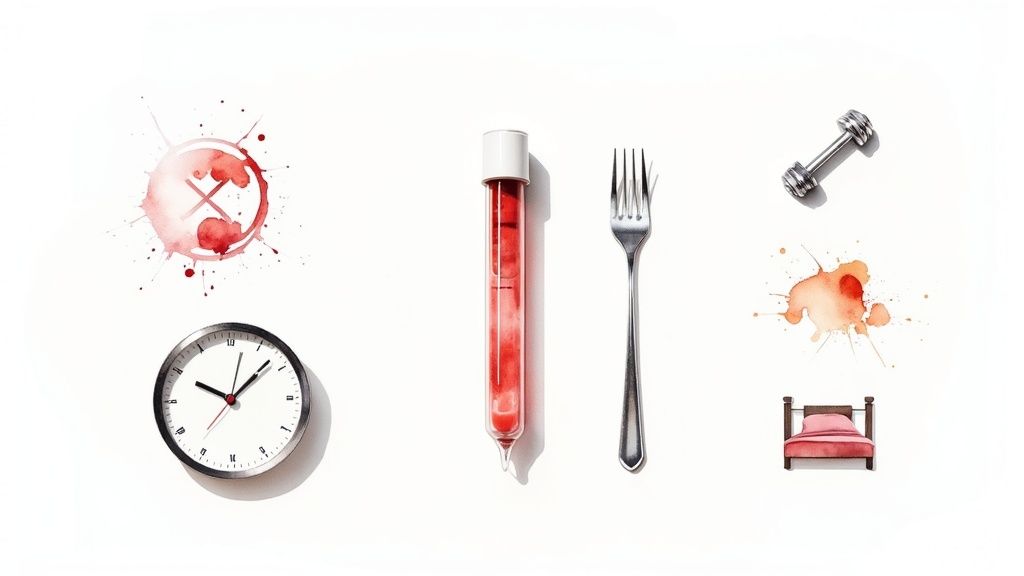
To get a truly accurate snapshot of your hormonal health, a little preparation goes a long way. The results of your testosterone blood test aren't set in stone; they can be influenced by your recent activities, sleep quality, and stress levels.
Think of it like getting your car's engine checked. You wouldn't test its performance right after racing it around a track. The same principle applies here. By controlling a few key variables in the 24 hours before your test, you ensure the results reflect your genuine hormonal baseline, not just a temporary fluctuation. Getting this right is a key first step in your longevity plan and avoids the need for re-testing.
A few simple, actionable steps will help guarantee your results are reliable and truly represent your body's natural rhythm.
Time Your Test for Peak Accuracy
Your testosterone levels have their own daily clock, a natural rhythm called a diurnal variation. They're at their highest in the early morning and gradually fall as the day goes on. This is why timing your test correctly is absolutely essential for actionable data.
For the most reliable and insightful results, always aim to have your blood drawn between 7 am and 10 am. If you test later in the day, your levels might appear artificially low, giving you a misleading picture and potentially delaying important health interventions.
Key Preparation Steps for Your Test
To make sure your results are as precise as possible, follow this simple checklist before your appointment. These steps are designed to eliminate common variables that can skew your testosterone readings.
- Avoid Strenuous Exercise: An intense workout, particularly heavy weightlifting, can cause temporary shifts in your hormone levels. It's best to take a rest day and avoid any strenuous physical activity for at least 24 hours before your test.
- Prioritise a Good Night's Sleep: A huge chunk of your testosterone production happens while you sleep. A poor night's sleep, getting less than seven hours, can cause your levels to drop temporarily. Aim for a full, restful night before your appointment.
- Stay Well Hydrated: Remember to drink plenty of water leading up to your test. Being properly hydrated not only makes the blood draw smoother but also ensures dehydration doesn't affect your results.
- Postpone if You're Unwell: Being ill or under significant mental stress raises cortisol, the body's main stress hormone, which can suppress testosterone. If you're sick or feeling unusually stressed, it's wise to reschedule your test for when you're feeling better to get a true baseline.
Taking these preparatory steps is not just about getting a number; it's about getting the right number. Accurate data is the foundation of any effective longevity strategy, ensuring you and your doctor make decisions based on a true reflection of your hormonal health.
While fasting isn't typically required for a standalone testosterone test, your doctor might ask you to if other biomarkers are being checked at the same time. For a more detailed guide on getting ready, you can learn more about how to prepare for phlebotomy in our dedicated article. By taking control of these factors, you’re setting yourself up to get the most reliable data possible to guide your health path.
How to Interpret Your Test Results
https://www.youtube.com/embed/qY6m7aR5w0s
Getting your testosterone results back is a key moment in your health path. It’s your first data-driven look at your internal hormonal environment, and understanding these numbers is the first step toward taking control of your long-term health.
The key is to differentiate between what's considered 'typical' and what's 'optimal'. Typical ranges, like those often used by the NHS, are based on the general population—a group that includes many people who are not in peak health. Optimal ranges are what we should be aiming for when vitality and a long, healthy life are the goals.
Reading Your Results Through a Longevity Lens
When you're focused on healthspan, even a result that falls within the 'normal' range can be an early warning signal. Think of it as a chance to make targeted changes now before small issues snowball into bigger health problems later on.
For instance, your total testosterone might be technically 'normal' but at the bottom of the range. This could be the hidden reason for persistent fatigue or sluggish recovery. Acting on this data early gives you the power to prevent a slow slide into poor metabolic health or cognitive decline down the line.
Your lab results aren't a final judgement—they're a roadmap. They provide actionable data to make smart, targeted adjustments to your lifestyle, diet, and fitness, steering your health towards a better future.
Understanding Key Biomarkers
A proper testosterone blood test will give you more than just one number. It breaks down several key markers that tell a cohesive story about your hormonal health.
Here’s a look at the key players and the ranges we’re interested in for men in the UK.
UK Testosterone Level Reference Ranges (nmol/L)
This table shows typical and optimal ranges for key markers in a testosterone blood test for adult men in the UK. Note that 'optimal' ranges are often sought for longevity and wellbeing, while 'typical' ranges represent the broader population.
| Biomarker | Typical Range (NHS) | Optimal Range (Longevity Focus) |
|---|---|---|
| Total Testosterone | 8.6 - 29.0 nmol/L | 15.0 - 25.0 nmol/L |
| Free Testosterone | > 0.25 nmol/L | 0.40 - 0.70 nmol/L |
| SHBG | 18.3 - 54.1 nmol/L | 20.0 - 40.0 nmol/L |
As you can see, understanding the interplay between these markers is essential. For example, a high Sex Hormone-Binding Globulin (SHBG) level can be a real problem. SHBG is like a taxi that picks up testosterone, and if too many taxis are on the road, they can lock up most of your supply. This leaves you with low 'free' testosterone, the kind your body can actually use, even if your total level looks perfectly fine.
This is a classic but often missed reason for low-T symptoms, and it’s exactly why a full panel is so vital for a longevity strategy. If you want to go deeper on this, our guide on how blood test results are explained in the UK is a great next step.
Interestingly, it seems where you live in the UK might even have an impact. A study looking at over 20,000 results found that men in London had the highest average testosterone at 17.2 nmol/L, while men in the North East had the lowest at 15.9 nmol/L.
This kind of variation suggests that things in our local environment, like exposure to endocrine-disrupting chemicals found in plastics and pesticides, could be influencing our hormone levels. It really hammers home the need to look at your own results in the context of your life and take proactive steps toward a healthier future.
So, You've Got Your Results. What Now?
Getting your testosterone results back is not the end of the process; it's the starting point for action. This number is your personal roadmap for building a thorough health strategy for the years ahead. Whether your levels are suboptimal or right where they should be, your next actions are what truly matter for your longevity.
Think of your results as a "you are here" marker on a map. They give you a clear starting point, helping you to plot a course toward a healthier, more vibrant future. The whole point is to use this insight to make smart, effective changes.
The Action Plan for Lower Testosterone
If your results are on the lower side of the optimal range, this is a clear signal to take control. The most effective method for improving your hormonal health are often the simplest, and they are entirely within your control.
Here are the key actionable areas to focus on:
- Fine-Tune Your Diet: Ensure you are getting plenty of micronutrients essential for testosterone production. Focus on zinc (oysters, beef, pumpkin seeds), magnesium (leafy greens, nuts), and vitamin D.
- Start Lifting: Resistance training is one of the best natural ways to support healthy testosterone. Focus on large, compound movements like squats, deadlifts, and bench presses a few times a week.
- Prioritise Sleep: Your body performs critical hormone production while you're asleep. Make 7-9 hours of quality, uninterrupted sleep a non-negotiable part of your health strategy.
- Manage Your Stress: Chronic stress elevates cortisol, a hormone that actively suppresses testosterone. Find an effective stress-management technique, meditation, deep breathing, or walking, and integrate it into your daily routine.
When to Bring in a Professional
If you've implemented these lifestyle changes and your levels are still not optimal, or if they were very low to begin with, it’s time to consult with a doctor. This conversation is your opportunity to discuss your symptoms, your test results, and your longevity goals.
This could lead to a discussion about options like Testosterone Replacement Therapy (TRT). A good doctor will walk you through all the potential benefits and risks, helping you make a decision that aligns with your long-term health plan.
Your testosterone results are a critical piece of the puzzle. They give you concrete data to have a meaningful conversation with an expert who can put it all into the context of your overall health.
The Strategy for Maintaining Optimal Levels
If your results came back in the optimal range, congratulations. Your job now shifts from fixing a problem to maintaining your health advantage for the long haul. The goal is to lock in your hormonal health, protecting your vitality for decades to come.
This means doubling down on the consistent habits that support your health. Continue with regular exercise, a nutrient-dense diet, and excellent sleep hygiene. It’s like protecting a valuable investment in your future self.
This proactive mindset is supported by major research. In the UK, large-scale projects like the UK Biobank, with data from over 500,000 people, are demonstrating the deep links between hormone levels and future health. This research highlights how knowing your testosterone levels can help predict long-term issues like cardiovascular disease and type 2 diabetes, reinforcing why it’s so important to know your numbers and keep them optimal. You can read more about these fascinating findings on the UK Biobank website.
At the end of the day, your results are a practical tool. Use them to build a strong foundation for a long, energetic life.
Got Questions About Testosterone Testing? We've Got Answers.
Even after you've got the basics down, it’s completely normal to have a few more questions. Deciding to get a testosterone blood test is a significant step toward taking charge of your long-term health, and the more you know, the better you can use the results to your advantage.
Here are some straightforward answers to the most common questions.
How Often Should I Get My Testosterone Levels Checked?
For men over 40 or anyone experiencing symptoms, a baseline test is an excellent first move. It provides a clear snapshot of your current hormonal status.
If your results are optimal, a re-test every two to five years is a solid proactive strategy to monitor your levels and stay ahead of any changes.
However, if you are actively working to improve your levels through lifestyle interventions or are on a treatment plan like TRT, more frequent monitoring is necessary. In that scenario, testing every three to six months is standard practice to track your progress and ensure your strategy is effective.
your testing schedule should be a personalised part of your longevity plan, tailored to your age, health goals, and medical history.
Can I Actually Raise My Testosterone Naturally?
Yes, absolutely. For many men, targeted lifestyle changes can have a real, measurable impact on hormone levels, translating directly into improved vitality and long-term health.
Your first blood test serves as your starting line. It gives you a concrete number to work from, allowing you to track the efficacy of your efforts. Consistency with these key habits is vital:
- Hit the weights: Regular resistance training is one of the most powerful natural tools you have.
- Eat smart: Ensure your diet includes plenty of zinc, vitamin D, and healthy fats.
- Prioritise sleep: Aim for seven to nine hours of quality sleep every night. It’s non-negotiable for healthy hormone production.
- Keep stress in check: Chronic stress is a known testosterone killer. Find healthy ways to manage it and cut back on excessive alcohol.
What Symptoms Should Make Me Consider a Testosterone Test?
The signs of low testosterone can be subtle, often creeping up so slowly that it’s easy to dismiss them as just "getting older." But they could be your body's early warning that something is off balance.
Be on the lookout for a constant feeling of tiredness that sleep doesn't fix, a noticeable dip in your libido, or frustrating 'brain fog' that makes it hard to focus. Other tell-tale signs include unexplained weight gain (especially around your middle), loss of muscle mass despite working out, or increased irritability.
If several of these resonate, a blood test is the most direct and actionable way to determine if a hormone imbalance is the root cause.
Are Those Home Testosterone Kits Reliable?
At-home, finger-prick kits can be a convenient first step to get a rough idea of your total testosterone levels. They can provide a starting point for your health investigation.
However, if your goal is true health optimisation and longevity, a more detailed picture is required. Nothing beats a full venous blood draw, which can be done at a clinic or by a visiting phlebotomist. This method provides a larger, higher-quality sample needed to accurately measure other significant biomarkers like free testosterone and SHBG. This detailed data is what allows you and your doctor to build a truly effective health strategy.
Ready to stop guessing and start knowing? With Lola, you can book a professional phlebotomist to collect your sample at home or in a clinic. You’ll get a full analysis reviewed by a doctor, giving you the clear, actionable insights you need to move forward.
Take the first step by visiting Lola Health's website today.
Test This Biomarker at Home
This biomarker is included in our Testosterone Test and Male Hormones Clarity 14 — results in 2-3 working days with GP-reviewed insights.
At-Home Blood Testing
Check your levels from home
Professional phlebotomist visit. Doctor-reviewed results in 2-5 days. Track your health with comprehensive blood panels.
→45-70 biomarkers tested · Venous blood draw · From £130