


Getting your blood test results back can feel like you’ve been handed a document in a foreign language. It's a jumble of acronyms, numbers, and ranges that don't mean much on their own. But the key to understanding blood test results in the UK is to stop seeing it as a confusing medical report and start seeing it for what it truly is: a personal blueprint for a longer, healthier life.
This report is a powerful snapshot of your current wellbeing, packed with vital clues that can help you steer your health in the right direction for the long haul.
Your Personal Health Blueprint: Understanding Blood Tests
Imagine your body is a high-performance engine. Like any complex piece of machinery, it needs a regular diagnostic check to keep it running smoothly for decades to come. A blood test is exactly that—an internal audit. It gives you a detailed, data-driven look under the bonnet, showing you precisely how your organs are functioning and flagging potential issues that could impact your lifespan.
When you learn to read this report, you’re no longer just a passenger on your health journey. You’re in the driver's seat. This shift is fundamental for longevity. Instead of waiting for a doctor to interpret the results for you, understanding them yourself empowers you to make informed, effective changes to your lifestyle. It turns a moment of potential anxiety into a source of real, actionable intelligence for a longer life.
From Numbers to Narratives
Every single marker on your blood test tells a piece of your personal health story. Your cholesterol levels, for example, aren't just abstract numbers; they tell a story about your diet, your genetics, and your long-term risk of heart disease. In the same way, your liver enzyme readings paint a clear picture of how well your body is coping with its daily load, a key factor in how well you age.
Seeing your results through this lens helps you connect the dots between your daily habits and their biological impact. The aim isn't just to check if a number is "in range," but to grasp what that number truly means for your longevity goals and how you can influence it.
Building a Foundation for a Longer Life
The real value in understanding your blood test results is how you can apply that knowledge to live a longer, healthier life. By spotting subtle imbalances or negative trends early on, you can make targeted lifestyle changes long before they snowball into age-related diseases. This proactive approach is what modern, preventative health is all about.
A blood test is more than a diagnostic tool; it's a strategic guide for longevity. It offers a clear map of your internal terrain, showing you exactly where to focus your efforts—whether that’s diet, exercise, stress management, or sleep—to build a more resilient and longer-lasting foundation for your health.
This guide is designed to demystify the entire process. We’ll break down the key markers and explain how they directly impact your healthspan and lifespan. Together, we'll explore how to use this information to:
- Identify Early Warnings: Learn to spot the subtle shifts in biomarkers that can signal future health risks, often years before any symptoms appear.
- Personalise Your Lifestyle for Longevity: Use your unique data to fine-tune your nutrition and fitness plans, ensuring you’re doing what works best for your body to extend its healthspan.
- Track Your Progress: Objectively measure the impact of the changes you're making, which is fantastic for motivation and for ensuring your longevity strategy is working.
Ultimately, getting to grips with your blood test results is the first, most crucial step toward taking control of your health and actively building a longer, healthier future.
The Four Pillars of UK Blood Panels: Your Core Health Blueprint
Think of your body as a high-performance car. To keep it running smoothly for the long haul, you can't just wait for the engine to start smoking. You need regular, targeted diagnostics. In the UK, four core blood panels act as these essential checks, forming the very foundation of preventative health and giving us a real insight into our longevity potential.
These four pillars are the Full Blood Count (FBC), the Kidney Function test, the Liver Function Test (LFT), and the Lipid Panel.
Getting to grips with what these panels actually measure is empowering. It means you stop being a passenger on your health journey and start being the one in the driver's seat. Suddenly, you can spot subtle imbalances long before they turn into serious problems, giving you a crucial window for early, effective action. This proactive approach is exactly what optimising your healthspan is all about.
The infographic below breaks down how you can turn that raw data from your blood test report into meaningful, practical steps for longevity.

As you can see, your results are more than just numbers. They’re a snapshot of your current health, offering vital clues for where to focus your attention and forming the basis of a solid action plan for a healthier, longer life.
The Full Blood Count (FBC): Your Body's Internal Census
The Full Blood Count, or FBC, is one of the most frequently ordered blood tests in the UK, and for good reason. It’s essentially a headcount of the cells floating around in your bloodstream—your red blood cells, white blood cells, and platelets. From a longevity standpoint, the FBC gives us a clear picture of your body's ability to transport oxygen, fight off infections, and heal itself—all critical processes for healthy ageing.
A few key markers to watch for longevity:
- Haemoglobin (Hb): This is the protein inside your red blood cells that does the heavy lifting of carrying oxygen from your lungs to every other part of your body. Low levels indicate poor oxygenation, which can accelerate cellular ageing and leave you feeling fatigued, directly impacting your quality of life.
- White Blood Cells (WBC): Think of these as the soldiers of your immune system. An FBC measures the total number of these cells and can even break them down into different types. Numbers that are consistently too high or too low could signal underlying infection or chronic inflammation—a key driver of ageing that needs to be addressed for long-term resilience.
- Platelets: These tiny cell fragments are your first responders for injuries, rushing to the scene to help your blood clot. Monitoring their levels is crucial for understanding how well your body can repair itself, a fundamental aspect of staying healthy for longer.
Kidney and Liver Function: Your Body's Powerhouse Filters
Your liver and kidneys are your body's master detoxification and filtration plants, working tirelessly behind the scenes. For a long and healthy life, keeping them in top condition is non-negotiable. Liver Function Tests (LFTs) and Kidney Function tests give us a direct look at how well these vital organs are handling their workload, which is a key indicator of biological age.
For example, LFTs measure enzymes like Alanine Aminotransferase (ALT) and Alkaline Phosphatase (ALP). When these are elevated, it can suggest the liver is under stress or has sustained some damage. This is an early warning that gives you a chance to make lifestyle changes—like reducing alcohol, improving diet, or managing weight—to protect this critical organ and slow down age-related decline.
Kidney tests work in a similar way, looking at markers like Creatinine and eGFR (estimated Glomerular Filtration Rate) to see how effectively your kidneys are clearing waste products from your blood. Preserving kidney function is a cornerstone of longevity.
Think of these tests as an early warning system. They don't just tell you if something is wrong right now; they highlight trends that could affect your health a decade from now, giving you the power to change course and enhance your healthspan.
For a deeper dive into the markers that give a broader view of your body's internal systems, you can learn more about what is included in a comprehensive metabolic panel. Understanding these tests is fundamental to making sense of your UK blood test results and building a complete picture of your metabolic health.
The Lipid Panel: A Glimpse Into Your Cardiovascular Future
Last but certainly not least, the Lipid Panel measures the fats and fatty substances, like cholesterol and triglycerides, that your body uses for energy. When these levels are out of balance, they become a major risk factor for cardiovascular disease, a leading cause of premature mortality in the UK.
This panel gives you a direct look at your personal risk profile by measuring:
- Total Cholesterol: The overall amount of cholesterol in your blood.
- LDL Cholesterol: Often called the "bad" cholesterol, as high levels can lead to the build-up of fatty plaques in your arteries (atherosclerosis).
- HDL Cholesterol: Known as the "good" cholesterol because it helps ferry excess cholesterol out of your system, protecting your arteries.
- Triglycerides: Another type of fat in your blood that, when high, indicates poor metabolic health and is a key driver of heart disease.
Interpreting these results isn't just about dodging disease—it’s about actively optimising your cardiovascular system so it performs at its best, well into your later years. This is a core strategy for extending your life.
Common UK Reference Ranges for Core Health Panels
To help you make sense of your own results, here’s a quick-reference table showing the typical UK reference ranges for some of the key biomarkers we've discussed. Keep in mind that for longevity, the goal is often to be in the optimal part of this range, not just within the 'normal' limits.
| Biomarker | Test Panel | Typical UK Reference Range | Longevity Significance |
|---|---|---|---|
| Haemoglobin (Hb) | Full Blood Count | 130–170 g/L (Men), 120–150 g/L (Women) | Key to oxygen transport, energy, and cellular health. |
| White Cell Count | Full Blood Count | 4.0–11.0 x10^9/L | Reflects immune health and chronic inflammation levels. |
| Platelets | Full Blood Count | 150–450 x10^9/L | Indicates blood clotting and the body's repair capability. |
| ALT | Liver Function | < 40 IU/L | A primary marker for liver health and detoxification capacity. |
| Creatinine | Kidney Function | 60–120 µmol/L | Shows how well kidneys are filtering waste, crucial for ageing. |
| eGFR | Kidney Function | > 60 mL/min/1.73m² | Estimates overall kidney filtration capacity and biological age. |
| Total Cholesterol | Lipid Panel | < 5.0 mmol/L | Overall cardiovascular risk indicator. |
| LDL Cholesterol | Lipid Panel | < 3.0 mmol/L | "Bad" cholesterol linked to arterial plaque and heart disease. |
| HDL Cholesterol | Lipid Panel | > 1.0 mmol/L (Men), > 1.2 mmol/L (Women) | "Good" cholesterol that protects your arteries. |
| Triglycerides | Lipid Panel | < 1.7 mmol/L | A key marker of metabolic health and cardiovascular risk. |
This table provides the context you need to begin interpreting your report, helping you see where you stand and what conversations you might need to have with your healthcare provider to optimise your long-term health.
Advanced Health Markers for Optimizing Longevity
Once you've got a handle on the basic blood panels, you can start digging into the next layer of biomarkers. This is where things get really interesting for anyone serious about living a long, vibrant life. Think of these advanced markers as high-definition cameras, revealing the subtle, day-to-day processes in your body that are central to how well you age.
By getting to grips with these UK blood test results, you can shift from simply reacting to health problems to proactively optimising your biology for the years ahead. These are actionable clues that tell a detailed story about your metabolic health, hidden inflammation, and hormonal balance—all pillars of longevity.
Let's break down four key markers that give you a real insight into your longevity potential.
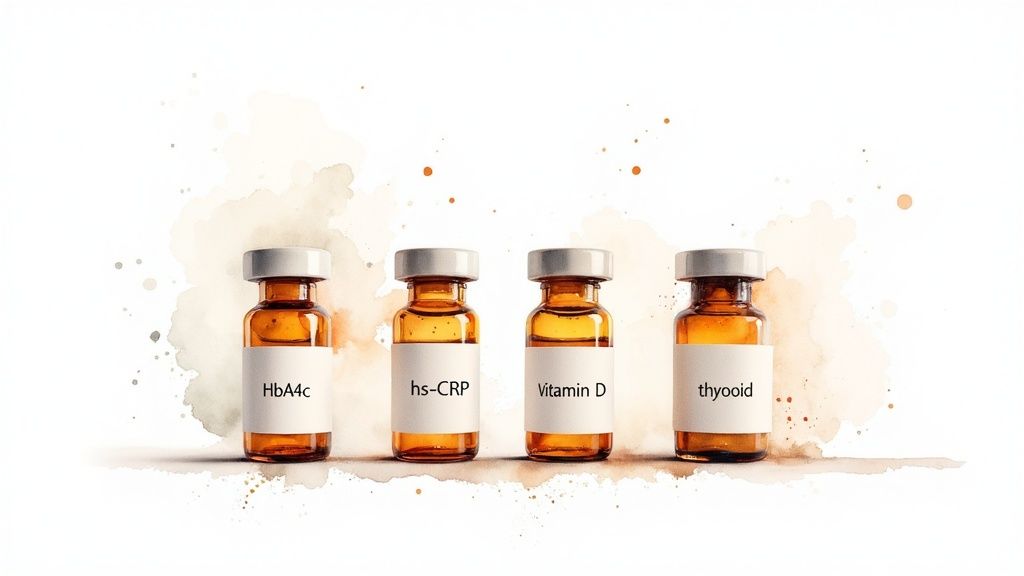
HbA1c: The Three-Month Sugar Report
A standard glucose test is like a single photo of your blood sugar – it only tells you what’s happening in that one moment. HbA1c, or glycated haemoglobin, is completely different. It’s more like watching a highlight reel of the last three months, giving you the average picture of your blood sugar control over the past 90 days.
Why does this matter so much for longevity? Persistently high blood sugar speeds up the ageing process through something called glycation. This is where excess sugar molecules damage proteins and fats, creating harmful compounds that stiffen tissues, fuel inflammation, and accelerate ageing.
An optimal HbA1c level is a cornerstone of metabolic health and longevity. Keeping it in the ideal range isn't just about preventing diabetes; it's about protecting your cells, blood vessels, and organs from the cumulative damage that shortens healthspan.
Actionable Insight: To lower your HbA1c, focus on a whole-food diet, time your carbohydrate intake around exercise, and ensure you get a 10-15 minute walk after meals. These actions directly improve your body's glucose management.
hs-CRP: Uncovering Hidden Inflammation
We all know about inflammation when we get a cut or a bug – it’s the body’s essential short-term defence force. But when that response smoulders away at a low level all the time ("inflammageing"), it becomes a silent threat, quietly contributing to almost every major age-related disease, from heart conditions to neurodegeneration.
This is where the high-sensitivity C-reactive protein (hs-CRP) test is so valuable. It’s designed to pick up minuscule levels of this body-wide inflammation, giving you a window into this otherwise hidden process. A low hs-CRP is a strong indicator of a body that is ageing well.
Knowing your number empowers you to take direct action. To lower chronic inflammation for longevity, you can:
- Eat an anti-inflammatory diet: Prioritise oily fish (omega-3s), colourful fruits and vegetables (antioxidants), and fibre.
- Optimise sleep: Quality sleep is crucial for keeping your body’s inflammatory response in check.
- Manage stress: Chronic stress is a huge driver of inflammation. Practices like mindfulness, yoga, or even deep breathing exercises can make a measurable difference to your hs-CRP level.
Vitamin D: The Immune and Bone Guardian
Often called the "sunshine vitamin," Vitamin D actually behaves more like a powerful hormone, influencing hundreds of processes critical for healthy ageing. We know it's essential for absorbing calcium and keeping our bones strong, but its role in longevity is much bigger than that.
Vitamin D is a master modulator of the immune system. Optimal levels help you fight off infections effectively but also prevent your immune system from overreacting, which can lead to autoimmune issues and chronic inflammation. Here in the UK, deficiency is incredibly common, compromising a key system for long-term health.
Actionable Insight: A blood test is the only way to know your Vitamin D status. If levels are low, targeted supplementation (especially during autumn and winter) is a simple and highly effective action to bolster your immune resilience and support long-term health.
Key Thyroid Hormones: Your Metabolic Thermostat
Tucked away in your neck is the thyroid, a small, butterfly-shaped gland that acts as the master regulator of your metabolism. It produces hormones, mainly Thyroxine (T4) and Triiodothyronine (T3), which dictate the speed at which every cell in your body burns energy.
If your thyroid is underactive (hypothyroidism), your entire system can slow down, impacting energy, weight, and cognitive function. An overactive thyroid (hyperthyroidism) can send your body into overdrive. A sub-optimal thyroid function can significantly impair your quality of life and long-term health.
Actionable Insight: A full thyroid panel testing for Thyroid-Stimulating Hormone (TSH), Free T4, and Free T3 gives you a complete picture. Catching and correcting an imbalance early—often through nutrition, stress management, and medication if needed—can have a massive impact on your energy, mental clarity, and metabolic health, providing a stronger foundation for a long life. Our guide on understanding liver function test results also explores how interconnected these systems are, as the liver is vital for converting thyroid hormones into their active form.
Decoding Your Cholesterol for Peak Heart Health
When you get your blood test results back, the lipid panel – the section on cholesterol – is one of the most important parts for understanding and improving your long-term health. It’s easy to fall back on the old "good vs. bad" cholesterol story, but to take real action for longevity, you need to look a little deeper.
Think of your bloodstream as a busy motorway. Cholesterol and other fats can't just float around on their own; they need to be packaged into transport vehicles called lipoproteins. Your blood test is a traffic report, counting these different vehicles and telling you how they're affecting your cardiovascular health.

The Key Players in Your Lipid Panel
So, what are these different vehicles? Your report will list several key markers, and knowing their roles is the first step to taking control and improving them.
- Low-Density Lipoprotein (LDL): Often called the "bad" cholesterol, LDL’s job is to deliver cholesterol to your cells. The problem arises when there’s too much of it, as it can build up in your artery walls, creating plaque that narrows and hardens them over time.
- High-Density Lipoprotein (HDL): This is your "good" cholesterol, and it acts like a fleet of cleanup trucks. HDL’s role is to cruise through your arteries, pick up excess cholesterol, and carry it back to the liver for disposal. Higher HDL levels are protective.
- Triglycerides: These are a type of fat your body uses for energy. High levels are a strong indicator of poor metabolic health and significantly increase your risk of heart disease, often more so than LDL alone.
The importance of tracking these numbers in the UK can't be overstated. Data from over 24,000 UK blood tests show just how much our cholesterol is influenced by things like age, menopause, and lifestyle choices. This kind of information is what helps us move towards truly personalised health advice.
Why Ratios Tell a Deeper Story
Here’s where it gets interesting for longevity. Focusing on a single number can be seriously misleading. For instance, you might have a "high" total cholesterol result, but if your protective HDL is also very high, your actual risk could be much lower than someone with "normal" total cholesterol but rock-bottom HDL.
This is why ratios are so powerful.
The ratio of your Triglycerides to HDL (TG:HDL ratio) is a potent predictor of heart disease risk and insulin resistance. A lower ratio is what you’re aiming for, as it suggests you have fewer harmful particles and good metabolic health—a key goal for longevity.
Many longevity experts now believe this ratio is a more accurate predictor of future cardiovascular events than LDL alone. It gives you a much more complete picture of what's really going on inside your body. For a detailed breakdown of what the numbers mean, our guide to the UK cholesterol level chart is a great reference.
Actionable Longevity Insights
Your lipid panel isn't just a set of numbers; it's a direct call to action. The great news is that these markers are incredibly responsive to lifestyle changes, giving you a powerful way to improve your future health.
Improving your cholesterol profile is one of the best things you can do to protect your heart for the long haul. Here’s where to start:
- Prioritise Healthy Fats: It's about the type of fat, not just the amount. Swap saturated and trans fats for monounsaturated fats (olive oil, avocados) and polyunsaturated fats, especially omega-3s from oily fish, which directly lower triglycerides.
- Boost Soluble Fibre: Foods like oats, barley, beans, and apples are packed with soluble fibre. It works by binding to cholesterol in your gut and helping to escort it out of your body. A simple but highly effective daily habit.
- Incorporate Regular Movement: Physical activity is a proven winner for heart health. A mix of aerobic exercise (brisk walking, cycling) and resistance training is fantastic for raising your protective HDL and lowering triglycerides.
By learning to decode these results and taking targeted action, you can turn your lipid panel from a source of worry into a powerful tool for building a foundation of life-long heart health.
Turning Your Blood Test Results Into Action
So, you’ve got your results. You’ve waded through the markers, the reference ranges, and the clinical terms. But what happens next? Knowledge is only powerful when you use it, and the real value of a blood test for longevity is turning those numbers into meaningful, positive change.
Think of your results not as a final judgement, but as a personal feedback report. It’s the data you need to start fine-tuning your diet, lifestyle, and fitness routine to specifically target the biological processes of ageing.
How to Have a Productive Chat with Your GP
Your blood test report is the perfect starting point for a focused conversation with your GP or healthcare professional. To get the most out of your appointment, a little preparation goes a long way. Instead of simply asking, "Are my results normal?", you want to dig deeper into optimisation for longevity.
Before you go, take a few minutes to review your report. Highlight any markers that are outside the optimal range or that you have questions about.
Here are a few questions you can ask to get genuinely actionable advice:
- "This marker is technically in the 'normal' range, but is it truly optimal for my long-term health and longevity?"
- "Based on these results, what are the top one or two lifestyle changes that would have the biggest impact on my long-term health?"
- "Could we re-test this in three to six months? I’d like to track how the changes I'm making are affecting my biomarkers."
- "Are there any other related tests we should consider to get a fuller picture of my cardiovascular or metabolic health?"
This simple shift in approach turns a passive check-up into an active strategy session for your future health.
From Data to Daily Habits: Practical Action Plans
The true power of understanding blood test results in the UK is using them as a launchpad for specific, targeted actions. Let’s walk through a common example of how a single result can translate into a clear longevity plan.
Example: Your HbA1c is Borderline
A borderline HbA1c result is an early warning light for your metabolic health. It's your body's way of telling you it's starting to struggle with blood sugar control, a key driver of ageing. Here are three simple, proven strategies you can put into practice straight away:
- Time Your Carbs: Avoid eating carbohydrates on their own. Pairing them with a source of protein, fat, or fibre—like adding a scoop of nuts to your morning porridge—blunts the glucose spike and improves metabolic response.
- Walk After You Eat: A brisk 10-15 minute walk after your largest meal of the day can do wonders for your body’s glucose control and insulin sensitivity. It’s a small habit with a huge impact on your metabolic future.
- Prioritise Your Sleep: Never underestimate the power of a good night's rest. Consistently poor sleep can play havoc with blood sugar regulation. Aiming for 7-8 hours of quality sleep is one of the most effective actions you can take for your long-term metabolic health.
Action isn’t about overhauling your entire life overnight. It’s about making small, consistent, data-driven adjustments. Your blood test results provide the 'why,' and these simple strategies provide the 'how' to add healthy years to your life.
Tracking Your Biomarkers Over Time
A single blood test is just a snapshot in time. The real magic for longevity happens when you start tracking your biomarkers over multiple tests, turning those snapshots into a moving picture of your health. Are your inflammatory markers slowly creeping up? Is your Vitamin D level staying consistently in the optimal zone?
By monitoring these trends, you can:
- Celebrate Your Wins: Seeing your cholesterol numbers improve after three months of consistent effort is incredibly motivating and proves your longevity strategy is working.
- Spot Negative Trends Early: You can catch a gradual decline in kidney function or a slow rise in blood sugar long before it becomes a clinical problem, giving you a crucial window to intervene.
- Personalise Your Approach: Over time, you’ll learn exactly what works for your body. If adding more oily fish to your diet dramatically lowers your triglycerides, you know that’s a high-impact habit worth keeping for life.
Your blood test results are your personal health dashboard. Use them to make informed decisions, track your progress, and take confident, effective action towards a longer, healthier life.
Your Top Questions Answered: UK Blood Tests and Longevity
Once you start digging into your own health data, it's only natural for questions to pop up. The world of blood tests can seem a bit intimidating at first, but getting clear, straight-up answers is the key to using this knowledge to live a longer, healthier life.
Let's walk through some of the most common questions we get asked about blood test results here in the UK, especially when the goal is longevity.
How Often Should I Really Be Getting a Blood Test?
If you're serious about proactive health and longevity, you need to think beyond the standard 'test-when-you're-sick' model. While the NHS is fantastic for dealing with immediate health problems, a truly preventative approach calls for a more regular rhythm.
For most healthy adults focused on longevity, a comprehensive blood panel at least once a year is a great starting point. This annual check-in helps you establish your personal baseline and lets you see subtle changes over time, long before they could ever become a real issue.
However, if you're actively working to improve a specific marker, like cholesterol or vitamin D, testing more often—say, every 3-6 months—provides the crucial feedback you need to see if your new lifestyle strategies are working.
"Normal" vs "Optimal" – What's the Big Deal?
This is probably the single most important idea to get your head around when it comes to longevity. The standard 'normal' range you see on a lab report is worlds away from an 'optimal' range for peak health.
A 'normal' range is just an average, calculated from a huge pool of the general public, which includes people who are already unwell. So, being 'in the normal range' just means you're average, not that you're in fantastic health for your age.
An 'optimal' range, however, is a much tighter target. It’s the range associated with the lowest possible risk of future disease and the highest level of wellness.
For instance, a 'normal' Vitamin D level will stop you from getting rickets, but an 'optimal' level is what you need for a powerful immune system and lower inflammation. Chasing optimal ranges is the mindset shift that takes you from just avoiding sickness to actively building a long and vibrant life.
Can My Lifestyle Choices Really Change My Blood Test Results?
Without a doubt. Your blood test results aren't set in stone. Think of them as a dynamic snapshot of your recent habits, and you absolutely have the power to change the picture. This is the foundation of actionable longevity.
The impact of simple lifestyle tweaks can be surprisingly fast and powerful. Here are just a few examples:
- Food Swaps: Just by switching from saturated fats to the healthy omega-3s found in oily fish, you can see a real drop in your triglycerides and a better cholesterol ratio in a matter of months.
- Getting Moving: Regular cardio exercise is one of the best tools we have for boosting our protective HDL ("good") cholesterol, a massive win for long-term heart health.
- De-Stressing: Chronic stress sends your cortisol and inflammation markers (like hs-CRP) through the roof. Bringing a bit of mindfulness or meditation into your day can bring these numbers down, literally calming your body from the inside out and slowing a key ageing process.
Your blood tests are the ultimate feedback loop. They tell you what's working and where you might need to try a different approach, putting you firmly in the driver's seat of your long-term health.
Take the guesswork out of your health journey with Lola. We provide comprehensive, at-home blood testing with professional analysis, giving you the clear, actionable insights you need to optimise your health for longevity. Get your personalised health blueprint today at https://lolahealth.com.