


An Antinuclear Antibody (ANA) blood test is a highly sensitive screening tool designed to spot autoantibodies—proteins your immune system mistakenly creates to attack your own body's tissues. Traditionally used to investigate autoimmune diseases, the ANA test is now a useful measure for longevity, offering actionable insights into your immune system's health. Understanding this biomarker can help you get ahead of low-grade inflammation and cellular stress, optimising your healthspan for the long term.
What an ANA Blood Test Reveals About Your Health

Think of your immune system as a sophisticated security team, trained to distinguish between "self" (your own cells) and "other" (invaders like viruses). An ANA test checks if this team is becoming confused, a process known as autoimmunity. For those focused on longevity, this isn't about waiting for a diagnosis; it’s about getting a baseline read on your immune system's behaviour and its potential impact on ageing and performance.
Nagging symptoms like chronic fatigue, brain fog, slow recovery, or unexplained joint aches are often the earliest signs of low-grade inflammation, which can accelerate ageing. An ANA test can provide a important clue, helping you understand if an underlying immune imbalance is contributing to these issues and hindering your long-term health goals.
A Shift to Proactive Wellness
In the past, an ANA test was reserved for when symptoms became severe. The modern approach to longevity flips this script. Why wait for problems to escalate? By monitoring key biomarkers like ANA, you can gain early warnings about your body's internal environment and take steps to maintain resilience. An ana blood test is a vital piece of data in a proactive longevity strategy.
It provides personal health intelligence that help you to ask smarter questions:
- Is my persistent fatigue linked to an immune system imbalance?
- Could low-grade inflammation be the real cause of my joint soreness?
- Are hidden immune stressors affecting my body's ability to repair and regenerate?
By catching subtle autoimmune signals early, you can move from reactive symptom management to proactive health optimisation. It’s about building a more resilient, high-performing body to extend your healthspan, not just your lifespan.
Making Advanced Insights Accessible
This shift towards proactive health is enabled by convenience. You no longer need to wait weeks for a GP referral to investigate a concern. Modern at-home phlebotomy services allow a professional to draw your blood sample at your home or office. The sample is processed in a UKAS-accredited lab, ensuring clinical-grade accuracy. If you want to look more closely at what the numbers mean, our guide on how to get blood test results explained in the UK is a great place to start.
When results are delivered via an easy-to-use app with a doctor's review, complex data becomes a clear, actionable starting point. This single test can provide the initial clue you need to take control, guiding smarter decisions about lifestyle, nutrition, and training to build a solid foundation for a long and healthy life.
Making Sense of Your ANA Titer and Pattern
Receiving your ANA blood test results can feel complex, but understanding the two key components, the titer and the pattern, provides a clear window into your immune system's current state. This knowledge is essential for anyone looking to fine-tune their health for longevity. Let's break down what these results mean for you.
What Is an ANA Titer?
The ANA titer measures the concentration of autoantibodies in your blood, essentially gauging the "volume" of your body's autoimmune signal. It’s written as a ratio, like 1:80. A higher second number indicates a stronger antibody presence.
A low titer might be a temporary blip caused by intense training, a recent viral infection, or high stress—all common factors for high-performers. A consistently high titer, such as 1:160 or 1:320, suggests a more persistent immune response that warrants attention as part of a long-term health strategy. It’s an opportunity to investigate and address underlying factors before they become more significant.
A positive ANA test isn't an immediate cause for alarm. It's a data point. When tracked over time and viewed alongside your overall health, it helps build a clearer picture of your immune function and guides your longevity plan.
Your ANA titer is a powerful biomarker, especially when you monitor it over time. The table below helps you understand what different titer levels could mean in a UK context.
Interpreting ANA Titers: What Your Result Could Mean
| ANA Titer Level | Common Interpretation | Likelihood in Healthy UK Adults | Potential Next Steps |
|---|---|---|---|
| Negative | No significant antinuclear antibodies detected. | Around 70-80% of the population. | No further action is usually needed unless symptoms persist. |
| 1:40 | Very low positive, often considered borderline. | Can be found in up to 20-30% of healthy individuals. | Monitor symptoms; re-testing may be suggested later. |
| 1:80 | Low positive. | Found in about 10-15% of healthy people. | May warrant further investigation if symptoms are present. |
| 1:160 | Moderate positive. | Less common in healthy adults (approx. 5%). | More likely to be clinically significant; further tests are often recommended. |
| ≥ 1:320 | High positive. | Rare in healthy individuals (approx. 3%). | Strongly suggests an autoimmune process; specific antibody tests are usually next. |
This table is a guide; your doctor will interpret these results based on your individual health profile and longevity goals.
The Significance of ANA Patterns
If the titer tells you "how much," the ANA pattern tells you "what." This describes the visual pattern the antibodies create under a microscope. Different patterns are linked to different autoantibodies, offering clues about which part of the cell nucleus the immune system might be targeting. For longevity, this detail helps refine your strategy for managing immune health.
Common patterns include:
-
Homogeneous Pattern: A smooth, even stain across the cell nucleus, often associated with systemic lupus erythematosus (SLE) and drug-induced lupus.
-
Speckled Pattern: Small, bright dots scattered throughout the nucleus, linked to a wide range of conditions like Sjögren's syndrome and lupus.
-
Centromere Pattern: Distinct, separate speckles strongly associated with a specific form of systemic sclerosis (CREST syndrome).
-
Nucleolar Pattern: Staining focused on the nucleolus (inside the nucleus), often linked to systemic sclerosis (scleroderma).
Understanding your pattern helps your doctor decide on next steps, such as ordering more specific tests to fine-tune your health plan.
In the UK, the ANA test is highly sensitive, meaning it can flag positives in healthy people. For example, 20-30% of healthy adults may show a positive result at a 1:40 dilution, dropping to just 3% at 1:320. This highlights why a positive result is a starting point for investigation, not a final answer. For a deeper dive, the NHS Scotland guidelines on when to check anti-nuclear antibodies are a great resource.
Why a Positive ANA Test Isn’t a Final Diagnosis
Seeing a "positive" result on an ANA test can be unsettling, but it is important to view it as a piece of intelligence, not a verdict. Think of it as an invitation for a deeper conversation about your health and a chance to optimise your long-term wellness strategy. It is just one data point in your larger health picture.
For high-performers, a positive ANA blood test can sometimes stem from the unique stresses placed on the body. Recognising this helps you avoid unnecessary worry and take measured, strategic next steps to support your longevity.
Understanding Benign Positives
A positive ANA test simply means antinuclear antibodies are present. It doesn't tell us why. Many healthy people have a low-level positive ANA and never develop an autoimmune condition. Several factors can trigger a temporary rise in ANA levels.
Common triggers for a fleeting positive ANA include:
- Recent Viral Infections: Fighting off an illness can sometimes produce these antibodies as a side effect.
- Certain Medications: Some prescription drugs can induce a positive ANA, which often resolves once the medication is stopped.
- Intense Physical Stress: The strain of elite training can create low-grade inflammation, potentially leading to a temporary positive result.
- The Natural Ageing Process: Immune system precision can decline with age, making autoantibody production more common.
A positive ANA is a reason to investigate, not to panic. It prompts a critical question: is this a temporary blip related to your lifestyle, or is it a persistent signal that needs closer attention for your long-term health?
The Critical Role of Clinical Correlation
Clinical correlation is essential. A doctor will never interpret a lab report in isolation. They will connect the result with your specific symptoms, lifestyle, medical history, and physical examination to build a complete picture.
A positive test in someone with fatigue and joint pain means something different from the same result in a high-performing athlete who feels fine. This context is key to turning data into actionable longevity insights.
The numbers support this. In the healthy UK population, 3-15% of people may have a positive ANA, rising to 10-37% in those over 65. A low-positive result (up to 1:160) often doesn't indicate disease on its own. Only about 11-13% of individuals with any positive ANA are eventually diagnosed with lupus. Contextualising your result, like understanding that SLE affects 12-28 per 100,000 people in the UK, helps manage perspective. For more detail, you can explore the NHS guidelines for ANA testing in the UK.
This chart helps visualise how the importance of an ANA result scales with the titre level.
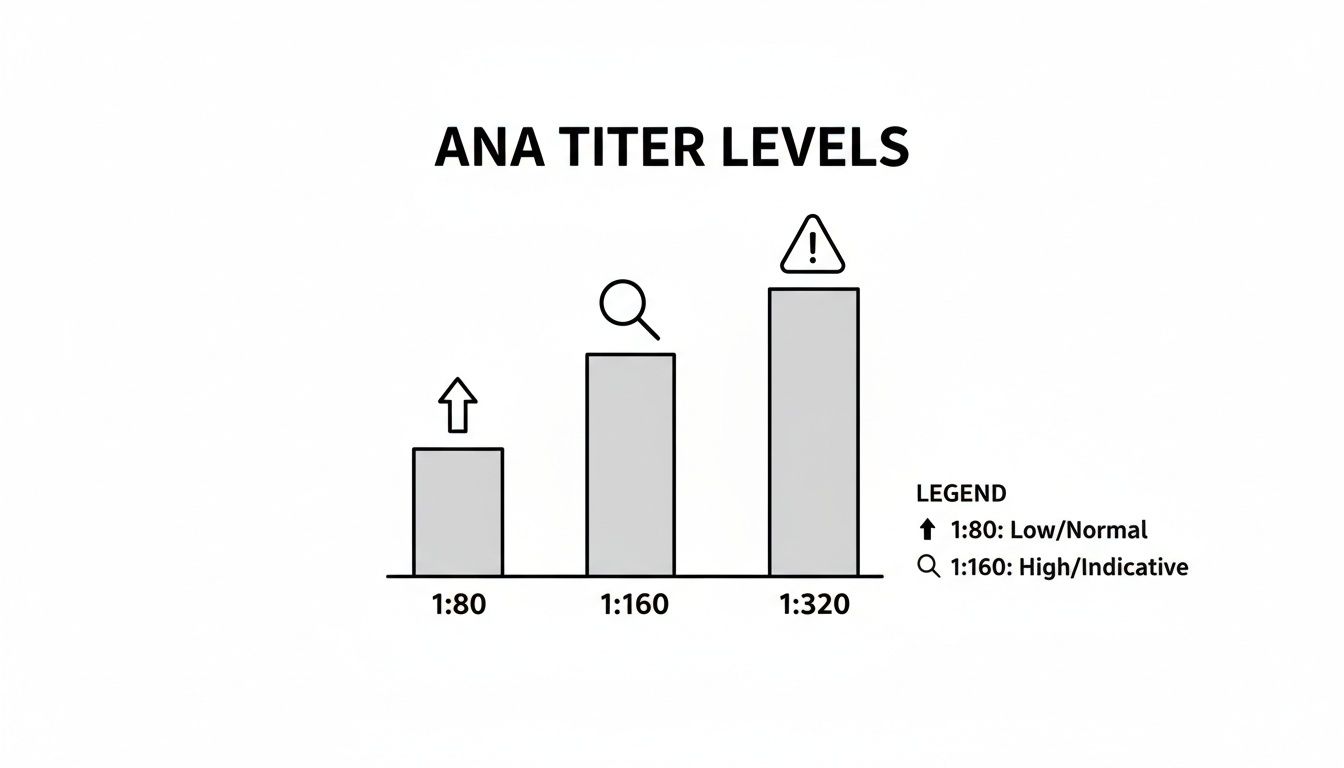
A low titre is a quiet signal. Higher titres are a louder alert, justifying a closer look and potentially a more proactive management strategy.
The Next Step: Specific Antibody Tests
If your ANA titre is high and you have relevant symptoms, the next step is more specific testing. Your doctor will likely order an ENA (Extractable Nuclear Antigen) panel. This test hunts for antibodies against specific proteins within the cell nucleus, offering a much more precise picture. This targeted approach provides the clarity needed to make informed decisions about your long-term health strategy.
Getting an Accurate ANA Test Without the Hassle

For busy professionals and dedicated athletes, time is precious. Traditional healthcare logistics, booking appointments, waiting for referrals, and clinic visits, can delay access to vital health insights. Modern services remove these barriers, making it simple to book an ana blood test online and have it done on your terms. This shift integrates proactive health monitoring smoothly into your life, enabling your longevity goals.
Bringing the Gold Standard to Your Door
At-home testing no longer means compromising on quality. Professional phlebotomy, having a trained medical professional collect your blood sample via venipuncture, is the same gold standard used in hospitals. This method ensures a high-quality sample, collected correctly the first time.
It eliminates the common issues of DIY finger-prick tests, such as errors, contamination, or insufficient sample volume. A professional phlebotomist ensures a successful collection over 99.8% of the time, providing clinical-grade accuracy with unmatched convenience.
Modern health testing should fit into your life, not disrupt it. Professional at-home collection ensures the data you receive is reliable, providing a solid foundation for your longevity strategy.
Why UKAS Accreditation is a Non-Negotiable
Where your sample is analysed is as important as how it's collected. For a sensitive test like the ana blood test, you need absolute confidence in the laboratory. This is where UKAS (United Kingdom Accreditation Service) accreditation is vital. UKAS is the sole body recognised by the government to assess the competence of testing labs, holding them to the highest international standards.
What this means for you:
- Results You Can Trust: The lab's methods are rigorously audited for quality, ensuring precise ANA titre and pattern analysis.
- Consistency and Confidence: Results are accurate and repeatable, which is essential for tracking your immune health over time.
- Clinical-Grade Integrity: The lab uses the same high-calibre methodologies trusted by the NHS.
For anyone serious about data-driven health optimisation, choosing a service that partners with UKAS-accredited labs is essential. It guarantees your information is trustworthy and actionable. You can explore this further by learning about the benefits of an at-home blood test in our detailed guide.
Turning Data into Your Strategic Advantage
The process is designed to be simple and enabling, from easy online booking to results delivered straight to an app. But the real value lies in the personalised doctor's review that accompanies your results. A qualified doctor interprets your ANA findings in the context of your health profile and longevity goals. This review transforms raw data into a strategic advantage, clarifying what the results mean for you and outlining clear, practical next steps to optimise your health and performance.
What to Do After Your ANA Blood Test

Receiving your ANA blood test results is a key moment in your health goals. It's not just a number; it's valuable intelligence about your long-term health. The goal is to use this insight proactively. Whether your result is negative, borderline, or positive, you've gained important information about your immune system's behaviour, allowing you to build a practical plan that supports your longevity goals.
Think of this as your personal health roadmap. It’s about taking control with objective data to maintain peak performance, enhance recovery, and build a more resilient body for the years to come.
Responding to a Negative ANA Result
A negative result is excellent news. It strongly indicates no significant autoimmune activity, meaning that any fatigue or aches are likely due to other factors like training load, nutrition gaps, or stress. This is not an endpoint but a green light to fortify the lifestyle habits that support long-term immune balance.
- Optimise Your Diet: Focus on an anti-inflammatory eating pattern rich in omega-3s, antioxidants from diverse fruits and vegetables, and high-quality protein for cellular repair.
- Prioritise Recovery: Deep, consistent sleep is non-negotiable for immune regulation and cellular regeneration, underpinning both physical and cognitive performance.
- Set Your Baseline: Use this result as your healthy benchmark. Periodic re-testing allows you to track your immune health over time and catch any changes early.
Navigating a Low-Positive or Borderline Result
A low-positive result (e.g., a 1:80 titer) without clear symptoms is a powerful opportunity to be proactive. Consider it an early warning from your body. It could be a temporary signal from recent illness or intense stress, but it's also a call to action. This is where targeted lifestyle adjustments can have a significant impact, helping to calm your immune system and prevent the signal from growing louder.
A borderline ANA test is your cue to look deeper. It's a chance to address the subtle stressors, physical and mental, that could be contributing to low-grade immune activation and impacting your longevity.
Actionable steps include:
- Master Your Stress: Implement consistent stress-reduction techniques. This could be daily mindfulness, breathwork, or building structured recovery and downtime into a demanding schedule.
- Focus on Gut Health: Your gut microbiome is a key regulator of your immune system. Incorporate fermented foods and prebiotic fibres while reducing processed foods to support a balanced immune response.
- Track Symptoms and Biomarkers: Log any subtle symptoms alongside your ANA results in a journal or app. Creating this personal dataset helps you connect lifestyle choices to your body’s signals over time.
A Clear Plan for a High-Positive Result
A high-positive result (1:160 or higher) is a clear signal that requires a structured approach and professional medical advice. Your first priority is to consult your GP or a rheumatologist, who can place the result in a full clinical context. While awaiting your appointment, you can take proactive steps to support your health.
- Gather Your Health Data: Compile a detailed history of any symptoms, noting when they started, their frequency, and any triggers.
- Continue Lifestyle Support: The principles of an anti-inflammatory diet, stress management, and prioritising sleep are important for supporting your body’s overall resilience.
- Prepare for Follow-Up Tests: Your doctor will likely recommend more specific tests, like an ENA panel, to pinpoint the antibodies involved. Understanding your options help you to be an active participant in your healthcare. You can learn more about how to request a blood test to understand the process.
If an ANA test leads to a diagnosis requiring ongoing care, services like home health nursing can be a valuable part of a long-term plan. Ultimately, a high-positive result is the start of a focused investigation. Moving forward with a clear, medically-guided plan is the optimal way to manage your health for the long run.
Your ANA Blood Test Questions Answered
When you’re investigating your health, questions are a natural part of the process. Let's address some of the most common queries about the ANA blood test to help you feel confident about what your results mean for your long-term health strategy.
Do I Need to Fast Before an ANA Blood Test?
No, for a standalone ANA test, you do not need to fast. You can eat and drink normally before your appointment. The only exception is if your ANA test is part of a larger panel that includes tests requiring fasting, such as for glucose or lipids. A quality testing service will provide clear instructions when you book to ensure result accuracy.
Can Intense Exercise Affect My ANA Test Results?
This is an important question for anyone pushing their physical limits. A single strenuous workout is unlikely to cause a positive ANA result. However, the chronic stress from overtraining or elite-level competition can sometimes dysregulate the immune system, potentially leading to a temporary, low-positive ANA in an otherwise healthy individual. This is why tracking your health data over time is so valuable—it helps differentiate a training-related blip from a persistent immune signal.
A single data point is a snapshot; a trend is a story. Viewing your ANA results over time, in the context of your physical demands, provides a much clearer picture of your immune health baseline.
How Often Should I Retest a Positive ANA?
There is no single answer; it depends on your individual situation. If your ANA is positive but you have no symptoms, your doctor may recommend a 'watch and wait' approach. However, if you are focused on longevity and have a borderline result, retesting in 6-12 months can be a smart strategy to establish your personal baseline and monitor for any changes. A doctor's review of your results can provide a personalised recommendation for your retesting schedule.
What Is the Difference Between an ANA and an ENA Test?
Think of the ANA blood test as a wide-beam searchlight. It’s excellent at telling you if something is present (i.e., your immune system is making autoantibodies), but it doesn't identify the specific target. If the ANA test is positive and your symptoms warrant further investigation, the ENA panel acts like a laser pointer. It is a follow-up test that looks for antibodies against specific proteins within the cell, like anti-Ro or anti-Sm. This specificity is important for diagnosing specific autoimmune conditions and refining your health management plan.
Take control of your long-term health with proactive insights. With Lola, you can book a professional phlebotomist for convenient at-home or clinic blood collection, with analysis performed in a UKAS-accredited lab. Receive your results, complete with a doctor’s review, directly on our app to start building your personal health roadmap. Visit the Lola Health website to begin your journey.
At-Home Blood Testing
Check your levels from home
Professional phlebotomist visit. Doctor-reviewed results in 2-5 days. Track your health with comprehensive blood panels.
→45-70 biomarkers tested · Venous blood draw · From £130