


Of course, you can request a blood test in the UK. Whether you decide to go through the NHS or use a private service, you have options when it comes to understanding what’s really going on inside your body. Let's walk through how it works so you can take charge of your health and optimise for longevity.
A Proactive Approach to Health and Longevity
Asking yourself, "can I request a blood test?" is a fantastic first step towards a longer, healthier life. It signals a shift in mindset from reacting to illness to proactively managing your healthspan - the period of your life spent in good health.
For driven professionals and athletes, this isn't just about avoiding sickness. It’s about fine-tuning your body for peak performance and extending your years of vitality. Getting a clear picture of your internal data through blood analysis is the bedrock of any serious longevity strategy.
In the UK, you have two main pathways to get this done:
- The NHS Route: Your first port of call is usually your GP. You can ask for a test, and they'll decide if it's clinically necessary based on any symptoms or your medical history.
- The Private Route: This option lets you order tests directly from a private provider. It gives you full autonomy over which biomarkers you want to track for your longevity goals and how often you monitor them.
Choosing the Right Path for Your Longevity Goals
Deciding between the NHS and a private service really comes down to what you’re trying to achieve. If you’re dealing with specific, noticeable symptoms, your GP is absolutely the right person to see.
But if your focus is on longevity and optimising your healthspan, catching the subtle signs of ageing before they become problems, then a private test provides a more direct, detailed, and faster route.
Pathology services are a cornerstone of UK healthcare, underpinning an incredible 95% of all clinical pathways. British labs conduct over a billion tests every single year, which shows just how vital they are. It also helps explain why the NHS has to be selective, prioritising tests based on immediate clinical need rather than long-term health optimisation.
To get a better sense of what a full screening looks like, our guide on choosing a complete blood test in the UK is a great resource.
When you proactively request and monitor your own blood biomarkers, you're no longer just a passenger on your health goals. You become the driver, using concrete data to inform your decisions on nutrition, training, and lifestyle for a longer, healthier life.
How to Get Your GP on Board with a Blood Test Request
Getting a blood test through the NHS isn't always straightforward, especially for longevity purposes, but you can improve your chances by preparing for the conversation with your GP. The key is to frame your request around preventative health in a way that aligns with clinical practice.
Rather than just walking in and asking for a test, you need to build a compelling case. Explain that you’re serious about preventative health and want to establish a baseline for key biomarkers to track your long-term wellness. This positions you as an engaged, informed patient, not just someone with a vague request.
Before You Go: Acing the GP Appointment
A productive chat with your GP starts well before you step into their office. Your aim is to give them a clear, concise snapshot of your health goals or any concerns you might have. A bit of prep work makes a huge difference, especially when you only have a few minutes of their time.
Here's what you should consider bringing with you:
- Your Symptom Diary: Don't dismiss minor issues. Things like persistent fatigue, brain fog, or unusually slow recovery times are all relevant and could indicate underlying imbalances affecting your long-term health.
- Your Family History: This is a big one. If conditions like heart disease, diabetes, or thyroid problems run in your family, it gives your GP a solid clinical reason to test certain markers as a preventative measure.
- Your Specific Longevity Goals: Be clear about why you want to know about certain biomarkers. You could say something like, "Given my family history of heart disease, I'd like to check my hs-CRP and ApoB levels to get a baseline for my long-term cardiovascular health."
This diagram shows the two main routes you can take: going through your GP or using a private service.
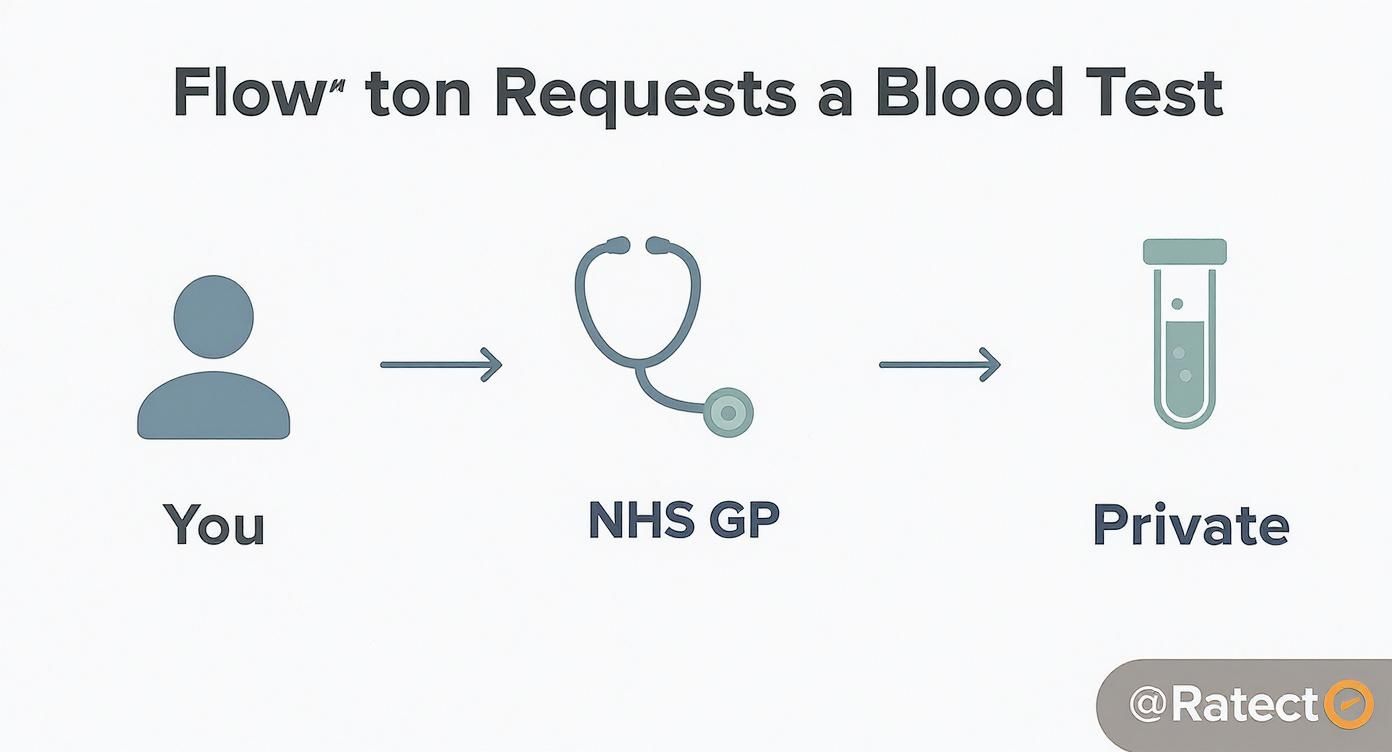
As you can see, both paths are valid, but they generally serve different needs - the NHS focuses on clinical diagnosis, while private testing is geared more towards proactive health monitoring for longevity.
A Reality Check on NHS Timelines
It’s important to be realistic about the pressures the NHS is facing. Demand for diagnostic tests is constantly rising; late last year, around 1.6 million people were on waiting lists. While the NHS aims for a maximum six-week wait for these tests, this target hasn't been met consistently since 2017, largely due to staff shortages. If you're curious about the bigger picture, you can learn more about pathology facts and figures.
If your GP says no, don't lose heart. Calmly ask them to note their clinical reasoning in your medical file. This documents your proactive stance and keeps the door open for another chat down the line or even seeking a second opinion.
If your request gets the green light, brace yourself for a potential wait. If they decline, or the wait is simply too long for your goals, this is the natural point where many people decide to look at private testing for faster, more detailed insights into their health.
Choosing the Private Route for Faster Health Insights
If you're serious about longevity, you can't afford to wait for symptoms to show up. That’s a reactive approach. Private blood testing flips the script, putting you firmly in control of your health with speed, convenience, and a level of detail you’re unlikely to get through standard channels.
The private health world lets you pinpoint the exact biomarkers you want to track, so you can align your testing directly with your personal longevity goals. As you look into your options, understanding how telehealth works is a huge advantage, since it's the engine behind many of these modern, on-demand services.

Navigating Your Options: From Home Kits to Clinic Visits
Once you decide to go private, you’ll find there are two main ways to get your sample collected. Each has its pros and cons, really depending on what you’re comfortable with and how detailed your chosen longevity panel is.
- At-Home Finger-Prick Kits: These are all about convenience. A kit arrives at your door, you collect a few drops of blood yourself, and simply post it back to the lab. They’re fantastic for keeping an eye on a handful of specific biomarkers regularly.
- Venous Draws: For the big, full panels that give a deep look at your health, a venous draw from your arm is the way to go. Many services, including Lola, make this easy by sending a professional phlebotomist to your home or booking an appointment for you at a partner clinic. It’s the gold standard of sample collection.
People often ask if the at-home kits are as accurate. In short, yes. As long as the sample is handled by a UKAS-accredited lab, the results are just as reliable. The key difference is the type of sample, not the quality of the analysis itself.
A Real-World Scenario: Selecting a Longevity Panel
Let’s say you’re focused on optimising your metabolic health to reduce your long-term disease risk. You’d simply go online, look through a provider’s test menu, and choose a panel that covers inflammation, blood sugar control, and advanced lipid markers.
The process is simple. You purchase the test online and then use their portal to book a phlebotomy appointment for a time that suits you. After your sample is taken, the results typically appear on your private online dashboard within 48-72 hours. But you don't just get a list of numbers; you get a doctor's analysis explaining what each marker means in the context of your longevity goals.
The real power of private testing isn't just the data; it's the speed and context. Seeing your hs-CRP (a key inflammation marker) trend downwards after you've cleaned up your diet gives you immediate, powerful feedback that you're on the right track for a longer, healthier life.
The cost for private tests can vary. A single marker might be around £40, while a full-scale longevity panel could be £200 or more. Think of it as a direct investment in your healthspan - one that delivers clear, actionable insights you can use right away. To get a better sense of the advantages, take a look at our article on why private blood tests are a key tool for longevity.
Key Biomarkers for Longevity and Peak Performance
When you request a blood test with longevity in mind, you’re looking beyond a basic health check. The aim here is to gather specific data that paints a detailed picture of your biological age, not just your chronological one. This is about proactively identifying and addressing the root causes of ageing at a cellular level.
Knowing exactly what to test for is the first real step. The smart approach is to focus on biomarkers directly tied to the hallmarks of ageing. These specific markers offer actionable insights into inflammation, metabolic health, hormonal balance, and nutrient status - the true pillars of your healthspan.
Inflammation and Metabolic Health Markers
Think of chronic, low-grade inflammation as a silent accelerator of ageing. A standard GP check-up might not even look for it, but a targeted test can give you a crystal-clear warning sign.
-
High-Sensitivity C-Reactive Protein (hs-CRP): This is your best single measure of systemic inflammation. While the standard 'normal' range can be surprisingly broad, for longevity, you want this level to be consistently below 1.0 mg/L.
-
HbA1c and Fasting Insulin: Together, these two markers give you a powerful look at your blood sugar management over the past few months. Optimal HbA1c for longevity is generally considered to be below 5.5%, while your fasting insulin should ideally be under 5 µIU/mL. If these numbers are creeping up, it can signal insulin resistance, a huge factor in metabolic ageing.
Keeping an eye on these gives you direct feedback on how your diet and lifestyle are affecting your health at a cellular level. It’s also worth noting that once you identify areas for improvement, like blood sugar, you can explore other interventions. For instance, some research looks into how Hyperbaric Oxygen Therapy and blood sugar control may be linked.
Hormones and Critical Nutrients
Your hormone and nutrient levels are the engine of your daily performance and long-term vitality. When they're out of balance, you'll feel it - fatigue, slow recovery, and an unwelcome acceleration of the ageing process.
Key tests to consider include a full thyroid panel (TSH, Free T3, Free T4) to get a proper handle on your metabolic rate. For men, tracking testosterone is non-negotiable for maintaining muscle mass, energy, and cognitive sharpness as you age.
When it comes to essential nutrients, some of the most common culprits for sub-optimal health are:
- Vitamin D: Absolutely vital for immune function and bone health.
- Vitamin B12: A cornerstone for energy metabolism and neurological function.
- Iron/Ferritin: important for transporting oxygen and staving off fatigue.
One of the most important things to realise is that 'optimal' ranges for longevity are often much narrower than the standard laboratory 'normal' ranges. The goal isn't just to be 'not deficient' - it's to be in a zone that actively supports peak cellular function and extends your healthspan.
Focusing on these specific biomarkers allows you to build a detailed panel that gives you real, usable information.
Essential Biomarkers for Your Longevity Panel
This table breaks down the key tests, what they measure, and why they're so vital for tracking your long-term health and performance.
| Biomarker Category | Specific Tests | Why It Matters for Longevity |
|---|---|---|
| Inflammation | High-Sensitivity C-Reactive Protein (hs-CRP) | Measures underlying systemic inflammation, a key driver of chronic disease and ageing. |
| Metabolic Health | HbA1c, Fasting Insulin, Fasting Glucose | Provides a clear picture of blood sugar control and insulin sensitivity over time. |
| Lipid Profile | ApoB, LDL-P, HDL-C, Triglycerides | Assesses cardiovascular risk with more precision than a standard cholesterol test. |
| Hormonal Balance | Testosterone (Total & Free), DHEA-S, Thyroid Panel (TSH, T3, T4) | important for energy, muscle mass, mood, and metabolic rate. |
| Key Nutrients | Vitamin D, Vitamin B12, Magnesium, Ferritin (Iron) | Ensures you have the essential building blocks for cellular energy and function. |
With this data, you can start making targeted changes instead of guessing what your body needs.
It's also interesting to see how routine blood analysis is already deeply integrated into healthcare settings. For example, recent NHS England statistics show that 90.4% of hospital admissions for patients aged 16 and over were risk-assessed for venous thromboembolism (VTE), a process that often relies on blood analysis. This just goes to show how fundamental blood testing is for proactive, preventative health strategies.
By focusing on these specific areas, you can turn a simple blood test into a useful measure for your long-term health strategy. If you want to get more into the weeds, you can learn more about what blood biomarkers show in our detailed guide.
Turning Your Blood Test Results into Actionable Steps
Getting your blood test results back isn't the finish line. It’s the starting block for your longevity plan. This is the moment you stop guessing and start making real, targeted changes to how you feel and perform. The true power of testing is turning those numbers into a concrete plan for boosting your healthspan.
When you first open that report, you'll see your results plotted against standard 'reference ranges'. It’s important to understand what these really mean. A lab's 'normal' range is often incredibly broad, calculated from an average of the general population—a group that includes many people who are not in optimal health. For anyone serious about longevity, just being 'normal' isn't the goal.
Optimal Zones Versus Normal Ranges
Think of it this way: the 'normal' range is designed to flag immediate illness. The 'optimal' range, on the other hand, is where your body is actually thriving and ageing slowly.
Take Vitamin D, for example. The standard lab range might dip quite low before flagging a deficiency. But for a powerful immune system and solid long-term bone health, longevity experts aim for levels in the upper end of that scale.
Another classic example is hs-CRP, a key marker for inflammation. You might be told that anything up to 3.0 mg/L is 'normal'. For longevity and actively reducing your risk of chronic disease, however, the optimal target is below 1.0 mg/L. This difference is everything. It’s the gap between just 'not being sick' and being truly well.
Your blood test results are your personal health blueprint. The numbers tell a story about how you're ageing. Learning to read that story help you to make targeted, effective adjustments to your nutrition, training, and lifestyle. This is proactive health management at its best.
So, let's talk about putting this into practice. When you request a blood test and get your results, you can finally connect the dots between your biomarkers and your daily habits. It's all about building a sustainable longevity strategy based on your unique biology.
Creating Your Personalised Action Plan
Once you’ve pinpointed which biomarkers are falling outside their optimal zones, you can build a highly targeted plan. The idea is to make specific, evidence-backed changes instead of just throwing things at the wall to see what sticks.
Here are a few real-world examples of how this plays out:
-
High hs-CRP (Inflammation): This is a clear signal to double down on anti-inflammatory habits to slow ageing. You could start by adding more omega-3-rich foods like salmon and walnuts into your diet, experimenting with turmeric, and making quality sleep non-negotiable—poor sleep is a huge driver of inflammation.
-
Sub-optimal Vitamin D: A low reading points to a very straightforward solution: more sun or targeted supplementation. This could be as simple as committing to a 15-minute walk outside during your lunch break and speaking with a professional about the right supplement dose for you.
-
Elevated HbA1c (Blood Sugar): If you see your blood sugar control is slipping, you can take immediate action to improve your metabolic health. This might mean cutting back on refined carbs and sugar, loading your plate with more fibre-rich vegetables, and adding a brisk walk after your biggest meal to help your body manage glucose.
These are precise, manageable tweaks directly informed by your own data. By systematically working on each suboptimal marker, you create a powerful, cumulative effect that can elevate your performance and protect your health for the long run.
Got Questions About Blood Tests? Let’s Clear Things Up
When you start digging into your own health, especially with a long-term goal like longevity, a lot of questions pop up. It's totally normal. Getting a blood test in the UK can seem a bit complicated at first, but once you know the ropes, it's pretty straightforward.
Here are some of the most common things people ask.
Can I Just Ask My GP for a Blood Test?
You can always ask, but the NHS typically needs a solid clinical reason to run tests. They are focused on diagnosing and treating illness, not necessarily on optimising for longevity.
So, if you're looking to proactively track biomarkers for your healthspan without any obvious symptoms, going private is usually the more direct route. If you do talk to your GP, framing your request around a concrete concern can help. For instance, you could mention monitoring your cholesterol because of a family history of heart disease.
Are Those At-Home Finger-Prick Tests Actually Accurate?
That’s a big one, and a good question to ask. The short answer is yes, as long as you use a reputable company that processes samples in UKAS-accredited labs. The accuracy is high.
The real difference is how the blood is collected. An at-home kit uses a finger-prick to get capillary blood, while a clinic appointment involves a venous draw from a vein in your arm. For most of the key longevity biomarkers, both methods are perfectly reliable. But for really extensive panels, a venous draw is the gold standard. It guarantees a larger, cleaner sample for the lab to work with.
How Much Should I Expect to Pay for Private Blood Tests in the UK?
This is where it really varies. The cost of a private blood test depends entirely on who you go with and what you're testing for.
- A simple, single-marker test like Vitamin D could set you back around £30 to £50.
- A full-blown longevity panel, checking dozens of biomarkers, can be anywhere from £150 to over £500.
When you're comparing options, look closely at what’s included in the price. Does it come with a doctor's review? That part is important. Raw data is one thing, but having an expert interpret it for you in the context of longevity is what turns numbers into a real, actionable plan.
Think of it less as a cost and more as an investment in your future healthspan. You're getting the precise data you need to move beyond generic health advice and build a strategy that’s genuinely personalised to your own body.
What Can I Do if My GP Says No to My Request?
It's definitely frustrating when your GP turns down a request for a test, but you haven't hit a dead end. First off, you're well within your rights to ask them to explain their reasoning and to have that conversation noted in your medical records. You could even ask for a second opinion from another doctor at the practice.
If you’ve tried that and still want the test, that's the perfect time to look into private options. It puts you back in the driver's seat, letting you get the specific health insights you’re after for your longevity goals without needing a referral.
Ready to take control of your health with data-driven insights? Lola offers thorough, doctor-reviewed blood testing with convenient at-home or in-clinic sample collection. Get the clear, actionable information you need to optimise your performance and extend your healthspan. Discover your personalised health blueprint today.
Test This Biomarker at Home
This biomarker is included in our ALT Test and Liver & Kidney Function — results in 2-3 working days with GP-reviewed insights.
At-Home Blood Testing
Check your levels from home
Professional phlebotomist visit. Doctor-reviewed results in 2-5 days. Track your health with comprehensive blood panels.
→45-70 biomarkers tested · Venous blood draw · From £130