


Monitoring your cholesterol from home is one of the most powerful steps you can take for your long-term healthspan. With a simple finger-prick blood sample, you can measure the key players in your lipid profile: total cholesterol, LDL, HDL, and triglycerides. This isn't just about getting numbers; it's about gaining actionable data to build a proactive strategy for a longer, healthier life.
This guide will show you exactly how to use at-home cholesterol testing as a cornerstone for extending your healthspan.
Your Proactive Path to Heart Health and Longevity
To grasp why this matters for longevity, think of your cardiovascular system as an intricate highway network essential for your body's function. Cholesterol particles are the vehicles on these roads. You need them, but an imbalance—too many of the wrong kind—leads to blockages (atherosclerosis) that silently compromise your health over decades.
Regularly checking your levels gives you a real-time view of this internal traffic, allowing you to intervene long before symptoms appear. It shifts you from a reactive stance on health to being the architect of your own longevity, using concrete data. This guide will take you beyond just reading numbers to understanding what they mean for your future self.
Building a Long-Term Wellness Strategy
When you integrate home cholesterol testing into your routine, you create a powerful bio-feedback loop for longevity. You can see, in black and white, how your diet, exercise, and other lifestyle choices directly impact your internal biochemistry. The goal isn’t a single perfect result; it’s about observing trends over time to build a smart, sustainable plan for a long and vibrant life.
Your lipid profile is not static; it's a dynamic report on your biological age. By monitoring it, you gain the power to steer your cardiovascular future and make choices that compound into years of healthy living.

Before diving into the mechanics, it’s worth understanding the fundamental role of cholesterol in heart health. Knowing the 'why' makes the 'how' much more potent. From there, we'll cover the essentials:
- Choosing the Right Test: We’ll explore different kits so you can select one that aligns with your longevity goals.
- Interpreting Your Results: You’ll learn to translate raw data into genuine insights about your long-term heart disease risk.
- Integrating Knowledge into Action: We’ll show you how to connect your results to practical lifestyle habits that make a measurable difference to your healthspan.
By taking charge of this vital health metric, you are putting yourself in the driver's seat of your own longevity journey.
Choosing the Right Home Cholesterol Test Kit
Selecting the right home cholesterol test is your first actionable step toward managing your long-term health. The market offers various options, but they fall into two main categories, each providing a different depth of insight for your cardiovascular longevity strategy. Your choice depends on the level of detail you need to make informed decisions.
Consider the first type, test strips, as a quick health check-in. Using a small drop of blood, you get a total cholesterol reading in minutes. While useful for a basic snapshot, they lack the granular detail required for a comprehensive longevity plan.
Deeper Insights from Full Lipid Panels
For a complete picture essential for longevity planning, mail-in lab kits that provide a full lipid panel are the superior choice. This is the difference between a quick glance and a detailed blueprint of your cardiovascular health. These tests break down your cholesterol into LDL ('bad' cholesterol), HDL ('good' cholesterol), and triglycerides. This is where the actionable insight for longevity lies, as it reveals the specific dynamics of your lipid profile.
This infographic lays out the main types of home cholesterol tests you'll come across.
Understanding the difference helps you align the test's detail with your personal goals, ensuring the information you receive is truly actionable for your long-term health.
Comparing Home Cholesterol Test Kits
To help you decide, let's break down the key differences. This table compares basic test strip kits with the more comprehensive mail-in lab kits, highlighting which is better suited for a serious longevity strategy.
| Feature | Test Strip Kits | Mail-in Lab Kits |
|---|---|---|
| Speed of Results | Almost instant (a few minutes) | Slower (a few days to a week) |
| Data Provided | Typically just total cholesterol | Full lipid panel (Total, HDL, LDL, Triglycerides) |
| Level of Detail | Basic snapshot of overall levels | In-depth, actionable insights for longevity |
| Best For | Quick, occasional monitoring | Thorough health assessment & long-term tracking |
| Cost | Generally lower per test | Higher initial cost, but more value for data |
The choice boils down to a trade-off between immediacy and insight. For a quick check, strips are fine. But for building a strong, long-term health strategy, the detailed data from a mail-in kit is indispensable.

Why Home Testing is on the Rise
The growth in at-home cholesterol testing is part of a larger movement towards proactive, data-driven health management. The global market is valued at around $250 million and is projected to grow by 10% annually until 2033. In the UK, this trend is driven by a desire for early detection and personal empowerment. New technologies, like apps that help interpret results, are making it easier than ever for individuals to manage their own health trajectory.
You'll find various lipid panel test kits offering this deeper analysis. So, which should you choose? It comes back to your goals.
If you're just starting, a simple test can be a great entry point. But for a serious, long-term longevity strategy, only a full lipid panel provides the rich, actionable data needed to track progress and make meaningful, health-extending lifestyle changes.
For those new to self-testing, our guide on what at-home blood testing involves is an excellent resource. The best kit is the one that transforms numbers on a page into a powerful tool for a longer, healthier life.
Getting an Accurate Result: How to Do Your Test Properly
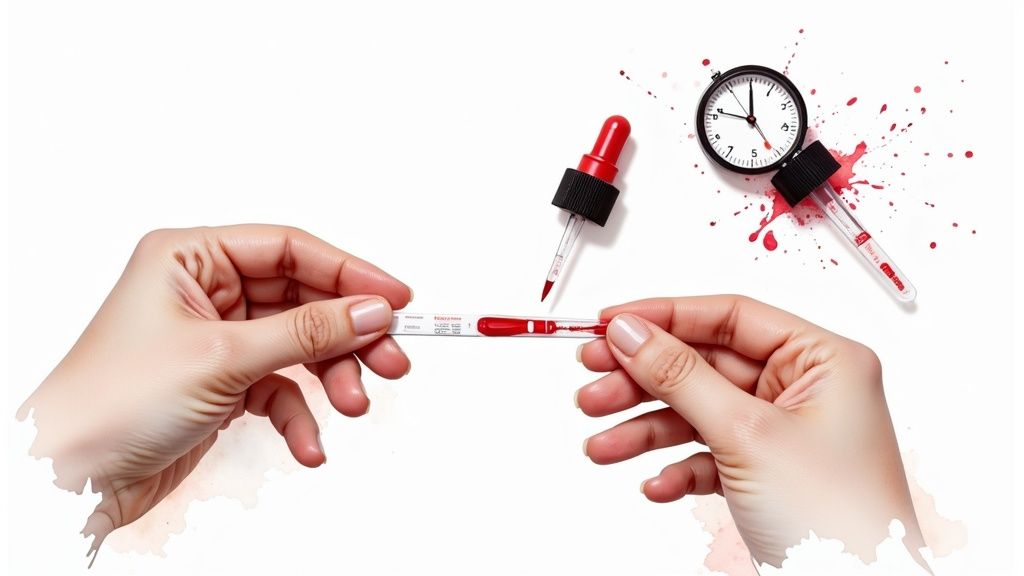
Executing your home cholesterol test correctly is important for obtaining data you can trust for your longevity plan. Think of it as a simple scientific measurement you're conducting on yourself. Consistency is key, as it ensures your results accurately reflect your internal health, allowing you to track the impact of your efforts over time.
Nail this process, and you’ll gain a clear view of how your lifestyle choices are paying dividends for your long-term heart health. The small details, from preparation to sample collection, make all the difference.
Prepping for Your Home Cholesterol Test
A little preparation before you open the kit can significantly improve the quality of your sample and the accuracy of your results. Following these steps helps eliminate variables that could skew your data.
Most kits, especially those providing a full lipid panel, require you to fast for 9-12 hours. This is non-negotiable for accuracy. Food, particularly fats, can temporarily raise triglyceride levels, masking your true baseline. Fasting ensures you're measuring your body's steady state, not your last meal. The simplest way to achieve this is to test first thing in the morning before eating or drinking anything but water.
Hydration is also critical. Drinking plenty of water the day before your test makes your blood flow more easily, simplifying sample collection. Dehydration can make the finger-prick difficult and may slightly concentrate your blood, potentially affecting the final numbers.
The Finger-Prick: A Step-by-Step Guide
The finger-prick is the central action, but a few techniques can make it both effective and nearly painless. The aim is to get a clean, full drop of blood without excessive squeezing.
First, warm your hands to encourage blood flow. Washing them in warm water or rubbing them together for a minute can make a surprising difference.
A Quick Tip for Tracking Over Time: For maximum consistency, try to use the same finger for each test. This small detail helps eliminate minor physiological variables from one test to the next, making your long-term trend data even more reliable for your longevity strategy.
Here’s how to get a clean and easy sample:
- Clean the Spot: Use the provided alcohol wipe to clean the side of your fingertip. Let it air dry completely.
- Use the Lancet: Press the lancet firmly against the side of your fingertip—it has fewer nerve endings than the pad, making it less sensitive. Click to prick the skin.
- Collect Your Sample: Gently massage your finger from the base towards the tip to help a single, large drop of blood form. Follow the kit's instructions for applying it to the test strip or into the collection tube.
- Seal and Send (If Needed): For a mail-in lab test, seal the sample as instructed and post it as soon as possible. Prompt shipping ensures the sample remains stable for accurate analysis.
By following this process, you ensure the data you receive is a true reflection of your health, helpful you to make informed decisions for a longer life.
Making Sense of Your Cholesterol Test Results
Receiving your results is where data transforms into your personal longevity roadmap. These numbers are a direct communication from your body, offering a clear window into your long-term cardiovascular health. Learning to interpret them is the critical step in turning a simple home test into a powerful tool for extending your healthspan.
Think of your full lipid panel as a performance review for your internal health team. You need to understand how each member is contributing, not just the final score (Total Cholesterol). This level of detail is what enables smart, targeted interventions to improve your long-term wellness.
What Your Lipid Panel Actually Tells You
To use your results for longevity, let's break down the four key biomarkers. The goal is not just to see if you are within a generic "healthy range," but to understand why each number is a critical lever for your long-term health.
-
Total Cholesterol: This is your overall score—a useful starting point, but it lacks the necessary detail for a detailed strategy because it combines both "good" and "bad" cholesterol.
-
Low-Density Lipoprotein (LDL): Often called "bad" cholesterol, think of LDL as the primary driver of arterial aging. High levels lead to the buildup of fatty plaque in your arteries (atherosclerosis), which silently increases your risk of heart attack and stroke over your lifetime.
-
High-Density Lipoprotein (HDL): This is the "good" cholesterol, acting as your body's arterial maintenance crew. HDL's job is to remove excess cholesterol from your arteries and transport it back to the liver for disposal, actively protecting your cardiovascular system.
-
Triglycerides: Another type of fat used for energy. Consistently high levels, often linked to diet, are a key indicator of metabolic stress and also contribute to the hardening of arteries over time.
Your cholesterol levels are dynamic indicators of your health trajectory. By tracking these numbers, you can see the direct impact of your lifestyle choices, enabling you to fine-tune your approach for a longer, healthier life.
Tying Your Results to Your Real Life
The true power of at-home cholesterol testing for longevity is the ability to get regular, actionable feedback. Fast results are key, as they enable you to make timely adjustments to your lifestyle. Learn more about why fast turnaround for lab results is so important for maintaining momentum. This cycle of testing, adjusting, and re-testing is what turns knowledge into lasting health improvements.
Regional UK data shows that lipid health can vary significantly, often influenced by local lifestyle factors and healthcare access. Home testing helps democratise this information, giving adults everywhere a direct way to manage their cardiovascular risk and take control of their healthspan.
Ultimately, each number in your report is a piece of your personal longevity puzzle. Together, they provide a clear picture of your cardiovascular risk, allowing you to move from passive awareness to proactive management of your health for the decades ahead.
Turning Your Results into a Longevity Strategy
Your cholesterol test results are not a final grade; they are the starting coordinates for your longevity journey. With this data, you can plot a clear course toward a longer, healthier life by translating insights into sustainable habits.
This requires moving beyond a one-off test. The true power lies in monitoring your levels over time, creating a feedback loop where you see the tangible impact of your choices. While testing frequency depends on your personal risk and goals, regular checks transform cholesterol monitoring from an event into an ongoing, data-driven strategy for life extension.
Building Your Action Plan
Information without implementation is useless. The most vital step is using your results to drive meaningful change. The encouraging news is that cholesterol levels are highly responsive to lifestyle interventions.
Here are a few high-impact habits to build:
-
Dietary Tweaks: Focus on incorporating foods rich in soluble fibre (oats, beans, apples) and healthy fats (avocados, nuts, olive oil). A key skill for long-term success is understanding food labels; a guide on deciphering nutrition labels is an invaluable resource.
-
Consistent Exercise: Aim for at least 150 minutes of moderate-intensity aerobic exercise, like brisk walking, swimming or cycling, per week. This is one of the most effective ways to raise your protective HDL cholesterol.
-
Stress Management: Chronic stress can negatively influence cholesterol levels through hormonal pathways. Integrating practices like mindfulness, meditation, or yoga provides powerful support for your long-term cardiovascular health.
Partnering with Your Healthcare Provider
Your home test is a potent tool, but it achieves its full potential when used in collaboration with a healthcare professional. Always discuss your results with your doctor to create a holistic view of your health. They can help you interpret trends in the context of your overall health profile and decide if further action is needed.
Think of your home test as providing the high-frequency data, while your doctor helps you interpret the long-term narrative. This partnership ensures you make safe, effective decisions tailored to your unique biology.
This proactive approach places you in control, combining the convenience of home monitoring with the wisdom of expert medical guidance. For those wanting to dive deeper, detailed services like The Peak Insights Blood Test can offer a broader perspective on your overall wellness, perfectly complementing your cholesterol management efforts.
Got Questions About Home Cholesterol Tests? We’ve Got Answers.

It’s natural to have questions when you're taking a more proactive role in your health. Let's address some common queries about at-home cholesterol testing so you can proceed with confidence on your longevity journey.
Do I Really Need to Fast Before My Test?
Yes, for the most accurate and actionable data, fasting is essential. Full lipid panel tests require you to avoid all food and drink (except water) for 9-12 hours beforehand.
Fasting provides a true baseline of your body’s lipid metabolism, free from the temporary influence of your last meal. This clean data is what allows you to accurately track changes over time and make informed decisions for your long-term health.
What Should I Do if I Get an Abnormal Result?
First, do not panic. An abnormal result from a home test is not a diagnosis; it is a essential piece of data prompting you to take the next logical step.
Your immediate action should be to schedule a consultation with your GP. They can confirm the result with a clinical test and, most importantly, place it in the context of your overall health to create a forward-looking plan. This is where your home test helps a more productive conversation with your doctor.
Your home test acts as an early-warning system. It gives you the information needed to engage with healthcare experts proactively, allowing you to address potential issues long before they become significant problems.
How Do Home Tests Compare to Ones at the Clinic?
Home tests are designed for convenience and regular monitoring, making them perfect for tracking the impact of your lifestyle changes over time.
Clinic tests remain the gold standard for diagnostic accuracy, performed in a controlled environment. The optimal strategy for longevity involves using both. Use regular cholesterol testing at home to maintain momentum and gather data, and use periodic clinic tests with your doctor to validate your numbers and refine your long-term health plan.
Ready to get a clearer picture of your health and build a proactive longevity plan? With Lola, you get professional, at-home blood analysis using UKAS-accredited labs. Our service includes a personalised doctor review, delivering actionable insights directly to you.
Take control of your health today with Lola.
Article created using Outrank
At-Home Blood Testing
Check your levels from home
Professional phlebotomist visit. Doctor-reviewed results in 2-5 days. Track your health with comprehensive blood panels.
→45-70 biomarkers tested · Venous blood draw · From £130