


So, what exactly is a male hormones test? Think of it as a deep dive into your body's internal messaging system, offering a strategic blueprint for your long-term health. It's a blood analysis that measures crucial hormones, like testosterone, giving you a clear picture of your endocrine health. It’s not just for when things go wrong; it’s a proactive tool for understanding your unique chemistry and spotting imbalances that could impact your energy, vitality, and longevity.
Why Your Hormones Are Key to a Longer, Healthier Life

Imagine your hormones as the behind-the-scenes directors managing your body's entire operation for the long haul. They orchestrate everything from your mood and metabolism to your cognitive sharpness. When these directors work in harmony, you feel on top of your game—focused, energetic, and resilient. But as men age, this finely-tuned balance can start to waver, introducing subtle but noticeable changes that can compromise your future health.
That’s why a male hormones test is more than a routine check-up. It's a strategic investment in your healthspan—the years of your life spent feeling good and fully functional. By getting a clear baseline of your personal hormone profile, you equip yourself with the data to make smart, forward-thinking decisions. This isn’t just about tackling current issues like fatigue or a dip in libido. It’s about laying the biological groundwork for a long, vibrant, and active life.
It's More Than Just Muscle and Libido
Testosterone gets all the press for building muscle and firing up sex drive, but its role in longevity is far more extensive. Keeping your hormone levels in their optimal range is vital for so much more:
- Mental Clarity: Hormones like testosterone are linked to memory, concentration, and protecting against age-related cognitive decline.
- Heart Health: A balanced hormonal profile is a key player in maintaining a healthy cardiovascular system for decades to come.
- Strong Bones: Sufficient testosterone is essential for maintaining bone density and warding off osteoporosis in later years.
- Metabolic Control: Hormones are crucial for managing body composition, dictating where you store fat and how easily you build muscle, which is a cornerstone of metabolic health as you age.
The trouble is, many men are living with declining hormone levels and have no idea. Recent UK health data reveals that low testosterone impacts 1 in 4 men over 30, yet an astonishing 90% of them aren't getting treatment. Why? Often, the symptoms get dismissed as a normal part of ageing, preventing men from seeking the simple clarity a blood test can provide. You can find out more about how a straightforward hormone blood test in the UK can offer crucial insights.
Understanding your hormonal baseline gives you actionable data to push back against age-related decline. It changes the narrative from passively accepting the effects of ageing to actively managing your health for peak performance and longevity.
When you view a male hormones test as a tool for long-term wellness, it becomes a powerful investment in your future. It gives you the knowledge to fine-tune your biology, ensuring your body’s internal systems are running smoothly to support your goals for decades to come.
Understanding Your Complete Male Hormone Panel
A proper male hormones test provides a far richer picture than just a single testosterone number. Think of it as an executive board meeting for your body, where each hormone has a critical job in your long-term health strategy. To make smart decisions for your longevity, you need to hear from every member of that board, not just the loudest voice in the room.
When we see how these hormones interact, we get the real story behind your energy, mood, metabolism, and resilience. Let's break down the key players you'll find on a complete panel.
To see the bigger picture, it helps to know exactly what we’re looking for. A truly comprehensive test goes beyond the basics to give you a full, actionable overview of your hormonal health.
Here’s a look at the essential markers we analyse, what they do, and why they matter for your longevity.
Key Markers in a Comprehensive Male Hormones Test
| Hormone Marker | Primary Function | Symptoms of Imbalance Linked to Longevity |
|---|---|---|
| Total Testosterone | Overall measure of circulating testosterone. | Low energy, reduced muscle mass, poor recovery, low libido. |
| Free Testosterone | The active, usable form of testosterone. | Symptoms of low T even with normal total testosterone, brain fog. |
| SHBG | Binds to testosterone, controlling its availability. | High SHBG can lower free testosterone; linked to ageing and diet. |
| Oestradiol | Balances libido, mood, and bone health in men. | Excess can cause fat gain, moodiness, and erectile issues. |
| LH | Signals the testes to produce testosterone. | Helps pinpoint if low T is a brain or testicular issue. |
| FSH | Primarily stimulates sperm production. | Important for assessing fertility and testicular function. |
| Prolactin | Can suppress testosterone when elevated. | High levels linked to low libido and erectile dysfunction. |
| Cortisol | The body's primary stress hormone. | Chronic high levels can suppress testosterone production. |
Understanding what each of these markers means is the first step. The next is seeing how they work together, because no hormone acts in isolation.
Total and Free Testosterone: The Main Event
Total Testosterone is exactly what it sounds like: the entire amount of testosterone floating around in your bloodstream. It’s a vital top-line figure, but it doesn't give you the full story on its own. The reason is that most of this testosterone is bound to proteins—mainly Sex Hormone-Binding Globulin (SHBG) and albumin—which makes it inactive.
This is where Free Testosterone steps in. It’s the small fraction, usually just 1-2% of your total, that isn't bound to anything and is biologically active. This is the testosterone that can actually get into your cells and do its job—maintaining muscle, keeping bones strong, and firing up your libido. A low free testosterone level can explain symptoms even when total testosterone looks fine, making it absolutely critical for assessing your true hormonal status for optimal ageing.
SHBG: The Testosterone Taxi Service
To get your head around free testosterone, you first have to understand Sex Hormone-Binding Globulin (SHBG). Think of your testosterone molecules as VIP passengers that need to get around your body. SHBG acts like a fleet of taxis.
When a testosterone molecule is riding in an SHBG taxi, it’s being safely transported, but it can’t get out and do anything. A high number of these taxis (high SHBG) means more of your testosterone is tied up, leaving less "free" testosterone available for your tissues. On the flip side, low SHBG means more testosterone is free to act. Things like ageing, liver health, and diet can have a big impact on your SHBG levels, making it a crucial piece of the longevity puzzle.
Oestradiol: The Essential Balancer
Many men are surprised to see oestradiol on their report, as it’s often dismissed as a "female" hormone. The truth is, oestradiol is vital for male health, playing a key role in erectile function, libido regulation, and maintaining bone health. Your body actually makes it by converting a small amount of testosterone.
The issue isn't whether you have oestradiol, but whether it’s in balance with your testosterone.
Too much oestradiol relative to testosterone can cause symptoms often blamed on low T, like fatigue, extra body fat, and mood swings. This is exactly why testing oestradiol is non-negotiable for a complete picture of your long-term health.
LH and FSH: The Brains of the Operation
Your brain is the command centre for hormone production. Two specific hormones released by the pituitary gland, Luteinising Hormone (LH) and Follicle-Stimulating Hormone (FSH), are the messengers that tell the testes what to do.
-
Luteinising Hormone (LH) is the signal that tells the testes to produce testosterone. If your testosterone is low but your LH is high, it suggests your brain is shouting for more, but your testes aren't responding.
-
Follicle-Stimulating Hormone (FSH) is mainly responsible for kick-starting sperm production.
Measuring these two helps us figure out the root cause of low testosterone—is the problem originating in the brain (secondary hypogonadism) or in the testes themselves (primary hypogonadism)? This is key to finding a sustainable, long-term solution. For a deeper dive, you can find some great information about the nuances of total vs. free testosterone and novel treatment approaches.
Prolactin and Cortisol: The Stress Responders
Finally, a complete panel has to look at hormones that can throw a spanner in the works, especially those related to stress, which is a major factor in accelerated ageing.
Prolactin is a hormone mostly associated with lactation in women, but men produce it in small amounts too. If levels become chronically high in men, it can suppress testosterone production and hit your libido and erectile function hard. We often check it to rule out underlying issues with the pituitary gland.
Cortisol, your body's main stress hormone, has a seesaw relationship with testosterone. When chronic stress keeps cortisol levels persistently high, it can put the brakes on testosterone production. Getting cortisol in check is a powerful longevity strategy to optimise your testosterone and build long-term resilience.
You can learn more in our dedicated guide to the testosterone blood test. By assessing each of these markers, your hormone test transforms from a simple number into a strategic map for your health and longevity.
How to Prepare for Your Test to Ensure Accurate Results
Getting your hormone levels tested is a bit like tuning a high-performance engine; to get a true reading, you have to control the conditions. The results are only as good as your preparation, and following a few simple but crucial steps ensures the numbers reflect your genuine hormonal baseline, not just a temporary blip. This data is the foundation of your longevity strategy.
Consistency is everything. In the UK, it’s estimated that male hypogonadism affects somewhere between 6-12% of men, a diagnosis that hinges on these tests. The problem is, a 2018 survey of UK labs found significant inconsistencies in how results were analysed, which could easily lead to a misdiagnosis. This just goes to show how vital it is for you to control every variable you possibly can before the blood is even drawn.
By following the right protocol, you can be confident that the results—whether the sample is collected by an at-home phlebotomist or in a clinic—give you a true snapshot of your hormonal health.
Timing Is Everything: The Morning Rule
The single most important factor for an accurate testosterone reading is timing. Your testosterone levels follow a natural daily rhythm, peaking in the early hours and then gradually falling as the day goes on.
To capture this peak and get a reliable baseline for your long-term tracking, your blood sample must be taken between 7 AM and 10 AM. Simple as that. A test done in the afternoon will almost certainly show lower testosterone levels, which could completely throw off the interpretation. It’s not a guideline; it’s a biological necessity for accuracy.
On top of that, you need to be in a fasted state. This means no food or drink (except for water) for at least eight hours before the test. Eating can nudge certain hormone levels around, so fasting just removes that variable and gives us a clean, reliable measurement. For a more detailed breakdown, have a look at our guide on how to prepare for phlebotomy.
The diagram below shows the key hormones we're trying to measure with precision.
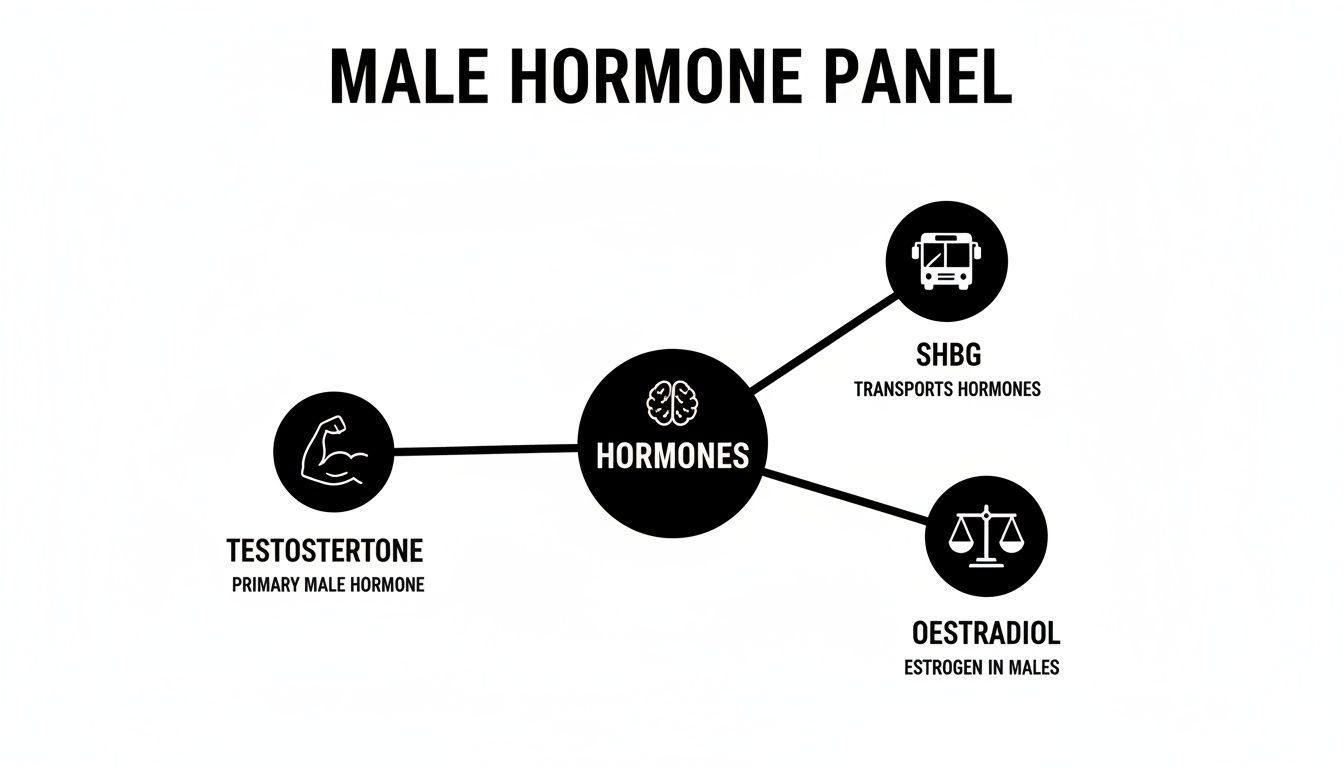
This map gives you a sense of how testosterone production is signalled by the brain and then managed by proteins like SHBG and balanced by oestradiol. It really drives home why a properly prepared test is so critical for an accurate picture to build your health strategy upon.
Controlling Key Lifestyle Factors
Beyond the basics of timing and fasting, a few other lifestyle factors can temporarily throw your hormones out of whack. To get the most accurate results for your longevity plan, you’ll want to keep these in check for a day or two before your blood draw.
-
Avoid Intense Exercise: A tough workout, especially heavy lifting or a long run, can cause a short-term spike in both testosterone and the stress hormone cortisol. It’s best to skip any strenuous exercise for at least 24 hours—ideally 48 hours—before your test. A gentle walk is perfectly fine, though.
-
Prioritise a Full Night's Sleep: Your body does some of its most important testosterone production while you sleep. One bad night can artificially lower your levels the next morning. Aim for a solid 7-9 hours of quality sleep to make sure your results reflect your true baseline.
-
Minimise Stress: High stress floods your body with cortisol, which we know can put the brakes on testosterone production. On the morning of the test, try to keep things calm. Don’t rush around or get wound up by work emails. Even a few minutes of quiet, deep breathing can make a difference.
By standardising your preparation, you eliminate the background noise. This allows your test results to tell a clear and actionable story about your long-term health, rather than just reflecting a stressful day or a hard workout.
Reading Your Results for a Deeper Health Story
Getting your male hormones test report can feel a bit like being handed a complex financial statement. It’s a page full of numbers, strange acronyms, and reference ranges that can seem more confusing than helpful at first glance.
But just like that financial report tells the story of a business's health, your hormone results tell the story of your body's internal resilience. They give you a real, tangible insight into your readiness for a long, healthy life. The key is simply learning how to read between the lines to find actionable longevity insights.
The first and most important step is to move past the idea of a simple "pass" or "fail". Your results aren't just data points; they're clues in a bigger puzzle, showing how different systems in your body are communicating with each other. This mindset shift is what turns a confusing report into an empowering tool for longevity.
Standard Ranges vs Optimal Ranges
When you look at your results, you'll notice a 'reference range' next to each marker. This is the "standard" range, and it’s calculated from the average results of a huge population—a group that often includes people who are far from peak health.
Simply falling within this very broad range means you aren't considered clinically deficient. But it absolutely does not mean you are operating at your best. For longevity and peak performance, we need to focus on 'optimal' ranges.
These are much narrower bands where men typically report feeling their best, with high energy, sharp mental clarity, and robust physical health. Being at the low end of the 'standard' range might be classed as ‘normal’, but it could be the very reason you're feeling fatigued, foggy, or struggling to recover from workouts—all signs that your body isn't primed for a long healthspan.
Think of it like the oil level in your car. As long as it's above the minimum line, the warning light won't come on. But for the engine to run smoothly and last for years, you want the oil level in that sweet spot—not just scraping by at the bottom.
The goal of a proactive male hormones test is not just to avoid disease but to build a foundation for exceptional health. Aiming for optimal hormonal balance is a core strategy for enhancing your healthspan.
This distinction is crucial, especially when you discuss your results with a healthcare professional. Having your numbers allows you to have a much more informed conversation about your personal goals, moving the discussion beyond merely avoiding deficiency to actively pursuing optimisation.
The Interplay of Hormones: A Longevity Story
Here’s where it gets interesting: no hormone works in isolation. They all exist in a delicate, interconnected web. Understanding their relationships is where the real insights for longevity are found. A single number on your report can be seriously misleading without its context.
We see this all the time. A man’s total testosterone comes back within the normal range, yet he’s experiencing all the classic symptoms of low T—fatigue, low libido, and difficulty building muscle. When we look deeper into the results, the real culprit often reveals itself.
-
High Oestradiol: Even with plenty of testosterone, if oestradiol (an oestrogen) levels are too high, the balance is thrown completely off. Oestradiol can effectively compete with testosterone at a cellular level, blunting its positive impact. This hormonal imbalance can create low-T symptoms despite a "normal" T level.
-
High SHBG: Another common scenario involves high Sex Hormone-Binding Globulin. As we covered earlier, SHBG acts like a taxi that locks up testosterone, making it inactive. Your total testosterone might look healthy, but if most of it is bound to SHBG, your biologically active 'free' testosterone will be low, leaving you feeling the effects.
This is exactly why a comprehensive male hormones test is so vital. It gives you the full story—not just the headline character (Testosterone) but the entire supporting cast (Oestradiol, SHBG, LH) that dictates the plot of your health.
This need for a complete picture and expert interpretation is reflected in clinical practice. For instance, one UK study that looked at testosterone testing trends found that of the men identified with low testosterone, only about 10% actually started therapy through NHS channels. This highlights a key point: a single number is rarely enough to prompt action. A clinician has to weigh it against symptoms, how other biomarkers are interacting, and the patient's overall health goals before deciding on the best path forward. You can read the full research about these testing trends for more detail.
By learning to see your results as an interconnected narrative, you shift from being a passive recipient of data to an active participant in your own health journey. That knowledge is what empowers you to ask better questions and make truly informed decisions that will support your vitality for years to come.
Actionable Steps for Hormonal Optimisation and Longevity
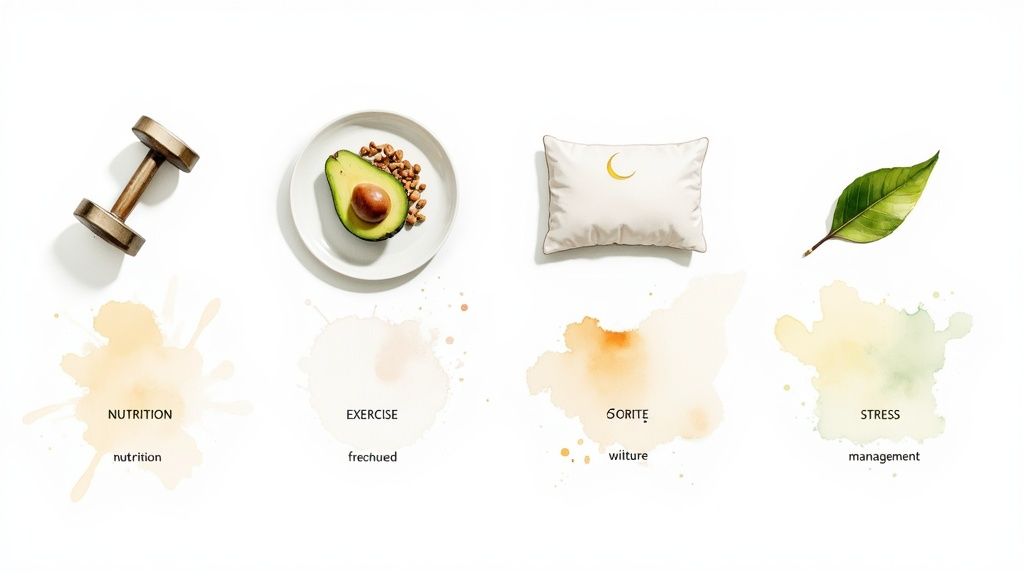
Your male hormones test results aren't the final verdict; they're the blueprint. Now, it’s time to get to work building a solid foundation for long-term health. The numbers on your report are a starting point for making targeted, meaningful changes. By focusing on four key pillars—nutrition, exercise, sleep, and stress management—you can take direct control over your hormonal profile and build a robust framework for longevity.
Think of these pillars as an interconnected system. A terrible night's sleep can wipe out the benefits of a great workout, just as chronic stress can undermine the cleanest diet. Real, sustainable optimisation happens when you address them all together, creating a lifestyle that naturally supports your body's endocrine function. This is how you turn data into daily habits that compound over a lifetime.
The Nutritional Foundation for Hormones
What you eat quite literally provides the raw materials your body needs to manufacture hormones. Your diet is the supply chain for your endocrine system; if the deliveries are poor quality, production will suffer. For male hormonal health and longevity, certain nutrients are non-negotiable.
Healthy fats are the direct precursors to testosterone, and micronutrients like zinc and Vitamin D are crucial co-factors in the hormonal assembly line.
Here are a few actionable nutritional tweaks to get started:
- Prioritise Healthy Fats: Weave sources like avocados, nuts, seeds, olive oil, and oily fish (salmon, mackerel) into your daily meals.
- Ensure Adequate Zinc: This mineral is vital for testosterone synthesis. You can find it in red meat, shellfish (oysters are a powerhouse), pumpkin seeds, and lentils.
- Optimise Vitamin D: Many men in the UK are deficient, especially in winter. Get regular, safe sun exposure, and consider supplementing once you've had your levels checked.
Beyond what's covered here, a comprehensive guide on how to improve male fertility offers many related nutritional strategies that are also excellent for overall hormonal health.
Exercise as a Potent Hormonal Signal
Exercise is one of the most effective ways to send a powerful, positive signal to your endocrine system. While all movement is good, certain types have a particularly potent effect on male hormones, and resistance training is king for longevity.
Lifting weights creates a direct stimulus for testosterone and growth hormone release, both of which are essential for muscle repair, metabolic health, and maintaining vitality as you age. Studies confirm that big, multi-joint exercises trigger the most significant hormonal response.
When you lift heavy weights, you aren't just building muscle; you are instructing your body to create a more anabolic, resilient internal environment. This is a direct investment in your long-term strength and metabolic function.
Try to integrate these principles into your routine:
- Focus on Compound Lifts: Build your workouts around movements like squats, deadlifts, bench presses, and overhead presses.
- Train with Intensity: The name of the game is progressive overload—gradually increasing the weight, reps, or sets over time to consistently challenge your body.
- Don't Neglect Cardio: While lifting is key, moderate cardiovascular exercise helps manage cortisol and improve insulin sensitivity, which fosters a better overall hormonal environment for the long term.
The Critical Role of Sleep and Recovery
You could have the perfect diet and a flawless training plan, but without enough sleep, your hormonal health will stall. Your body produces a huge chunk of its daily testosterone and growth hormone during the deep stages of sleep. Cutting that short is like directly sabotaging your body's most important rejuvenation cycle.
Even one poor night of sleep can lower your testosterone levels the next day. Chronic sleep deprivation acts as a major stressor, jacking up cortisol levels, which further suppresses testosterone and torpedoes your recovery. Making sleep a non-negotiable priority is one of the highest-impact changes you can make for your longevity.
Managing Stress to Protect Your Progress
Finally, you have to get a handle on your stress. Cortisol, your body's primary stress hormone, has an inverse relationship with testosterone. When you're stuck in a state of chronic stress, cortisol stays elevated, effectively slamming the brakes on testosterone production and accelerating the ageing process.
This is a deep-seated biological survival mechanism. In a high-stress state, your body diverts resources to immediate survival, not long-term projects like building muscle. To optimise your hormones for the long haul, you must actively work to lower your baseline cortisol through dedicated stress-management practices. This could be mindfulness, meditation, deep breathing exercises, or even just making time to walk in nature.
Your test results gave you the "what." These pillars give you the "how."
Got Questions About Male Hormone Testing? We’ve Got Answers.
Even after getting the facts, it's completely normal to have a few practical questions rattling around before you decide to get a male hormones test. Let’s tackle some of the most common ones we hear, giving you straight answers so you can move forward with confidence.
Think of this as your final briefing before taking a big step towards owning your long-term health. We'll clear up the details on how often you should test, whether at-home options are actually reliable, and how all this fits in with your GP.
How Often Should I Test My Hormones for Long-Term Health?
The ideal frequency really comes down to your age, your goals, and whether you're experiencing any symptoms. It’s not about obsessively tracking numbers; it’s about strategic check-ins that guide your health journey.
Here’s a sensible way to think about it:
- Setting Your Baseline: If you're a healthy guy in your late 20s or early 30s, getting a comprehensive panel done now is a brilliant longevity move. It creates a snapshot of your hormones at their peak, giving you a personal benchmark to compare against for decades to come.
- Keeping an Eye on Things: After establishing that baseline, re-testing every 2-5 years is a solid plan. This is usually enough to spot any significant long-term shifts before they cause problems.
- When You're Actively Making Changes: Are you over 40, noticing symptoms, or starting a new diet or fitness regime? This is when more frequent testing really pays off. A follow-up test 3-6 months after making changes will show you if they're actually working. After that, testing annually is a great way to stay on course.
Ultimately, your testing schedule should be a personal strategy. The aim is to get useful data that helps you and your doctor make smart decisions for a long, vibrant life.
Are At-Home Hormone Tests as Reliable as a GP Test?
This is a fantastic and important question. The short answer is: it all depends on how the sample is collected and where it’s analysed.
Let’s be honest, the old-school finger-prick tests have a bad reputation for a reason—the tiny sample size and risk of contamination can easily skew the results. But modern at-home testing has evolved. Services that send a professional phlebotomist to your home to perform a proper venous blood draw (from a vein in your arm) are a completely different ball game.
The reliability of a test has nothing to do with where the blood is drawn. It's about the quality of the sample and the credentials of the lab. A professional blood draw sent to an accredited lab is the gold standard, whether it happens at your kitchen table or in a clinic.
When a trained professional takes your blood, the sample is just as good as one taken at your GP’s surgery. From there, it’s sent to the very same UKAS-accredited, NHS-standard labs that the NHS uses. This ensures your results are as accurate as they can possibly be, giving you a solid foundation for any health decisions you make.
Will My GP Order a Full Hormone Panel for Me?
This is where things can get a bit tricky. The NHS is designed to diagnose and treat existing illness, not necessarily to proactively optimise health for longevity. Because of this, a GP is most likely to order a basic testosterone test if you come in with clear, strong symptoms of a clinical deficiency, like hypogonadism.
Getting a GP to order a comprehensive male hormones test—one that looks at the bigger picture with markers like SHBG, oestradiol, LH, and cortisol—purely for health optimisation is much less common. The system just isn't set up for that kind of proactive, preventative care.
That’s why so many men who are serious about their long-term wellness decide to go private. It gives them direct access to the detailed data they need to truly understand their hormonal health and take meaningful steps towards a longer, healthier future.
Ready to get started? Lola brings a professional phlebotomist to you, delivering NHS-standard lab results and a doctor’s review straight to your inbox. It’s time to take control of your health story. Book your comprehensive male hormones test today.