


In the UK, a typical creatine kinase (CK) level generally falls between 40–320 IU/L for adult men and 25–200 IU/L for adult women. But these are just guidelines. Your personal 'normal' is a unique fingerprint shaped by your activity levels and muscle mass, making it a powerful gauge of your muscle health and long-term vitality.
What Creatine Kinase Reveals About Your Health
Think of Creatine Kinase (CK) as your body’s built-in engine light for your muscles. It's an enzyme that lives primarily in your muscles, heart, and brain.
When your muscles are put under stress—whether from a challenging gym session or an unexpected injury—they release tiny amounts of CK into your bloodstream. A temporary spike is completely normal; it’s just a sign that your body is busy repairing and rebuilding muscle tissue, a crucial process for maintaining strength as you age.
However, if your levels are consistently too high or unusually low, it could point to an underlying issue. Getting to know your personal baseline CK value is a smart, proactive step towards managing your physical health for the long run.
Understanding the Standard UK Ranges
To really get a grip on CK levels, it helps to know what doctors are looking for. Here in the UK, the NHS uses established reference ranges to interpret results, measured in international units per litre (IU/L).
For a quick reference, here are the standard ranges you'll see in the UK:
Standard UK Reference Ranges for Creatine Kinase (CK)
| Group | Normal CK Range (IU/L) | Average UK Level (Forth Data) |
|---|---|---|
| Adult Men | 40–320 IU/L | 292.7 IU/L |
| Adult Women | 25–200 IU/L | 127 IU/L |
These numbers provide a solid starting point, but they don't tell the whole story.
Interestingly, real-world data from a study of over 2,000 UK individuals showed that the average levels were quite a bit higher than the bottom end of the official range. The average CK for men was 292.7 IU/L, while for women it was 127 IU/L.
This chart helps to visualise the difference between the average levels and the standard reference ranges.
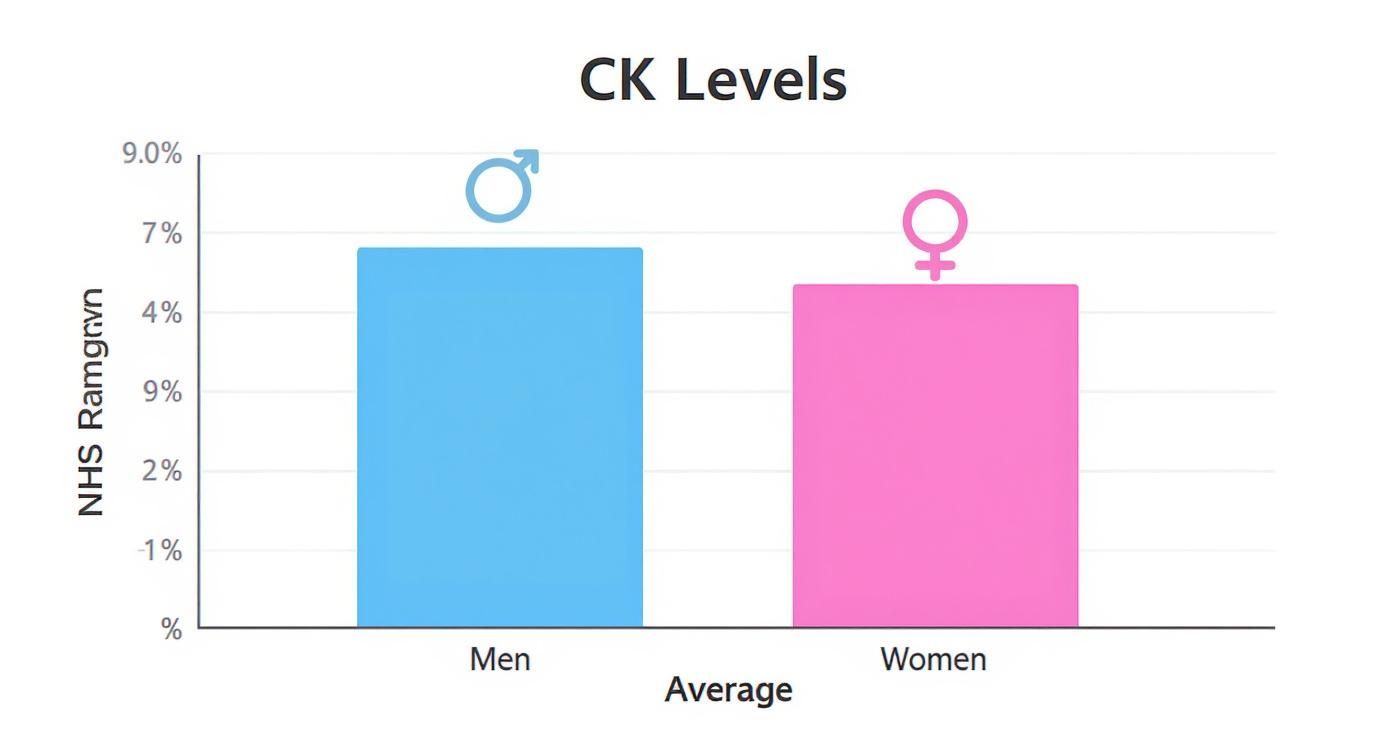
As you can see, many healthy, active people naturally sit closer to the upper end of the 'normal' scale, especially men. It just goes to show that what’s considered typical on paper might not reflect the reality for someone who is physically active.
Your CK level is more than just a number; it’s a dynamic reflection of your body’s muscle stress and recovery. It’s not about hitting a perfect figure, but about understanding what is normal for you and tracking trends over time to support a long, active life.
Keeping an eye on your CK trends gives you a huge advantage, especially if you take your long-term health seriously. It offers actionable insights that can help you:
- Judge how well you’re recovering from exercise.
- Avoid overtraining and lower your risk of injury.
- See the real impact of lifestyle changes on your muscle health.
By learning to read this important biomarker, you can make smarter decisions to protect your muscles and build physical resilience for longevity. The best way to start is by establishing your personal baseline with a Creatine Kinase blood test.
Why Your CK Levels Might Be Elevated

If you see a creatine kinase level flagged as ‘high’, it's natural to feel a bit concerned. But more often than not, it’s just your body's normal response to physical work. The real key is understanding what’s causing the spike, so you can interpret your results accurately. The most common culprit? A good, hard workout.
When you push your muscles, you’re actually creating tiny, microscopic tears in the muscle fibres. This is a crucial part of the process of getting stronger, and it triggers CK to be released into your bloodstream. Think of it as a signal that the repair and rebuild crew is on the job.
Exercise: The Leading Cause
Strenuous physical activity is far and away the number one reason for a temporary jump in normal CK values. Just how high your levels climb depends a lot on the intensity and type of exercise you’re doing.
- Resistance Training: Heavy lifting, especially movements with a focus on the eccentric or lengthening phase (like lowering a dumbbell slowly), is a classic trigger for elevated CK.
- High-Impact Activities: Think of sports that involve a lot of sprinting, jumping, or sharp changes in direction. These place a huge demand on your muscle tissue.
- Endurance Events: A long run, particularly one with a lot of downhill sections, can cause significant muscle breakdown and send CK levels soaring for days afterwards.
A spike after a tough session isn't a red flag for damage; it’s a green light for adaptation. It's solid proof you've challenged your body enough to grow stronger. By keeping an eye on these fluctuations, you can fine-tune your training to build lasting muscle resilience—a key component of lifelong fitness.
Other Factors That Raise CK Levels
While a workout is the usual suspect, several other factors can push your CK readings higher. Knowing what these are helps you and your doctor get the full story about your health.
Medications are one common area to consider. Certain drugs, especially statins used to manage cholesterol, are well-known for causing muscle inflammation and pain, which naturally elevates CK. If you’re taking statins and feeling any muscle discomfort, it’s definitely something to bring up with your doctor.
Of course, any direct muscle trauma from an injury or accident will cause a major CK release as your body gets to work healing the damaged tissue. Less frequently, underlying health conditions can play a part. Some viral infections might cause temporary muscle inflammation (myositis), and certain chronic conditions that affect muscle function can also result in consistently high CK.
Understanding the 'why' behind an elevated CK level empowers you to distinguish between a normal physiological response and a potential health concern. This context is vital for making informed decisions about your training, recovery, and long-term wellbeing.
Finally, don't forget about lifestyle choices and supplements. Something as simple as dehydration can put extra stress on your muscles and magnify the CK release. And since supplements can also influence things, understanding the impact of creatine supplementation on muscle health and CK levels can add another layer of context to your results. When you piece all these possibilities together, you can turn your CK value into a genuinely useful tool for optimising your health for years to come.
How an Active Lifestyle Shapes Your CK Levels

If you're committed to training, you need to know that the standard definition of 'normal' CK values simply doesn't apply to you. Regular exercise fundamentally changes your body's baseline, which means a 'high' CK reading on a standard lab report might be perfectly healthy for you.
Think of it like this: a sedentary person’s muscles are like a quiet country road, whereas an athlete’s are a busy motorway. The constant 'traffic' of muscle breakdown and repair from training means there's always more activity, and therefore, a higher baseline level of CK in your blood.
This isn’t a red flag for damage; it's a sign of adaptation. It shows your body is constantly responding to the demands you place on it, growing stronger and more resilient in the process. This elevated baseline is a hallmark of a well-trained system ready for the long haul.
Your Training Style And CK Levels
The type, intensity, and sheer volume of your workouts will directly influence what your normal CK level looks like. Different activities create different levels of muscle stress, and that leads to very different CK responses.
- Strength Athletes: Powerlifters, bodybuilders, and anyone focused on heavy resistance training will often have the highest baseline CK levels. This is down to the intense, highly-localised muscle damage that heavy lifting causes.
- Endurance Athletes: Marathon runners, cyclists, and triathletes also see elevated CK, particularly after long or especially gruelling sessions that lead to prolonged muscle stress.
- Team Sport Players: Footballers, rugby players, and others in sports that demand explosive movements will see significant CK spikes after a tough match or a demanding practice.
It's this huge variation that makes a single 'normal' range almost useless for anyone who takes their training seriously.
The Athlete's 'Normal' CK Range
So, what does a typical CK level look like for someone who trains regularly? While it’s highly individual, we can look at the data to see a clear trend. Here's how the median CK levels in UK athletes stack up against the standard NHS reference ranges.
Median CK Levels In UK Athletes vs General Population
| Sex | Median CK in UK Athletes (IU/L) | Standard NHS Normal Range (IU/L) |
|---|---|---|
| Male | 230 | 38 - 174 |
| Female | 131 | 26 - 140 |
As you can see, the typical CK value for an active man is well above the standard 'normal' range, while for a woman, it sits right at the very top end. This data, drawn from UK sports-focused blood testing, clearly shows the gap between the general population and those who are physically active. For a deeper look, you can explore the findings on athlete biomarkers from Sportsbloodtests.co.uk.
This shows why context is everything. What might be an alarming number for a GP looking at a standard report could simply be business as usual for an athlete.
For an athlete, a higher baseline CK level is not an alarm bell but a data point. It’s evidence of hard work and adaptation, providing valuable feedback on training load and recovery status to ensure you can train effectively for a lifetime.
By tracking your CK trends over time, you can turn this biomarker into a powerful tool for longevity. It helps you understand how your body is handling your training load, allowing you to fine-tune your routine to prevent overtraining and reduce your risk of injury. This proactive approach helps make sure your fitness journey is both productive and sustainable for years to come. To go deeper, you can learn how to use blood tests for fitness and gain a genuine competitive edge.
What Low CK Levels Can Tell You
While high CK levels tend to grab the spotlight, consistently low readings can also be a quiet but important clue about your health. It’s not necessarily a good or bad thing on its own, but think of it as a signal from your body that might warrant a closer look, especially when you’re thinking about long-term health and longevity.
The most common reason for low CK is simply having less muscle mass. Since CK is an enzyme that lives in your muscle tissue, it makes sense that fewer muscle fibres mean less of it floating around in your bloodstream. This is something we often see in people who lead more sedentary lives or in older adults who are naturally losing muscle as they age.
Low Muscle Mass and Your Future Health
A pattern of low CK values could be an early hint of sarcopenia—the gradual loss of muscle mass, strength, and function that is a key factor in how well we age. Sarcopenia isn't just about feeling a bit weaker; it can have a real knock-on effect on your metabolic health and how resilient your body is over time.
Keeping a healthy amount of muscle is absolutely vital for longevity:
- Metabolic Control: Muscle is a huge consumer of glucose. More muscle helps keep your blood sugar in check and makes your body more sensitive to insulin.
- Physical Resilience: Strong muscles act like scaffolding for your joints, improve your balance, and lower the risk of falls and fractures as you get older.
- Overall Vitality: Having enough muscle supports a higher resting metabolism and is a big contributor to your overall energy and strength.
When you look at a low CK reading through this lens, it’s not just a number on a page. It can be a practical nudge to focus on activities that build and protect the muscle you need for a long, active life.
Other Things That Can Cause Low CK
Aside from low muscle mass, a few specific health conditions have also been linked to reduced CK levels. These are less common, but it’s why it’s always important to chat with your doctor about any trends you notice in your results.
For example, some studies have found a connection between very low CK and certain chronic conditions. A 2019 study, using data from the UK's ME/CFS Biobank, discovered that people with severe myalgic encephalomyelitis/chronic fatigue syndrome had significantly lower CK levels. This difference was still there even after the researchers adjusted for things like muscle mass and activity. You can read more about the research into CK levels and ME/CFS on the ME Association's website.
Consistently low CK isn't a diagnosis. It's a data point that can spark a positive change—the perfect catalyst for focusing on strength training, getting your protein intake right, and building a more resilient body for the years ahead.
Ultimately, a low CK reading gives you a great opportunity to be proactive. It might be the push you need to add some resistance training to your week or make sure you're eating enough protein. These are concrete steps you can take to protect your physical strength and metabolic health, laying a solid foundation for your future self.
How to Prepare for an Accurate CK Test

If you want to truly understand your normal CK values, timing and preparation are everything. A CK test is just a snapshot in time, capturing your muscle health at a single moment. What you do in the days leading up to it can dramatically change the result. By taking a few simple steps, you can ensure your test reflects your genuine baseline, not just a temporary spike from a hard gym session.
This preparation is so important for tracking your health over the long term. Getting an accurate reading gives you a reliable benchmark to monitor your muscle health for years to come. It allows you to make smarter, more informed decisions about your training, recovery, and overall wellness. Without that clear baseline, spotting meaningful trends becomes almost impossible.
The single most important step is to rest for 48 to 72 hours before your blood test. Intense exercise is the biggest culprit behind temporarily high CK levels. Giving your muscles a break allows them to recover and your CK to settle back down to its true resting state.
Your Pre-Test Checklist
To get the most reliable results, follow this simple checklist. It’s designed to minimise outside factors that could skew your numbers, ensuring the data you get is genuinely useful for your long-term health planning.
- Schedule Rest Days: Plan for at least two full days without any intense exercise. Light activity like walking is perfectly fine, but you'll want to skip the heavy lifting, long runs, or high-intensity interval training.
- Stay Well-Hydrated: Dehydration can put extra stress on your muscles, which may artificially inflate your CK levels. Make sure you're drinking plenty of water in the 24 hours leading up to your test.
- Avoid Alcohol: Alcohol can interfere with muscle recovery and metabolism. It’s best to avoid it for at least a day before your blood draw to make sure it doesn’t influence your results.
- Review Your Medications: Let your healthcare provider know about any medications or supplements you’re taking. Some can have a surprising impact on CK levels.
Beyond the Basics
While you're getting your CK levels checked, you might also want to explore comprehensive blood testing for biomarkers for an even fuller picture of your health. Services like these can offer much wider insights into how your body is functioning.
Capturing an accurate CK reading isn't just about getting a number; it's about collecting reliable data to inform your long-term health strategy. Proper preparation turns your test from a simple measurement into a powerful tool for longevity.
Following these guidelines puts you in a much better position to have a productive conversation with your doctor. For even more tips on making your blood draw go as smoothly as possible, have a look at our guide on how to prepare for phlebotomy.
When to Discuss Your CK Results with a Doctor
https://www.youtube.com/embed/DLUjSKQfST4
Getting your blood test results back is a great first step, but the real power comes from knowing what they actually mean for you. It’s one thing to know your normal CK values, but it’s far more important to recognise when a result is a red flag that warrants a conversation with your doctor.
This isn’t about panicking over every little fluctuation. Far from it. It's about using the information from your test to work with your healthcare provider, turning those insights into a solid plan for your long-term health. A single high or low reading is often just a momentary blip, but a persistent pattern, or a result that comes with certain symptoms, is definitely worth looking into.
Key Scenarios for a Doctor's Visit
Think of your CK level as one piece of a much larger health puzzle. When that piece doesn't seem to fit with the rest of the picture, it's time to talk to your doctor.
Here are a few specific situations when you should book an appointment to go over your results:
- Persistently High Levels Without Exercise: If your CK is consistently high even after you’ve taken a proper rest from intense exercise (at least 48-72 hours), it’s time to get it checked out.
- Results Paired with Symptoms: If you get a high CK result and you're also experiencing symptoms like severe muscle pain, weakness, or dark-coloured urine, you should seek medical advice right away.
- Consistently Low Readings: While often just a sign of lower muscle mass, a consistent pattern of unusually low CK values is worth exploring, especially if you’re also feeling persistent fatigue or weakness.
Acting on your results isn't about reacting to a single number, but about recognising patterns. This proactive approach helps you and your doctor work together to protect your muscle health, which is a cornerstone of a long and active life.
By knowing when it's time for a medical consultation, you shift from simply gathering data to actively using it. This ensures you can address potential issues early, avoid needless worry, and make informed choices that will support your health for years to come.
Answering Your Questions About CK Levels
Can Diet Affect My Creatine Kinase Levels?
While your diet doesn't directly dictate your CK levels in the way a hard workout does, it absolutely plays a crucial supporting role in muscle health and recovery. Think of it this way: exercise causes the muscle damage, but your diet provides the tools for the repair job.
For instance, if you're not getting enough protein, your body's ability to mend those muscle fibres slows right down. This can mean your CK levels stay higher for longer after training. Dehydration is another big one; it can amplify muscle damage during a session, leading to a much bigger spike in CK than you'd normally see.
It's also worth knowing that some supplements, like the popular creatine monohydrate, can cause a slight, harmless bump in your baseline normal CK values. This is completely expected for anyone taking it.
How Long Until CK Levels Normalise After Exercise?
This really comes down to the intensity of your workout and your personal fitness level. There's no single timeline that fits everyone.
After a moderately tough session, you can expect your CK levels to peak around 24-48 hours later and then settle back to your usual baseline within three to five days. But if you’ve just run a marathon or competed in a heavy powerlifting event, that's a different story. In those cases, it’s perfectly normal for levels to stay high for a week or even more as your body works through some serious repairs.
Is a Very Low CK Level Always a Concern?
Not necessarily. Often, a low CK reading simply points to having less muscle mass or being more sedentary for a while. It's not usually an immediate red flag on its own.
Where it becomes really useful is when you look at it as part of a bigger picture over time. If a low reading is a new development, or if you're also feeling symptoms like unusual fatigue, it’s definitely something to bring up with your doctor.
For many, a low CK reading is simply a valuable nudge to focus on resistance training and protein intake to build or maintain muscle, which is crucial for healthy aging and longevity.
Ultimately, tracking your personal trends is what gives you the power to make smart, informed decisions for your long-term health.
Take control of your muscle health with Lola. Get a clear picture of your baseline with our at-home blood tests, analysed in UKAS-accredited labs, with results and a doctor's review delivered straight to your phone. Find out more about our health testing services.