


Are you feeling constantly run down, struggling with brain fog, or noticing that it takes you longer to bounce back? It’s easy to chalk these feelings up to 'burnout', but they can be tell-tale signs that hidden nutrient gaps are undermining your long-term health. A vitamin deficiency test in the UK isn't just a tool for spotting illness; it's a strategic move to fine-tune your biology and boost your healthspan.
Why Your Longevity Hinges on Hidden Nutrient Gaps

Think of your body as a high-performance engine built for the long haul. It can have the best chassis and the most powerful parts, but if you’re putting in the wrong fuel, it’s never going to achieve its full potential or last the distance. Vitamins and minerals are the important additives in that fuel, orchestrating everything from cellular energy production to mental sharpness and the fundamental processes of repair and renewal.
When these micronutrient levels are even slightly off-kilter, your longevity is compromised. You might find yourself pushing through the day feeling a step behind, blaming stress or a bad night’s sleep. The real culprit, however, could be an invisible deficiency quietly accelerating the ageing process. This is where a data-driven approach becomes absolutely vital for a long and healthy life.
The Silent Drain on Your Healthspan
Unseen deficiencies can take a serious toll on both your day-to-day vitality and your long-term health. Just think about these common scenarios impacting longevity:
- Vitamin D: We often call it the 'sunshine vitamin', but its role is far more profound, acting like a hormone that regulates immunity and cellular health. With nearly 50% of UK adults having below-optimal levels, it’s a widespread issue that can weaken your immune defences and impair muscle function - a cornerstone of healthy ageing.
- B Vitamins (B12 & Folate): These are the spark plugs for your body's energy production and nerve protection. A shortfall can directly cause the brain fog and fatigue that hinder daily performance, but over the long term, it can impact cognitive health and nerve function.
Making the switch from guessing to knowing is the first, most important step in building a foundation for a long and vibrant life. If you want to look more closely at the essential role of nutrients and dietary strategies, you can explore the nutrition category.
A Proactive Approach to Longevity
Waiting for obvious symptoms to show up is a reactive way to manage your health. Longevity science, on the other hand, is all about being proactive - spotting and fixing small imbalances before they snowball into bigger problems. A vitamin deficiency test gives you the actionable data you need to fine-tune your biology for the years ahead.
By understanding your body's unique biochemical needs, you can make targeted adjustments to your diet and supplementation. This isn't just about feeling better today; it's about building a resilient biological system capable of thriving for decades to come.
The good news is that modern testing has made getting this information easier and more precise than ever. This guide will walk you through how to use these tools to take back control, ensuring your body has everything it needs to support your long-term health goals - both now and for years to come.
What Does a Vitamin Deficiency Test Actually Tell You?
Think of your body as a high-performance engine. A vitamin deficiency test in the UK is essentially the diagnostics report. It’s not just about a general check-up; it's about getting precise data on the essential compounds that fuel your energy, sharpen your focus, and drive cellular repair - the very things that underpin longevity.
These tests look at specific biomarkers in your blood. In simple terms, a biomarker is a measurable indicator of what’s happening inside your body. It’s like the oil light on your car’s dashboard. That light doesn't mean the engine has seized; it's an early warning, a chance to top up the oil and prevent serious damage down the line. In the same way, a biomarker showing low Vitamin D gives you a heads-up long before you feel the full, debilitating effects, allowing you to correct the course and protect your future health.
For anyone serious about building a longer, healthier life, these early warnings are gold. They let you stop guessing what your body needs and start making decisions based on solid evidence.
Beyond 'Normal': Why 'Optimal' is the Goal for Longevity
One of the biggest shifts in modern health is understanding the difference between ‘normal’ and ‘optimal’ ranges. A ‘normal’ range is usually just a broad average drawn from the general population. If you fall within it, it generally just means you aren't acutely ill.
But for longevity, ‘normal’ is a pretty low bar. Optimal ranges are much narrower targets, backed by evidence showing they are associated with the lowest risk of future disease and the highest levels of physical and mental function. A good vitamin deficiency test gives you the clarity to aim for optimal, helping you move from simply not being sick to actively building a more resilient, vibrant you for the long term.
Pursuing optimal levels is the fundamental difference between reactive healthcare and proactive health optimisation. It’s about fine-tuning your engine for maximum power and endurance, not just keeping it ticking over.
This proactive approach has never been more relevant. A recent study found that 48% of the UK population doesn't get their required daily vitamins and minerals from diet alone. This figure shoots up to a massive 61% among 18–24-year-olds - a group whose current habits will shape their future health. This isn't just a statistic; it's reflected in NHS England data showing a rise in hospital treatments for iron and B vitamin shortages. Add to that the fact that an estimated 60% of Brits have insufficient Vitamin D levels, and the picture becomes clear. You can explore the full UK nutritional analysis to see the data for yourself.
The Key Vitamins That Drive Longevity and Performance
While a comprehensive test can check for many things, a few key players are absolutely critical for energy, brain function, and long-term health. Understanding what they do is the first step to taking meaningful action based on your results.
The table below breaks down the most important vitamins and minerals a high-quality test should cover, what they do, and the tell-tale signs that you might be running low.
Key Vitamins for Longevity and What They Do
| Vitamin/Mineral | Role in Longevity & Performance | Common Deficiency Symptoms |
|---|---|---|
| Vitamin D | Often called the "sunshine vitamin," it acts more like a hormone, controlling immune function, muscle strength, and mood. important for long-term resilience. | Persistent fatigue, low mood, frequent colds or infections, muscle weakness. |
| Vitamin B12 | The master vitamin for energy and cognitive health. It's vital for creating red blood cells and protecting your nerves. Non-negotiable for a sharp mind. | Brain fog, constant tiredness, pins and needles, memory issues. |
| Folate (Vitamin B9) | Works hand-in-hand with B12. It’s essential for DNA synthesis and repair - a core process for healthy ageing and cell renewal. | Unexplained fatigue, irritability, pale skin, shortness of breath. |
| Iron | The backbone of haemoglobin, the protein that carries oxygen to every cell in your body, from your brain to your muscles. Low iron starves your body of energy. | Poor stamina, breathlessness during exercise, poor concentration, cold hands and feet. |
By measuring these specific biomarkers, a vitamin deficiency test gives you an incredibly clear, scientific snapshot of your internal health. This isn't just a page of numbers; it's your personal roadmap to building a stronger, more resilient foundation for a long and vibrant life.
Navigating Your UK Testing Options: NHS vs Private
So, you’ve decided to get a vitamin deficiency test in the UK. The next big question is: where do you go? Broadly, you have two main routes – the National Health Service (NHS) or a private provider. It’s a important choice, as the path you take will massively influence the speed, access, and depth of information you get back about your long-term health.
The NHS is, of course, a cornerstone of UK healthcare. But it’s fundamentally a reactive system, designed to step in when you’re already feeling unwell. To get a vitamin test via your GP, you’ll first need an appointment, then you'll need to present symptoms that justify further investigation. Only then might you get a referral for a blood test, and even then, you're facing a wait.
This model can be a real roadblock if you're trying to be proactive about your longevity – to get ahead of problems before they even start. The tests your GP orders will usually be limited to the one or two vitamins they suspect might be causing your symptoms, so you won’t get that full, 360-degree view you need for a true longevity strategy.
The Private Pathway: Proactive and Personalised
This is where private testing really changes the game. It flips the entire model from reactive to proactive. With a private service, you don’t need a GP referral, and you certainly don’t need to be showing symptoms. It's designed for people who view health not just as the absence of illness, but as a platform for building long-term vitality.
The advantages are pretty clear:
- Direct Access: You’re in control. You can book a test online whenever you decide it's time, without needing anyone's permission.
- full Panels: Instead of just one or two markers, private tests can analyse a whole suite of biomarkers, giving you a much richer picture of what’s going on inside.
- Sheer Convenience: Many services, including Lola, offer at-home testing where a trained phlebotomist comes to you. No travel, no waiting rooms. Simple.
- Speedy Results: We're talking about getting detailed results back in a matter of days, not weeks. This means you can act on the insights almost immediately.
This image shows you exactly what a detailed metabolic health panel looks at. It’s not just a single number; it breaks down key biomarkers, vitamins, and their optimal ranges, turning complex data into your personal health dashboard.
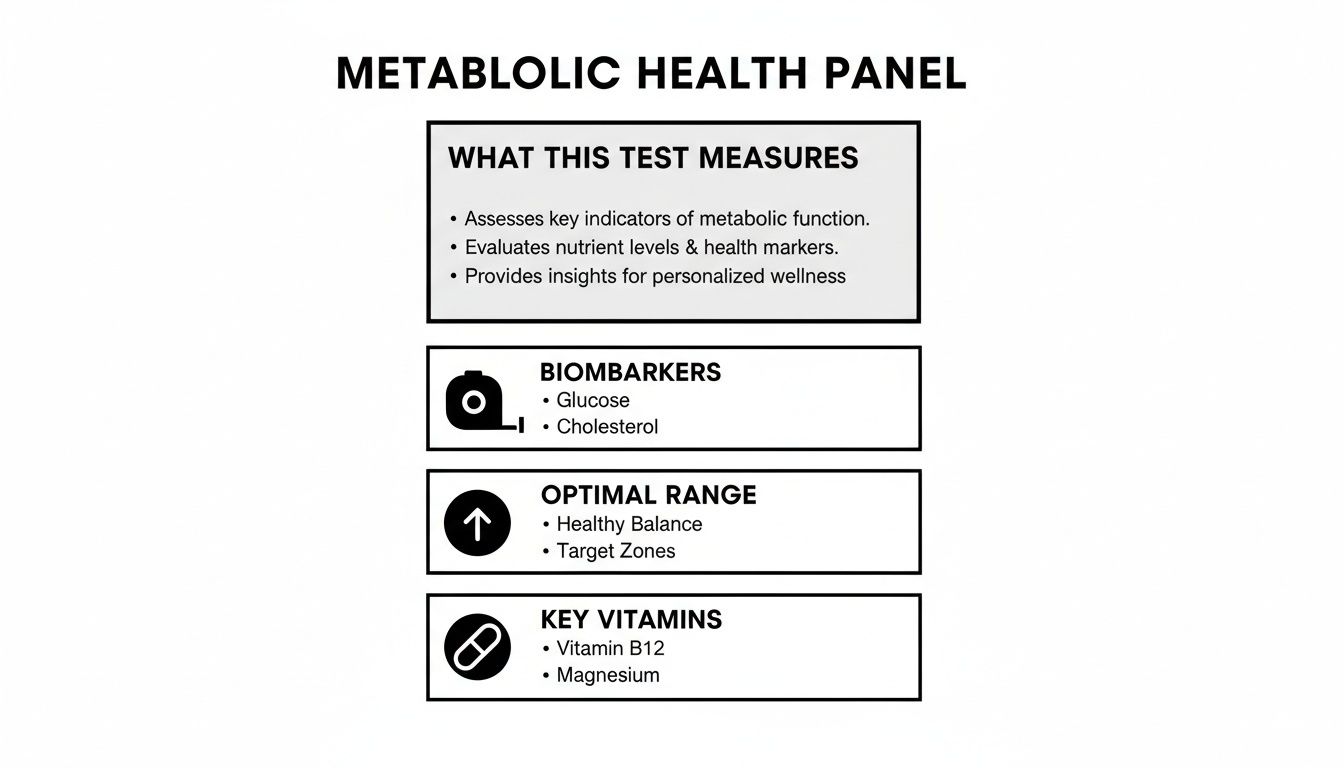
Seeing it laid out like this makes it obvious how much more actionable this kind of information is compared to a simple "deficient" or "not deficient" result.
Comparing Vitamin Test Providers: NHS vs Private
To put it all into perspective, let's break down the key differences side-by-side.
| Feature | NHS Pathway | Private Service |
|---|---|---|
| Access | Requires GP appointment and symptomatic justification. | Direct access; book online anytime. |
| Speed | Can involve long waits for appointments and results. | Quick turnaround, often with results in a few days. |
| Scope | Typically tests for specific, suspected deficiencies only. | Offers broad, thorough panels for a full overview. |
| Convenience | Requires travel to a GP surgery and/or clinic. | At-home sample collection is a common, convenient option. |
| Cost | Free at the point of service. | Paid service; cost varies by the test panel's depth. |
Ultimately, while the NHS offers an essential service at no cost, the private route provides a level of speed, detail, and convenience that is simply in a different league for those serious about longevity.
An Investment in Your Long-Term Health
While going through the NHS is free, the waiting times and narrow scope come with a different kind of price – a cost to your time, your peace of mind, and your ability to be proactive about your future. The strain on the health service is making this more apparent than ever. In just one recent year, NHS hospitals in England recorded 191,927 admissions related to iron deficiency, an 11% increase on the year before. And admissions for anaemia caused by B12 or folate deficiencies hit 3,490, a staggering fourfold rise since the late 1990s.
Opting for a private test is an investment in yourself. It's about choosing efficiency, deeper insights, and personalised care to get ahead of potential issues and build a solid foundation for a long, healthy life.
This approach puts you firmly in the driver's seat. If you're wondering about the specifics of getting started, our guide on whether you can request a blood test in the UK walks you through it. For anyone truly committed to optimising their healthspan, the private pathway is the clear choice.
How Does At-Home Vitamin Testing Actually Work?

Let’s be honest, the traditional route for getting a blood test can be a real hassle. Between booking a GP appointment, queuing at a clinic, and then waiting days for the results, the whole process feels clunky and slow - especially when you’re building a long-term health strategy.
Thankfully, modern private health services have stripped all that away. Getting a vitamin deficiency test in the UK is now a simple, straightforward experience you can manage entirely from home.
It all starts with a quick online order. You simply choose the test panel that matches your health goals, whether that’s a focused vitamin check or a broader look at your metabolic health. The best part? No referral is needed, so you’re in the driver's seat from day one.
This new way of doing things gets rid of the friction that often puts people off being proactive about their health. Instead of working your week around an appointment, the appointment works around you.
Why Sample Quality is Non-Negotiable
Once you've booked, a qualified phlebotomist comes to you at a time and place that suits you, whether that's your home or even your office. They’ll perform a venipuncture blood draw, which means taking a small sample from a vein in your arm.
This isn’t just for convenience; it’s about getting the most accurate results possible to inform your longevity plan.
Venipuncture is the same 'gold standard' method the NHS uses for a reason. It provides a clean, high-volume blood sample, which avoids the contamination issues and higher failure rates sometimes seen with finger-prick tests.
When you're making decisions that affect your long-term health and performance, you can't afford to compromise on data quality. The venipuncture method ensures your results are 99.8% accurate, as they’re processed in the very same UKAS-accredited labs the NHS relies on.
This guarantees the insights you get are solid, reliable, and something you can actually build a health strategy on. If you're curious to learn more, our guide on how to get a blood test at home breaks down the entire process.
Your Results, Explained in an App
After the sample is collected, the final step is getting your results. Forget waiting for a letter or a phone call. Your health data is delivered straight to a secure, easy-to-use app on your phone.
But this isn’t just a list of numbers. The platform is designed to make your data meaningful:
- Clear Visuals: You can instantly see where your levels sit within the optimal ranges, with no confusing jargon.
- Track Your Progress: The app helps you monitor your biomarkers over time, so you can see the real impact of any changes you make to your diet, supplements, or lifestyle.
- Expert Medical Review: Most importantly, a qualified doctor personally reviews your results and provides a plain-English summary, explaining what it all means for you and your healthspan.
From booking the test online to reading a doctor’s analysis on your phone, the entire process is designed to be effortless. It turns a clinical task into an enabling tool for managing your health, so you can make smarter decisions for a longer, healthier life.
Turning Your Results into a Longevity Strategy
Getting your vitamin test results back is the starting line, not the finish. You've got the data, but the real value comes from turning those numbers into a practical, personal plan. This is the moment you stop just gathering information and start actively building a strategy for a longer, healthier life.
The first thing to do is reframe what ‘normal’ means. For anyone serious about longevity, the goal isn't just to be 'within range' — it's to be optimal. An optimal level doesn't just keep you from getting sick; it fuels your body to perform at its peak, supporting everything from mental clarity to the cellular repair processes that define healthy ageing. Your results are the blueprint for reaching that state.
This proactive mindset is more important than ever. It's quite shocking, but hospital admissions in England for vitamin deficiencies shot up by a staggering 5.4-fold between 2001 and 2021. While better testing is part of the story, the figures from the University of Birmingham paint a clear picture: what we eat (or don't) has a direct impact on our long-term health, especially when it comes to vitamin D's role in immunity and muscle function.
From Data to Daily Habits: Your Tiered Action Plan
Once you’ve got your head around your biomarkers, it’s time to act. The best way to make lasting changes is with a structured, tiered approach. Think of it as a three-layer strategy, starting with the quickest wins and building up to a sustainable wellness routine.
The first layer is targeted supplementation. If your results show a clear deficiency, like low Vitamin D or B12, a high-quality supplement is the most direct way to get your levels back up. For those with an eye on longevity, this could also mean looking at advanced options like NMN (Nicotinamide Mononucleotide), which is known to support the cellular energy and repair processes that are so fundamental to healthy ageing.
Next up: precise dietary adjustments. Your test results essentially become your personalised shopping list. Low in iron? That's a clear signal to bring more iron-rich foods like spinach, lentils, or lean red meat into your diet. This isn't about a complete, drastic overhaul, but about making small, smart tweaks based on exactly what your body is telling you it needs for long-term resilience.
Knowing When to Bring in Your GP
Finally, the third layer is all about strategic lifestyle changes. Your results might reveal patterns connected to your daily habits. For instance, if your Vitamin D is consistently low, it might be time to prioritise a bit more midday sun exposure. Similarly, low B vitamins could be a sign that you need better stress management techniques, as stress is known to burn through these essential nutrients that protect your long-term health.
Your test results are enabling. They give you informed control, turning vague feelings like fatigue or brain fog into specific, actionable steps. This is how you build a solid, sustainable plan for a longer healthspan.
It's also important to know when to chat with your GP. Some results, especially those falling far outside the normal range or hinting at a deeper issue, really do need a professional medical opinion. A detailed report from a private vitamin deficiency test in the UK provides the precise data you need for a productive conversation with your doctor. To get a better handle on what each marker signifies, have a look at our guide on how to get your blood test results explained in the UK. This way, your longevity strategy is built on a foundation of safety and expert medical advice.
Time to Take Control of Your Biology
In the pursuit of a long, healthy life, guesswork simply won't cut it. The real difference between feeling just ‘okay’ and operating at your absolute best is hidden in your data. A vitamin deficiency test in the UK is the key that unlocks this data, moving you from simply reacting to symptoms to proactively taking command of your biology. Think of it as a personalised biological blueprint, showing you exactly where you can make targeted improvements that will have a real impact on your future.
This shift in approach is fundamental. It’s about moving away from waiting for fatigue, illness, or brain fog to set in, and instead building a resilient, optimised system from the ground up. It’s about making sure your body has precisely what it needs to not only handle pressure but to truly thrive, supporting a long and productive life.
Your First Step Towards a Longer, Healthier Life
Deciding to get tested is easily the most powerful first step you can take to optimise your health for longevity. It cuts through the noise and confusion, replacing vague advice with concrete, actionable insights. This help you to make precise, meaningful adjustments to your diet and lifestyle. Why settle for ‘normal’ when you can aim for optimal?
Understanding your biomarkers is the cornerstone of modern health management. It means you can invest your time, energy, and money into strategies that are scientifically proven to work for your body, ensuring every effort you make directly supports your long-term health goals.
With modern, convenient testing services, the old barriers of time and hassle have disappeared. It's never been easier to get the answers you need without disrupting your packed schedule. Don't let a hidden deficiency dictate your healthspan for a single day longer.
Ready to stop guessing and start knowing? It's time to explore a personalised health analysis and discover what your biology is trying to tell you. This is your chance to build a stronger foundation for tomorrow, starting today.
Frequently Asked Questions
Getting your head around health testing can feel a bit overwhelming, so we've put together some straightforward answers to the questions we hear most often about vitamin deficiency tests in the UK. The goal is to give you the confidence to make the right choices for your long-term health and performance.
How Often Should I Get a Vitamin Deficiency Test?
For most people who are generally healthy, getting a test once a year is a great way to stay on top of things. Think of it as an annual MOT for your body, giving you a clear snapshot of your nutrient levels so you can track how they change over time and spot any issues early on.
That said, some of us might need a check-up a bit more often. It’s worth considering a test every six months if you’re:
- An athlete pushing your body through intense training.
- Juggling a high-stress professional career.
- Following a specific diet, like veganism, that might leave you short on certain nutrients.
- Trying out a new supplement routine and want to see if it's actually working.
If you already know you have a deficiency and are actively working to fix it, your doctor will probably suggest re-testing sooner. Usually, they'll want to check your progress after about three months to make sure your levels are moving back into a healthy range.
Is an At-Home Venipuncture Blood Draw Safe and Accurate?
Yes, absolutely. A venipuncture draw is the gold standard for getting an accurate reading, and it's perfectly safe. This is the exact same method your GP or the hospital would use – a small needle drawing blood from a vein in your arm.
The whole process is carried out by a qualified and fully vetted phlebotomist who follows strict safety and hygiene standards. You’ll just feel a quick pinch, but this technique yields a pure, high-quality blood sample. It's far more reliable than finger-prick tests, which can sometimes be affected by contamination or errors during collection. This way, you know the results you get are spot on.
Can a Vitamin Test Really Improve My Longevity?
It certainly can. But real longevity isn’t just about living longer; it’s about extending your healthspan—the number of years you spend feeling vibrant, healthy, and free from chronic illness.
When you're consistently low on key nutrients, even by a little, it puts a quiet but constant strain on your body. This can lead to issues like systemic inflammation, sluggish cellular repair, and oxidative stress, all of which are known to speed up the ageing process. A vitamin test gives you the precise data you need to fight back.
By finding and fixing these nutritional gaps early on, you're directly supporting your body at a fundamental level. For instance, getting your Vitamin D to an optimal level bolsters your immune system, while making sure you have enough B vitamins is important for protecting your brain health as you age.
It's like proactive maintenance for your body's engine. Testing provides the specific insights you need to make targeted changes, building a more resilient biological foundation for the years ahead. It’s one of the smartest moves you can make to take charge of your long-term health.
Ready to stop guessing and start knowing? Lola brings a professional phlebotomist to your home for a lab-accurate vitamin deficiency test, complete with a personalised review from a doctor. Take control of your health today.
Test This Biomarker at Home
This biomarker is included in our Core Health 45 and Vital Check 56 — results in 2-3 working days with GP-reviewed insights.
At-Home Blood Testing
Check your levels from home
Professional phlebotomist visit. Doctor-reviewed results in 2-5 days. Track your health with comprehensive blood panels.
→45-70 biomarkers tested · Venous blood draw · From £130