


A modern blood test kit is more than just a diagnostic tool; it's a window into your biological age, giving you actionable insights to build a longer, healthier life. For anyone serious about extending their healthspan, it’s the key to moving beyond guesswork and into a longevity strategy driven by real data.
The Proactive Path to Peak Performance and Longevity

Imagine having a personal health dashboard that shows you exactly how your body is ageing on the inside. For those committed to a long and vibrant life, this isn't science fiction anymore. It’s the new gold standard for longevity management.
Generic advice on diet and exercise often falls short because it ignores your unique biology. A blood test kit cuts through the noise. It delivers personalised data on your key longevity markers, helping you to make targeted interventions that can improve cellular health, boost vitality, and slow down the ageing process. This data-driven approach is essential for building a strong foundation for a long and healthy life.
From Reactive Care to Proactive Longevity
Historically, blood tests were reactive - something you did only when you were sick. Today, they have become a useful measure for prevention and longevity optimisation. By regularly tracking key biomarkers, you can spot subtle declines in your health and negative trends long before they manifest as age-related diseases.
This shift is a significant advantage for anyone looking to maximise their healthspan. Instead of waiting for health to decline, you can use hard data to fine-tune your lifestyle. For example, tracking inflammatory markers can help you optimise your diet to combat "inflammageing," while monitoring hormonal balance can give you the insights needed to maintain vitality for longer.
By turning vague longevity goals into concrete numbers, you take back control. It’s about making smarter decisions today that pay dividends for your health decades down the line.
A Growing Trend Among Longevity Enthusiasts
This move towards data-driven health isn't just a fleeting trend; it reflects a fundamental change in how we approach ageing. The UK blood testing market, valued at USD 1,645.6 million, is forecast to hit USD 3,944.9 million by 2035, growing at an impressive 8.27% annually. This growth is being fuelled by individuals who need detailed biological insights to optimise their longevity strategies.
This massive expansion highlights a simple truth: longevity pioneers know that understanding their internal biology is non-negotiable for a longer, healthier life. A premium, doctor-reviewed blood test kit delivers the actionable intelligence you need to thrive, not just survive. You can learn more about the role of at-home health testing in our detailed guide.
Finger Prick Kits Versus Professional Venipuncture Services
When it comes to tracking your health for longevity, choosing the right blood test is a important first step. It's not just about convenience; it’s about getting data you can trust to build a powerful anti-ageing strategy. The way your blood is collected has a massive impact on the quality and scope of your results, so let's break down the two main options.
Think of a finger-prick test as a quick snapshot. It's fast, you can do it anywhere, and it gives you a glimpse into a few basic markers. On the other hand, professional venipuncture, a proper blood draw from a vein, is like a high-resolution blueprint of your health. It captures the deep, detailed, and complete picture you need to make intelligent decisions for your long-term wellness.
The Convenience and Limitations of Finger Prick Tests
At-home finger-prick kits have exploded in popularity, and it’s easy to see why. You can get a sample in minutes without leaving your house. This kind of accessibility makes them a tempting choice for a quick check-in.
But for anyone serious about tracking longevity biomarkers, the trade-offs are significant. The biggest problem is the tiny sample volume. A few drops of blood just isn't enough for a comprehensive panel of tests, especially for the more advanced markers that reveal your true biological age and cellular health.
Then there's the high risk of user error. It’s surprisingly easy to contaminate the sample, use the wrong technique, or simply not collect enough blood. Any of these mistakes can lead to skewed results or force the lab to reject the sample entirely. It’s frustrating, a waste of money, and puts your longevity tracking on hold.
When your goal is to optimise for a longer life, precision is everything. An inaccurate result is worse than no result at all because it can lead you to make the wrong interventions in your health regimen.
Why Venipuncture is the Gold Standard for Longevity Tracking
There’s a reason why professional venipuncture, performed by a trained phlebotomist, is considered the gold standard. This method involves drawing blood from a vein, usually in your arm, which guarantees a large, high-quality sample every single time.
That larger volume of blood is a significant advantage for longevity analysis. It allows labs to run a full suite of tests, from hormonal panels to inflammatory markers, and even re-run them for verification if needed. This is a safety net you just don't get with a finger-prick sample. Plus, having a professional handle the collection virtually eliminates user error, pushing the test success rate to over 99%.
For those who choose venipuncture, knowing how well-equipped medical testing labs are can offer extra peace of mind. The reliability of this method is precisely why it's the only one used in clinical research and hospitals. You can look more closely at the key differences between at-home and clinic blood tests in our full guide.
To make the choice crystal clear, here’s a straightforward comparison of the two methods.
Comparing Blood Collection Methods: Finger Prick vs. Venipuncture
| Feature | At-Home Finger-Prick Kit | Professional Venipuncture Service |
|---|---|---|
| Sample Quality | Small volume, higher risk of clotting and contamination. | Large, high-quality sample ideal for multiple tests. |
| Accuracy | Can be less reliable for sensitive biomarkers due to potential user error. | Considered the gold standard for accuracy and reliability. |
| Test Success Rate | Lower, with a higher chance of sample rejection by the lab. | Extremely high (over 99%), eliminating test failure frustration. |
| Convenience | Highly convenient, can be done anywhere at any time. | Convenient with at-home phlebotomy services, requires booking. |
| Best For | Quick, simple checks of a few basic biomarkers. | detailed longevity tracking and detailed health analysis. |
At the end of the day, if you are committed to a data-driven approach to your longevity, the precision you get from professional venipuncture is non-negotiable. It delivers the trustworthy, detailed insights you need to fine-tune your biology for a longer, healthier life.
Choosing the Right Blood Test for Your Longevity Goals
A blood test is only as good as the actionable insights it provides. Think of it less like a simple check-up and more like a strategic blueprint for extending your healthspan. A generic test might give you a vague overview, but a targeted analysis provides a clear, actionable roadmap to keep you functioning optimally for years to come.
This is where a one-size-fits-all approach just doesn't cut it. Your longevity goals are unique, and your blood test should reflect that. Whether you're aiming to optimise cellular health, manage age-related inflammation, or maintain hormonal vitality, the right biomarkers will light the way forward.
This decision tree gives you a simple framework for choosing between a quick health check and a more detailed analysis, all based on your longevity strategy.
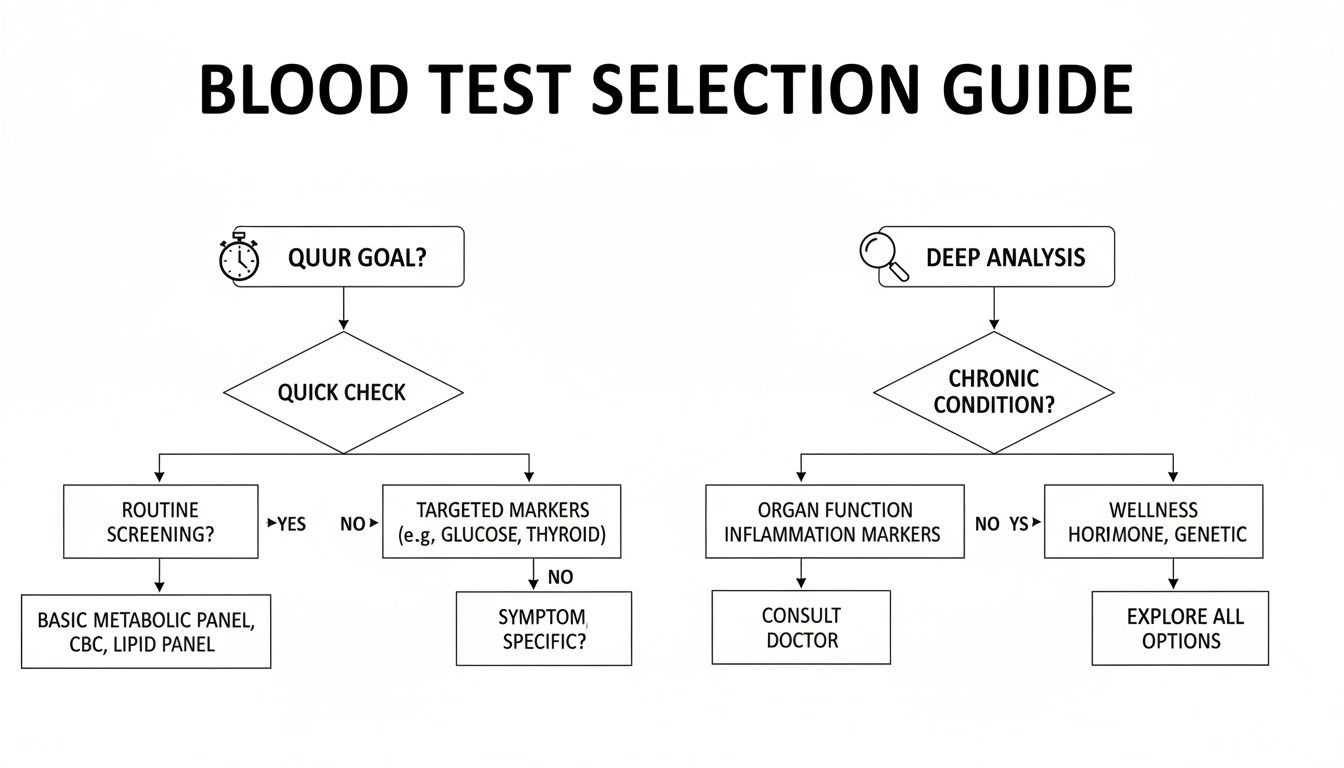
As the guide shows, a quick check is perfect for routine monitoring. But if you're building a wide-ranging longevity strategy or investigating a specific aspect of your health, a deep analysis is essential.
For Optimising Cellular Health
Slowing the ageing process starts at the cellular level. A standard health screen can easily miss the subtle imbalances that accelerate biological ageing, such as nutrient deficiencies or metabolic dysfunction. A targeted blood test panel helps you get ahead of these issues before they cause long-term damage.
Key biomarkers to keep an eye on include:
- Metabolic Efficiency: Your HbA1c levels reveal your long-term blood sugar control, a cornerstone of longevity. Tracking this helps you fine-tune your diet to prevent the glycation that ages cells and tissues.
- Nutrient Status: Optimal levels of nutrients like Vitamin B12, folate, and Vitamin D are absolutely important for cellular energy, DNA repair, and overall metabolic health.
- Organ Function: Markers for liver and kidney health give you a direct look at how well your body's detoxification systems are working, which is vital for long-term resilience.
This focused approach shifts your longevity strategy from passive to proactive, helping you build a more resilient body from the inside out. In the UK, the self-testing market generated USD 568.7 million, and it's forecast to reach USD 888.3 million by 2030. Blood tests are the main driver of this growth as more people take control of their long-term health.
For Managing Age-Related Decline
For those focused on maintaining physical and cognitive function as they age, certain biomarkers act as an early warning system. Your body is a finely tuned machine, and a blood test kit acts as its diagnostic dashboard, giving you critical feedback to prevent age-related decline.
You’ll want to consider a panel that monitors:
- Muscle Health & Recovery: Creatine Kinase (CK) is a key indicator of muscle damage. Tracking it helps you balance training and recovery to preserve muscle mass, a key factor in longevity.
- Inflammation: High-sensitivity C-reactive protein (hs-CRP) measures systemic inflammation, a primary driver of ageing. Managing this is a core tactic in any serious anti-ageing plan.
- Hormonal Balance: Hormones like testosterone, DHEA, and thyroid hormones are vital for energy, bone density, and vitality. Keeping this balance optimised is essential for maintaining a high quality of life.
Turning Data into Actionable Longevity Strategies
The real power of regular testing is seeing the direct link between your interventions and your biological data. It allows you to measure the real-world impact of your lifestyle changes, whether that's a new diet, a different exercise routine, or a supplement regimen like NMN.
Instead of just hoping your longevity efforts are working, you can see the proof in your data. This feedback loop turns your health regimen from a guessing game into a precise, data-driven strategy for a longer, healthier life.
For example, after starting NMN, you might want to track markers related to cellular energy and metabolic health. Seeing those biomarkers shift in a positive direction over a few months gives you concrete evidence that your investment in your health is paying off. This is what proactive longevity is all about - making informed decisions based on your own personalised data.
To get started, explore our guide on finding a full blood test in the UK that aligns perfectly with your longevity goals.
From Simple Booking to Actionable Health Insights
When you’re making decisions that affect your long-term health, trust is everything. You need to be confident in the entire process, from booking a test to receiving actionable longevity insights. The whole experience should be seamless, professional, and ultimately, put you in control of your healthspan.
It all starts with a simple online booking. Just pick the blood test that matches your longevity goals, choose a time that works for you, and a certified phlebotomist will visit you at home or in the office. This removes the hassle of travelling to a clinic, fitting essential health tracking into your life, not the other way around.
The Gold Standard of Collection, at Your Doorstep
The convenience of a home visit doesn't mean compromising on quality. The phlebotomist who arrives is a trained professional, and they perform a venipuncture blood draw - the very same method used in hospitals and clinical trials. This is the gold standard, ensuring a high-quality sample with a success rate of over 99%. No more frustrating failed tests that can happen with finger-prick kits.
Once collected, your sample is professionally packaged and whisked off by priority courier to a fully accredited laboratory. We're talking about the same labs the NHS relies on, all operating under strict UKAS (United Kingdom Accreditation Service) standards. This guarantees your sample is analysed with the highest possible precision.
This is the very same infrastructure that underpins the UK’s entire healthcare system. The NHS performs over 1 billion pathology tests each year, and 70-80% of those are blood tests. By tapping into this established network, your results are held to the highest clinical benchmarks, giving you a solid foundation for your longevity strategy. You can discover more about the UK blood testing market and the scale of its operations.
Turning Data into a Clear Action Plan
Getting a report full of numbers is one thing, but knowing what those numbers mean for your longevity is something else entirely. The real power of a premium blood testing service is in its ability to turn that raw data into clear, actionable insights you can use to extend your healthspan.
The goal isn't just to gather data; it's to create a personalised longevity roadmap. Raw numbers tell you 'what', but expert interpretation tells you 'so what' and, most importantly, 'what's next'.
These days, your results are delivered through a user-friendly app, available on both iOS and Android. But this is more than just a results viewer. The platform lets you track your biomarkers over time, so you can see trends emerge and watch how your lifestyle interventions are making a real difference. Whether you're lowering inflammation or optimising vitamin levels, these visualisations make your progress tangible.
The important Final Step: A Personalised Doctor's Review
While an app is great for tracking trends, it can't replace the insight of a qualified doctor focused on proactive health. That’s why a personalised review from a medical professional is the most important part of the journey. An automated report might flag a result as "high" or "low," but it completely lacks the context of your individual health profile and longevity goals.
A doctor, on the other hand, looks at your results as a whole. They consider your lifestyle, goals, and personal health history to connect the dots between different biomarkers. They explain how one result might influence another and what the bigger picture means for your healthspan.
This expert interpretation finally answers the key question: "So, what should I do now?" It provides the targeted, actionable advice you need to start optimising your health, turning a simple report into a useful measure for a longer, more vital life.
Decoding Key Biomarkers for Your longevity goals
Getting a blood test is the first step; knowing what to do with the results is where the real work of longevity begins. A sheet full of numbers doesn't mean much on its own. The real power comes from understanding what these key biomarkers are telling you about your biological age and how they link directly to your healthspan goals. It’s about turning raw data into a clear roadmap for optimisation.
Instead of getting lost in medical jargon, it helps to group these markers into intuitive categories that are central to ageing well: metabolic health, inflammation, and hormonal vitality. By looking at these pillars of longevity, the bigger picture starts to snap into focus.
This knowledge doesn't just put you in the driver's seat; it prepares you for more productive conversations with your doctor. You'll shift from being a passive recipient of health advice to an active, informed partner in your own longevity goals.
Metabolic Health: The Engine of Your Energy
Your metabolic health is the engine room of your body and a cornerstone of longevity. It’s responsible for converting food into the fuel that powers your cells, repairs damage, and sustains you through a long life.
When this system runs efficiently, you feel energetic and resilient. But when it starts to decline, it accelerates the ageing process.
One of the most important dials on this dashboard is HbA1c (Glycated Haemoglobin).
- What it measures: HbA1c provides an average of your blood sugar levels over the last two to three months, giving you a stable, long-term view.
- Why it matters for longevity: Consistently high blood sugar leads to glycation, a process where sugar molecules damage proteins and fats, accelerating ageing throughout the body. Keeping your HbA1c in an optimal, low-risk range is fundamental for slowing down ageing and extending your healthspan.
An upward creep in your HbA1c is a important early warning. It gives you a window to adjust your diet and lifestyle before metabolic dysfunction takes root and shortens your healthy years.
Inflammation and Cellular Ageing: The Silent Threat
Chronic, low-grade inflammation, often called "inflammageing", is a primary driver of the ageing process. It can simmer under the surface for years, quietly damaging your cells, tissues, and DNA, and increasing your risk for almost every major age-related disease.
A key biomarker for monitoring this silent threat is hs-CRP (high-sensitivity C-reactive protein).
This marker measures low-level, systemic inflammation throughout your body. Think of it as a smoke detector for your internal health, alerting you to the hidden fires that are accelerating the ageing process.
- What it measures: hs-CRP is an incredibly sensitive gauge of underlying inflammation, often tied to lifestyle factors like diet, stress, and poor sleep.
- Why it matters for longevity: An elevated hs-CRP is a powerful predictor of future health problems and a shorter healthspan. By tracking it, you can see the impact of anti-inflammatory interventions, like dietary changes or stress reduction, and take tangible steps to protect your cells from premature ageing.
Hormonal Vitality: The Conductors of Your Performance
Hormones are the chemical messengers that conduct the entire orchestra of your body’s functions. They influence everything from energy and mood to muscle mass and cognitive clarity.
While it's natural for hormone levels to decline with age, maintaining them in an optimal range is vital for preserving a high quality of life. To truly decode your health insights, understanding specific biomarkers like the IGF-1 peptide can provide valuable information for your longevity goals.
Two of the most important players to watch are Testosterone and DHEA.
- Testosterone (Total and Free): important for both men and women, testosterone supports muscle mass, bone density, energy, and cognitive function—all pillars of healthy ageing. Sub-optimal levels can lead to fatigue, loss of strength, and faster physical decline.
- DHEA (Dehydroepiandrosterone): Often called the "anti-ageing hormone," DHEA is a precursor to other key hormones. Its levels peak in our 20s and then steadily decline, making it a useful biomarker for tracking biological age and overall vitality.
Tracking these hormones provides objective data to help you build a more resilient body and maintain your vitality for longer. It provides the insights needed to make targeted improvements through nutrition, stress management, and smart exercise.
Got Questions About Longevity Blood Testing? We’ve Got Answers.
Stepping into the world of proactive health and longevity naturally brings up questions. It's a new frontier for many. Here, we'll tackle the most common queries about using blood tests to build your longevity strategy, giving you the clear, straightforward answers you need.
Think of this as your final briefing before you take control, armed with the right information to make smart decisions about extending your healthspan.
How Often Should I Be Testing My Blood?
As a general rule, a detailed blood panel every six to twelve months is a fantastic starting point for any longevity plan. This establishes your personal baseline and allows you to track trends over time, which is far more insightful than a single test.
However, the ideal frequency depends on your specific longevity goals and interventions.
- Establishing a baseline: If you're just starting, a test now and another in six months is perfect to see your starting point and initial progress.
- Monitoring interventions: When you start a new supplement protocol, like with NMN, or make a significant dietary change, testing every three to four months allows you to objectively measure the impact. This lets you see if your strategy is working at a biological level.
- Active optimisation: For those in a focused period of health optimisation, more frequent testing (e.g., quarterly) can provide the granular feedback needed to fine-tune your approach for maximum benefit.
It’s all about tailoring the frequency to get the actionable insights you need, right when you need them.
Is a Professional At-Home Blood Test as Accurate as Going to a Clinic?
Yes, absolutely. The accuracy of a blood test depends on two key factors: the quality of the sample collection and the standard of the laboratory analysing it. A professional at-home service excels at both.
When a certified phlebotomist performs a venipuncture draw at your home, they are using the exact same "gold standard" method as a hospital or clinic. This ensures a large, high-quality sample, effectively eliminating the risk of user error or contamination that can compromise finger-prick tests.
Your sample is then sent to the very same accredited, clinical-grade laboratories that the NHS uses. You are getting the identical level of precision and reliability, just without the travel and waiting room time.
The bottom line is that you’re not trading quality for convenience. You’re getting the best of both: clinical-grade results that provide a solid foundation for your longevity strategy, all from the comfort of your own home.
What’s the Real Benefit of a Doctor’s Review Instead of Just an Automated Report?
Automated reports are useful for showing if your numbers fall within a standard "normal" range. But longevity isn't about being "not sick"—it's about being optimal. This is where a doctor's review is invaluable.
A medical expert focused on proactive health interprets your results in the full context of your goals, lifestyle, and health history. They connect the dots between biomarkers to reveal the bigger picture of your biological age and healthspan potential. They can identify subtle patterns that an algorithm might miss and provide clear, actionable advice tailored specifically to you.
This expert analysis transforms a simple page of data into a personalised longevity roadmap. It answers the important question: "Okay, what do I do next to live a longer, healthier life?" An algorithm can flag a result, but only an experienced doctor can provide the detailed guidance you need to make genuinely effective changes. That human insight is what elevates a blood test from a data point into a useful measure for extending your healthspan.
Ready to stop guessing and start building a data-driven strategy for your health? With Lola, you get professional, at-home blood testing combined with doctor-reviewed insights to help you perform at your peak, both now and in the years to come. Explore our tests and book your appointment today.
At-Home Blood Testing
Check your levels from home
Professional phlebotomist visit. Doctor-reviewed results in 2-5 days. Track your health with comprehensive blood panels.
→45-70 biomarkers tested · Venous blood draw · From £130