


Hormone tests for men are essentially a look under the bonnet, measuring the levels of key chemical messengers in your blood. This gives us critical clues about your energy, mood, and long-term health, helping to spot imbalances that can impact everything from muscle mass and mental focus to your healthspan and overall vitality.
Why Proactive Hormone Testing Is Key to Male Longevity
When you hear "hormones," it's easy to jump straight to muscle growth or sex drive. And while they're absolutely vital for that, it's a very narrow view of a much bigger picture for longevity. Think of your hormones as the body's master control system – a complex communication network that dictates your energy levels, mental sharpness, mood, and ability to thrive for decades to come. Getting a handle on these levels isn't just a good idea; it's a cornerstone of preventative health and a powerful way to extend your healthspan.
Here’s a important distinction: simply falling within the 'normal' reference range on a lab report doesn’t automatically mean you’re optimised for a long, healthy life. There’s a world of difference between being average and being optimal. That standard 'normal' range is incredibly wide because it’s based on a huge population, including people who might not be in great health. Your personal optimal level is the one that allows you to feel and perform at your peak, setting the stage for healthy ageing. Establishing your unique hormonal baseline with a test is the first step in moving from guesswork to a data-driven longevity strategy.
Understanding Your Personal Baseline
Your hormones, from testosterone and cortisol to thyroid-stimulating hormone, all work together in a delicate symphony. If one instrument is out of tune, it can create a domino effect across the entire orchestra, accelerating age-related decline. That’s why a single data point is far less revealing than seeing the complete picture. You can get a better sense of what a detailed screening looks at in our guide to the wide-ranging blood test in the UK.
"For too long, men's health has been reactive, waiting for problems to show up before we act. Proactive hormone testing flips that script. It lets you monitor your body's internal environment and make targeted tweaks to optimise your long-term health, heading off age-related decline before it even gets started."
This proactive stance is critical for longevity and becomes even more pronounced when we look at issues like the often-forgotten male perspective in infertility.
The reality is, many men are flying blind. Low testosterone, for instance, affects roughly 1 in 4 men over 30. Yet, an alarming 90% of these cases in the UK go untreated, highlighting a massive, underdiagnosed health issue that can significantly impact healthspan. Thankfully, modern services are making these essential health insights far more accessible, putting you back in the driver's seat of your long-term vitality.
Decoding the Most Important Male Hormones
Trying to get your head around your hormones can feel like learning a new language. But instead of verb conjugations and tricky grammar, you're dealing with biomarkers that call the shots on everything from your energy and mood to your long-term health. Think of a hormone panel as your body’s internal dashboard; learning to read it is the first real step toward revealing a longer, healthier life.
Let's demystify the key players on the board. I'll break down their roles with some simple analogies, so you can see how they all work together to influence your wellbeing and why a complete test is so revealing for your longevity goals.
This diagram shows you the direct link between getting on top of your health, achieving hormonal balance, and feeling your best.
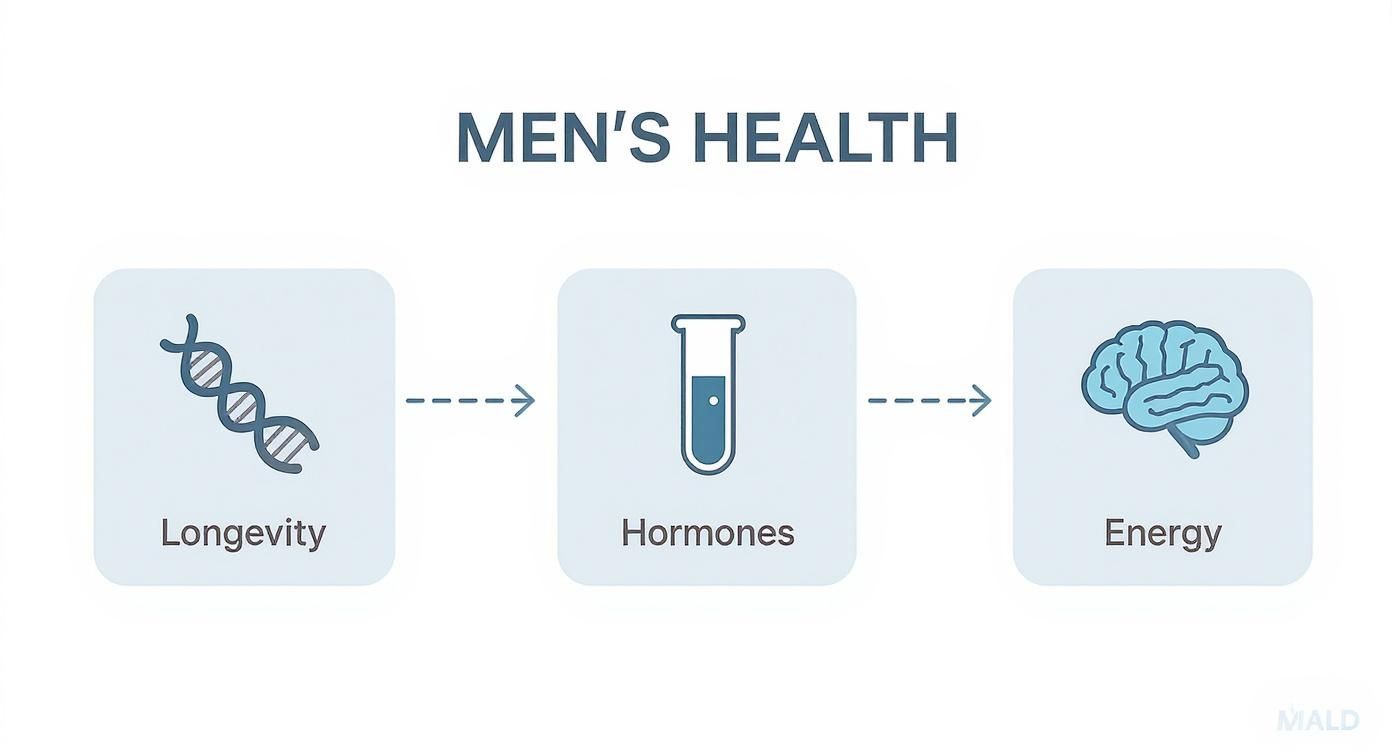
It really highlights how understanding your hormones is a foundational step towards building sustained energy and improving your healthspan.
Testosterone: The CEO of Male Health
Testosterone is often seen as the undisputed king of male hormones, and for good reason. It’s like the CEO of your body, making the big calls on muscle mass, bone density, fat storage, sex drive, and even your competitive spark. When your testosterone levels are in an optimal place, you feel sharp, energetic, and resilient - key markers of vitality and healthy ageing.
But here’s what you need to know for longevity: there are two critical numbers to watch. You have your Total Testosterone and your Free Testosterone. Total testosterone is the sum of every bit of it in your blood, but a huge chunk of that is locked up by proteins, making it inactive. Free testosterone is the unbound, bioavailable hormone that your body can actually use to maintain physiological function. For a deeper dive, check out our guide on the testosterone blood test.
Symptoms of low testosterone can creep up on you - things like persistent fatigue, stubborn weight gain around your middle, and just a general lack of drive. Getting your levels checked is the only way to know for sure what's going on.
SHBG: The Transport Manager
If testosterone is the CEO, then Sex Hormone-Binding Globulin (SHBG) is the transport manager. This protein latches onto testosterone, controlling how much of it is free to be used by your cells. You can have a perfectly normal total testosterone level, but if your SHBG is high, your usable, free testosterone could be in the gutter.
Think of it this way: you have a warehouse packed with goods (total testosterone), but not enough delivery vans to get them where they need to go. That’s what high SHBG does. Testing SHBG gives you the full story, providing important context that a total T test alone just can't offer for assessing your true hormonal status.
Estradiol: The Balancer
Estradiol, a form of oestrogen, might seem out of place here, but it’s absolutely critical for men's health and longevity. Your body naturally converts a small amount of testosterone into estradiol, which is vital for maintaining healthy bones, brain function, and even libido. The key word is balance.
When your estradiol is too high or too low relative to your testosterone, problems start. High levels can cause water retention, moodiness, and fat gain. Too low, and you risk issues with your bones and sexual function. It’s the testosterone-to-estradiol ratio that really matters for long-term health.
Cortisol: The Emergency Response System
Cortisol is your body's built-in alarm system, absolutely essential for handling short-term stress. It’s what gives you that burst of energy and focus when you’re up against a challenge. The problem is, in our modern world of endless deadlines and notifications, this emergency system can get stuck in the 'on' position.
Chronically high cortisol is destructive to longevity. Over time, it can lead to muscle breakdown, increased belly fat, a weakened immune system, and persistent brain fog. Testing your cortisol reveals if chronic stress is quietly sabotaging your health goals.
LH and FSH: The Messengers from HQ
Luteinising Hormone (LH) and Follicle-Stimulating Hormone (FSH) are like managers sent from headquarters - your pituitary gland in the brain. Their job is to travel to the testes and give the order to produce testosterone and sperm. Simple as that.
If your testosterone is low, checking LH and FSH helps pinpoint the source of the problem. If LH and FSH are high but testosterone is low, it suggests the issue is with the testes themselves. On the other hand, if all three are low, it could point to a problem upstream with the pituitary gland.
To get a clearer picture of your own hormonal health, it's helpful to see how all these pieces fit together. Below is a quick summary of the main players.
Key Male Hormones and Their Longevity Impact
| Hormone | Primary Role in Male Health | Symptoms of Imbalance (Low/High) |
|---|---|---|
| Testosterone (Total & Free) | Muscle mass, bone density, libido, mood, energy | Low: Fatigue, weight gain, low sex drive, poor focus |
| SHBG | Binds to testosterone, regulating its availability | High: Reduces free testosterone, causing low T symptoms |
| Estradiol | Bone health, cognitive function, libido regulation | High: Water retention, mood swings. Low: Poor libido, bone loss |
| Cortisol | Stress response, energy mobilisation, inflammation control | High: Anxiety, fat storage, poor sleep, brain fog |
| LH & FSH | Signal the testes to produce testosterone and sperm | Imbalance: Can indicate testicular or pituitary issues |
| Thyroid (TSH, T3, T4) | Regulates metabolism, energy, body temperature | Low: Fatigue, weight gain, cold intolerance, brain fog |
| Prolactin | Affects testosterone production and sexual function | High: Reduced libido, erectile dysfunction, low energy |
This table shows why a single biomarker test rarely tells the whole story. True insight into your long-term health comes from seeing how these hormones interact with one another.
To further explore the nuances, you can find great information on understanding testosterone levels and their regulation and how they are influenced by lifestyle. A full hormone test puts all these pieces together, giving you the data you need to build a targeted strategy for a long and vibrant life.
Recognising the Subtle Signs of Hormonal Imbalance
Hormonal imbalances in men rarely shout for attention. They’re more of a whisper. It’s that slow creep of fatigue, a subtle shift in your mood, or just a nagging feeling that you’re not quite firing on all cylinders anymore. Learning to tune into these quiet signals is the first real step towards using a male hormone test as a tool for a long, healthy life, not just as a reaction to a problem.
It’s all too easy to write these symptoms off. Many men just put it down to getting older or the price you pay for a demanding career. And while life certainly takes its toll, persistent and unexplained changes are often your body’s way of sending up a flare, signalling that something in its internal wiring is off. The goal is to stop guessing and start getting hard data to protect your future health.
Unpacking the Physical Warnings
Your body is usually the first to tell you when key hormones like testosterone or cortisol are out of whack. Think of these signs as the dashboard warning lights for your health.
- Persistent Fatigue: We’re not talking about feeling knackered after a long week. This is a bone-deep exhaustion that sleep just can’t seem to fix, leaving you dragging yourself through the day. This is a key sign your hormonal system isn't supporting optimal energy production.
- Changes in Body Composition: Are you losing muscle even though you’re still hitting the gym? Maybe you’ve noticed more stubborn fat around your middle that no amount of diet or exercise will shift. This is a classic sign your hormonal environment is favouring fat storage over muscle - a process that accelerates ageing.
- Poor Recovery: If you’re an athlete or just someone who likes to stay active, you might notice it’s taking you way longer to bounce back after a workout. That inability to recover properly can be directly linked to hormonal issues and is a barrier to long-term fitness.
These physical clues aren’t just about how you look; they’re direct indicators of your metabolic and cellular health - the very foundation of a long and active life.
The Mental and Emotional Toll
Your hormonal health is deeply tied to how your brain works and how you feel. When your key hormones are out of balance, your mental state is often one of the first casualties.
A hormonal imbalance is like trying to run sophisticated software on outdated hardware. Your brain, the 'software', struggles to perform because the body's 'hardware', your endocrine system, isn't providing the right signals to maintain peak cognitive function.
This problem often shows up in a few key ways:
- Brain Fog and Poor Concentration: You might find it hard to focus, struggle to recall information, or just lose that mental sharpness you used to have. This cognitive dip is a common complaint when testosterone is low or cortisol is chronically high, impacting your professional and personal life.
- Low Motivation and Drive: That ambition and competitive edge that used to push you forward can start to feel completely flat. It's not a character flaw; it's often a direct biochemical consequence of a hormonal downturn.
- Increased Irritability and Mood Swings: Snapping at people more than usual? Feeling a constant, low-level agitation? These mood changes are frequently tied to hormonal fluctuations that throw your emotional equilibrium off-kilter.
Connecting Lifestyle to Symptoms
It’s vital to see how these symptoms connect to your everyday life. A high-pressure corporate job, for instance, can lead to chronically elevated cortisol, which in turn can tank your testosterone production. For a dedicated athlete, overtraining without enough recovery can trigger a similar hormonal cascade, leading straight to burnout and worse performance.
Recognising these patterns puts you back in control. Instead of just vaguely feeling "off," you can start to draw a clear line between your lifestyle and how you feel. This is exactly where a hormone test for males becomes so valuable. It turns those subjective feelings into objective data, giving you a clear roadmap for what to do next - whether that means dialling in your nutrition, changing your training, or getting a handle on stress. It’s the definitive step from wondering what’s wrong to knowing precisely where to begin your longevity goals.
How to Prepare for Your Test to Get Accurate Results
Think of your hormone test as a high-precision snapshot of your body's internal workings. For that picture to be sharp and genuinely useful for your longevity plan, a little preparation goes a long way. Just as a photographer needs the right conditions for a perfect shot, we need to control a few variables to get a true reading of your baseline health.
Skipping these steps can easily lead to skewed results. That might cause unnecessary worry or, even worse, mask an issue that needs attention. What you do in the 24-48 hours before your blood draw is absolutely important for getting data you can actually rely on.
Timing Your Test for Peak Accuracy
When it comes to hormone testing, timing is everything. This is especially true for testosterone. Your testosterone levels aren't static; they follow a natural daily rhythm, peaking early in the morning and then gradually falling as the day wears on.
Because of this, we always advise getting your blood drawn in the morning, ideally between 7 AM and 10 AM. If you test in the afternoon, your results could show artificially low testosterone, giving a completely false impression of your hormonal health. This is a simple but non-negotiable rule for getting an accurate picture.
Your Pre-Test Checklist: What to Do and What to Avoid
Getting the clearest possible results from your hormone tests for males means we need to minimise any temporary factors that could throw your levels off. Following these simple guidelines can be the difference between a clear, actionable report and a confusing one.
To make this easier, here’s a quick checklist to run through before your appointment.
Hormone Test Preparation Checklist
| Preparation Step | Why It's Important | Best Practice |
|---|---|---|
| Fast for 8-12 Hours | Food and drink (other than water) can cause temporary spikes in hormones and related biomarkers, skewing your results. | Schedule an early morning test and don't eat or drink anything except water after your evening meal the night before. |
| Avoid Strenuous Exercise | A heavy gym session or intense cardio can temporarily increase cortisol and other hormones, not reflecting your true baseline. | Skip the gym for 24 hours before your test. A gentle walk is perfectly fine, but save the heavy lifting for afterwards. |
| Get a Good Night's Sleep | Even one night of poor sleep can significantly lower testosterone and raise stress hormones like cortisol. | Aim for your usual 7-9 hours of quality sleep. Try to wind down and avoid screens an hour before bed. |
| Pause Alcohol & Supplements | Alcohol can interfere with hormone production. Certain supplements, like Biotin (Vitamin B7), can interfere with the lab tests themselves. | Avoid alcohol for at least 24 hours before your test. Stop taking Biotin supplements 3-5 days prior to your blood draw. |
Following this checklist helps ensure your results reflect your genuine, long-term state, not just a temporary blip from a late night or a tough workout.
"Your hormone test results should reflect your chronic, underlying state, not a transient fluctuation caused by a poor night's sleep or a heavy gym session. Proper preparation removes the 'noise' from the data, allowing you and your doctor to see the true signal."
These principles are exactly the same whether you're coming into a clinic or using a convenient at-home phlebotomy service. For a more detailed walkthrough of the blood draw process itself, you can find more information on how to prepare for phlebotomy. By taking these few simple steps, you put yourself in the best position to get accurate data - the essential first step in building an effective health plan.
Making Sense of Your Hormone Results
Getting your hormone test results back can feel a bit like looking under the bonnet of a car for the first time. You see a lot of numbers, acronyms, and ranges, but what does it all actually mean for your long-term health? This is where data transforms into actionable insights for your longevity strategy.
The first thing to get your head around is the difference between a ‘standard reference range’ and an ‘optimal range’. The standard range you see on a lab report is just the average for a massive group of people, many of whom aren't in peak condition. Being ‘in range’ simply means you’re not an outlier; it doesn't mean you're feeling or functioning at your best for a long life.
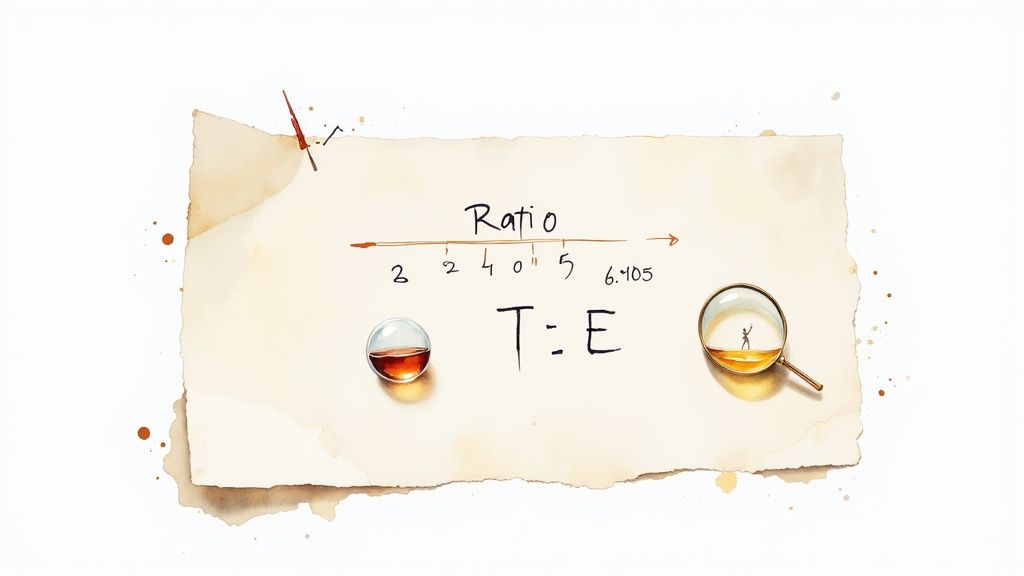
Think of it like this: the oil dipstick in your car has a ‘safe’ zone. Technically, the engine will run if the oil level is just above the minimum mark. But for the best performance and to keep the engine healthy for years to come, you want that level topped up, closer to the ‘full’ line. Your hormones are exactly the same.
Looking Beyond a Single Number
It's a common mistake to just focus on one number, like Total Testosterone. Your body’s endocrine system is more like a finely tuned orchestra than a solo performance. Hormones all work together, constantly influencing and balancing each other out. Focusing on just one player on the field gives you a completely skewed picture of the game.
To get a true understanding, we have to look at the relationships and ratios between different hormones. This is where the real story of your health is revealed, offering far more depth than any single marker could.
Your hormonal health isn’t about one high score. It’s about the balance and teamwork between all the players. A detailed male hormone test gives you the full team sheet, showing you how they’re all interacting.
Why Ratios Tell the Real Story
Looking at specific hormonal ratios cuts through the noise and gives you clear, practical information about what’s happening inside your body. It helps explain why you might have all the symptoms of low testosterone, even when your total T level looks "normal."
Here are a few of the most important relationships for male health and longevity:
- Total Testosterone to Estradiol (T:E) Ratio: This is arguably the most vital ratio for a man's sense of well-being. Testosterone converts to estradiol, and keeping that balance right is important for your mood, libido, and body composition. If your estradiol is too high compared to your testosterone, you can feel fatigued, hold water, and lose your drive, even if your testosterone number is decent.
- Free Testosterone to SHBG Ratio: This calculation gives you a much better idea of your bioavailable testosterone—the amount your body can actually use. If SHBG is high, it acts like a sponge, binding to your testosterone and making it unavailable to your cells. This ratio uncovers your true functional testosterone level.
- Cortisol to Testosterone Ratio: For athletes and busy professionals, this is a significant advantage. It’s a direct window into your stress and recovery balance. Chronically high cortisol (from stress or overtraining) actively suppresses testosterone production. A skewed ratio is a massive red flag that your body is in a breakdown state (catabolic) rather than a building state (anabolic), which is detrimental to long-term health.
By analysing these relationships, a complicated lab report starts to make a lot more sense. Instead of a dozen disconnected numbers, you start to see a clear picture. You can pinpoint the real source of the problem, is it stress, poor conversion, or something else?, and that’s the first step towards taking effective action. This level of detail is what moves you from just reading a report to truly understanding your body.
From Test Results to a Longevity Plan: What Now?
Getting your hormone results back isn't the end of the process—it's the real beginning. Think of it as swapping a vague map for a high-res GPS. You’re no longer just guessing what might be wrong; you have concrete data pointing you towards a smarter, more effective longevity strategy built just for you.
This is where you move from information to action. The path forward usually involves a mix of interventions, starting with the fundamentals and moving towards medical support if needed. For most men, the biggest wins come from making targeted adjustments to their daily lives, all guided by their unique hormonal profile.
Building Your Foundation: Smarter Lifestyle Choices
Your results give you the power to make intelligent, data-led decisions about how you eat, train, and manage stress. This isn't about overhauling your entire life overnight. It’s about making precise tweaks that can lead to significant, long-lasting hormonal balance and an better healthspan.
Here are actionable insights based on potential results:
- Fine-Tuning Your Nutrition: Let's say your results show high SHBG, which is notorious for locking up free testosterone. An actionable step could be increasing protein and healthy fat intake. On the other hand, if cortisol is chronically high, your action plan might focus on complex carbs and magnesium-rich foods to help calm your adrenal system.
- Optimising Your Training: A low testosterone-to-cortisol ratio often screams overtraining. Your action isn't to quit the gym, but to optimise. It might mean swapping one high-intensity session for strength training or making sleep an absolute priority to improve your recovery metrics.
- Building Stress Resilience: If your cortisol is constantly elevated, your plan needs a practical stress management protocol. That could mean scheduling genuine downtime, starting a 10-minute daily mindfulness practice, or ensuring you get morning sunlight to reset your circadian rhythm and manage cortisol spikes.
Smart Supplementation and Medical Options
Once you've got your baseline from testing, supplements can be used to plug specific nutritional gaps, rather than just throwing everything at the wall and seeing what sticks. For instance, if your tests flag low vitamin D, a key building block for testosterone, a targeted supplement, perhaps alongside something like NMN, can be incredibly effective when combined with the right lifestyle changes.
"A hormone test transforms your health strategy from guessing to knowing. It allows you to address the root cause of your symptoms with precision, whether that’s through optimising your sleep, adjusting your diet, or considering medical support under expert guidance."
Sometimes, lifestyle changes alone aren’t enough to get you back to optimal. This is where medical options like Testosterone Replacement Therapy (TRT) might enter the conversation. When it’s clinically necessary, TRT can be a significant advantage for energy levels, mood, and body composition.
But it’s a serious step and not one to be taken lightly. TRT demands a full evaluation and must be managed by a medical professional who can dial in your dosage, keep a close eye on your blood work, and manage any potential side effects. The thorough data from your initial hormone tests for males is the important starting point for having a properly informed discussion with a doctor about whether it's the right choice for your long-term health.
Ultimately, your results are the blueprint for a proactive, long-term health plan designed for one person: you.
Your Questions Answered: Male Hormone Testing FAQs
Diving into hormone testing can feel a bit overwhelming, and it's natural to have questions. Let's clear up some of the most common ones we encounter, so you can feel confident about taking the next step in managing your long-term health.
How Often Should I Check My Hormones?
For men over 30 looking to build a longevity strategy, establishing a wide-ranging baseline is the first important step. After that, re-testing every 12 months is a smart, proactive approach to track changes and optimise your healthspan.
However, if you're actively managing symptoms or on a treatment plan like TRT, your doctor will likely suggest re-testing every 3 to 6 months. This allows for precise adjustments and ensures you remain in your optimal range.
Are At-Home Blood Tests Actually Reliable?
Absolutely, as long as they're analysed by a properly accredited lab. The reliability doesn't come from where the blood is drawn, but who analyses it.
We use the exact same UKAS-accredited laboratories that your GP and local hospital rely on. By using a professional phlebotomist, whether at home or in a clinic, we ensure the sample collected is high-quality and ready for accurate analysis.
My GP Said My Testosterone Is 'Normal,' But I Still Feel Off. What Gives?
This is a classic, and genuinely frustrating, scenario that highlights the difference between standard healthcare and health optimisation. The "normal" range used by many GPs is incredibly wide and designed to catch serious diseases, not to identify what's optimal for your personal well-being. A basic test might also only look at your total testosterone.
This is why a complete panel is so important for longevity. By measuring free testosterone, SHBG, and estradiol, you get the full story. A men's health specialist can then look at these detailed results in the context of your symptoms, often uncovering imbalances that a standard test would completely miss.
Ready to stop guessing and start building your longevity strategy? With Lola, you can book a professional blood draw at home or in a clinic. Your results are delivered securely to our app, along with a review from a doctor. Take the first step towards taking control by booking your full male hormone panel at https://lolahealth.com.
At-Home Blood Testing
Check your levels from home
Professional phlebotomist visit. Doctor-reviewed results in 2-5 days. Track your health with comprehensive blood panels.
→45-70 biomarkers tested · Venous blood draw · From £130