


Mineral and vitamin deficiency testing is, at its core, a proactive strategy for longevity: analysing a blood sample to see precisely which essential nutrients your body has in abundance and which it's running low on. Think of it as a personalised blueprint for your long-term health, a tool to spot potential shortfalls before they start to impact your healthspan and performance. It’s about swapping guesswork for hard data, giving you a clear, objective picture of what your body actually needs to thrive for years to come.
The Hidden Roadblocks to Your Healthspan and Performance
Ever feel like you’re pushing for peak performance, but there’s an invisible force holding you back? For many of us, this isn't just a feeling - it’s the very real consequence of hidden nutrient gaps. These widespread mineral and vitamin deficiencies can act as silent saboteurs, quietly undermining both your daily performance and, more importantly, your long-term health and longevity.
Your body is like a high-performance engine designed for a long journey. You wouldn't dream of filling it with low-grade fuel, yet that’s effectively what we do when important micronutrients are missing from our diet. The engine might keep running, but it will never reach its potential and, over time, you risk doing serious, cumulative damage that can shorten your healthspan.
The Silent Saboteurs of Longevity
Even small dips in key nutrients can drain your energy, cloud your thinking, and slow down cellular repair. These aren't just minor inconveniences; they are genuine roadblocks stopping you from operating at your best and laying the foundation for future health issues. It's often these underlying deficiencies that hold us back; understanding how chronic illnesses can lead to serious health challenges really brings home the importance of being proactive.
This problem is far more common than you might imagine. That unexplained brain fog that settles in by midday? It might not just be a case of the "Monday blues." For a staggering 68% of British adults, this is a daily reality, a fact highlighted by the UK’s National Diet and Nutrition Survey. This landmark study revealed that 68% of adults are deficient in at least two critical micronutrients, and 31% are lacking in three or more. These are the very vitamins and minerals essential for everything from a strong immune system to sharp cognitive function - key pillars of a long and healthy life.
From Guesswork to a Precision Longevity Strategy
Relying on how you "feel" from one day to the next is a poor strategy for long-term health. We often dismiss fatigue or slow recovery as unavoidable side effects of a busy life, but they can be the first warning signs of a deeper imbalance that could impact you for decades. This is where mineral and vitamin deficiency testing comes in, providing the diagnostic clarity to see what’s really going on under the surface.
Proactive testing is the first critical step toward revealing your full potential and extending your healthspan. It replaces assumptions with objective data, allowing you to build a health strategy that’s precise, personal, and powerful.
With this kind of diagnostic tool, you can finally:
- Pinpoint specific nutrient gaps that could be impacting your energy and cellular health. Athletes, for instance, might want to check out our guide on the tell-tale signs of iron deficiency in runners.
- Shift from a reactive to a proactive mindset, tackling small issues before they have a chance to become bigger problems that affect your longevity.
- Fine-tune your diet and supplements based on what your body actually needs for optimal ageing, not on generic, one-size-fits-all advice.
By understanding your unique biochemical blueprint, you can start clearing away the hidden roadblocks holding you back, paving the way for sustained performance and a longer, healthier life.
Don't Guess When It Comes to Your Health
We all have those days when we feel 'a bit off'. It’s easy to blame a packed schedule or a stressful week. But what if that persistent fatigue, nagging brain fog, or slow recovery after a workout isn't just about being busy? What if it's your body's way of sending a subtle but important signal about your long-term wellbeing?
Relying on guesswork to manage your health is like trying to navigate a long voyage without a map. You wouldn't build a long-term financial plan on assumptions, so why take that risk with your most important asset: your healthspan? We often get used to feeling less than our best, not realising a simple nutrient gap could be silently undermining our future health.
What Nutrient Gaps Actually Feel Like
The connection between your micronutrient levels and how you feel day-to-day is incredibly direct. For high-achievers juggling demanding careers and personal goals, the effects of these gaps can limit today's performance and compromise tomorrow's health.
-
Iron Deficiency & Fatigue: That slump you hit mid-afternoon? It might not just be a poor night's sleep. Low iron directly impacts how oxygen travels to your brain and muscles. This can lead to a profound, bone-deep fatigue that no amount of coffee can seem to shift.
-
Low Vitamin D & Poor Recovery: If you're struggling to bounce back from workouts or find yourself in a persistent low mood, it could be a sign of low Vitamin D. It's important for immune function, muscle repair, and even regulating your mood, so a shortfall can leave you feeling sluggish and impact long-term resilience.
-
Magnesium Shortfalls & Stress: Feeling wired but tired? If poor sleep and a constant sense of being 'on edge' are your norms, a lack of magnesium might be at play. This essential mineral helps calm the nervous system, and when levels are low, it can be much harder for your body to switch off and properly recover.
These aren't just minor inconveniences; they're genuine roadblocks preventing you from performing at your peak. This is why we need to see mineral and vitamin deficiency testing not as a last resort when you're unwell, but as a strategic tool for optimising performance and protecting your long-term health.
A National Trend You Can't Afford to Ignore
The real-world consequences of overlooking our nutritional needs are becoming startlingly clear. Across England, hospitals are seeing a dramatic and worrying increase in admissions for problems directly caused by nutritional deficiencies - problems that undermine longevity.
According to NHS data, hospital admissions for iron deficiency alone soared to a staggering 191,927 in 2023-24. That's an 11% increase from the previous year and nearly ten times higher than the figures from the late 1990s.
It doesn’t stop there. Admissions for anaemia linked to vitamin B12 or folate deficiencies have quadrupled over that same period. The Royal College of GPs has called this trend 'very concerning', often pointing to the rising cost of living which can make it harder to access fresh, nutrient-dense foods. This is a particular problem for busy professionals and athletes who might find themselves relying on convenience foods. You can read more about these troubling statistics in PA Media's analysis for Women's Health UK.
This stark data makes one thing obvious: if you’re serious about your performance and long-term health, you can't afford to guess about your nutritional status. Proactive testing isn't a luxury anymore; it's a fundamental part of building a resilient, productive, and long life. It’s about taking precise, informed action today to secure your future.
Decoding the Biomarkers That Drive Longevity
If you’re serious about building a longer, healthier life, you can't just guess your way there. You need a clear blueprint of what's happening inside your body. That's where biomarkers come in - they are the measurable indicators that transform the vague goal of "being healthier" into a precise, data-driven mission for longevity.
These biomarkers tell the real story of your cellular health. Understanding them is the only way to move beyond generic advice and start building a truly personalised plan for peak performance and a longer healthspan.
Let's break down the essential vitamins and minerals you should be measuring.
The Power Players in Your Health Profile
Think of your body as a high-performance engine built to last for decades. For it to run smoothly and powerfully, every single component has to be working in perfect harmony. Certain vitamins and minerals are the critical components - if they're low, the whole system degrades over time.
Here are the key players a proper mineral and vitamin deficiency test should always cover for a longevity-focused strategy:
-
Vitamin D: Often called the "sunshine vitamin," it really acts more like a master hormone. It influences everything from your bone density and immune function to your mood. For a long and healthy life, optimal levels are non-negotiable for reducing inflammation and supporting cellular repair.
-
Vitamin B12: This is the spark plug for your nervous system and a central player in energy production. Even a small shortfall can lead to persistent fatigue and brain fog, directly impacting your cognitive health and long-term vitality.
-
Folate (Vitamin B9): Working hand-in-hand with B12, folate is essential for cell growth and DNA repair. It’s absolutely vital for protecting your genetic blueprint from damage, forming the very foundation of healthy ageing.
These aren't just minor details. A deficiency in any of these seemingly small molecules can have a huge impact on how you feel and function every single day, directly threatening your long-term health ambitions.
The High-Achiever's Risk Factor
It’s a modern paradox: demanding schedules and stressful lives, often combined with convenient but nutritionally sparse food choices, create a perfect storm for nutrient depletion. Intense physical training only adds to the demand. This means you could be at a higher risk of deficiency than you realise.
This is why that general feeling of being 'off' can often be traced back to specific, common deficiencies.
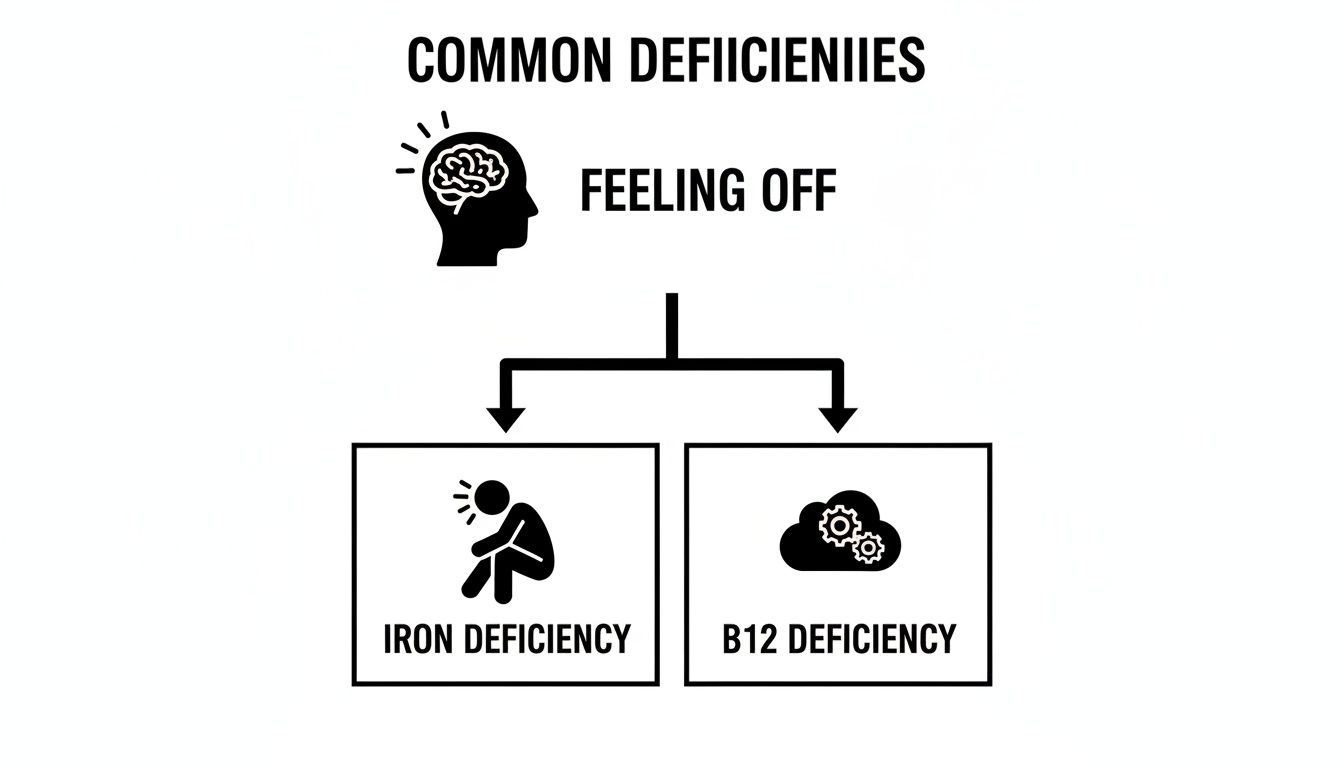
As the diagram shows, symptoms like constant fatigue or brain fog aren't just random feelings. They can be direct signals of underlying issues, like low iron or B12.
To get a clearer picture of what to look for, this table breaks down the most important biomarkers for anyone focused on performance and longevity.
Essential Biomarkers for Longevity: What to Test and Why
| Biomarker | Why It's important for Longevity | Common Deficiency Symptoms | Who Is Most at Risk? |
|---|---|---|---|
| Vitamin D | Regulates immune function, bone health, and mood. important for reducing inflammation and supporting cellular health. | Fatigue, bone pain, frequent illness, low mood. | People in the UK (low sun), older adults, those with darker skin. |
| Vitamin B12 | Essential for nerve function, DNA synthesis, and red blood cell formation. Supports energy and cognitive clarity. | Brain fog, fatigue, weakness, numbness or tingling. | Vegans, vegetarians, older adults, those with digestive issues. |
| Folate (B9) | Works with B12 for cell growth and repair. Vital for preventing DNA damage and supporting brain health. | Fatigue, irritability, poor concentration, mouth sores. | Pregnant women, individuals with high alcohol intake. |
| Iron (Ferritin) | Carries oxygen in the blood. Ferritin measures your body's iron stores, a key indicator of energy capacity. | Unexplained fatigue, shortness of breath, pale skin, poor athletic performance. | Women (menstruation), athletes, vegetarians, regular blood donors. |
| Magnesium | Involved in 300+ biochemical reactions, including muscle function, sleep regulation, and stress management. | Muscle cramps, poor sleep, anxiety, fatigue. | Athletes, individuals under high stress, those with type 2 diabetes. |
Getting these levels right isn't just about avoiding deficiency; it's about optimising your body's systems to function at their absolute best for as long as possible.
The Unsung Heroes: Iron and Magnesium
Beyond the B vitamins and Vitamin D, two minerals are absolutely critical for anyone looking to optimise their performance and longevity.
First, Iron (including Ferritin). Iron is the core component of haemoglobin, the protein in red blood cells that ferries oxygen around your body. Low ferritin, your body’s iron storage protein, is like trying to run a race with the brakes on. It leads to profound fatigue, shortness of breath, and a sharp drop in physical performance.
Then there's Magnesium. This mineral is a true powerhouse, involved in over 300 biochemical reactions, from muscle function and nerve signalling to blood pressure regulation. A deficiency can show up as muscle cramps, poor sleep, and an inability to manage stress effectively, sabotaging both your recovery and your cognitive function.
These deficiencies aren't rare. The UK Health Index flags Vitamin D, B12, folate, iron, and magnesium as top national deficiencies, creating a significant public health concern.
The scale of the problem is startling. A recent study revealed that nearly half of Brits, a staggering 48% of the population, are failing to meet their daily nutrient targets through diet alone. This figure climbs to a worrying 61% among 18-24 year olds.
For Vitamin D, the situation is even more detailed. While 20% of the population is considered clinically deficient, further analysis suggests that 49.5% of adults have suboptimal levels, preventing their bodies from functioning at their best. You can find more insights from the study on nutraceutical analysis.
Knowing which biomarkers are most relevant to your goals, whether that’s sharpening your mind or speeding up physical recovery, is the first, most important step. It turns a generic health check into a personalised roadmap for a longer, more vibrant life.
Choosing the Right Testing Method for Your Lifestyle
So, you’ve decided to stop guessing and get a real, data-driven look at your nutritional health. The next big question is, what’s the best way to get it done? In a world where time is our most precious commodity, convenience is a huge factor, but it can't be at the expense of accuracy. The aim is to find a mineral and vitamin deficiency testing method that gives you trustworthy, clinical-grade results without derailing your already packed schedule.
For most busy professionals, parents, or dedicated athletes, the mere thought of booking a clinic appointment, taking time off work, and sitting in a waiting room is enough to put testing on the back burner. This is exactly where modern health diagnostics have changed the game, offering solutions that fit into your life, not the other way around. But it's vital to know what you're choosing, because not all tests are created equal. The way your sample is collected, for instance, directly affects the quality of your results.
Venipuncture: The Gold Standard for Accuracy
When it comes to getting a truly comprehensive picture of the biomarkers that matter for long-term health, nothing beats a venipuncture blood draw. This is the familiar method where a trained professional takes a sample from a vein in your arm, and it remains the undisputed gold standard for a reason. It provides a larger, cleaner serum sample, which is exactly what the high-tech lab equipment needs to accurately measure a wide array of vitamins and minerals.
Here’s a simple way to think about it: a finger-prick test is like taking a quick snapshot on your phone. It gives you a rough idea of what's going on, but it often lacks the fine detail needed for a proper analysis. A venipuncture draw, on the other hand, is like using a professional high-resolution camera. It captures a rich, detailed picture, allowing for a far more precise and dependable assessment of your internal health.
For anyone serious about optimising their health for the long run, cutting corners on the quality of your initial data is a mistake. Your entire health plan, from diet changes to supplements, is built on these results. Accuracy isn't just a nice-to-have; it's everything.
This is precisely why cutting-edge services have started bringing this gold-standard method right to your doorstep, giving you the best of both worlds: clinical-grade accuracy with ultimate convenience.
How At-Home Phlebotomy Works
The idea of a professional phlebotomist coming to your home might sound complicated, but the reality is a smooth, simple process designed to fit smoothly into your day. It completely removes the usual logistical headaches of getting a blood test, putting you firmly in control from the very start.
The whole thing is built around your schedule:
- Book Your Test Online: You start by choosing the biomarker panel that matches your health goals, whether that's tackling fatigue, sharpening your focus, or speeding up athletic recovery.
- Schedule a Phlebotomist: Next, you pick a time and place that suits you - your home before the first video call of the day, or even your office in a quiet meeting room. A certified phlebotomist then comes to you.
- Professional Sample Collection: The collection itself is exactly the same as you'd get in a clinic. The phlebotomist performs a quick, professional venipuncture draw, ensuring your sample is collected perfectly.
- Accredited Lab Analysis: Your sample is whisked away to a UKAS-accredited, NHS-standard laboratory. This is the same calibre of facility your GP relies on, so you can be confident your results meet the highest clinical standards.
This approach truly combines the trusted accuracy of a clinical environment with the unmatched convenience of an at-home service. If you’re still weighing up the options, you can look more closely at the important differences in our article on the difference between at-home and clinic blood tests.
Ultimately, choosing the right testing method is about giving yourself the most reliable data possible, in a way that respects your time. It’s about making top-tier health diagnostics work for you, creating the solid foundation needed to build a truly effective and personalised health strategy.
Turning Your Test Results Into an Action Plan

Your test results have landed. This is the important moment where cold, hard data gets transformed into a powerful, personal strategy for a longer, healthier life. The real work, and the real rewards, start right now. Think of this report as your unique blueprint, the key to moving beyond generic health advice and building a plan that’s tailored precisely to what your body needs.
The first step is simply getting your head around what the numbers actually mean. A standard lab report will show your levels next to a ‘normal’ reference range. But here’s the thing: for anyone serious about longevity and peak performance, just being ‘within normal’ isn’t the goal. True optimisation means aiming for the optimal range—a much narrower band where your body functions at its absolute best.
It's a bit like tuning a high-performance car. A vehicle might be road-safe with tyre pressure at the bottom end of the normal range, but a racing team will inflate it to a very specific, optimal pressure to get maximum grip and speed. Your body is no different. The goal isn’t just to avoid a breakdown; it’s to achieve peak performance for the long term.
From Numbers to Actionable Insights
Once you have your mineral and vitamin deficiency results in hand, you need to compare your results to normal ranges. This comparison is the foundation, but it’s the professional interpretation that provides the important context for building your personalised plan.
This is exactly where a service like Lola comes in. Your results don't just get uploaded to an app and left for you to figure out. They come with a personalised review from a qualified doctor. This clinical guidance is what turns a list of numbers into a clear health directive, helping you understand the subtle interplay between different biomarkers and what they’re saying about your health as a whole.
An experienced clinician can see the story behind the data. They can explain why your Vitamin D might be low despite a healthy diet or how suboptimal B12 levels could be the hidden cause of your afternoon energy slumps, providing a clinical perspective that a raw data sheet simply can't.
This expert analysis is invaluable. It helps you steer clear of common pitfalls like self-diagnosing or over-supplementing one nutrient while ignoring another related deficiency. A professional can help you build a strategy that’s safe, effective, and balanced.
Building Your Personalised Health Strategy
With your results properly interpreted, you can start building a targeted action plan. This strategy usually revolves around three core pillars, each one directly informed by your unique biomarker data.
1. Targeted Supplementation Instead of the scattergun approach of a generic multivitamin, your results allow you to supplement with real precision. If your test flags low magnesium, you can add a high-quality magnesium supplement. If your ferritin is suboptimal, a targeted iron supplement might be the answer. This ensures you’re giving your body exactly what it needs, without wasting money on nutrients you already have plenty of.
2. Strategic Diet Adjustments Supplements are powerful, but they work best alongside a nutrient-dense diet. Your results can shine a light on where your current diet might be falling short. For instance:
- Low Iron: Could prompt you to bring in more red meat, lentils, or spinach.
- Suboptimal B12: If you're on a plant-based diet, this result reinforces the need for fortified foods or a reliable B12 supplement.
- Low Vitamin D: Might encourage you to eat more oily fish and get some sensible sun exposure.
3. Informed Lifestyle Changes Your action plan goes beyond just what you eat. Low magnesium, for example, is often linked to high stress. Your plan might, therefore, include recommendations for stress-management techniques like meditation or focusing on better sleep hygiene.
This detailed, multi-faceted approach transforms your mineral and vitamin deficiency testing results from a simple snapshot into a dynamic roadmap for your health. To see how this all comes together, check out our complete guide on how to get your blood test results explained in the UK. By combining data, professional guidance, and targeted action, you can start actively building a healthier, more resilient, and longer life today.
Building Your Personalised Longevity Strategy
Your test results aren't just a snapshot of your health; they're the starting point for a proactive, long-term health goals. We've covered the 'what' and 'why' of nutrient deficiencies. Now, it's time to get practical and look at how to build a solid plan for your health and longevity, using your unique biochemistry as the foundation.
This approach means you can finally step away from generic, one-size-fits-all advice. Instead, you can focus on targeted changes that will deliver real, measurable improvements in how you feel and perform every day.
The Three Pillars of a Data-Driven Health Plan
Think of your personalised strategy as being built on three core pillars. Each one is directly informed by your mineral and vitamin deficiency test results, ensuring every action you take is purposeful and effective.
-
Precision Supplementation: It's time to ditch the scattergun approach of a standard multivitamin. Your results allow you to supplement with surgical precision. For instance, if your report flags suboptimal ferritin, you know to add a targeted iron supplement. If magnesium is on the low side, a high-quality, bioavailable form can be a significant advantage for your sleep and stress levels.
-
Strategic Dietary Shifts: Supplements are a useful measure, but they should always support, not replace, a nutrient-dense diet. Your results can shine a light on where your current eating habits might be falling short. Low folate levels, for example, could be your cue to load up on leafy greens and legumes. Suboptimal B12 might highlight the need for fortified foods or a dedicated supplement, especially if you follow a plant-based diet.
-
Consistent Monitoring and Adjustment: Your nutritional needs aren't set in stone. They shift with your age, lifestyle, and even your stress levels. That’s why mineral and vitamin deficiency testing shouldn't be a one-off event. It’s the start of a continuous feedback loop.
Your Health Is an Ongoing Journey
Imagine your health strategy is like navigating a long-distance voyage. Your initial test results are your starting coordinates—they give you a clear direction. The dietary and supplement changes you make are how you adjust your sails and rudder to move towards your destination.
Re-testing your biomarkers every six to twelve months is like checking your compass. It confirms you’re still on course, shows you the tangible impact of your efforts, and gives you the data needed to make any necessary adjustments.
This cycle of testing, acting, and monitoring is the essence of a true longevity strategy. It puts you firmly in the driver's seat, allowing you to make small, consistent improvements that compound over time. This proactive approach is genuinely the best investment you can make in your future self, helping to ensure you have the vitality and resilience to perform at your best for decades to come.
Answering Your Top Questions
It's completely normal to have a few questions when you're looking into vitamin and mineral testing. Getting clear answers is the best way to feel confident about taking control of your health. Let’s tackle some of the most common ones we hear.
How Often Should I Be Testing?
This really comes down to your individual circumstances – things like your diet, lifestyle, and what your first test results show. A good baseline test is the best place to start, as it gives you a detailed snapshot of where you stand right now.
From there, re-testing every 6-12 months is a great rhythm to get into. It allows you to track your progress, see if the dietary changes or supplements you've introduced are actually working, and make small adjustments to keep you on the right track for the long haul.
Are At-Home Blood Tests as Accurate as Going to a Clinic?
Yes, they absolutely can be, but it all hinges on how the sample is collected. For results you can trust, you need to look for a service that uses the 'gold standard' method: a venipuncture draw.
This is when a trained professional takes blood from a vein in your arm, exactly like they would in a hospital or your GP’s office. The science behind the analysis is identical, so the accuracy is the same. The only difference is you get to do it from the comfort of your own home.
You might wonder how this differs from an NHS test. Think of it this way: proactive wellness testing is for health optimisation. It uses comprehensive panels to spot subtle imbalances long before they cause problems. In contrast, NHS tests are generally used to diagnose a specific symptom or condition you already have, so they often screen for fewer markers. This makes proactive testing a fantastic tool for anyone serious about preventative health and longevity.
At the end of the day, it’s all about getting reliable data that you can actually use.
Take control of your long-term health with data-driven insights. Lola brings professional, NHS-standard blood testing directly to you, complete with a doctor's review to help you build your personalised longevity plan. Discover your baseline today.
At-Home Blood Testing
Check your levels from home
Professional phlebotomist visit. Doctor-reviewed results in 2-5 days. Track your health with comprehensive blood panels.
→45-70 biomarkers tested · Venous blood draw · From £130