


Keeping your iron levels in check is one of the most fundamental things you can do for your day-to-day energy. But what most people don’t realise is that the standard definition of "normal" often misses the mark for what's truly optimal for your long-term health and longevity.
True wellness isn’t just about dodging a severe deficiency. It’s about fine-tuning your body’s balance to support cellular health, reduce the biological stress that accelerates ageing, and promote a longer, healthier life.
Why Your Iron Levels Are a Key to Longevity
You can think of iron as a double-edged sword for your healthspan. On one hand, it's an absolutely essential mineral. It’s the core component of haemoglobin, the protein inside your red blood cells that ferries oxygen from your lungs to every cell in your body. Without enough iron, this critical delivery system falters, leaving your cells starved of oxygen and unable to produce energy efficiently. This is the root cause of the fatigue and brain fog associated with iron deficiency.
But the story doesn't stop there. Too much iron is just as damaging, acting as a potent pro-oxidant. When iron levels are too high, it kickstarts a process called oxidative stress, which is like rust inside your body. This process damages cells, proteins, and even your DNA, accelerating ageing and fuelling the chronic inflammation behind many age-related diseases. This is why just being "in range" simply isn't good enough for a long and healthy life.
The Goldilocks Zone for Healthspan
For peak performance and a longer healthspan, the years you feel healthy and vibrant, you need to aim for the ‘Goldilocks Zone’. Not too little, not too much, but just right. This optimal window is often much tighter than the wide reference ranges you'll see on a standard lab report, which are primarily designed to flag outright disease, not to fine-tune your health for longevity.
Many people, especially those who are already health-conscious, assume their levels are probably fine. The reality, however, often tells a different story.
In one private health check study, a shocking 84.7% of females and 32.9% of males were found to have either absolute or functional iron deficiency. This points to a massive, hidden issue of suboptimal iron levels, even in people who are actively trying to look after themselves. You can explore the full scope of iron deficiency research to get a better sense of its prevalence.
Moving Beyond Basic Metrics
Pursuing longevity isn't just about adding years to your life; it's about adding life to your years. Managing your iron is one of the most powerful levers you can pull to achieve that.
By getting to grips with the subtleties of how your body uses iron, you can make smarter decisions that boost your cellular energy, cut down on oxidative stress, and protect your body from the inside out. This guide will help you move past generic advice and take precise control of this vital mineral for a healthier, longer life.
How to Read Your Iron Blood Test Results
Getting a blood test report back can feel like you've been handed a page of hieroglyphics. All those numbers, acronyms, and ranges don't exactly spell out the story of your health in plain English. But when it comes to your iron panel, learning to decode it is one of the best things you can do for your energy and long-term well-being. The secret isn't looking at one number in isolation; it’s about understanding how the key markers work together to paint a picture of your cellular health.
To really get to grips with your normal iron levels, let’s think of your body as a busy, sprawling city. Iron is the essential cargo that keeps everything from the power plants to the local businesses running smoothly. Your blood test, then, is a detailed report on how efficiently this cargo is being transported, stored, and used - all of which has a direct impact on your biological age.
Your Four Key Iron Markers Explained
Think of your iron report as a logistics summary for your city's entire cargo network. There are four main figures that, when read together, give you the complete picture of what's going on.
-
Serum Iron: This is the iron that’s actively travelling through your bloodstream, hitched to a protein called transferrin. In our city analogy, this is the 'cargo currently in transit' on the motorways. It gives you a snapshot of the iron that’s immediately available for your cells to use right now.
-
Ferritin: This is the protein that stores iron inside your cells for later. Think of this as your 'central storage warehouse'. If your ferritin is low, it means your reserves are dwindling, even if there’s still plenty of cargo on the roads. In fact, ferritin is often the very first marker to signal a developing iron deficiency.
-
Total Iron-Binding Capacity (TIBC): This test measures how many transport proteins (transferrin) are available and ready to carry iron. In our city, this represents the 'total number of empty seats on all the delivery buses'. When your body senses it's low on iron, it starts producing more of these proteins, hoping to grab any available iron it can find. That’s why a high TIBC often points towards a deficiency.
-
Transferrin Saturation: This is a percentage that shows you how much of your available transferrin is actually carrying iron. Sticking with our analogy, this tells you the 'percentage of bus seats that are currently filled with cargo'. A low percentage means you have a lot of buses driving around empty, which is a classic sign of an iron shortage.
By looking at these four markers in concert, you get a far more detailed picture than any single value could provide. A low ferritin level combined with a high TIBC, for instance, clearly indicates an iron deficiency long before your serum iron drops or you develop full-blown anaemia. That's what proactive health management is all about. To see how this all connects to your red blood cells, you can get a clearer picture by understanding the full blood count explained in our detailed guide.
The Dual Role of Iron Balance
Getting your iron levels right is a delicate balancing act. Both too little and too much can cause significant problems for your long-term health and vitality.
This is where you have to walk a fine line between deficiency, which starves your cells of energy, and excess, which creates the oxidative stress that accelerates ageing.
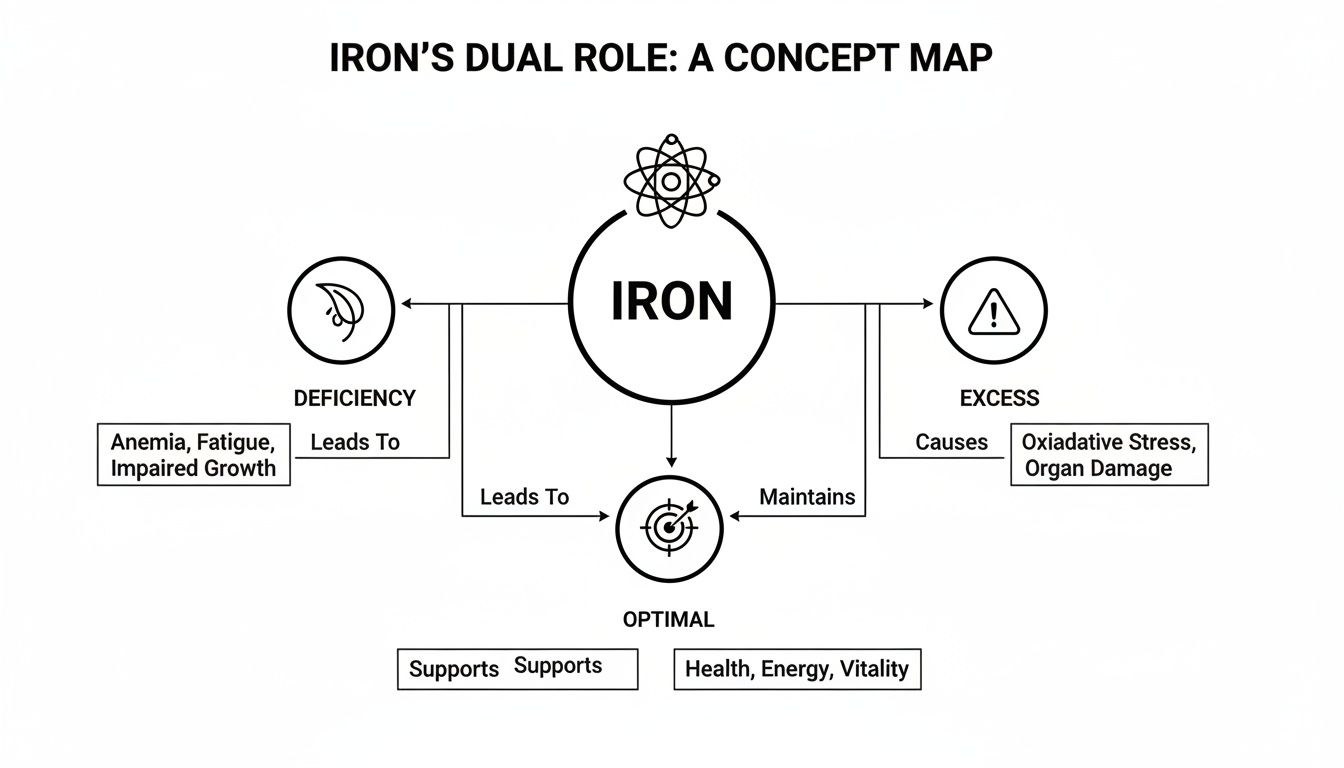
The goal isn't just to avoid being low on iron; it's about staying within that precise, optimal zone. Too much iron can cause oxidative stress, a process that can damage cells and accelerate ageing.
An isolated lab value tells you very little. Context is everything. For instance, ferritin is also an acute-phase reactant, meaning it can be artificially elevated by inflammation or illness, masking a true underlying iron deficiency. This is why looking at the entire panel is non-negotiable for an accurate diagnosis.
To truly manage your health for the long haul, you have to move beyond just being "in range." The aim is to make sure every part of your iron transport and storage system is working in harmony. This complete view help you to spot imbalances early, make targeted changes, and keep your body's essential systems running like clockwork for years to come.
Normal Iron Levels for Different UK Demographics
Figuring out a “normal” iron level is a lot more detailed than just looking at a single number. Your age, sex, and even your stage of life all play a huge part in determining what your body needs to feel and function at its best. What’s considered a perfectly healthy iron reserve for an adult man could leave a pre-menopausal woman feeling drained and fatigued, which is exactly why a one-size-fits-all approach to health just doesn’t cut it.
This isn't random variation; it’s all tied to our physiology. Different life stages place completely different demands on our iron stores. Take menstrual cycles, for example. The regular blood loss means pre-menopausal women have far higher iron needs than men of the same age.
Once menopause occurs, those requirements drop, and a woman's typical ferritin range starts to look more like a man's. On the flip side, as we all get older, our ability to absorb nutrients can decline, which introduces a whole new set of challenges. Understanding where you fit in is the first, most important step toward truly optimising your health.
The Problem with Standard UK Ranges
When you get a lab report back, it usually shows a very broad “reference range.” This range is really just designed to catch clear-cut disease, not to help you achieve optimal health or longevity. For instance, a ferritin level of 20 µg/L would likely be flagged as "normal" in the UK. The reality? Many people start experiencing classic symptoms of iron deficiency, like fatigue, brain fog, and even hair thinning, at levels well below 70 µg/L.
This gap is a massive blind spot in conventional healthcare. Being told your levels are “normal” can be incredibly frustrating when you know you don’t feel right. If you’re focused on longevity, the goal isn't just to avoid anaemia. It's to keep your iron stores within a much tighter, more effective window that supports peak cellular function while keeping oxidative stress in check.
The idea of 'normal' is built on population averages, and that population includes a lot of people with less-than-ideal health. For longevity, the aim should be for 'optimal' - the specific level associated with the best long-term health outcomes and the lowest risk of chronic disease.
Key Demographic Differences in the UK
National surveys in the UK show just how different iron status can be across various groups. The National Diet and Nutrition Survey found that iron deficiency anaemia hit 9% of girls aged 11–18, a worrying increase from previous years. On top of that, low iron stores were found in 24% of adolescent girls and 5% of adult women. Interestingly, that figure dropped to just 1% in older women, showing how dramatically risk can shift with age.
This data really drives home the need for personalised assessments. An athlete, especially a female endurance runner, will often have much higher iron needs because of increased red blood cell turnover and iron loss through sweat. They can’t afford to just be “normal”; they need a proactive strategy to stay in their peak performance zone. Knowing what you specifically need is everything. Our guide to essential blood tests for vitamins and minerals can help you build a more complete picture of your nutritional status.
To make this clearer, the table below shows the standard UK reference ranges for ferritin. But more importantly, it includes insights into the optimal targets you should really be aiming for and discussing with your healthcare provider for better long-term health.
UK Reference Ranges for Ferritin (µg/L) by Age and Sex
This table provides a breakdown of typical ferritin reference ranges from UK labs, highlighting how what's considered normal shifts across different life stages for males and females.
| Demographic Group | Typical Lower Limit (µg/L) | Typical Upper Limit (µg/L) | Notes on Longevity and Optimisation |
|---|---|---|---|
| Adult Men | 30 | 400 | The optimal range is much tighter, typically between 70-150 µg/L. Levels above 200 µg/L may increase oxidative stress. |
| Pre-Menopausal Women | 15 | 150 | Aiming for a ferritin level of at least 70 µg/L is important for preventing deficiency symptoms and supporting energy. |
| Post-Menopausal Women | 30 | 300 | The target range aligns closer to men's, with an optimal window of 70-150 µg/L to balance sufficiency and avoid overload. |
| Older Adults (70+) | 40 | 300 | Maintaining levels above 50 µg/L is important, but careful monitoring is needed to avoid excess iron accumulation. |
As you can see, the gap between "typical" and "optimal" can be significant. Simply staying within the standard reference range isn't enough if your goal is to feel your best now and protect your health for the future.
The Hidden Impact of Low Iron on Your Healthspan

When we talk about low iron, most of us immediately think of fatigue. And while that persistent, bone-deep tiredness is a classic sign, it’s really just the tip of the iceberg. Chronic iron deficiency works away silently in the background, chipping away at your long-term health in ways that go far beyond just feeling knackered. It’s a subtle drain on your vitality that can actually speed up the ageing process.
Understanding this link is vital for anyone serious about longevity. Low iron isn't just an inconvenience; it's a direct threat to your cellular health and resilience. Seeing it this way shifts the goal from simply avoiding anaemia to actively safeguarding your future healthspan.
The Biological Cost of Running Low on Iron
At its most basic, iron's most famous job is binding with oxygen in your red blood cells. Think of it as the magnet that allows each blood cell to grab oxygen as it passes through the lungs, ready for delivery to every tissue, organ, and muscle in your body.
When your iron levels drop, this entire oxygen delivery network becomes handicapped. Your cells, starved of the oxygen they need to produce energy, begin to function poorly. This biological energy crisis doesn't just make you feel tired; it sets off a cascade of negative effects throughout your body.
- Brain Fog and Cognitive Decline: Your brain is an energy guzzler, using up about 20% of your body's oxygen. When that supply line is squeezed, cognitive functions like memory, focus, and mental clarity start to suffer.
- Weakened Immune Response: Your immune cells rely on a steady supply of iron to mature and effectively fight off pathogens. Low iron can leave you far more vulnerable to picking up infections.
- Impaired Cellular Repair: Without enough energy, your body’s ability to repair everyday cellular damage slows right down. This is a key factor that contributes to the physical signs of ageing.
This isn’t a new problem. Historical data from the UK, brought together by the Scientific Advisory Committee on Nutrition (SACN), points to a stubborn, long-term issue with low iron intake, particularly among young women and children, that stretches back decades. The latest figures show that 10% of children aged 1.5–3 have iron intakes below the recommended minimum. Add to that a 23% anaemia prevalence in pregnant women, and you can see how this public health challenge continues to affect long-term health across generations. You can read the full research on this persistent challenge.
Subtle Symptoms Masking a Deeper Issue
Because the slide into iron deficiency is often slow and gradual, its symptoms can be easily brushed off as the normal stress of a busy life. But it's important to recognise these subtler signs, as they are early warnings that your cellular health is under strain.
Beyond fatigue, things like thinning hair, brittle nails, restless legs, and even strange cravings for non-food items like ice (a condition known as pica) can all point towards low iron stores. These aren't just trivial complaints; they are your body's way of signalling a deeper metabolic imbalance.
Ignoring these warnings allows the underlying problem to fester. To get a better handle on the factors that can lead to this state, you can explore our detailed guide on what causes low iron levels.
Over time, this chronic, low-grade cellular stress can have major consequences for your healthspan. It weakens your body's defences, slows down recovery, and creates an internal environment where age-related decline can take hold much more easily. Proactively managing your iron levels is a powerful strategy to fight back, ensuring your body has the fundamental resources it needs to thrive for years to come.
Why High Iron Levels Can Speed Up Ageing

We hear a lot about the dangers of low iron, but the other side of the story, iron overload, is a potent and often overlooked factor in the ageing process. Keeping your iron levels in the sweet spot isn't just about avoiding deficiency. It’s about preventing a surplus that can turn this vital mineral toxic.
Here’s why. When iron isn't safely bound to a protein, it becomes highly reactive. It acts as a powerful pro-oxidant, sparking the creation of destructive molecules called free radicals. You can think of this process, known as oxidative stress, as a kind of biological rusting from the inside out. It damages everything it touches, cell membranes, proteins, even your DNA, directly contributing to cellular breakdown and accelerated ageing.
This internal damage then stokes the fire of chronic, low-grade inflammation, another key driver of ageing. Together, oxidative stress and inflammation create a perfect storm for age-related diseases to take hold. It's a stark reminder that staying within that optimal 'Goldilocks Zone' is important for a long and healthy life.
The Sneaky Signs of Too Much Iron
Just like with iron deficiency, the symptoms of high iron can be frustratingly vague and easily confused with other health issues. They tend to creep up slowly, making them tough to identify without proper blood tests. Because the signs are so non-specific, many people put up with them for years, never guessing that an excess of iron is the root cause.
Common but subtle clues that your iron might be too high include:
- Persistent fatigue and weakness that rest just doesn't seem to fix.
- Achy joints, especially in your hands and knuckles.
- Abdominal pain or a feeling of discomfort around your liver.
- A drop in libido or other signs of hormonal imbalance.
- Changes in skin colour, which can sometimes take on a bronze or greyish tint.
Noticing these symptoms is the first step, but only a comprehensive iron panel can connect the dots and give you the full picture needed to take action.
The Causes and What's at Stake Long-Term
The most common culprit behind serious iron overload is a genetic condition called hereditary haemochromatosis. It’s surprisingly prevalent, affecting about 1 in 200 people in the UK, and it makes your body absorb far too much iron from your food. The real kicker is that many people with the condition have no idea they have it.
Another major contributor is simply misguided supplementation. Taking high-dose iron supplements without first confirming you actually need them is an easy way to push your levels into the danger zone. A well-intentioned health habit can quickly become a major source of cellular stress.
High ferritin levels aren’t just a number on a lab report; they’re a warning light. Research has connected chronically elevated iron stores to a much higher risk of developing serious health problems, including liver disease (cirrhosis), metabolic issues like type 2 diabetes, and even neurodegenerative diseases.
This clear link between too much iron and chronic illness really hammers home how important regular testing and careful management are. The goal should never be to just max out your iron stores. Instead, you want to keep them in a narrow, optimal range that supports your health without fuelling the very processes that age you. Getting this balance right is fundamental to any effective longevity plan.
An Action Plan for Optimising Your Iron Levels
Knowing the theory behind iron balance is one thing, but actually putting that knowledge into practice is where the real magic happens. The key is to move from simply understanding the numbers to actively managing them for your long-term health. Think of this as your roadmap for taking control of your iron status, turning abstract lab values into a real-world strategy for better performance and a longer healthspan.
The first step, always, is to get a clear picture of where you stand right now. This means getting a complete iron panel that looks at serum iron, ferritin, TIBC, and transferrin saturation. While your GP can certainly help (especially if you’re symptomatic), private testing services like Lola give you a more direct way to get the data you need. They offer professional phlebotomy services either at your home or a clinic nearby, cutting out the long waits.
Interpreting Your Results Like a Pro
Once you have your report in hand, the trick is to look for the story the numbers are telling together, not just focusing on one value that’s slightly out of range. Put on your health detective hat and start looking for clues.
- The Classic Deficiency Pattern: If you see low ferritin and low transferrin saturation alongside a high TIBC, that’s a loud and clear signal. Your body’s iron stores are empty, and it’s sending out a search party (high TIBC) to find more.
- The Early Overload Pattern: On the flip side, high ferritin and high transferrin saturation suggest your storage tanks are overflowing. This is a red flag for potential oxidative stress.
- A Hint of Inflammation: This one can be tricky. High ferritin with low transferrin saturation can be confusing. It often points towards chronic inflammation, which can lock iron away in storage, making it unusable even when your ferritin levels look high.
Learning to spot these patterns helps you see beyond the simple "normal" ranges and understand the dynamic process of how your body is actually handling this vital mineral.
Strategies to Increase Your Iron Levels
If your results show you’re running low, a smart, multi-pronged approach is far more effective than just popping a high-dose supplement. The real challenge isn’t just getting iron in, it’s getting your body to absorb it.
The goal is to help your body absorb and use iron effectively, not just to consume more of it. Small, consistent tweaks that boost bioavailability often work much better than big, isolated doses that just end up causing an upset stomach.
Here are a few evidence-based ways to give your levels a boost:
- Bring in a Helper: Vitamin C: Having some vitamin C with your iron-rich foods or supplements can massively increase how much non-haem iron you absorb. Think a squeeze of lemon on your spinach, or some berries with your iron-fortified cereal.
- Keep Inhibitors Separate: Certain compounds can block iron absorption. The main culprits are calcium (dairy), polyphenols (tea and coffee), and phytates (wholegrains and legumes). Try to have your iron-rich meal at least an hour apart from your milky coffee or high-fibre snack.
- Choose the Right Form: When it comes to food, haem iron from animal sources like red meat and liver is the easiest for your body to absorb. If you’re supplementing, look for forms like ferrous bisglycinate, which is known for being gentler on the gut and more bioavailable than the common ferrous sulphate.
Managing High Iron for a Longer Healthspan
If you find your iron levels are creeping up, taking proactive steps is important for minimising the oxidative stress that can speed up the ageing process. While diet is part of the puzzle, the single most effective way to lower iron is through therapeutic phlebotomy—which is just the clinical term for giving blood.
For people with high iron, especially those with the genetic condition haemochromatosis, regular blood donation is an incredibly useful measure. It physically removes iron from your system, helping to pull ferritin levels back into that sweet spot for longevity (ideally between 70-150 µg/L for most adults).
By testing thoroughly, interpreting your results intelligently, and using these targeted strategies, you can take firm control of your iron status. This isn't just about hitting "normal" numbers; it's about fine-tuning your body's chemistry for a healthier, more energetic life.
Your Iron Level Questions, Answered
Here's a look at some of the most common questions we get about understanding and managing iron levels. Here are the clear, practical answers you need.
How Often Should I Get My Iron Checked?
For most healthy adults with no symptoms, getting a full iron panel done every 2-3 years as part of a routine check-up is a solid plan. It’s enough to keep an eye on your long-term trends and catch any slow drifts downwards.
However, some of us need to be a bit more vigilant. If you're a menstruating woman, follow a plant-based diet, train hard as an endurance athlete, or give blood regularly, you're in a higher-risk group. For you, checking every 6-12 months is a smart move to stay ahead of any potential dips. And if you're already taking steps to correct low iron, testing every 3-6 months is important to make sure your strategy is actually working.
Is It Possible to Feel Awful Even with "Normal" Ferritin?
Absolutely. This is a situation we see all the time, and it’s a perfect example of why just being "in range" isn't the whole story. Many labs in the UK will flag a ferritin level as normal even if it's as low as 15-30 µg/L.
From a functional health perspective, that’s just not enough. We know that symptoms like persistent fatigue, brain fog, and even hair loss can start to creep in when ferritin falls below 50-70 µg/L. This is the critical difference between simply not having a disease and truly feeling your best.
Just because your ferritin result falls within the standard lab range doesn't mean it's optimal for you. Pay attention to your symptoms—aiming for a functionally healthy level is the key to real vitality.
Why Did My Doctor Only Test My Haemoglobin?
This is a very common practice. A Full Blood Count (FBC), which includes haemoglobin, is a standard first-line test. It’s good at doing one thing: spotting full-blown, late-stage iron deficiency anaemia.
The problem is, it’s a terrible early warning sign. Haemoglobin is the last domino to fall. Your iron stores (ferritin) have to be almost completely empty for a long time before your body can no longer produce enough red blood cells, causing your haemoglobin to finally drop. If you want to be proactive about your health, you need the full iron panel. It's the only way to catch an imbalance early, long before it becomes a much bigger problem.
Stop guessing about your health. With Lola, you can get a comprehensive iron panel with a professional blood draw at home or in a clinic, processed at UKAS-accredited labs. You'll get your results, along with a doctor's review, right in our app. It gives you the clear, confident insights you need to take control of your health for the long run. Find out more and book your iron test today.
Test This Biomarker at Home
This biomarker is included in our Iron Test and Core Health 45 — results in 2-3 working days with GP-reviewed insights.
At-Home Blood Testing
Check your levels from home
Professional phlebotomist visit. Doctor-reviewed results in 2-5 days. Track your health with comprehensive blood panels.
→45-70 biomarkers tested · Venous blood draw · From £130