


Navigating your health can feel like trying to solve a puzzle with half the pieces missing. Understanding your hormones is a crucial first step towards seeing the full picture, giving you powerful insights into your body's complex inner workings.
Testing hormones at home provides an accessible, private way to map out everything from your daily energy levels to how you're navigating major life stages. It's about making informed decisions for a healthier, longer life.
Why Testing Hormones At Home Is a Modern Health Strategy

Let's face it, waiting months for an appointment to understand what's happening inside your own body can be incredibly frustrating. At-home hormone testing puts that power back in your hands, shifting your approach from reactive to proactive. It’s not just about curiosity; it’s about building a detailed, personal map of your internal health to inform your longevity strategy.
Think of your hormones as your body's internal messaging service. They're constantly sending signals that regulate your mood, metabolism, energy, and so much more. When these messages get mixed up or the levels are off-balance, the effects can be subtle but significant, quietly chipping away at your quality of life and long-term healthspan.
Gaining Control Over Your Health Journey
Traditionally, getting this kind of information involved a GP visit, a referral to a specialist, and a long wait. Now, you can collect a sample from the comfort of your own home, pop it in the post to a certified lab, and get a detailed report sent directly to you. This convenience is a complete game-changer for anyone serious about optimising their health for the long run.
The growing popularity of these tests in the UK isn't surprising when you consider the pressures on traditional healthcare. NHS waiting times for women's healthcare, for example, have skyrocketed. Between 2013 and 2023, the share of women waiting over 18 weeks for treatment shot up from 5.71% to 42.14%—a massive 638% increase. It's no wonder so many people are looking for faster, private alternatives to get the answers they need. You can read more about these concerning trends in women's healthcare access.
By testing key biomarkers, you create a personal health baseline. This isn't just a one-off snapshot; it's the first chapter in your long-term health story, empowering you to make meaningful lifestyle adjustments that actually work for you.
The Power of Proactive Monitoring
If longevity is your goal, then proactive monitoring gives you a serious advantage. Why wait for symptoms to show up? You can track key hormonal indicators that directly influence ageing and vitality right now. This modern take on personal health lets you:
- Identify imbalances early: Catch subtle shifts in hormones like cortisol, thyroid, or oestrogen before they snowball into bigger problems that could impact your healthspan.
- Personalise your wellness plan: Use your results to fine-tune your diet, fitness routine, and stress management strategies. No more guesswork.
- Track progress over time: Actually see the tangible effects your lifestyle changes are having on your body's chemistry.
Ultimately, testing your hormones at home is about taking ownership. It gives you the knowledge to have more productive conversations with your doctor and steer your own health journey with confidence.
So, What Are Your Options For At-Home Hormone Testing?
When you start looking into testing your hormones at home, you'll find there’s more than one way to do it. It’s important to realise that not all tests are the same. The collection method you pick really shapes the kind of insights you get, so getting to grips with your options is the first step towards taking control of your long-term health.
Think of each test method as a different tool in a toolkit. You wouldn't use a sledgehammer to hang a picture frame, right? In the same way, the best test for measuring daily stress patterns isn't necessarily the right one for getting a clear picture of your reproductive health. Let's walk through the main types you'll come across.
Finger-Prick Blood Tests
The most common and straightforward method you'll see is the finger-prick blood test. It’s exactly what it sounds like: you use a tiny, sterile lancet to prick your fingertip and collect a few drops of blood. This is usually done either in a small vial or onto a special collection card. It’s a great middle-ground, offering real convenience without sacrificing the quality of the data.
This approach is incredibly versatile and can measure a whole host of hormones that are critical for healthy ageing, such as:
- Sex Hormones: Think testosterone, oestrogen, and progesterone. These are fundamental for maintaining bone density, muscle mass, mood, and even brain function as you get older.
- Thyroid Hormones: This includes TSH, Free T3, and Free T4. These hormones are the engine of your metabolism, directly impacting your energy levels and overall vitality.
- Stress Hormones: A blood test can give you a precise snapshot of your cortisol levels at a single moment, showing your body's immediate stress response.
Because your blood carries a high concentration of hormones, this method is fantastic for getting a clear, quantitative reading of your baseline levels. These are the solid numbers you can track over time to see if your diet, exercise, or lifestyle changes are actually making a difference inside your body. For a closer look, our guide on hormone blood tests in the UK breaks this down even further.
Saliva Tests
If a blood test is a photograph, a saliva test is more like a short video. Saliva testing is brilliant for measuring the 'free' hormones—the ones that are unbound and ready for your body to use right now. This makes it the go-to choice for tracking hormones that rise and fall throughout the day.
Its real superpower is in mapping out your cortisol rhythm. You'll typically collect several samples over a day—when you wake up, at noon, in the afternoon, and before bed. This builds a curve that paints a picture of how your body handles stress, which is a massive piece of the longevity puzzle. A wonky cortisol pattern can be an early warning sign of chronic stress, long before you feel completely burnt out.
A saliva test can give you practical clues for managing stress. For example, if you see high cortisol levels in the evening, it could finally explain why you struggle to switch off at night. That’s a clear signal to build a better wind-down routine to protect your long-term health.
Urine Tests
Finally, we have urine tests. These offer a much broader view, showing an average of your hormone production over a full 24-hour period. Rather than giving you a single snapshot, a dried urine test (you’ll often hear it called a DUTCH test) involves collecting samples on filter paper at several points during the day.
What makes this method unique is that it measures not just the hormones, but also their metabolites. These are the by-products left over after your body has used the hormones. It gives you an incredibly rich understanding of how your body is actually processing, using, and getting rid of hormones—something blood and saliva tests simply can't do.
This is a game-changer for longevity. It can show how well your body is detoxifying oestrogen, for instance, which has big implications for long-term health. It’s the tool for anyone who wants to build a truly complete and detailed picture of their entire hormonal landscape.
Comparing At-Home Hormone Testing Methods
To make things a bit clearer, here’s a quick rundown of how these different testing methods stack up against each other. Each has its own strengths and is suited for different purposes.
| Method | Collection Process | Best For Measuring | Pros | Cons |
|---|---|---|---|---|
| Finger-Prick Blood | Prick fingertip with a lancet to collect a few drops of blood. | Baseline hormone levels (e.g., testosterone, TSH, oestrogen). | Convenient, minimally invasive, provides accurate quantitative data. | Only a snapshot in time; may not capture daily fluctuations well. |
| Saliva | Spit into a collection tube at various times of the day. | Hormones with daily rhythms, especially free cortisol. | Non-invasive, excellent for tracking daily patterns, measures 'free' hormones. | Less accurate for hormones with low concentrations in saliva. |
| Urine | Collect urine on filter paper multiple times over 24 hours. | Hormone metabolites and a 24-hour average of hormone production. | Comprehensive overview of hormone metabolism and detoxification pathways. | More complex collection process; less common than blood or saliva tests. |
Choosing the right test really comes down to what you want to learn about your body. Whether you need a precise baseline, a look at your daily rhythms, or a deep dive into your metabolic pathways, there’s an at-home option that can give you the answers you’re looking for.
How Accurate Are At-Home Hormone Tests?
It’s the big question on everyone’s mind before they commit to an at-home test: can you actually trust the results? The short answer is yes, but it comes with a few important ‘ifs’. The accuracy of your hormone test really boils down to two things: the quality of the lab analysing your sample and how well you collect that sample at home.
Getting your head around these two factors is crucial if you want to use at-home testing to effectively track your long-term health. A reliable test gives you a powerful piece of data, but a dodgy one can send you down a completely wrong path, causing needless worry and confusion.
The Lab Makes All the Difference
Let's be clear: not all labs are created equal. If you want results you can truly rely on, you have to choose a testing company that partners with properly accredited laboratories. Here in the UK, that means looking for certifications like UKAS (United Kingdom Accreditation Service) or checking that the lab is regulated by the CQC (Care Quality Commission).
These accreditations aren't just for show; they're your guarantee of quality control. They prove that the lab adheres to rigorous standards for every step of the process—from handling and processing to the final analysis. This directly translates into results that are far more reliable and consistent.
A test is only as good as the lab that analyses it. Choosing a service that uses accredited labs is the single most important step you can take to ensure you're getting trustworthy data about your body.
Unfortunately, the UK market has had its share of issues. Recent investigations uncovered that some popular private online tests were giving out misleading results. One large UK-based lab apparently continued to process certain hormone tests despite knowing about accuracy problems since 2021. Stories like this, which you can read more about in this BMJ Group report on unreliable UK hormone tests, really hammer home why doing your homework on a test provider is so vital.
The “Snapshot in Time” Problem
Your hormones aren’t static numbers; they're in a constant state of flux. Levels can swing based on the time of day, where you are in your menstrual cycle, how stressed you are, and even what you had for breakfast. A single test only ever gives you a snapshot—one still frame from a constantly moving film.
This is exactly why establishing a health baseline is so powerful. A one-off result is interesting, sure, but the real magic happens when you track those results over time. It’s by looking at the bigger picture that you can start to spot trends, understand your body’s unique rhythm, and see if the lifestyle changes you're making are actually having an impact.
This infographic helps you visualise the different ways you can get that initial snapshot.
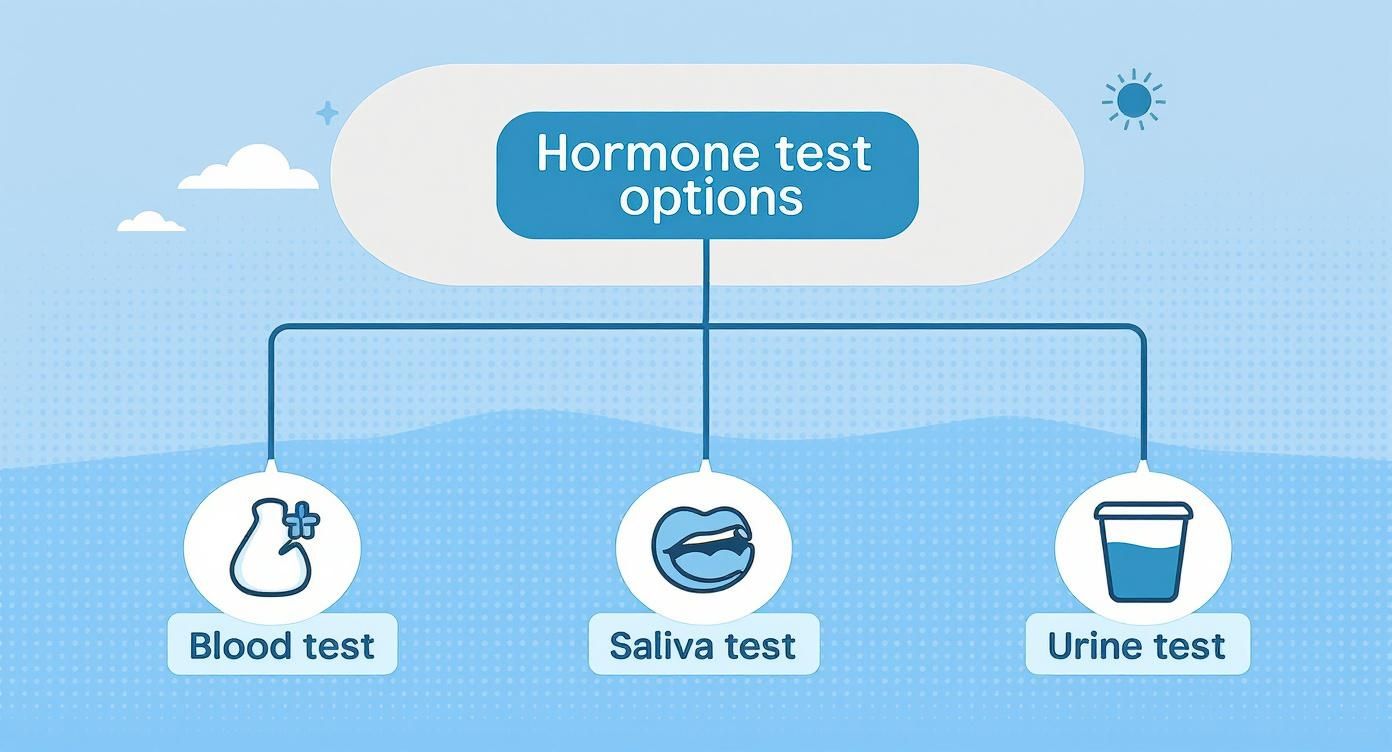
As you can see, while saliva and urine tests have their place, blood tests remain the go-to for getting a solid, quantitative baseline.
Common Errors That Can Skew Your Results
Even with a top-tier lab, the final result is only as good as the sample you send them. Simple user error during collection is one of the biggest reasons for wonky at-home hormone test results. To get the most dependable data, you’ve got to sidestep these common pitfalls:
- Bad Timing: Collecting a sample at the wrong time of day or on the wrong day of your cycle can completely throw off results for hormones like cortisol or progesterone.
- Contamination: It sounds obvious, but not washing your hands properly before a finger-prick test or letting the collection tube touch another surface can easily contaminate your sample.
- Not Enough Sample: If you don't provide enough blood, saliva, or urine, the lab might not be able to run the test at all, or it could lead to an inaccurate reading.
- Damaged Sample: Leaving your sample out in extreme heat or taking too long to pop it in the post can cause the hormones to break down, making the results useless.
These points bring up a key trade-off. While finger-prick tests are incredibly convenient, they leave more room for error than a traditional blood draw done by a trained professional. Understanding the difference between at-home and in-clinic blood tests can help you figure out which approach is the best fit for your personal health journey.
Making Sense Of Your Hormone Test Results
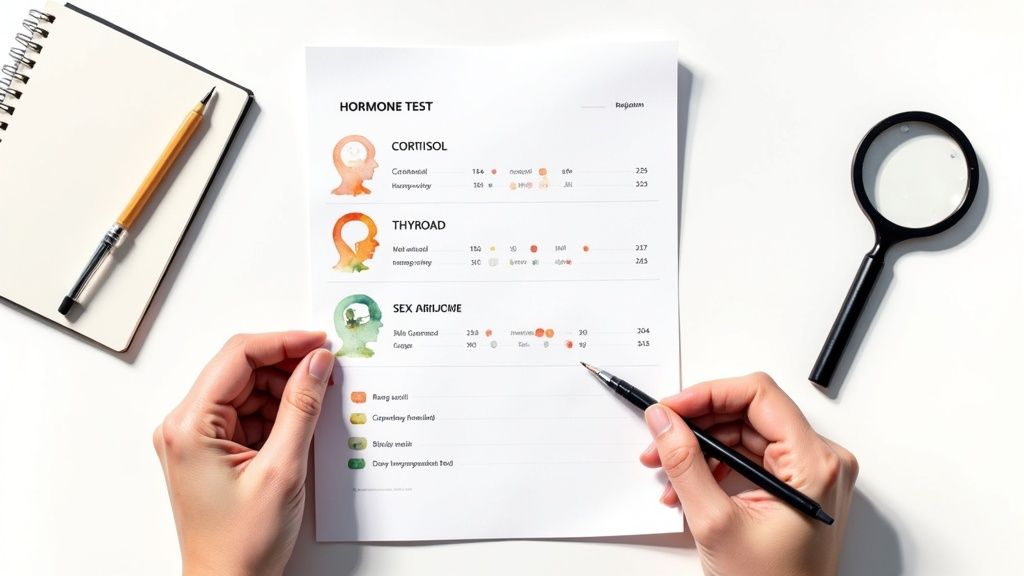
Getting your hormone test results back can feel a bit overwhelming at first. You’re suddenly faced with a report full of acronyms, numbers, and graphs that looks more like a scientific paper than a guide to your health. But this isn't just a collection of data; it's the start of a story about what’s really going on inside your body.
The first thing you’ll notice is your personal result for each hormone, listed next to a ‘reference range’. This range simply shows the typical values found in the general population. It’s a decent starting point, but it's far from the whole story, especially if you’re aiming for long-term health and vitality, not just avoiding illness.
Standard Ranges vs Optimal Ranges
Let's use an analogy. Think of the standard reference range as the basic pass mark for a car's MOT. As long as it's within that wide band, it's considered 'normal' and road-legal. But if you wanted that car to perform at its absolute best – peak fuel efficiency, smooth handling, and longevity – you'd aim for a much tighter, more specific set of metrics.
This is the key difference between standard and optimal ranges.
Optimal ranges are much narrower and are geared towards feeling your best, not just ticking a box to say you're not sick. Your results might technically fall within the standard lab range, but they could still be miles away from what's ideal for high energy, sharp thinking, and healthy ageing. Aiming for your optimal levels is a proactive strategy to genuinely enhance your quality of life.
"Your results are more than just numbers on a page. They are clues that connect your internal biochemistry to how you feel every single day. The goal is to move beyond 'normal' and aim for 'optimal'."
This shift in thinking is what makes at-home hormone testing so powerful. It gives you the power to see exactly where you can make targeted improvements, rather than just settling for a passing grade from a standard test.
Connecting the Dots Between Data and Daily Life
The real magic happens when you start linking the numbers on your report to how you actually feel. Your results aren't just a list of isolated facts; they are a map that can help explain the 'why' behind your symptoms.
Here’s how you can start translating that data into real-world insights:
- High Cortisol: If your results show cortisol is spiking, especially in the evening, does that match up with that ‘wired but tired’ feeling at bedtime? It’s a classic sign that chronic stress is messing with your sleep and recovery, potentially setting you on a path to burnout.
- Low Thyroid (TSH, Free T4): Are your thyroid levels bumping along the bottom of the normal range? That could be the very reason you’re dealing with persistent fatigue, brain fog, or struggling to manage your weight, even if you don't have a formal thyroid diagnosis.
- Imbalanced Sex Hormones: For men, low testosterone could be the culprit behind a lack of motivation and difficulty maintaining muscle. For women, ups and downs in oestrogen and progesterone can be directly linked to mood swings, poor sleep, and other symptoms of perimenopause.
This process turns an abstract report into your own personal health guide. It provides the evidence you need to make specific, targeted changes. For example, seeing high cortisol might be the push you need to finally prioritise a proper evening wind-down routine, while low thyroid markers could spark a conversation with your doctor about nutritional support.
In the UK, this kind of precise testing is becoming more central to advanced preventive healthcare. New research from Manchester University NHS Foundation Trust has shown that a highly sensitive blood test can assess hormone levels to help fine-tune preventive strategies for breast cancer in post-menopausal women. It's a clear sign that personalised testing is being recognised for its role in long-term health. You can read more about these preventive healthcare findings.
Ultimately, interpreting your results is about becoming the lead investigator in your own health journey. It arms you with the knowledge to have a much more informed, productive conversation with your doctor, helping you move from, "I just don't feel right" to, "Here's my data, let's make a plan."
When To Choose At-Home Phlebotomy Services
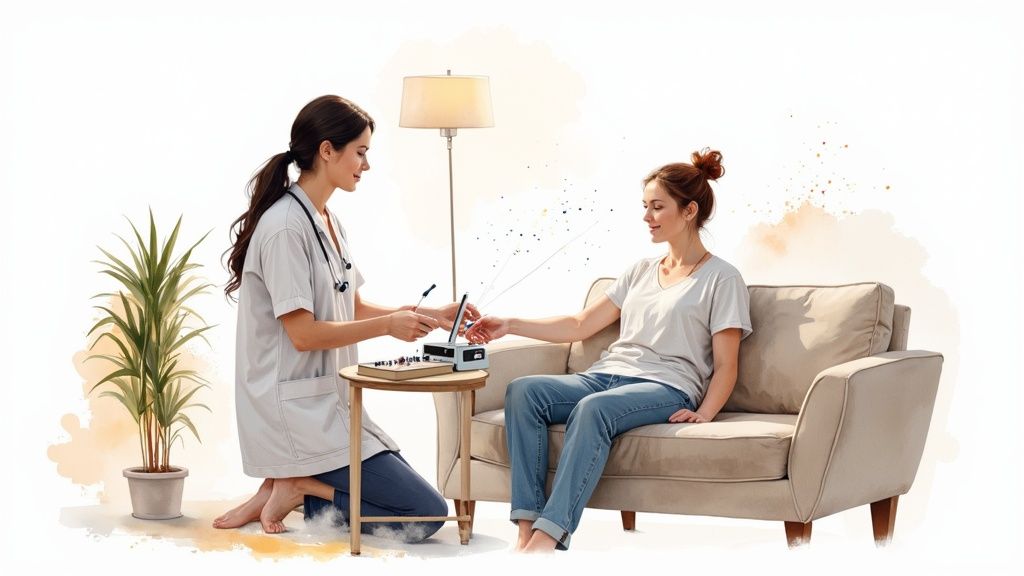
While finger-prick and saliva tests are incredibly convenient, there are times when you simply can't compromise on precision. If you're serious about tracking your hormonal health to inform your longevity strategy, at-home phlebotomy is the gold standard. It’s professional healthcare, delivered right to your front door.
Think of it as the perfect blend of at-home convenience and clinic-level accuracy. A certified phlebotomist visits you to perform a venous blood draw, the exact same procedure you’d get at your GP's office or a hospital. They draw the sample directly from a vein in your arm.
This is a world away from a finger-prick test, which uses capillary blood. A venous sample is much larger and cleaner, giving a far more stable and accurate picture of what’s really going on inside your body.
Eliminating the Risk of User Error
Perhaps the biggest advantage of using a phlebotomist is that it eliminates the risk of user error. As we've seen, it’s surprisingly easy to make small mistakes during self-collection—from not collecting enough blood to accidentally contaminating the sample. A professional handles everything, so you know it's done right.
This completely removes any doubt about the quality of your sample. You can be confident that the results you get back are a true reflection of your health. When you're making big decisions about your diet, supplements, or fitness routine based on this data, that peace of mind is priceless.
For anyone tracking biomarkers for longevity, consistency is key. At-home phlebotomy provides lab-grade, repeatable results, making it the superior choice for building a reliable health baseline over months and years.
Unlocking a Wider Range of Biomarkers
Another massive plus is the sheer number of tests you can run. A venous blood draw provides a much larger, higher-quality sample, which means labs can analyse a far more extensive range of biomarkers. This is crucial if you want to get a properly detailed look at your health.
With at-home phlebotomy, you can move beyond the basics and test a whole panel of markers related to your metabolic health, inflammation levels, and even cellular ageing. This includes things like:
- Advanced Cardiovascular Markers: Getting a read on things like ApoB and Lp(a) gives you a much clearer picture of your heart disease risk.
- Comprehensive Nutrient Panels: You can check your levels of key vitamins and minerals that affect everything from your energy to your brain function.
- Inflammatory Markers: Measuring indicators like hs-CRP helps you track low-grade inflammation, a major driver of age-related disease.
This depth of insight just isn't possible with the tiny amount of blood from a finger-prick. If you want to see exactly how the service works, our complete guide to at-home phlebotomy walks you through the entire process. It’s the clear choice for anyone truly committed to a data-driven approach to their well-being.
So, Your Results Are In. What Now?
Getting your hormone test results back isn't the finish line; it’s the starting gun. Those numbers on the page are a powerful first step, but they only become truly useful when you turn them into a concrete plan. This is where your investment really starts to pay dividends, giving you a clear roadmap for improving your long-term health.
The first, and most important, thing you need to do is book a chat with a qualified healthcare professional. Think of your at-home test as a brilliant screening tool that flags potential issues—it’s not a formal medical diagnosis. Your GP or a specialist can place your results in the wider context of your health history, symptoms, and lifestyle.
This conversation is your opportunity to build a health strategy that’s genuinely tailored to you. Armed with hard data, you and your practitioner can work together to pinpoint exactly what needs attention, whether that means more in-depth testing, simple lifestyle tweaks, or other specific interventions.
Turning Data Into a Plan for Longevity
Your test results are like a compass, pointing you towards lifestyle changes that can directly influence your hormonal balance and, ultimately, your healthspan. You’re essentially using your own biological data as the blueprint to build a foundation for a longer, more vibrant life.
The aim here is to support your body's natural rhythm. For example, if your cortisol levels are consistently high, that’s a clear signal to get serious about managing stress. If your thyroid markers aren't quite optimal, you can start exploring nutritional changes that support its function.
Your hormone test results are a catalyst for change. Use them to make informed, targeted adjustments that support your body's systems, moving you from reacting to symptoms to proactively building long-term resilience.
Practical Steps to Support Hormonal Balance
Once you’ve got professional medical advice, you can start making some impactful changes. While a plan designed just for you is always best, there are some well-established strategies known to have a positive effect on hormonal health.
Here are a few key areas to focus on:
- Fine-Tune Your Nutrition: Start prioritising a diet packed with whole foods. Think lean proteins, healthy fats from sources like avocados and olive oil, and a rainbow of different vegetables. These provide the essential building blocks your body needs to produce and regulate its hormones.
- Consider Strategic Supplements: Your results might show up specific gaps. With your doctor's guidance, targeted supplements like Vitamin D, magnesium, or specific B vitamins can be incredibly helpful for supporting your endocrine system.
- Move Your Body Intelligently: It's all about balance. Combining strength training to maintain muscle mass and support testosterone with restorative activities like yoga or even just a brisk walk can help manage cortisol. Finding the right mix is key.
- Make Sleep a Non-Negotiable: Aim for 7-9 hours of quality sleep every night. This is when your body does its most critical hormonal repair and regulation work. Cutting corners here can throw your entire system out of whack.
At the end of the day, testing your hormones at home gives you the knowledge to take control. It turns vague wellness goals into a clear, data-driven strategy, empowering you to make choices today that will pay off for decades to come.
Your Questions, Answered
Dipping your toes into at-home hormone testing can feel a bit overwhelming, and it's natural to have questions. Let's walk through some of the most common ones to help you get clear on how to make the best decisions for your health.
We'll cover how often you should really be testing, what these tests can (and can't) tell you, and the real-world differences between the testing methods out there.
How Often Should I Test My Hormones At Home?
This is a great question, and the honest answer is: it completely depends on you and your goals. There’s no one-size-fits-all schedule. The key is to test with purpose, not just for the sake of it.
If you're working with a doctor to manage something specific like hormone replacement therapy (HRT), they might recommend testing every 3-6 months to see how things are progressing. But if you’re focused on general wellness and longevity, one solid, comprehensive test each year can be a fantastic way to establish your baseline and keep an eye on trends over time. Remember, your hormones fluctuate naturally, so testing too often can just create noise.
The best strategy is always to chat with a healthcare professional. They can help you map out a testing plan that makes sense for your unique situation, so every test gives you genuinely useful information.
Can At-Home Hormone Tests Diagnose A Medical Condition?
No, they can't, and this is a really important distinction to grasp. At-home hormone tests are brilliant screening tools. They offer a window into your body’s chemistry and can flag potential imbalances that might need a closer look.
Here's a good analogy: an at-home test is like the "check engine" light in your car. It alerts you that something might be off, but it doesn't tell you precisely what the problem is or how to fix it. A formal diagnosis can only come from a qualified medical professional after a full evaluation, which includes your symptoms, medical history, and likely more in-depth clinical tests.
What Is The Difference Between A Finger-Prick Test And A Venous Draw?
The core difference really boils down to the quality of the blood sample and, ultimately, the reliability of your results.
A finger-prick test involves collecting a few drops of capillary blood from your fingertip. It’s convenient, for sure, but it's also much more susceptible to issues like contamination or simple user error, which can throw off the accuracy.
On the other hand, a venous blood draw is done by a trained phlebotomist who takes blood directly from a vein. This is the exact same method the NHS uses—it’s the gold standard for a reason. You get a larger, cleaner sample, which leads to far more accurate and dependable results. For anyone serious about tracking their health for the long run, it's the clear winner.
Take the guesswork out of your health journey with Lola. Our at-home phlebotomy service brings clinic-grade accuracy right to your doorstep, giving you the reliable data you need to build a proactive longevity plan. Explore our comprehensive blood testing services and take control of your health today.