


A creatine kinase (CK) blood test is a simple but useful measure for measuring the amount of an enzyme called creatine kinase in your blood. For those focused on longevity and optimising healthspan, it acts as a important biomarker, offering insights into how your body is handling physical stress and cellular repair - particularly in your muscles, heart, and even your brain.
What Is Creatine Kinase and Why Does It Matter for Longevity?

Creatine kinase is a vital enzyme that resides within your body’s most energy-demanding tissues. Its primary job is to help recycle adenosine triphosphate (ATP), the fundamental energy currency that fuels nearly every cellular action. When these cells are healthy and their walls are intact, the amount of CK circulating in your bloodstream remains consistently low.
However, when tissue is stressed or damaged - whether from an intense workout, an underlying inflammatory process, or an injury - the compromised cell walls allow CK to leak into the bloodstream. This is what makes the creatine kinase blood test so valuable for a longevity strategy; it provides a direct, measurable signal of cellular stress and recovery status.
A Simple Analogy for CK Levels
Imagine your body is a well-maintained estate. A low, stable level of background noise is normal - it signifies routine maintenance and healthy activity. This is your baseline CK level, indicating that normal cellular turnover and repair are proceeding smoothly.
Now, picture a period of intense renovation on that estate. The noise and dust would increase significantly, showing that major work is underway. In the same way, a temporary spike in your CK level is like a biological signal of intense work, such as muscle adaptation after exercise. A persistently high level, however, could indicate that the renovation crew (your body's repair systems) is overworked and falling behind, signalling a potential problem for long-term structural integrity.
Why This Test Is So Valuable for Longevity
Monitoring your CK levels is a proactive strategy for optimising long-term health. By understanding your personal baseline and how your body responds to various stressors, you can make more intelligent, data-driven decisions about your lifestyle, training, and recovery protocols.
For anyone focused on maximising healthspan, the CK test offers actionable insights:
- Optimising Recovery for Sustainable Fitness: It helps you quantify your recovery needs, preventing the chronic inflammation associated with overtraining, which is a key factor in accelerated ageing.
- Monitoring Muscle Health and Preventing Sarcopenia: Tracking CK provides an early warning system for underlying muscle strain and can also signal age-related muscle loss (sarcopenia) if levels become abnormally low, allowing for early intervention.
- Balancing Stress and Resilience: It provides the data needed to find your optimal balance between hormetic stress (beneficial challenges like exercise) and adequate rest, supporting cellular resilience and promoting long-term wellness.
Decoding Your CK Levels and Normal Ranges
Receiving your creatine kinase blood test results is the first step; interpreting them through a longevity lens is where true optimisation begins. The number on your report isn't just a static figure—it’s a dynamic clue to your muscle health, recovery efficiency, and overall physical resilience.
To make sense of your result, you must compare it against established reference ranges. These benchmarks are derived from population data, but a longevity-focused approach looks beyond them. To learn more about how these are created, this article on What Is Normative Data is a great resource.
Understanding UK Normal Ranges
In the UK, NHS pathology labs use benchmarks that account for physiological differences. For instance, it's normal for men to have higher baseline CK levels than women, primarily due to greater average muscle mass.
Here is a look at typical CK reference ranges used in the UK.
Typical Creatine Kinase (CK) Reference Ranges in the UK
| Provider/Source | Normal Range for Males (IU/L) | Normal Range for Females (IU/L) |
|---|---|---|
| North Bristol NHS Trust / Severn Pathology (Caucasian populations) | 40–320 | 25–200 |
It's important to note that these sources mention CK levels can be higher in black populations due to ethnic variations in muscle mass, highlighting the need for personalised interpretation of your results.
Beyond Normal to Optimal for Longevity
While falling within the “normal” range is good, a longevity mindset aims for optimal. Consistently hovering at the high end of the normal range, even without symptoms, could be a subtle indicator of chronic low-grade inflammation or inadequate recovery. This state of unresolved cellular stress is a known accelerator of the ageing process.
For a longevity enthusiast, your CK level is more than a pass/fail metric. It is a dynamic biomarker reflecting how effectively your body is managing stress and repair. It provides direct feedback on your lifestyle, diet, and training, enabling you to fine-tune your inputs for a longer healthspan.
Conversely, consistently low CK levels could point towards sarcopenia, the age-related decline in muscle mass and function, which is a major predictor of frailty and reduced lifespan.
By viewing your CK result through this longevity lens, you can transform it from a simple data point into a useful measure for proactive health management. To explore this further, our detailed guide on normal CK level ranges offers deeper insights. This approach turns raw data into actionable strategies for a longer, healthier life.
Why Your Creatine Kinase Levels Might Be High
An elevated number on your creatine kinase test can seem alarming, but context is important. In most cases, a high CK level is a temporary and expected response from your body, not a sign of disease. The key to actionable insight is understanding the reason behind the spike.
The most frequent cause of high CK is exercise. Activities like weightlifting, HIIT, or long-distance running create microscopic tears in muscle fibres. This is a normal part of the process that leads to stronger muscles. As your body repairs these fibres, CK leaks into the bloodstream, causing a transient increase. This post-workout spike is evidence that you’ve created a sufficient stimulus for adaptation. However, if levels remain elevated without adequate rest, it may signal that your recovery is lagging behind your training load.
Exercise Is Just One Piece of the Puzzle
While exercise is the primary driver, other factors can also increase your CK levels. Knowing these can help you and your doctor interpret your results with greater accuracy, ensuring you don't mistake a normal physiological response for a health problem.
Other common causes include:
- Direct Muscle Injury: A fall, deep bruise, or any significant trauma will cause muscle cell breakdown and CK release.
- Dehydration: Inadequate fluid intake can stress muscle cells and lead to a more concentrated CK reading.
- Certain Medications: Some drugs, notably statins for cholesterol management, are known to cause muscle inflammation and raise CK.
- Recent Surgery: The body's healing response post-operation involves tissue repair, which can temporarily elevate CK.
The chart below provides the typical reference ranges for CK, offering a benchmark against UK standards.
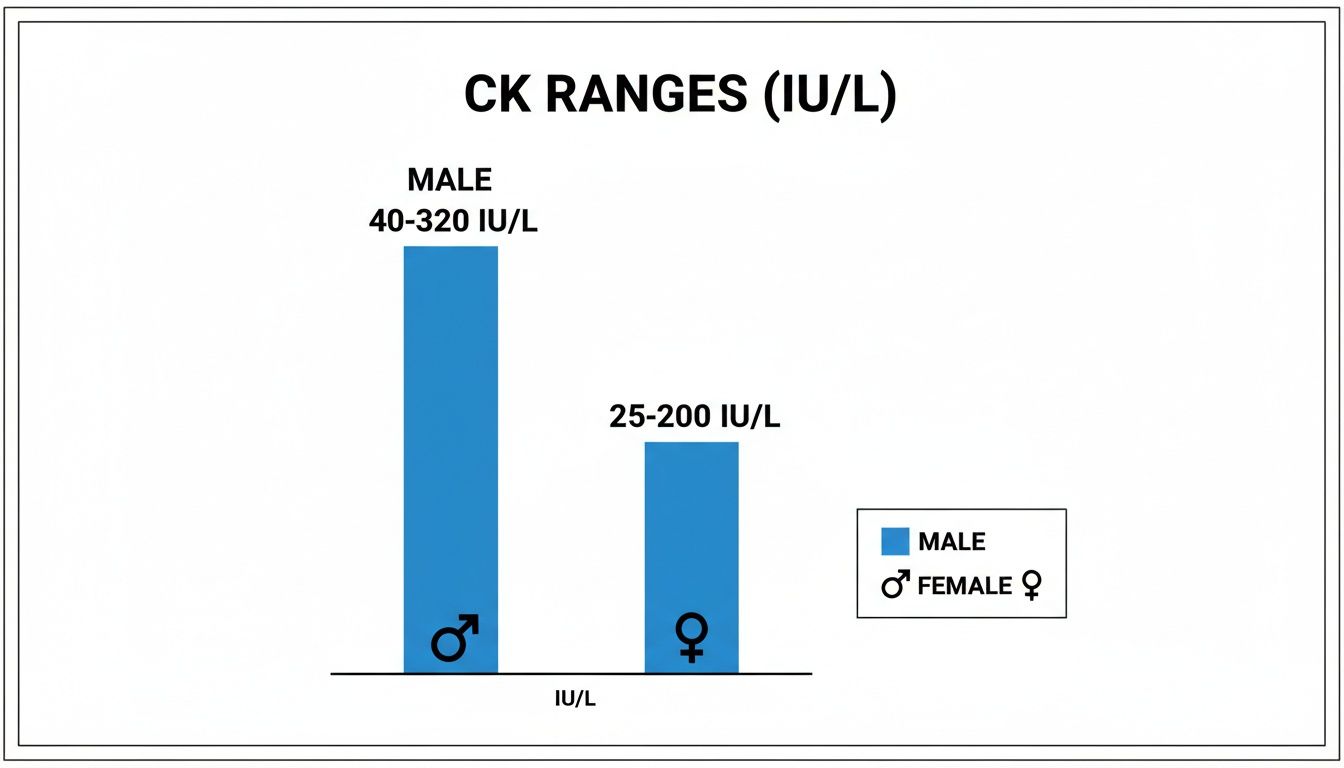
As shown, the normal range is typically higher for men than for women, largely due to differences in average muscle mass.
When High CK Signals a Deeper Issue
In less common scenarios, persistently high CK levels can indicate a more significant health issue that requires investigation. This is why a high result should not be ignored, particularly if accompanied by other symptoms like severe muscle pain, weakness, or dark-coloured urine.
Chronically elevated CK can serve as a vital biomarker for underlying cellular stress that goes beyond simple exercise fatigue. It prompts a deeper investigation into conditions that could impact long-term health if left unaddressed.
For instance, rhabdomyolysis, a severe syndrome of rapid muscle breakdown, causes extreme spikes in CK. Other possibilities include inherited muscle diseases like muscular dystrophy or inflammatory myopathies that cause chronic muscle inflammation. It's also worth noting that factors beyond direct muscle strain, such as chronic anxiety increasing the risk of heart attack, can influence conditions that may lead to elevated CK, particularly if the heart muscle is affected.
How CK Levels Tell Different Stories in Health and Disease
A biomarker like creatine kinase provides information that is highly dependent on context. What a creatine kinase blood test reveals for an athlete focused on performance longevity is entirely different from what it might suggest for an individual managing a chronic illness. Understanding these distinct narratives demonstrates the test's versatility in creating a personalised health strategy.
CK as a Tool for Athletic Longevity
For athletes and fitness enthusiasts, tracking CK is a scientific way to manage the balance between productive stress and harmful overexertion. Strenuous exercise is designed to break down muscle, which naturally elevates CK. This is a necessary part of the adaptation cycle that leads to improved performance.
The actionable insight, however, comes from monitoring the trend over time.
- Optimising Your Training Load: If your CK levels remain high long after a session, it’s a clear signal that your body hasn't fully recovered. This data allows you to intelligently adjust training intensity or add a rest day, preventing burnout and promoting sustainable progress.
- Preventing Injury and Enhancing Healthspan: Consistently training in a state of under-recovery increases inflammation and injury risk, both of which detract from long-term health. Monitoring CK enables you to be proactive, easing off before you cause significant damage and ensuring you can train effectively for decades to come.
For an athlete, chronically elevated CK is a red flag for overtraining, which can sabotage performance and accelerate wear and tear. Tracking this biomarker transforms recovery from guesswork into a data-driven science, directly contributing to career longevity and lifelong fitness.
CK in Chronic and Complex Conditions
In contrast, the narrative shifts when we examine certain chronic conditions, where the concern may be about unexpectedly low CK levels. Myalgic Encephalomyelitis/Chronic Fatigue Syndrome (ME/CFS) is a prime example. Here, CK levels can offer surprising clues about underlying metabolic dysfunction.
Research from the UK ME/CFS Biobank has revealed that individuals with severe ME/CFS can exhibit significantly lower serum CK levels compared to healthy controls. This counterintuitive finding suggests potential impairments in muscle energy metabolism. You can explore this fascinating research and its implications on the ME Association website.
This stark contrast highlights the adaptability of the creatine kinase blood test. It is not merely a muscle damage detector but a dynamic tool. When interpreted with the right context, it provides important information for anyone seeking to optimise their health, whether that means achieving peak performance or better managing a long-term condition for an improved quality of life.
The Role of CK Testing in Medical Diagnosis
When does a doctor decide a creatine kinase blood test is necessary? Unlike a routine cholesterol check, a CK test is typically ordered to investigate a specific issue. It acts as a diagnostic tool when there are clear signs of muscle-related trouble that need clarification.
Its primary strength lies in its ability to quickly confirm or rule out significant muscle tissue damage. In emergencies, this speed is critical. For instance, in a patient with chest pain, doctors will test for a specific type of CK called CK-MB, which is concentrated in the heart. A spike in CK-MB is a strong indicator of a heart attack, guiding immediate, life-saving interventions.
Investigating Muscle Weakness and Pain
Beyond emergencies, the CK test is fundamental for diagnosing the cause of chronic or unexplained muscle symptoms. If you experience persistent muscle pain, weakness, or cramping that isn't related to exercise, your doctor may order a CK test to investigate underlying muscle diseases (myopathies).
It is particularly useful for identifying conditions such as:
- Muscular Dystrophies: Genetic disorders causing progressive muscle weakness, often associated with extremely high CK levels.
- Inflammatory Myopathies: Conditions like polymyositis that cause chronic muscle inflammation, leading to persistently elevated CK.
- Rhabdomyolysis: A serious condition of rapid muscle breakdown that causes dangerously high CK levels.
By tracking CK levels, doctors can gauge the extent of muscle damage and monitor a condition's response to treatment. These measurements are important diagnostic biomarkers that provide a window into cellular health. To learn more, see our guide on understanding what are diagnostic biomarkers.
Understanding the Test's Limitations
While highly useful, a CK test is not a standalone diagnostic tool. Its results must be interpreted within a broader clinical context. A study in London, for example, examined the test's use in psychiatric settings to screen for a rare condition, neuroleptic malignant syndrome (NMS).
The study revealed that while 13.8% of patients tested had significantly high CK, none of them actually had NMS. This underscores that an elevated CK level itself is not a diagnosis—it is a piece of data that must be considered alongside other clinical signs.
This finding confirms that the CK test is most valuable when used to answer a specific question rather than as a general screening tool. You can find more details about this research on its clinical utility online. Understanding the test's appropriate application helps appreciate its vital role in modern medicine.
How to Prepare for Your CK Blood Test

To get a truly accurate and actionable reading from your creatine kinase blood test, preparation is key. The goal is to measure your true baseline CK level, free from temporary spikes caused by recent activities. Following a few guidelines ensures your results provide a reliable foundation for your health strategy.
The most critical step is to avoid strenuous exercise for at least 48 hours before your blood draw. Intense physical activity is the number one cause of transiently high CK levels. Giving your muscles adequate time to recover is essential for an accurate baseline reading. This means postponing heavy weightlifting, long runs, and high-intensity interval training.
Your Simple Pre-Test Checklist
In addition to resting your muscles, a few other factors can enhance the accuracy of your test. Proper hydration is important, as dehydration can concentrate substances in your blood and potentially skew results. Transparency with your healthcare provider is also vital.
- Stay Well-Hydrated: Drink plenty of water in the 24 hours leading up to your test to ensure a clean, accurate sample.
- Inform Your Doctor: Disclose all medications and supplements you are taking. Certain drugs, like statins, and supplements such as creatine monohydrate, can directly influence CK levels.
Securing an accurate CK baseline is about more than skipping a workout. It involves proper hydration and transparent communication about medications and supplements, giving you a trustworthy starting point for tracking your long-term health and optimising your longevity plan.
The Blood Draw and Modern Testing
The blood draw itself is a quick and straightforward procedure performed by a trained phlebotomist, who will take a small blood sample from a vein in your arm. For a detailed overview of the process, our guide on how to prepare for phlebotomy provides a comprehensive walkthrough.
Modern health services have made proactive testing more accessible than ever. With options like at-home phlebotomy and convenient clinic appointments, you can take control of your health monitoring without disruption. Your sample is processed in an accredited lab, ensuring reliable results. Once ready, they are delivered securely via an app, accompanied by a doctor's review to help you translate the numbers into meaningful actions for your health goals.
Got Questions About the CK Blood Test?
It's natural to have questions when exploring a new health metric. Here are answers to some of the most common queries about the creatine kinase test.
Can What I Eat or Take as a Supplement Affect My CK Levels?
Yes, they can. While your daily diet is unlikely to cause significant fluctuations, severe dehydration can concentrate your blood and potentially elevate your CK reading.
A more direct impact often comes from supplements, particularly creatine monohydrate, which is popular among those who exercise regularly. Taking creatine can often lead to a slightly higher baseline CK level. This is generally not a cause for concern but is critical information for your doctor to have when interpreting your results. Always disclose any supplements you are taking before a blood test.
How Long Does It Take for CK Levels to Go Back to Normal After a Workout?
The recovery timeline depends entirely on the intensity and duration of the exercise. After a workout, CK levels typically begin to rise within 4-12 hours, peak between 24 and 72 hours, and then gradually return to your baseline over the next 3 to 5 days. For particularly demanding activities, like a marathon or a new strength training program, this recovery period could extend to a week or more. This is precisely why resting for at least 48 hours before a test is important for obtaining a true baseline measurement.
Should I Panic if I Get a Single High CK Result?
No. A single high CK reading, especially in the absence of symptoms like severe muscle pain, weakness, or dark urine, is most often a reflection of recent physical exertion.
Context is paramount when interpreting a CK blood test. A clinician will not evaluate the number in isolation. They will consider your recent activity levels, medications, and overall health. A moderately elevated CK in a long-distance runner is expected, whereas a very high level in a sedentary individual who feels unwell warrants further investigation.
It is the persistently high levels, or readings that are five to ten times the upper limit of normal without a clear explanation, that signal the need for a deeper medical evaluation to rule out any underlying conditions.
Ready to get a clear picture of your muscle health and fine-tune your recovery strategy? With Lola, you can book a professional phlebotomist to come to your home or a nearby clinic, making the whole process incredibly simple. We deliver your results straight to our app, complete with a doctor’s review, so you get meaningful insights for your health goals. Book your health analysis today.
At-Home Blood Testing
Check your levels from home
Professional phlebotomist visit. Doctor-reviewed results in 2-5 days. Track your health with comprehensive blood panels.
→45-70 biomarkers tested · Venous blood draw · From £130