


Metabolic health isn't just about the absence of disease - it’s about the presence of optimal function. It’s a measure of how well your body generates and uses energy from the food you eat, a process that underpins everything from your daily energy levels to your long-term vitality.
When this system is working correctly, you’re not just avoiding illness; you're actively building a foundation for a longer, healthier, more vibrant life.
Understanding Your Metabolic Engine

Think of your body as a high-performance engine. The food you eat is the fuel, and your metabolism is the complex machinery that turns that fuel into power. When your metabolic health is in top shape, this engine runs smoothly and efficiently. It provides steady, reliable power, keeping your energy stable, your thinking clear, and your body resilient.
This goes far beyond just your weight or how quickly you burn calories. True metabolic health is a state of deep cellular balance where every part of your body gets the exact energy it needs, right when it needs it. This quiet efficiency is the bedrock of longevity.
The Five Pillars Of Optimal Metabolic Health
So, how do we measure the performance of this internal engine? Metabolic health isn't some abstract concept; it's a measurable state. It's defined by five key biomarkers all sitting within their ideal ranges, without you needing medication to keep them there.
When these markers are in harmony, it’s a clear sign your body is managing energy, inflammation, and cellular stress effectively - the core processes that dictate how well you age.
Here’s a breakdown of what optimal metabolic function looks like, based on these five pillars.
| Indicator | Optimal Range (General Guideline) | Why It Matters For Longevity |
|---|---|---|
| Blood Sugar | Fasting glucose < 5.5 mmol/L (100 mg/dL) | Stable blood sugar prevents cellular damage, reduces inflammation, and protects against insulin resistance, a key driver of ageing. |
| Triglycerides | < 1.7 mmol/L (150 mg/dL) | Low levels indicate your body is efficiently using fat for energy rather than storing it in a way that can harm arteries and organs. |
| HDL Cholesterol | Men: > 1.0 mmol/L (40 mg/dL) Women: > 1.3 mmol/L (50 mg/dL) |
High HDL ("good") cholesterol acts like a clean-up crew, removing harmful cholesterol from your arteries and protecting your cardiovascular system. |
| Blood Pressure | < 120/80 mmHg | Healthy blood pressure reduces strain on your heart and blood vessels, lowering the risk of damage that accumulates over a lifetime. |
| Waist Circumference | Men: < 40 inches (102 cm) Women: < 35 inches (88 cm) |
A smaller waist generally means less visceral fat - the dangerous fat around your organs that actively promotes inflammation and metabolic dysfunction. |
Maintaining these five pillars is about more than just good numbers on a lab report. When they're all optimised, they create a powerful biological defence system.
This state of metabolic fitness dramatically lowers your risk for chronic diseases and quite literally slows down the ageing process at a cellular level. It’s the key to a longer healthspan.
Why It Matters For Longevity
Poor metabolic health is like trying to run that high-performance engine on contaminated fuel. It might work for a while, but over time, the inefficiency causes widespread problems: cellular stress, chronic inflammation, and a slow-motion breakdown of critical systems.
This underlying dysfunction is the common thread linking many age-related diseases, from heart conditions and type 2 diabetes to cognitive decline.
By focusing on your metabolic engine, you’re switching from a reactive game of whack-a-mole, treating symptoms as they pop up, to a proactive strategy for a longer, healthier life. You’re directly influencing the fundamental processes that dictate how well you age.
Understanding and improving your metabolic health is arguably the most powerful lever you can pull to extend not just your lifespan, but your healthspan - the years you spend feeling and performing at your best. For a deeper look at the data, you can learn more about what a complete metabolic panel reveals about your internal health.
The UK's Metabolic Health Crisis: What It Costs Your Performance
The idea of a finely tuned metabolic engine isn't just a wellness trend. It's at the heart of a national conversation with serious consequences for our performance and long-term health. What many see as a distant public health problem is actually a direct and immediate threat to the energy, focus, and resilience that ambitious people depend on to build a long, successful life. The numbers paint a stark picture, revealing a silent crisis in the UK that is actively undermining personal and professional goals.
This isn't some abstract statistic. It has a real impact on your ability to perform at your best, whether you're in the boardroom or on the running track. Poor metabolic function is often the hidden culprit behind unexplained fatigue, brain fog, and a frustratingly slow recovery from physical and mental stress - all of which chip away at your potential for a long and vibrant future.
The Sobering Statistics
Let's be blunt: the UK is facing a huge challenge. In England, an eye-watering 64.5% of adults were living with overweight or obesity in 2023-24, and that figure is still climbing. This isn't just about appearances; excess body weight is a primary driver of metabolic chaos, throwing the delicate balance of blood sugar, cholesterol, and insulin sensitivity completely out of whack. You can explore more about these obesity statistics and their impact on health.
The consequences ripple outwards, placing a massive strain on individuals and the economy alike.
Poor metabolic health is estimated to cost the UK economy an astonishing £126 billion every year. That figure includes £12.6 billion in direct costs to the NHS and a staggering £31 billion in wider economic damage from lost productivity.
This economic cost is simply a large-scale reflection of a small-scale reality. For every professional fighting an afternoon slump or an athlete struggling to recover, there's often a metabolic root cause. This "performance tax" is paid daily through dulled cognitive sharpness, reduced physical output, and a much higher risk of burnout, ultimately shortening one's healthspan.
From National Trend To Personal Threat
It’s easy to look at national health data and think it doesn't apply to you, especially if you consider yourself active and healthy. But metabolic dysfunction doesn’t discriminate. It can quietly chip away at the very foundations of high performance, stealing from the healthy years you plan to enjoy in the future.
Think of it this way:
- For the Business Professional: Chronic insulin resistance, a key sign of poor metabolic health, causes sharp spikes and crashes in your blood sugar. This translates directly to inconsistent focus, a drop in creative problem-solving, and a midday energy drain that no amount of coffee can fix. It's a direct attack on the mental endurance you need to lead and innovate for decades to come.
- For the Athlete: An inefficient metabolism hamstrings your body's ability to use fuel. This means slower recovery times, more inflammation after a tough session, a higher risk of injury, and a hard ceiling on your performance. Your body simply can't repair and adapt in a way that supports a long athletic life.
This slow erosion of performance isn't just a short-term problem; it’s a long-term threat to your healthspan. Every day spent with a subpar metabolism speeds up the ageing process at a cellular level, taking away from the healthy, active years you’re working so hard to build.
The Longevity Equation
in the end, seeing the scale of the UK's metabolic health crisis serves one critical purpose: it reframes proactive health monitoring from a "nice-to-have" into an essential strategy for anyone serious about their performance and longevity. Ignoring the warning signs is like driving a high-performance car while ignoring a flashing engine light. It might run for a while, but a breakdown is inevitable.
Once you connect the dots between the national statistics and your personal ambition, the way forward becomes much clearer. Taking control of your metabolic health is the most direct way to protect your competitive edge, boost your daily energy, and invest in a future defined by what you can do, not by your limitations. The first step is finding out exactly what’s going on under the bonnet.
Your Personal Metabolic Dashboard: Key Biomarkers To Track
Forget the national statistics for a moment. The real power comes from understanding your own metabolic data. That vague feeling of fatigue or noticing your performance is just a bit... off? Those are symptoms. The root causes are often hidden in your bloodstream, and to really take control of your health and longevity, you need to look under the bonnet.
This is where specific blood biomarkers become your most valuable allies. They aren't just abstract numbers on a lab report; they are direct readouts from your internal engine. They tell you precisely how well your body is managing energy, inflammation, and cellular stress. By tracking these key metrics, you can shift from guessing to knowing, allowing you to make targeted decisions that have a real impact on your long-term vitality.
The flowchart below shows just how these individual health issues scale up, creating a significant economic burden in the UK through lost productivity and increased healthcare strain.
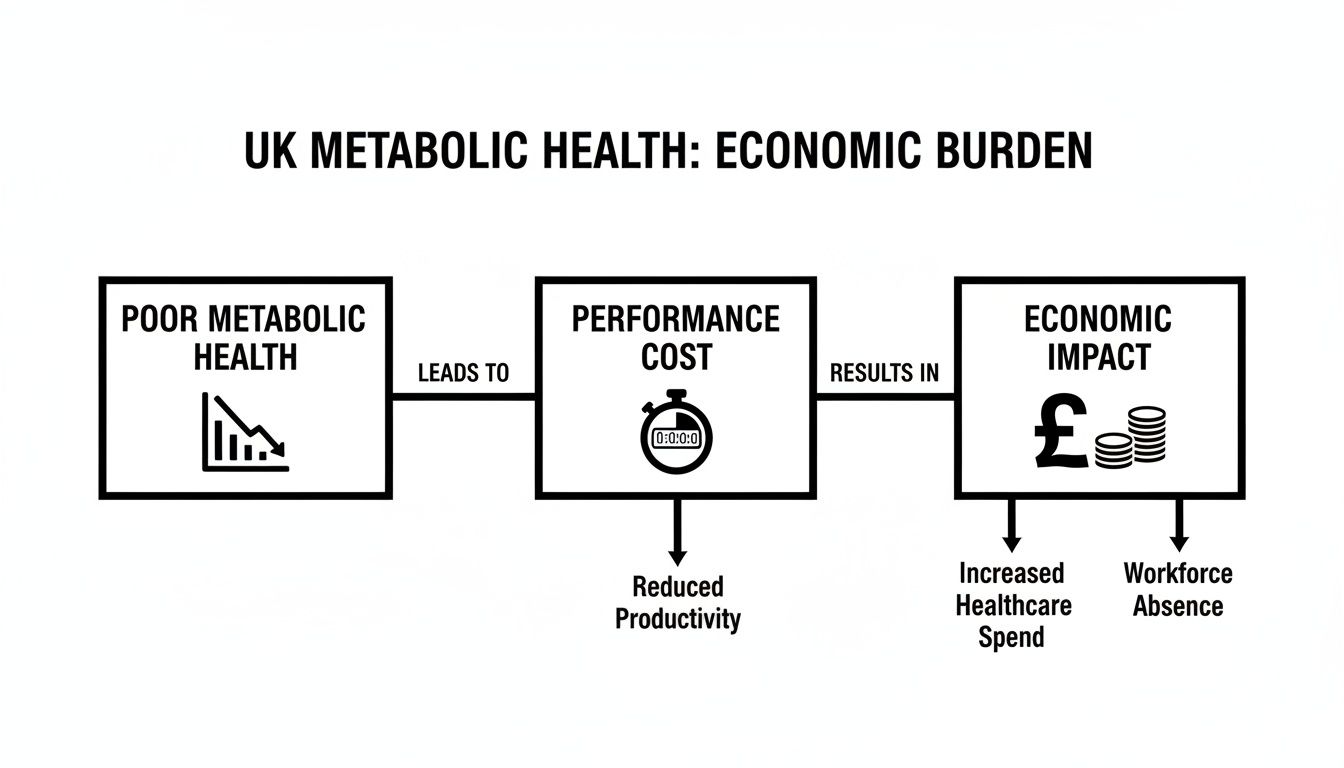
It’s a stark reminder of how personal health connects to the bigger picture.
Now, let's bring it back to you. Here's a look at the essential data points on your personal health dashboard and what they mean for your longevity.
Essential Metabolic Health Biomarkers and Their Significance
This table offers a detailed look at key blood markers, their optimal ranges for longevity, and what they indicate about your metabolic function.
| Biomarker | What It Measures | Optimal Range for Longevity | Implications of High/Low Levels |
|---|---|---|---|
| Fasting Glucose | A snapshot of your blood sugar after an overnight fast. | < 5.0 mmol/L | High levels can indicate insulin resistance, where cells struggle to take up sugar. |
| HbA1c | Your average blood sugar over the past 2-3 months. | < 33 mmol/mol (5.2%) | High levels show sustained poor glucose control, accelerating cellular ageing. |
| Triglycerides | The amount of fat circulating in your blood. | < 0.8 mmol/L | High levels suggest your body is storing, not burning, excess energy. |
| HDL Cholesterol | "Good" cholesterol that helps clear arteries. | > 1.5 mmol/L | Low levels are linked to a higher risk of cardiovascular disease. |
| hs-CRP | A sensitive marker for systemic, low-grade inflammation. | < 1.0 mg/L | High levels act as a warning sign for chronic stress and cellular damage. |
Tracking these numbers gives you a clear, objective picture of what's happening inside your body. It allows you to move beyond generic advice and build a strategy that's truly personalised for lasting performance and a longer healthspan.
Decoding Your Blood Sugar Regulation
Your body’s ability to manage blood sugar is a cornerstone of metabolic health. Get this right, and you feel great. When it’s out of sync, it creates a cascade of problems, from energy crashes and brain fog to accelerated ageing at a cellular level.
Two key markers give you the full story:
- Fasting Glucose: Think of this as a spot check. It measures the sugar in your blood after you haven't eaten overnight. A consistently high reading is a red flag that your cells might be struggling to absorb glucose properly - the first step towards insulin resistance.
- HbA1c (Glycated Haemoglobin): This isn't just a snapshot; it's the highlight reel. It shows your average blood sugar levels over the past 2-3 months. It's like your metabolic 'performance review' for the quarter, giving you a far more stable picture than a single glucose reading. To dig deeper, you can learn more about what HbA1c is and why it's a critical marker for longevity.
Keeping these markers in check is non-negotiable for a long and healthy life. Stable blood sugar protects your brain, keeps your blood vessels flexible, and minimises the chronic inflammation that drives the ageing process forward.
Assessing Your Lipid Profile for Heart Health
Your lipid profile, cholesterol and triglycerides, offers important insights into how your body processes and transports fats. These numbers are about much more than just heart disease risk; they are fundamental indicators of your metabolic efficiency, a key factor in longevity.
Here’s what to focus on:
- Triglycerides: High levels often mean your body is storing excess energy from your diet as fat. This isn't ideal, as that fat can start to accumulate in your liver and arteries. For longevity, the goal is to keep these numbers low, which shows your body is burning fat for fuel as it should be.
- HDL Cholesterol: Often called the "good" cholesterol, HDL is like a clean-up crew, scavenging for harmful cholesterol and removing it from your blood vessels. A higher HDL level is a sign of a healthy, resilient cardiovascular system and is strongly linked to a longer healthspan.
An optimal lipid profile isn't about eliminating fat; it's about achieving a healthy balance. It reflects a metabolism that can efficiently use, transport, and clear fats, protecting your arteries and organs from damage that quietly accumulates over decades.
Measuring Systemic Inflammation
Finally, we have the silent threat: underlying inflammation. Chronic, low-grade inflammation is a saboteur of both longevity and peak performance. It damages cells and is the common thread running through nearly every age-related disease.
A key biomarker here is hs-CRP (high-sensitivity C-reactive protein). Your liver produces this protein when there's inflammation anywhere in your body. An elevated hs-CRP reading is a powerful warning sign that your body is in a state of chronic stress, which can stem from a poor diet, lack of sleep, or even a hidden infection.
For anyone serious about extending their healthy years, keeping this marker as low as possible is a core goal. These biomarkers, glucose, HbA1c, triglycerides, HDL, and hs-CRP, are the essential dials on your metabolic health dashboard.
Translating Data into a Proactive Longevity Strategy
Getting a lab report full of numbers and strange acronyms isn't the end goal. It’s the starting line. The real magic happens when you turn that raw data into a powerful, forward-thinking plan for a longer, healthier life. This is the moment you switch from being a passenger in your own health to being the pilot, using precise information to steer your healthspan in the right direction.
True longevity isn't about chasing one perfect test result; it’s about understanding the direction your health is heading. When you track your biomarkers over time, you start to see your own personal health story unfold. You can quite literally see how that new sleep routine impacts your fasting glucose, or how adding a couple of resistance training sessions a week improves your triglycerides.
This kind of ongoing monitoring turns your health from a series of disconnected snapshots into a dynamic film, revealing the clear cause-and-effect relationship between your daily choices and your health at a cellular level.
From Reactive to Proactive Health
For most of us, the traditional approach to health is reactive. We wait for something to break before we try to fix it. A proactive longevity strategy flips this script entirely. It's about spotting the subtle shifts on your metabolic dashboard long before they ever become a real problem.
Think about seeing your HbA1c creep up by a single point, or your HDL cholesterol dip just slightly. These aren't red-alert emergencies, but they are incredibly important early warning signals for your long-term health.
Proactive health management means treating small, negative trends as vital information. A slight upward trend in an inflammatory marker or a gradual decline in a key vitamin level is your cue to intervene. You can then make small, targeted lifestyle adjustments that prevent a minor issue from snowballing into a major health crisis down the road.
This is the essence of managing your metabolic health for longevity. You're not just dodging disease; you are actively building an internal environment where your body can thrive for decades.
The Power of Spotting Trends Early
Spotting these trends early is critical because metabolic dysfunction doesn't just appear overnight. It's a slow burn, developing gradually over years, often with no obvious symptoms. This is precisely why a proactive mindset is so essential, especially in the current climate.
For instance, the UK's healthy life expectancy, the number of years people can expect to live in good health, has seen a worrying decline. It recently dropped to 62.4 years for men and 60.9 for women. This trend points to a growing metabolic health crisis that is quietly chipping away at our quality years, with socioeconomic factors creating even wider gaps in healthspan. You can read the full research about this health decline to grasp the scale of the issue.
Data like this really underscores the urgency of early intervention. By catching biomarkers like blood sugar or lipids just as they start to drift from optimal, you can make minor course corrections. Things as simple as adjusting your post-meal walk or increasing your fibre intake can have a massive long-term impact on your healthspan.
A Holistic View of Your Health Data
An effective longevity strategy demands looking at the whole picture. Your core metabolic markers are the headline acts, but they don't exist in a vacuum. They’re influenced by a huge range of other factors, including your micronutrient status.
Key nutrients play a surprisingly direct role in keeping your metabolic engine running smoothly.
- Vitamin D: This is so much more than a bone-health vitamin. It acts like a hormone, influencing insulin sensitivity and helping to regulate inflammation. Low levels can make it much harder for your body to manage blood sugar.
- Magnesium: Think of this mineral as a master key. It’s a cofactor in hundreds of important bodily reactions, including those essential for glucose metabolism. A deficiency can be a direct contributor to insulin resistance.
- B Vitamins: These are the spark plugs for your energy production, helping your cells convert the food you eat into fuel you can actually use.
Viewing your blood test results through this wider lens shows just how interconnected your body's systems truly are. It helps you see that a slight dip in Vitamin D might be contributing to that small rise in fasting glucose. This whole-body understanding is what allows you to build a truly strong strategy, addressing the root causes of metabolic imbalance to secure a longer, more vibrant life.
Actionable Strategies to Optimise Your Metabolic Health

Knowing your metabolic numbers is just the starting line. The real transformation happens when you turn that insight into action. But let’s be clear: optimising your metabolic health isn't about gruelling diets or quick fixes. It’s about building consistent, evidence-backed habits across four key areas of your life that work in combined effect to extend your healthspan.
Think of this as your practical toolkit for fine-tuning your body’s engine, not just for today's performance but for a longer, healthier future.
Master Your Nutrition and Blood Sugar
What you eat is the most useful measure you have to influence your metabolic health day in, day out. The goal is surprisingly simple: give your body high-quality fuel and keep your blood sugar levels stable. Wild swings in glucose are a huge source of cellular stress and a fast track to accelerated ageing.
A smart way to start is by building every meal around protein, fibre, and healthy fats. This powerful trio slows down digestion, which means you get a much gentler rise in blood sugar after you eat. Understanding how individual foods work, like olive oil's impact on blood sugar, is key to getting this right.
Here are a few tactical shifts to focus on for longevity:
- Prioritise Protein: Make sure a quality protein source, like lean meat, fish, eggs, or legumes, is on your plate at every meal. It keeps you feeling full and supports muscle, which is vital for glucose management as you age.
- Embrace Fibre: Load up on non-starchy vegetables, nuts, and seeds. Fibre acts like a brake on sugar absorption and also happens to feed the good bacteria in your gut.
- Time Your Nutrients: A simple but effective trick is to eat your carbs after your protein and fibre. This can further soften a post-meal glucose spike, keeping your energy levels nice and steady.
Build a Powerful Exercise Routine
For metabolic fitness, exercise is non-negotiable, and a strategic approach is key to longevity. A smart, balanced routine delivers long-term results. The ideal mix combines strength training with steady-state cardio to build a truly strong metabolic system.
Resistance training is absolutely essential because muscle acts as your body’s primary “glucose sink.” The more muscle you have, the more efficiently you can pull sugar out of your bloodstream after a meal, giving your pancreas a much-needed break.
By building and maintaining muscle, you are essentially upgrading your body’s glucose management hardware. This makes you more insulin-sensitive and dramatically improves your metabolic flexibility—your ability to switch efficiently between burning carbs and fats for fuel.
Pair that with Zone 2 cardio. This is your low-and-slow activity, like a brisk walk, a gentle jog, or a cycle where you can still hold a conversation. Training in this zone is fantastic for your mitochondria, the tiny power plants in your cells, making you far better at burning fat for energy and promoting cellular health.
Prioritise Restorative Sleep
Sleep isn't an indulgence; it's a fundamental metabolic reset essential for long-term health. Just one night of poor sleep can temporarily make your insulin sensitivity as poor as someone with prediabetes. Over time, a chronic lack of sleep plays havoc with the hormones that control your hunger, stress, and blood sugar.
While you're in a deep sleep, your body is hard at work on essential maintenance:
- Hormone Regulation: It gets cortisol (the stress hormone) and ghrelin/leptin (your hunger signals) back in balance, which helps stop cravings for sugary foods.
- Cellular Repair: It’s clearing out metabolic waste from your brain and repairing the day's cellular wear and tear.
- Glucose Management: It helps reset your body's sensitivity to insulin, getting you ready for the day ahead.
Aiming for 7-9 hours of quality, uninterrupted sleep is one of the single best things you can do for your metabolic health and longevity. For more practical advice, check out our article covering top tips on hydration, nutrition, exercise, and sleep.
Manage Your Stress Response
Chronic stress is the silent saboteur of good metabolic health. When you’re constantly wound up, your body is flooded with cortisol. While useful in a genuine emergency, persistently high cortisol tells your body to dump stored glucose into your bloodstream, pushing your blood sugar up and encouraging insulin resistance.
It also signals your body to store visceral fat—the dangerous type that wraps around your organs and pumps out inflammatory molecules. This is why making stress management a real priority is so important for a long, healthy life.
Things like mindfulness, meditation, or even just taking a walk in nature can help pull your body out of that constant "fight-or-flight" mode. By bringing your cortisol levels down, you directly support healthier blood sugar, reduce inflammation, and create an internal environment where you can thrive for years to come.
Your Top Questions About Metabolic Health, Answered
As you start to dig into the world of metabolic health, it's only natural for questions to pop up. You're not just looking for quick fixes; you're trying to build a solid foundation for a long, high-performing life. This final section tackles the most common queries, giving you clear, practical answers to guide your longevity strategy.
Let's cut through the noise and get to the real-world concerns that matter most when you're focused on sustained performance and a longer healthspan.
How Often Should I Be Testing My Metabolic Health?
For a healthy person focused on optimisation and longevity, getting a full blood panel done once a year is a great starting point. This annual check-in gives you a solid baseline and is usually enough to catch any slow, long-term drifts away from your optimal ranges. It gives you plenty of time to course-correct.
That said, there are definitely times when more frequent testing is not just useful, but a significant advantage for your healthspan.
You might want to test every three to six months if you're:
- Actively changing your lifestyle. If you’ve just overhauled your diet or started a new training plan, more frequent testing shows you the direct impact of your hard work in near real-time. It's incredibly motivating to see the numbers move in the right direction.
- An athlete fine-tuning performance. For athletes, tiny shifts in metabolic efficiency can be the difference between a good performance and a great one. Quarterly testing allows for precise tweaks to training and nutrition to maintain that competitive edge.
- Over 40. It's just a fact of life that our metabolic flexibility can start to decline as we get older. Checking in more regularly helps you stay ahead of these changes proactively, rather than reacting to them.
This kind of regular feedback loop turns your health strategy from guesswork into a data-driven science, allowing you to fine-tune your approach for a longer, healthier life.
Can I Improve My Metabolic Health Without Going on an Extreme Diet?
Absolutely. In fact, lasting metabolic improvements are almost always the result of consistency, not extremity. The problem with extreme diets is that they’re rarely sustainable. They often lead to a frustrating yo-yo effect that can put more stress on your body than the issue you were trying to solve in the first place.
The real key to long-term success is making small, sustainable changes that you can weave into the fabric of your daily life. It’s about creating a lifestyle that supports your metabolic engine for decades, not shocking it into submission.
Lasting health isn’t built on a foundation of restriction; it’s built on a foundation of consistent, positive habits. Small, intelligent choices, repeated over time, compound to create profound changes in your metabolic function and overall longevity.
Simple, powerful habits are your best friends here. Think about things like:
- A brisk 10-minute walk after your biggest meal of the day to help stabilise blood sugar.
- Prioritising 7-8 hours of quality, uninterrupted sleep to keep important hormones in balance.
- Adding a source of lean protein and fibre to every single meal for better satiety and glucose control.
- Taking just a few minutes each day for some mindfulness or deep breathing to manage your stress response.
These aren't drastic overhauls. They are the small hinges that swing the big doors of your long-term health.
Is Poor Metabolic Health Only a Concern If I’m Overweight?
This is one of the most critical and dangerous myths out there. While carrying excess body weight is certainly a major risk factor, you can absolutely be metabolically unhealthy at what most people would consider a "normal" weight. This condition is often called "TOFI" – Thin Outside, Fat Inside.
TOFI describes someone with a normal Body Mass Index (BMI) who is carrying a significant amount of visceral fat. This is the dangerous, inflammatory fat that wraps itself around your internal organs like the liver and pancreas. This internal fat is metabolically active and can quietly wreak havoc, driving insulin resistance and chronic inflammation, no matter what the number on the scale says.
Because visceral fat is invisible from the outside, relying on your weight alone can give a completely false sense of security. The only way to get a true picture of what’s happening inside your metabolic engine is with a detailed blood test.
How Quickly Can I Actually See Improvements in My Lab Results?
How fast you'll see changes really depends on which biomarker you're looking at and, of course, how consistent you are with your new habits. The fantastic news is that some markers respond remarkably quickly, which can give you a great motivational boost early on.
For instance, both fasting glucose and triglycerides can show significant improvement within just a few weeks of consistent dietary changes and more physical activity.
Other markers, which reflect longer-term trends, naturally take a bit more time to shift.
- HbA1c, which is your three-month average blood sugar, will take at least a couple of months to truly reflect your new, healthier lifestyle.
- Improvements in your "good" HDL cholesterol and key inflammatory markers like hs-CRP often take several months of dedicated effort across nutrition, exercise, and stress management to really move the needle.
The scale of this issue in the UK really underscores why starting now is so important. Today, one in five UK adults, that's over 12 million people, is living with diabetes or prediabetes. This explosion in blood glucose dysregulation, which costs the NHS £10.7 billion a year, isn't just a public health crisis. For high-achievers, it's silently eroding performance through fatigue and a higher risk of injury. To discover more insights about metabolic conditions in the UK, it's clear that being proactive is essential for maintaining peak function and long-term vitality.
It's time to move from knowing to doing. With Lola, you can get a clear, precise picture of your internal health with professional, at-home blood testing. Stop guessing and start optimising your health for today's performance and tomorrow's longevity.
Get Your Personalised Health Insights at lolahealth.com
Test This Biomarker at Home
This biomarker is included in our ALT Test and Liver & Kidney Function — results in 2-3 working days with GP-reviewed insights.
At-Home Blood Testing
Check your levels from home
Professional phlebotomist visit. Doctor-reviewed results in 2-5 days. Track your health with comprehensive blood panels.
→45-70 biomarkers tested · Venous blood draw · From £130