


Think of your creatine kinase (CK) level as a direct insight into the health and resilience of your muscles - a key pillar of longevity. It's like an engine warning light for your body; when levels are normal, it’s a sign that your muscles are in good shape, free from significant stress or damage, and well-equipped for a long, active life.
In the UK, a normal CK level generally falls between 40-320 IU/L for men and 25-200 IU/L for women. Keeping your levels within this sweet spot is a strong indicator of healthy muscle function and a foundation for lifelong vitality.
What Are Normal CK Levels for Optimal Health
Creatine Kinase, or CK, isn't just another medical acronym. It’s an enzyme that acts as a vital gauge for your muscle integrity, offering powerful clues about your long-term health and physical resilience.
CK's main job is to help generate and recycle the energy your muscles need to contract – everything from lifting weights at the gym to the constant, steady beat of your heart. When muscle fibres get damaged, whether from a tough workout, an injury, or an underlying condition, they release CK into your bloodstream. A simple blood test can measure this, and a spike in your CK levels tells us that your muscles have been under some strain.
Why Stable CK Matters for Longevity
If you're focused on living a long, healthy life, maintaining stable CK levels is important. Persistently high levels (when you’re not in the middle of a heavy training block) can point to chronic inflammation or underlying muscle stress. Over time, this can wear down your mobility and even impact your metabolic health, accelerating the ageing process.
On the other hand, unusually low CK levels could signal a loss of muscle mass (sarcopenia), a critical factor we all want to combat as we get older to maintain strength and independence.
By keeping an eye on your CK, you get real-time feedback on how your lifestyle choices, from workout intensity to recovery, are impacting your muscular system. It turns a standard blood test into a proactive tool for building a more resilient, age-proof body. To dive deeper, you can explore our detailed guide on the creatine kinase blood test.
Understanding the Numbers
To get a clearer picture of what's considered normal, it helps to look at both established clinical guidelines and real-world data.
Here's a summary of the typical reference ranges used in the UK, alongside average levels observed in a large study of our customers.
Typical UK Reference Ranges for Normal CK Levels
A summary of standard creatine kinase (CK) reference ranges for adults in the UK, providing a baseline for understanding test results.
| Group | Typical Normal Range (IU/L) | Forth with Life Average (IU/L) |
|---|---|---|
| Adult Males | 40 - 320 | 292.7 |
| Adult Females | 25 - 200 | 127.0 |
This data shows that while clinical ranges provide a broad guideline, average levels often sit at the higher end, especially for men. Knowing where you stand is the essential first step in taking control of your muscle health for the long haul.
What Can Affect Your Creatine Kinase Levels?
Your creatine kinase (CK) level isn't a fixed number. Think of it more like a dynamic marker, constantly responding to your body’s recent activities and stresses. The key to understanding your results for long-term health isn’t just seeing the number, but learning what makes it tick. While physical exertion is the most common cause of a rise, it's certainly not the only one.
The most frequent reason for a temporary spike in CK is a tough workout. When you really push your muscles, you create microscopic tears in the muscle fibres. This is a completely normal part of the process that makes you stronger. As your body gets to work repairing this damage, CK is released into your bloodstream. So, in this context, a higher number can actually be a sign of progress.
But a good workout isn't the only thing that can move the needle. A whole host of other factors can influence your results, and knowing them is important for getting an accurate picture of your health.
Everyday Activity and Exercise
There's a very direct link between exercise and CK. For the millions of us in the UK who hit the gym, it’s perfectly normal for CK levels to jump two to three times the upper limit within 12 hours of a really strenuous session. These levels typically peak around 24-72 hours later before gradually returning to normal within about five days.
Different types of activity have different impacts. For example, incorporating essential strength training exercises for runners will naturally cause a temporary rise. Managing these spikes is all about smart recovery, a critical component of longevity. Our guide on how to recover faster from workouts offers some great, practical strategies.
This image breaks down the general reference ranges for CK in both men and women.
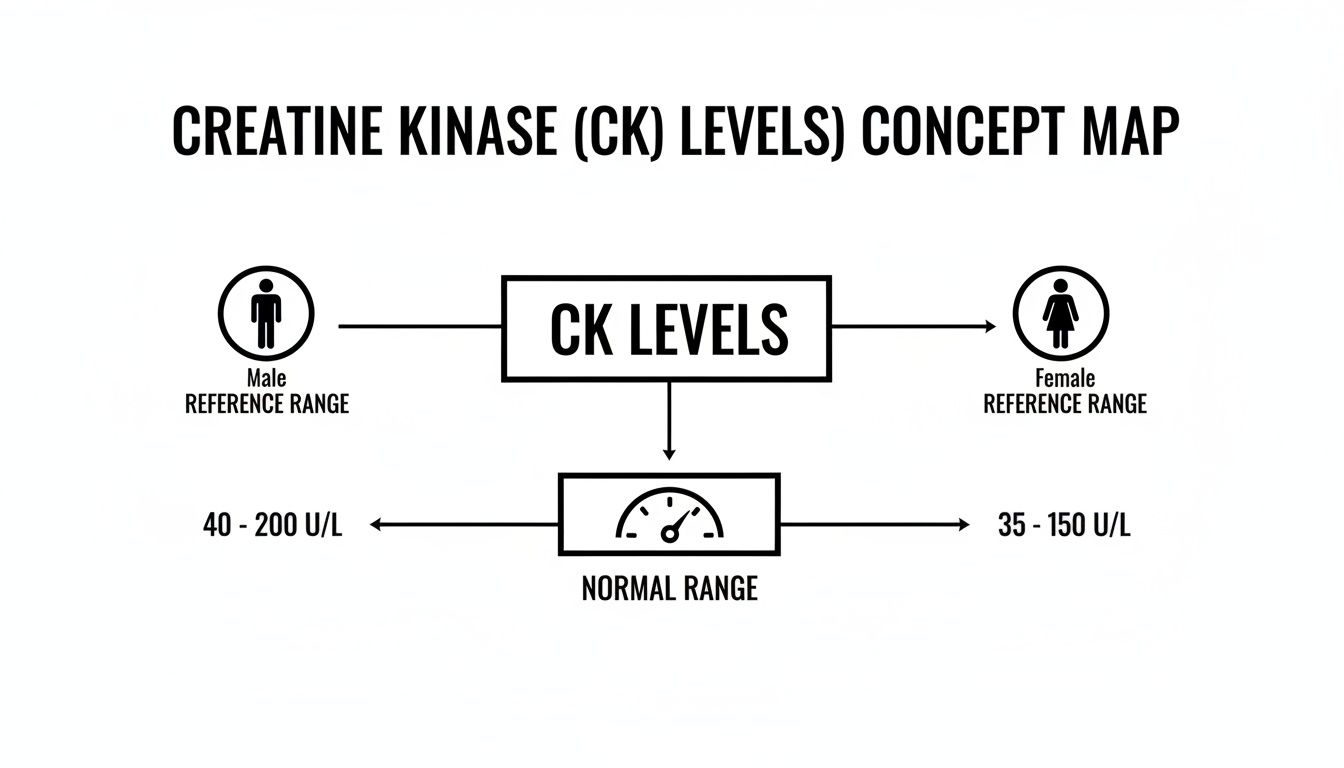
As you can see, baseline CK levels often differ between the sexes, which is largely down to average differences in muscle mass.
Your Body and Your Health
Beyond the gym, your unique physiology plays a huge part in what’s considered a "normal" CK level for you.
- Muscle Mass: It’s simple - the more muscle you have, the higher your baseline CK is likely to be. Maintaining healthy muscle mass is a cornerstone of longevity.
- Age: As we get older, we tend to lose some muscle mass, which can lead to a lower baseline CK reading. This makes resistance training even more vital as a long-term strategy.
- Medications: Some medicines, particularly statins used to manage cholesterol, are well-known for occasionally causing muscle inflammation and, in turn, raising CK levels.
It's vital to see your results within your own personal context. For example, UK laboratory standards acknowledge that people of African or Caribbean descent can have a normal CK range that is 20-50% higher due to genetic differences in muscle density. Understanding nuances like these helps you and your doctor interpret your results with far greater accuracy.
Making Sense of High CK Levels for Your Longevity
Seeing a high creatine kinase (CK) number on your blood test can be a bit unsettling. But before you jump to conclusions, it's important to understand that context is king. An elevated reading isn't always a warning sign; think of it more as a single data point in the broader picture of your muscle health. The real skill is learning to read the story your body is telling you, distinguishing between a normal, short-term spike from exercise and a persistent level that could impact your long-term health.
For instance, if you've just smashed a personal best in the gym, your muscle fibres will have tiny micro-tears. This is a good thing! It's the very process that tells your body to repair and rebuild stronger muscles. The CK that leaks out into your bloodstream during this recovery is a sign of positive adaptation, not a problem. In fact, it’s a natural part of the process, which you might know as understanding Delayed Onset Muscle Soreness (DOMS).

From Minor Spikes to Major Signals
The real insight for longevity comes from looking at how high the number is and for how long it stays that way. A moderate jump after you’ve run a marathon or tackled a heavy weights session is completely normal and expected. It's when your CK levels stay high without an obvious reason that it might hint at underlying muscle stress or chronic inflammation, which can negatively affect your healthspan.
Let's look at two very different scenarios:
- The Athlete: A dedicated triathlete sees a CK level of 500 U/L a couple of days after a big race. For them, this is a healthy, predictable response to incredible physical effort.
- The Professional: A busy executive who is mostly sedentary gets a routine blood test showing a CK level of 500 U/L. This is a potential signal of underlying stress and warrants discussion with their doctor to optimise their long-term health.
Knowing the difference helps you take the right action for your future well-being.
When a High CK Reading Needs Action
While most spikes are harmless, extremely high levels can signal a serious issue. In the UK, a typical reference range is around 24-170 U/L for women and 24-195 U/L for men. A serious condition like rhabdomyolysis, a rapid breakdown of muscle tissue that leads to about 500 hospital admissions in the UK each year, can send CK levels soaring to over 200 times the normal upper limit. This is a medical emergency that needs immediate attention to prevent kidney failure.
On a less dramatic but still important note, certain common medications like statins, prescribed to millions in the UK, can occasionally cause muscle side effects, pushing CK over 1,000 U/L. This is a clear sign to speak with your doctor about your prescription.
The key takeaway for your long-term health is this: treat your CK level as a conversation starter. A temporary spike is useful feedback on your training intensity. A stubbornly high number without a good explanation is your body's way of telling you to dig a little deeper with a healthcare professional to safeguard your future health.
What Low CK Levels Tell Us About Muscle Health
While high creatine kinase (CK) levels often grab the spotlight, consistently low readings can be just as revealing for your longevity strategy. Think of it less as a red flag and more as a quiet insight into your body’s current state. It’s not usually a cause for immediate worry, but it’s certainly a clue about your muscle health that’s worth paying attention to.
Often, persistently low CK levels can point towards a lower amount of overall muscle mass. This becomes particularly important as we get older, since preserving muscle is a cornerstone of healthy ageing and extending your healthspan. It might also simply reflect a more sedentary lifestyle where your muscles aren't getting the regular challenge they need to stay strong.
Why Your Muscles Are a Big Deal for Longevity
It’s helpful to see this information as an opportunity. Having strong muscle mass isn’t just about aesthetics; it’s a non-negotiable for a long, functional life. Your muscles are a critical part of your metabolic engine, playing a huge role in regulating blood sugar, keeping your metabolism fired up, and ensuring you stay mobile and independent for life.
Think of strong muscles as your longevity armour. They make you more resilient to injury, support your skeletal system, and help your body bounce back from illness. A low CK reading can be the very prompt you need to start building that foundation for a healthier future.
A low CK reading isn't a diagnosis. It’s an invitation to be proactive about your muscular health - one of the most powerful actions you can take to boost your long-term wellbeing.
Practical Steps to Boost Your Muscle Health
If your CK levels are consistently on the low side, you're in the driver's seat. The actionable goal is simple: send a message to your body that it needs to build and maintain more lean tissue. This doesn’t mean you have to live in the gym; it’s all about a smart, consistent approach.
Here are a few effective strategies to get you started:
- Prioritise resistance training. This is the most direct way to build muscle and bone density for life. Aim for two or three sessions a week, focusing on compound exercises like squats, deadlifts, and presses that deliver the most benefits.
- Optimise your protein intake. Protein provides the essential building blocks your muscles need to repair and grow stronger. Ensure you're eating enough high-quality protein (aim for 1.2-1.6g per kg of body weight) spread throughout the day.
- Make recovery a priority. Muscles don't grow while you're training; they grow while you rest. Prioritise getting 7-9 hours of quality sleep and find ways to manage stress, as both are important for your body’s repair cycles and long-term health.
Taking these steps is a direct response to what a low CK reading might be telling you. You’ll be building a stronger, more resilient body not just for today, but for decades to come.
Taking Control of Your Health with Proactive CK Monitoring
Knowing your numbers is one thing, but actually using them to build a longer, healthier life is where the real magic happens. When you proactively monitor your Creatine Kinase (CK) levels, you turn this single biomarker from a reactive measure into a useful measure for longevity. It’s all about translating data into daily decisions that compound over time, helping you build a more strong and age-resistant body.
For athletes, tracking your CK levels is like having an inside edge. It gives you objective, hard data on how your body is actually responding to your training load, allowing you to fine-tune your schedule with surgical precision. Imagine knowing exactly when to push and when to pull back, helping you sidestep the cumulative fatigue that so often leads to overtraining and injury. This isn't just about preventing setbacks; it's about optimising every single workout for sustainable, long-term performance.

Your CK Level as a Lifestyle Barometer
For anyone focused on longevity, your CK level is a powerful lifestyle barometer. A consistently high reading, even if it's only slightly elevated, can be a quiet signal of chronic stress, poor sleep, or a sedentary routine—all factors that can accelerate ageing. Monitoring your CK levels can be the very nudge you need to make powerful, health-extending changes.
Seeing a direct biological response to your lifestyle provides incredible motivation. It connects the dots between taking a walk, getting to bed on time, and genuinely improving your muscle health for the long run.
Understanding your personal baseline and how it fluctuates with your routine is the first step toward building a more resilient body. By regularly checking your biomarkers with a convenient home blood test, you can start creating a personalised roadmap to vitality.
This proactive approach means you can introduce targeted strategies and see tangible proof that they’re working. It’s about making small, sustainable adjustments that compound into significant health benefits over time. You can use your CK data to:
- Validate Your Recovery: Confirm that your rest days and recovery protocols are truly effective for long-term progress.
- Encourage More Movement: Use your results as a personal reminder to break up long periods of sitting and build more activity into your day.
- Manage Stress Better: Observe how lifestyle changes aimed at reducing stress have a positive, physical impact on your body's inflammation levels.
Ultimately, tracking your CK levels helps you move beyond generic health advice. It help you to build a personalised longevity strategy designed for your body and your goals.
Take Control of Your health goals with Lola
Knowing your creatine kinase number is a great first step. But what do you do with that information? This is where raw data turns into real-world action, and where Lola can become your partner in managing your health for the long term. We help you turn abstract numbers into a personal roadmap for a longer, healthier life by making it easy to get reliable, lab-quality insights into your muscle health.
With Lola, the choice is yours: a professional phlebotomist can visit you at home, or you can pop into one of our partner clinics. Either way, you're getting the same high-standard venipuncture blood draw you'd expect from the NHS. This means you can trust your results are accurate. No guesswork, just clear, dependable data about what's going on inside your body.
Your Personal Health Dashboard
The real difference with Lola is how we present your results. Every test is reviewed by a qualified doctor who explains what your numbers mean in context. This isn't just about falling inside or outside a generic range; it's about understanding what your CK level means for you and your longevity goals.
The Lola app doesn't just give you a one-off snapshot. It helps you track your CK levels over time, building a visual story of your health and showing how your habits directly impact your wellbeing.
Connecting Your Actions to Your Results
This is where data becomes motivation. When you can see your CK trends in the Lola app, you can finally draw a straight line between the effort you put in and the results you get, creating a powerful feedback loop for positive change.
- Started a new fitness routine? You can actually watch how your baseline CK changes, a clear sign your muscles are adapting and getting more resilient.
- Improved your nutrition or sleep habits? You'll see the proof in how quickly your CK levels bounce back to normal after a tough workout, a marker of improved recovery.
- Working on managing stress? You might be surprised to see how a calmer state of mind can lead to more stable, healthy CK readings, reflecting lower systemic inflammation.
Lola helps close the loop between knowing what to do and actually doing it. It gives you the tools to not just watch your health from the sidelines, but to actively shape it, turning your longevity goals into something you can work on every single day.
Got Questions About CK Levels? We’ve Got Answers.
We get a lot of questions about creatine kinase. Let's tackle some of the most common ones to help you make sense of your own results.
How Should I Prep for a CK Blood Test?
To get a true baseline reading, essential for tracking your longevity progress, the single most important thing you can do is avoid any tough workouts for at least 48 hours before your test. Strenuous exercise is the number one reason for a temporary, and perfectly normal, spike in CK.
It's also a good idea to be well-hydrated. And always give your doctor or phlebotomist a heads-up about any medications or supplements you’re taking, as a few things can nudge the results.
How Long Until CK Levels Are Normal After Exercise?
After a really intense session, you can expect your CK levels to start climbing within about 12 hours. They typically hit their peak somewhere between the 24 and 72-hour mark.
From there, they'll gradually come back down to your usual baseline over the next three to five days. Of course, this can shift based on how hard you went, your fitness level, and how seriously you take your recovery—a key factor in long-term athletic health.
Can What I Eat Affect My CK Levels?
Diet isn't a primary driver of CK in the same way exercise is, but it absolutely plays a important supporting role in your long-term muscle health. For instance, chronic poor nutrition or conditions that lead to muscle wasting can sometimes result in lower-than-expected readings.
Think of it this way: a balanced, protein-rich diet provides the essential building blocks for muscle repair and growth. It helps you bounce back more efficiently after exercise raises your CK. On the flip side, serious dehydration can put extra stress on your muscles and kidneys, which might also affect your results. Good nutrition is a fundamental pillar of maintaining muscle mass for life.
Ready to get a clear picture of your muscle health? With Lola, you get convenient, lab-quality testing with a doctor's review, all tracked in our easy-to-use app. Book your health MOT today.
At-Home Blood Testing
Check your levels from home
Professional phlebotomist visit. Doctor-reviewed results in 2-5 days. Track your health with comprehensive blood panels.
→45-70 biomarkers tested · Venous blood draw · From £130