


When you get a blood test, the results come back with a "normal" range. For ferritin, that range is quite wide: typically 13-150 µg/L for women and 30-400 µg/L for men in the UK. But here’s a critical insight for your long-term health - just because your number falls somewhere in that massive bracket doesn't mean it's optimal for longevity and peak performance.
Your Body's Iron Reserve and Longevity
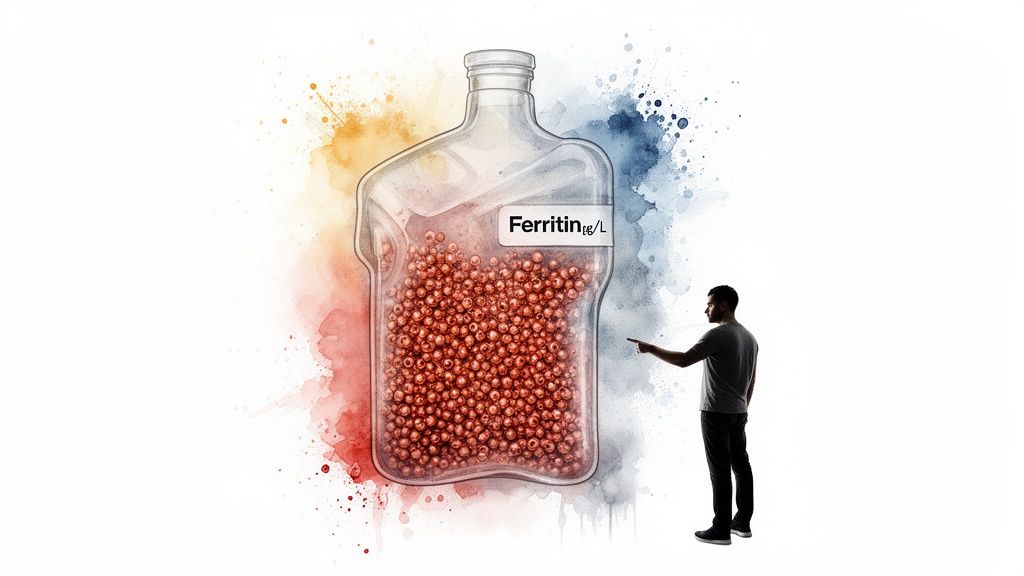
Think of ferritin as your body's iron bank account. It's not the cash you have in your pocket right now - that's serum iron, which circulates in your blood for immediate use. Ferritin is your savings, the important reserve you dip into when you need it. This stored iron is fundamental for cellular energy, DNA repair, and protecting against oxidative stress - all key pillars of a long, healthy life.
Simply having enough in the bank to avoid going overdrawn isn't the goal if you want to thrive for decades to come. An actionable strategy for longevity involves maintaining a healthy buffer to handle life's demands, whether that’s an intense workout, a mentally draining project, or recovering from illness. Managing this reserve is a critical, yet often overlooked, part of a proactive health strategy.
The Standard vs. Optimal Ferritin Range
In the UK, the exact "normal" ferritin range can vary slightly between different NHS trusts, but the general guidelines offer a good starting point. For instance, guidance from the Manchester Foundation Trust sets the typical ranges at 13-150 µg/L for women and 30-400 µg/L for men. These levels are measured in micrograms per litre (µg/L). You can dig deeper into the clinical specifics in the Manchester Foundation Trust's guide for GPs.
The problem is, a number that's simply 'not deficient' is a world away from one that's optimal for longevity. For anyone looking to maintain vitality and cognitive sharpness well into their later years, hovering at the lower end of that normal spectrum can leave a lot of potential on the table.
An optimal ferritin range is often considered to be above 70 µg/L. This level is associated with better cognitive function, sustained energy, and more efficient physical recovery. Falling short can lead to subtle but persistent drains on your long-term health, like nagging brain fog or poor cellular repair.
This distinction is the cornerstone of proactive health management. The table below outlines the standard reference ranges alongside the levels that experts often link to peak performance and well-being.
UK Normal Ferritin Reference Ranges at a Glance
This table summarises the standard NHS reference ranges for ferritin and contrasts them with the levels often recommended for optimal health, especially for active individuals.
| Group | Typical Normal Range (µg/L) | Optimal Range for Performance & Longevity |
|---|---|---|
| Adult Women | 13 – 150 | 70 – 150 |
| Adult Men | 30 – 400 | 100 – 300 |
Understanding your ferritin level isn't about getting a simple pass or fail. It’s about viewing it as a dynamic marker you can actively manage for a longer, healthier, and more energetic life.
Why Optimal Ferritin Is a Cornerstone of Longevity
Knowing the standard "normal" ferritin range is a decent start, but if you're serious about long-term health and vitality, you need to aim for optimal. There's a world of difference between just avoiding a deficiency and actually thriving. The best way to think about it is the 'Goldilocks principle' - not too little, not too much, but just right for sustaining health over a lifetime.
When your iron stores are too low, your body simply can't move oxygen around effectively, leading to fatigue and poor cellular function. On the flip side, having far too much iron can be just as damaging. Excess iron creates a pro-inflammatory environment, driving oxidative stress and cell damage - two processes at the very heart of accelerated ageing.
The Link Between Ferritin and Cellular Energy
Your ferritin level is directly connected to how well your mitochondria work. These are the tiny powerhouses inside every one of your cells, and their main job is to produce energy. They are absolutely dependent on iron to do this.
When ferritin is low, your mitochondria are essentially starved of a key ingredient they need for those critical energy-generating reactions. This isn't a small problem; it creates an energy deficit that ripples through your entire system, impacting your ability to age gracefully.
This isn't just about feeling a bit tired. It affects everything:
- Sustained Energy: With your mitochondria firing on all cylinders, you get consistent energy throughout the day. No more of those dramatic afternoon slumps.
- Sharper Cognitive Focus: The brain is a massive energy hog. Optimal ferritin ensures your mitochondria can meet the demand, preserving clear thinking, memory, and focus as you age.
- Better Cellular Repair: Optimal iron is non-negotiable for repairing cellular damage. Having enough iron in the tank makes this recovery process efficient, which means less wear and tear on your body over time.
This perspective changes ferritin from just another number on a lab report into an active lever you can pull for your long-term health. It’s not simply about dodging anaemia; it’s about fuelling your body at the cellular level for resilience and longevity.
Think of maintaining optimal ferritin as a proactive investment in your future self. It gives your body the raw materials it needs to fight daily stressors, repair damage, and keep both physical and mental performance high for your entire lifespan.
From Preventing Deficiency to Planning for Longevity
The standard medical approach often kicks in only when you hit outright deficiency - for example, when your ferritin plummets below a critical point like 15 µg/L. But for anyone focused on longevity, the game is different. The goal is to maintain a level that actively promotes good health, which many experts suggest is above 70 µg/L.
This higher level acts as a buffer. It ensures you have the reserves to handle illness, stress, or a tough training block without slipping into a state of functional iron deficiency that can compromise your long-term health.
A important part of this strategy is understanding why your levels might be suboptimal in the first place. If you're constantly battling fatigue or notice you're not recovering well, it’s worth digging into the common culprits. We cover this in our article on what causes low iron levels.
When you start viewing your ferritin level as a key performance indicator for your long-term health, you can make smarter, more informed decisions about your diet, lifestyle, and overall health strategy.
What Your Ferritin Results Really Mean
So you’ve got your ferritin test results back. That number on the page is more than just a data point; it’s a important insight into how your body is managing its iron, which directly impacts your energy, recovery, and even your inflammatory state. Seeing a result that isn't in the sweet spot is your body’s way of telling you to dig a little deeper.
Getting to grips with what your specific number means is the difference between simply reacting to a problem and proactively building long-term health. It’s a bit like getting a personalised health map, showing you exactly where you are now and which path to take to feel your best.
This decision tree gives you a quick visual overview of where your ferritin levels might fall and what that could mean for you.
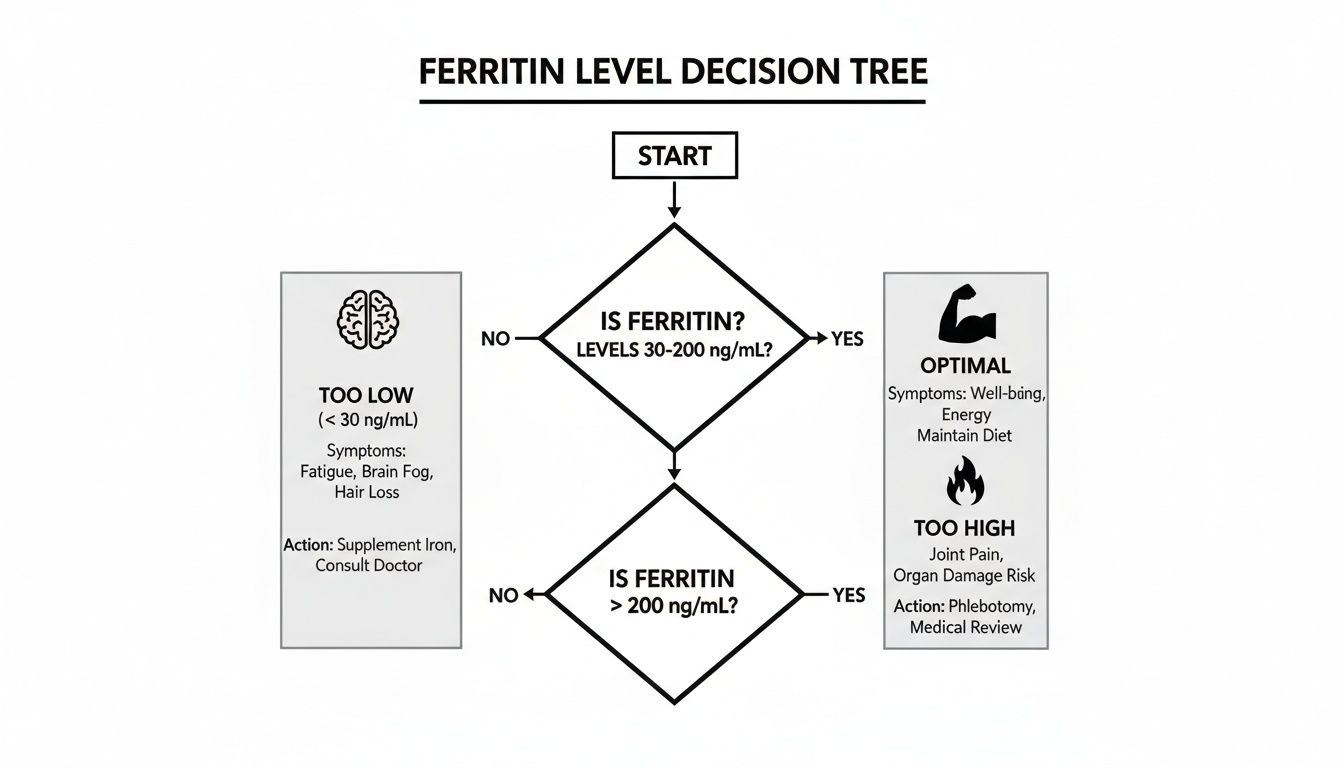
As you can see, it breaks down the results into three key zones, too low, optimal, and too high, each with its own set of clues about what’s happening with your brain, your physical strength, and your body's inflammation levels.
When Ferritin Is Too Low: The Silent Drain on Performance
Low ferritin often creeps up on you. It's a story of a slow, subtle decline long before you’d ever be diagnosed with full-blown iron deficiency anaemia. Your body starts struggling behind the scenes, often due to intense training, gaps in your diet (particularly common for those on plant-based diets), or even minor but chronic blood loss.
The early signs are frustratingly easy to brush off as just the side effects of a busy or stressful life:
- Persistent Fatigue: A deep-seated tiredness that a good night's sleep just doesn't seem to touch.
- Poor Recovery: Your muscles just ache for longer than they should after a workout.
- Hair Thinning: A sign that your hair follicles aren't getting the oxygen they need to thrive.
- Brain Fog: That feeling of not being quite as sharp or focused as you used to be.
Official NHS guidelines are very clear on what constitutes a clinical deficiency. A ferritin level below 15 µg/L signals that your iron stores are empty, and some NHS trusts raise a flag for anything under 30 µg/L. This is a significant issue, affecting an estimated 8-10% of women in the UK. Knowing these clinical thresholds, like those detailed by the South Tees NHS Trust on ferritin interpretation, helps put your own results into a proper medical context.
When Ferritin Is Too High: A Red Flag for Inflammation
On the other end of the scale, a high ferritin reading is rarely a straightforward case of having "too much iron." More often than not, it's a signal flare from your body telling you something else is wrong. That's because ferritin is what's known as an 'acute-phase reactant', meaning its levels shoot up in response to inflammation.
A high ferritin number is often a Trojan horse. It might look like an iron issue, but it's frequently masking deeper problems related to inflammation, liver stress, or metabolic health. Simply trying to lower iron without addressing the root cause is a mistake.
This is exactly why a high result, typically over 200 µg/L in women or >400 µg/L in men, should always be discussed with your doctor. They will almost certainly want to run a few more tests to get the full picture, such as:
- C-Reactive Protein (CRP): A direct marker that measures the general level of inflammation in your body.
- Transferrin Saturation: This shows how much of your body's main iron-transporting protein is actually in use.
These additional tests are vital for figuring out whether you're dealing with true iron overload (a genetic condition called haemochromatosis) or if the spike is being driven by inflammation. Making this distinction is the first and most critical step in creating a health plan that actually works, and it’s a key part of interpreting your normal iron levels correctly.
Right, you've got your ferritin result. Fantastic. But before you take that number as gospel, we need to talk about two massive spanners in the works: inflammation and your age. These factors can seriously muddy the waters, and if you don't account for them, you could be getting a completely misleading picture of your iron levels.
Think of ferritin as having a double life. Its day job is storing iron, but it moonlights as a first responder for your immune system. This dual role is exactly why a single ferritin number, viewed in isolation, can be so deceptive.
The Inflammation Smokescreen
Here’s the thing: ferritin is what scientists call an ‘acute-phase reactant’. In plain English, that means its levels shoot up whenever your body is dealing with inflammation. This could be anything from a tough week at the gym, fighting off a cold, a chronic health condition, or even significant stress.
When inflammation is present, your body ramps up ferritin production as part of its defence mechanism. The problem? This surge can completely mask an underlying iron deficiency.
Let me give you a real-world example:
- Imagine your true iron stores are running low, putting your ferritin at around 30 µg/L.
- Now, let's say you pick up a bug or push yourself too hard with exercise. The resulting inflammation could easily bump that reading up to 70 µg/L.
On paper, 70 µg/L looks perfectly healthy. But in reality, it's a false flag. It's hiding the fact that your iron reserves are actually scraping the bottom of the barrel. This is precisely why it’s so critical to get tested when you’re feeling well and properly rested - it gives you a much more honest baseline.
Why Your Age Changes the Game
Your body isn't the same at 65 as it was at 25, and your ferritin levels reflect that. What's considered a perfectly normal reading for an older, less active person might be a red flag for a young, female athlete training for a marathon.
Generally speaking, our ferritin levels tend to drift upwards as we age. This natural progression is a vital piece of the puzzle when you're looking at your results.
A ferritin level of 100 µg/L might be completely fine for a man in his sixties, but for an active young woman, that same number might not be enough to support peak energy and recovery. Your personal context is everything.
Recent UK data really drives this home. A 2025 analysis of over 3,700 UK blood tests revealed some clear age-related patterns. The median ferritin for women aged 18-29 was 50 µg/L, which climbed to 105.5 µg/L for those over 60. For men, the median started at 121.5 µg/L in the younger group and rose to 173 µg/L in the older one.
These numbers tell a story. They show how demanding lifestyles, particularly in younger years, can drain iron stores. It’s a powerful reminder that the normal ferritin range in the UK isn't a one-size-fits-all metric; it has to be interpreted through the lens of your own age and how active you are. You can look more closely at these UK ferritin trends and what they mean on the Forth with Life blog.
By keeping both inflammation and age in mind, you can start to see your ferritin not as a single, static number, but as part of a bigger trend. This approach gives you a much more accurate and genuinely useful insight into your long-term health and performance.
A Practical Guide to Accurate Ferritin Testing
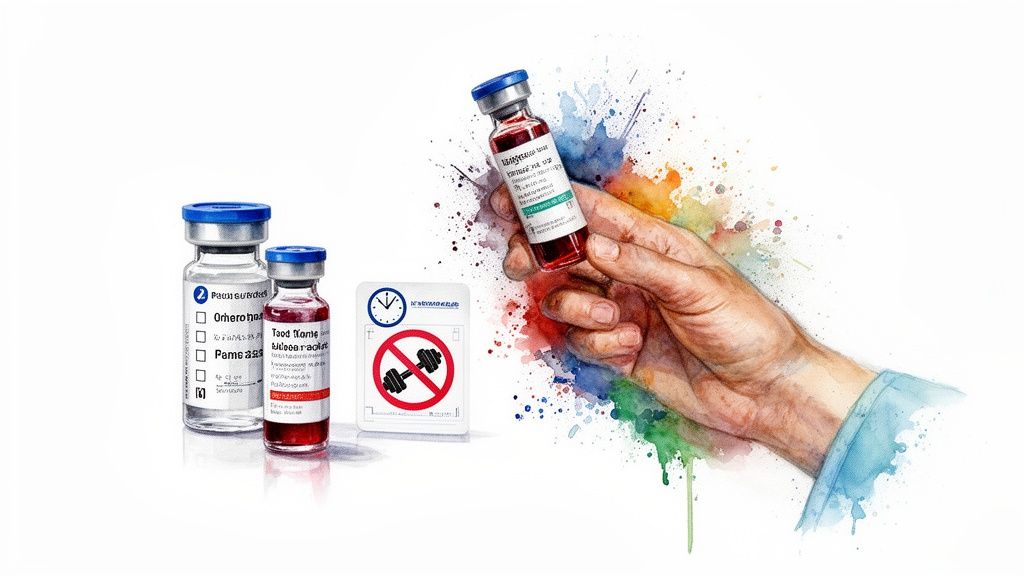
To make smart decisions about your health, you need data you can trust. A ferritin test is a fantastic tool, but its accuracy hangs entirely on getting a clean, representative sample. This means knowing not just what to test, but how and when to do it right.
For the most reliable results, nothing beats a venous blood sample - the kind taken from a vein in your arm by a professional. This method is the gold standard because it provides a high-quality sample that NHS-standard labs can analyse with precision. These days, at-home phlebotomy services can even bring this professional service to your doorstep, making it incredibly convenient.
But the "how" is only half the battle; the "when" is just as critical. Since ferritin levels can shoot up with inflammation, timing your test correctly is non-negotiable for an accurate reading.
Preparing for Your Test
To make sure your result reflects your true iron stores and isn't skewed by temporary factors, follow these simple but important steps:
- Avoid Intense Exercise: Hold off on any strenuous workouts for at least 48 hours before your blood draw. A heavy gym session can create a short-term inflammatory spike that artificially inflates your number.
- Test When Healthy: If you’re fighting off a cold or recovering from any kind of illness, it’s best to postpone the test until you’re feeling 100% again.
- Morning Is Best: Aim to have your blood taken in the morning, ideally after fasting overnight. This provides a more stable, reliable baseline.
Getting an accurate ferritin reading is about controlling the controllables. By minimising inflammatory triggers before your test, you ensure the number you get back is a true reflection of your iron reserves, not just a snapshot of recent stress.
Why a Full Iron Panel Is Better
While a standalone ferritin test is a great start, it only tells part of the story. For a truly complete and actionable picture of your iron status, a full iron panel is the way to go. It provides the context needed to understand how your body is actually managing the iron it has stored.
Think of it this way: a full panel helps connect the dots. It typically includes:
- Serum Iron: This measures the amount of iron actively circulating in your blood at that moment.
- Total Iron Binding Capacity (TIBC): This test assesses how much more iron your blood could carry, giving a sense of its transport potential.
- Transferrin Saturation: This calculates the percentage of your iron-transport proteins that are actually occupied and carrying iron.
With this complete dataset, you and your doctor can distinguish between a true deficiency, an inflammation-driven issue, or other underlying problems with much greater confidence. For an even wider perspective, you can learn more about a comprehensive blood test for vitamin and mineral deficiency in our detailed guide.
Taking Control: What to Do About Your Ferritin Levels
Getting your ferritin result is one thing, but knowing what to do with that number is what really matters for your health. The next step is to move from simply having the data to building a smart plan, whether your levels are low or high.
It’s not just about hitting a specific number on a chart. It’s about figuring out why your levels are off and making targeted changes that get to the root of the problem. For most people, that journey starts with nutrition.
Smart Strategies for Low Ferritin
If your test shows your iron stores are running on empty, the goal is to improve your diet and consider supplementation very carefully. It's important that you don't just start popping iron pills on your own—always speak to your doctor first. Self-supplementing can easily mask other underlying health issues or, worse, lead to dangerous iron overload.
The best place to start is by helping your body absorb more iron from the food you already eat. Here are a few simple but effective tricks:
- Bring in a Vitamin C Buddy: When you're eating plant-based iron sources (known as non-haem iron) like lentils, spinach, or fortified cereals, pair them with something rich in Vitamin C. Think a squeeze of lemon juice over your greens or having some red peppers with your lentil soup. This simple trick can massively boost absorption.
- Mix Your Iron Sources: The iron from animal products like red meat, chicken, and fish (haem iron) is much easier for our bodies to use. If you can, including a small amount of haem iron alongside your plant-based sources can give overall absorption a helpful lift.
- Time Your Cuppa: The tannins found in tea and coffee are notorious for blocking iron absorption. To get the most out of your meals, try to have your brew at least an hour before or after you eat anything iron-rich.
Some people also look into complementary health traditions, exploring options like Ayurvedic iron supplements for natural energy and wellness.
The bottom line is that raising low ferritin is an active process. You're trying to create the ideal conditions for your body to grab onto the iron you give it and put it to good use.
Addressing High Ferritin Levels
On the flip side, if your ferritin is high, your first and most important move is to book an appointment with your GP. A high ferritin result is almost always a signpost pointing to something else going on. It could be inflammation, a liver problem, or metabolic issues.
Your doctor needs to investigate what's causing the high reading before any action is taken. Trying to lower your iron with diet alone without a proper diagnosis is not a good idea. Use your result as a catalyst for a proactive conversation with your doctor to get to the heart of the issue and protect your long-term health.
Ferritin FAQs
Got questions about ferritin? We've got answers. Here are some of the most common things people ask about managing their iron stores for better health and performance.
How Often Should I Get My Ferritin Checked?
This really depends on your individual circumstances. If you're an athlete pushing your body hard or you're actively working to correct a known deficiency, checking in every 3-6 months is a sensible approach. It allows you to see how your levels are trending and adjust accordingly.
For most people who are generally healthy, an annual test is usually enough to establish a baseline and keep an eye on things. Of course, if you’re under a doctor's care for low or high ferritin, they'll set a specific testing schedule to make sure your treatment is working safely.
Can I Just Eat More Iron-Rich Foods to Raise My Ferritin?
If your levels are just a little bit on the low side, then yes, a diet-first approach can definitely help. Focusing on iron-rich foods like red meat (for easily absorbed haem iron) and plant sources like lentils and spinach (non-haem iron) is a great start. Just remember to pair them with Vitamin C, think a glass of orange juice or some red peppers, to give absorption a serious boost.
That said, if you have a true clinical deficiency, diet alone often isn't enough. It's a bit like trying to fill a swimming pool with a garden hose—it's just too slow. In these cases, your doctor will almost certainly recommend a specific supplement to rebuild your iron stores safely and effectively.
My Ferritin Is High, But I Don’t Take Iron Supplements. Why?
This is a really important question, and it's a signal from your body that shouldn't be ignored. When ferritin is high without any iron supplementation, it often points to an underlying issue.
The most common culprits are things like chronic inflammation, stress on the liver, metabolic syndrome, or even drinking too much alcohol. In these situations, ferritin is acting as an "acute phase reactant," meaning it's elevated because your body is in a state of stress or inflammation. It can also, in some cases, be a sign of a genetic condition called hemochromatosis, which causes your body to absorb too much iron.
It’s important to work with a doctor to get to the bottom of it. They'll help you figure out the root cause, which is the first step to understanding your personal normal ferritin range uk and what your results truly mean for your health.
At Lola, we provide convenient, at-home blood testing with professional phlebotomy and NHS-standard lab analysis to give you the clear, accurate insights you need to take control of your health. Discover our full body analysis today.
Test This Biomarker at Home
This biomarker is included in our Ferritin Test and Core Health 45 — results in 2-3 working days with GP-reviewed insights.
At-Home Blood Testing
Check your levels from home
Professional phlebotomist visit. Doctor-reviewed results in 2-5 days. Track your health with comprehensive blood panels.
→45-70 biomarkers tested · Venous blood draw · From £130