


Checking your cholesterol at home has never been easier. You've got a few different options, from simple finger-prick test kits and more sophisticated digital home monitors to a professional at-home phlebotomy service that sends a venous blood sample off for proper lab analysis. It's a convenient way to gather important data for your long-term health strategy without having to book a trip to the clinic.
Why Keeping an Eye on Your Cholesterol is a significant advantage for Longevity
When it comes to extending your healthspan, the number of years you live in vibrant health, waiting for symptoms to show up is a fundamentally flawed approach. Understanding your cholesterol numbers is a important part of playing the long game. High cholesterol is often dubbed a 'silent' condition because it typically causes no noticeable issues until it has already begun to compromise your arteries, silently chipping away at your future health.
Think of a dedicated individual who feels on top of their game. They eat clean, train hard, and feel fantastic. But behind the scenes, genetics or subtle dietary choices could be quietly elevating their LDL (low-density lipoprotein) cholesterol, creating a hidden risk for cardiovascular events that could shorten their life. This scenario is far more common than most people realise.
A Smarter, Data-Driven Approach to a Longer Life
It's time to treat your health with the same precision you’d apply to your career or training regimen. Regularly checking your cholesterol gives you a vital set of data for your personal longevity plan. It allows you to make smart, informed lifestyle changes long before any problems emerge, turning vague health advice into a clear, actionable strategy for a longer, healthier life.
Monitoring your lipid profile isn't just about dodging disease. It’s about optimising your healthspan. It provides the feedback you need to see if your nutrition, supplementation, and fitness protocols are genuinely working at a cellular level to support a long and healthy life.
Proactive cholesterol monitoring is a cornerstone of any serious longevity strategy. Of course, knowing your numbers goes hand-in-hand with living well. Putting evidence-based nutrition tips into practice can make a real difference to your biomarkers, including your cholesterol, helping you build a more resilient foundation for the decades to come.
The Wake-Up Call from UK Health Data
The need for this proactive mindset is starkly clear when you look at the national statistics. Research from Our Future Health and the NHS revealed that over half the people tested, a staggering 54% of 119,651 participants, had high total cholesterol.
What's more concerning from a longevity perspective is that high LDL ('bad') cholesterol is linked to 1 in 5 deaths from heart and circulatory diseases in the UK. You can read more about these transformative health research findings. These numbers point to a widespread, silent epidemic that individual monitoring can help tackle head-on. Knowing your numbers is the first step to taking control and ensuring you don't become just another statistic.
Your At-Home Cholesterol Testing Options Explored
Deciding to test your cholesterol at home is a powerful first step in your longevity goals, but now you must pick the right tool for the job. Your options boil down to three main categories, each with its own pros and cons. The best choice for you depends entirely on what you're trying to achieve - whether you just need a quick check-in or you demand clinical-grade accuracy to make meaningful decisions for your long-term health.
This push for more control over our own health data is becoming more and more common. The UK cholesterol testing market is set to hit a staggering £1,042.3 million by 2030, largely because professionals and health-conscious individuals want a more flexible way to keep tabs on their wellbeing.
Simple Finger-Prick Kits for a Quick Snapshot
The easiest way to get started is with an over-the-counter finger-prick kit. These are single-use tests that give you a basic reading of your total cholesterol, and sometimes a rough breakdown of HDL and LDL, in just a few minutes.
Think of these kits as a quick pulse check. Let's say you've just switched to a longevity-focused diet and want to see if it's moving the needle. A simple finger-prick test can give you that fast, directional feedback. They're cheap and you can find them anywhere, making them a great low-barrier option for anyone curious about their numbers.
But that simplicity comes with a trade-off. These tests are nowhere near as accurate as a proper lab analysis and are pretty susceptible to user error. They give you a ballpark figure, not a precise data point, so they are not suitable for anyone meticulously tracking their health for optimal longevity.
Digital Home Monitors for Tracking Trends
A step up from the disposable kits are the digital home cholesterol monitors. These gadgets still use a finger-prick blood sample and a test strip, but they give you a digital readout. The real advantage here is the ability to monitor your levels consistently over time.
For instance, if you're a biohacker experimenting with a new supplement like berberine or a high-dose fish oil, a digital monitor lets you take weekly readings. You can start to spot trends and see how your body is responding. While they're generally more reliable than the basic kits, the precision can still be a bit hit-or-miss.
Key Takeaway: Digital monitors are fantastic tools for personal accountability. Seeing your numbers change in response to a new gym routine or dietary tweak can be a powerful motivator to stick with habits that support a long and healthy life.
These devices put you in the driver's seat, letting you collect data that can lead to much more productive conversations with your doctor. If you're looking for more guidance on getting the most out of your tests, you might find our guide to at-home blood testing kits useful.
This quick decision tree can help you visualise which path might be right for your initial assessment.
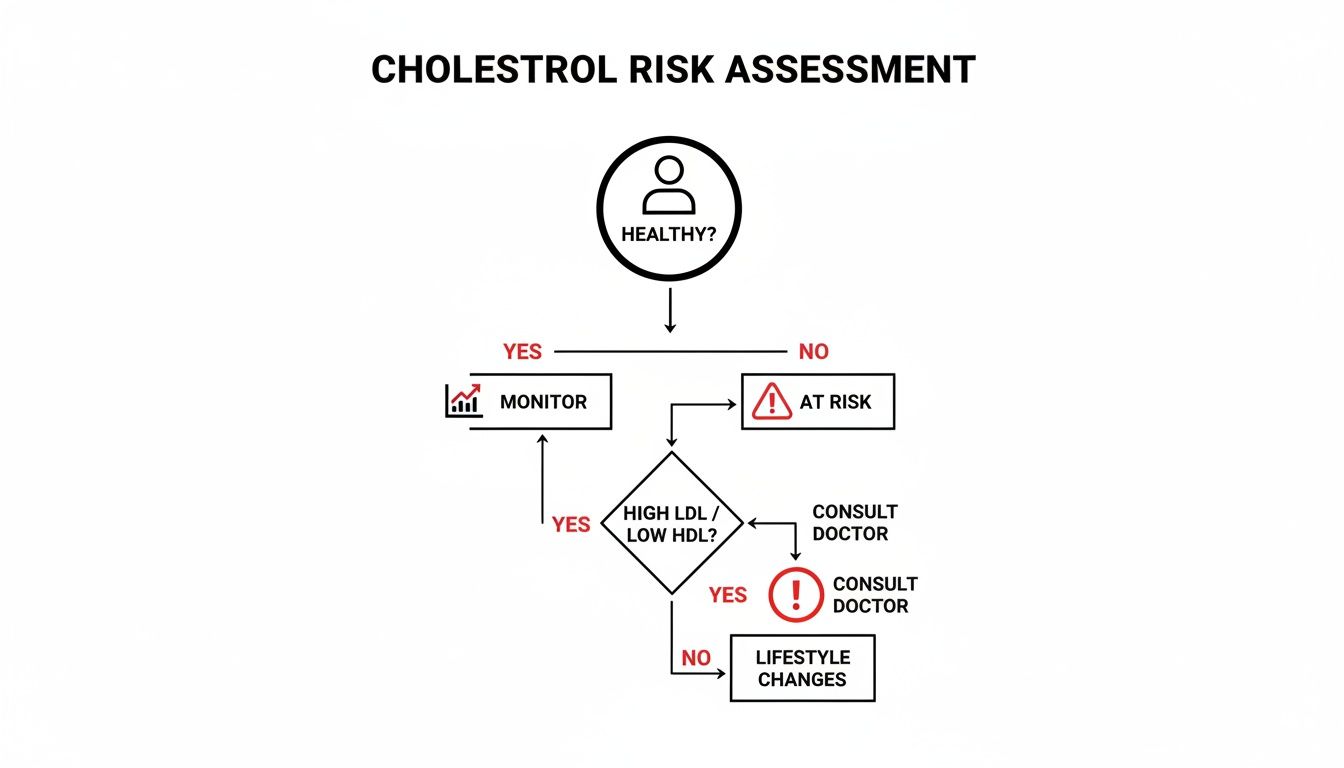
The flowchart makes a simple but vital point: whether you feel perfectly healthy or you're already managing a known condition, consistent monitoring is the bedrock of any proactive health strategy.
Comparing Your At-Home Cholesterol Testing Methods
Choosing the right test can feel overwhelming, so here’s a straightforward comparison of the three main options. Think about what you need, a quick snapshot or lab-grade data, to decide which one fits your health goals best.
| Feature | Finger-Prick Kits | Digital Home Monitors | At-Home Phlebotomy (Lola) |
|---|---|---|---|
| Accuracy | Low to moderate; best for general estimates | Moderate; better for tracking trends over time | Very high; clinical-grade, lab-analysed results |
| Data Provided | Usually just Total Cholesterol, sometimes HDL/LDL | Digital readings of Total Cholesterol, HDL, LDL | Comprehensive Lipid Panel (Total, HDL, LDL, Triglycerides) |
| Best For | A quick, one-off directional check after a lifestyle change | Consistent personal tracking and identifying trends | Making informed health decisions for longevity |
| Convenience | Very high; results in minutes at home | High; reusable device for regular home testing | High; professional draws your blood at home, no travel needed |
| Cost | Low (per test) | Moderate initial cost, plus ongoing cost of strips | Higher initial cost, but reflects professional service |
| Potential for Error | High (user-dependent sample collection) | Moderate (requires correct technique and calibration) | Very low (sample collected by a trained professional) |
Ultimately, while finger-prick tests offer a starting point, they can't match the reliability of a professional service when accuracy is what truly matters for your long-term health.
At-Home Phlebotomy for Unmatched Accuracy
For anyone who needs the highest level of precision for their longevity strategy, at-home phlebotomy is the gold standard. It's the perfect blend of convenience and clinical accuracy. Instead of a tiny drop of blood from your finger, a trained professional comes to you and performs a proper venous blood draw from your arm - the exact same procedure used in hospitals and GP clinics.
This is the only real option for someone making critical decisions based on their results. Think of someone fine-tuning their nutrition for peak cardiovascular performance and a maximal healthspan. They simply can’t afford the 15-20% variance that can crop up with finger-prick tests. They need exact, reliable numbers to guide their actions.
With a service like Lola, your sample is sent directly to a UKAS-accredited laboratory for full analysis. This guarantees your results are trustworthy. You get a complete, detailed lipid panel that breaks down:
- Total Cholesterol: The overall amount of cholesterol in your blood.
- LDL (Low-Density Lipoprotein): The 'bad' cholesterol that can lead to plaque buildup in your arteries.
- HDL (High-Density Lipoprotein): The 'good' cholesterol that helps clear out the excess.
- Triglycerides: A type of fat in your blood that, if high, increases your risk of heart disease.
This method completely removes the guesswork. You get data you can confidently act on, whether that’s adjusting your diet, tweaking your supplements, or having an informed discussion with your doctor. It’s a genuine investment in your long-term health, giving you the clarity you need to live a long and healthy life.
Getting It Right: How to Collect an Accurate Sample at Home
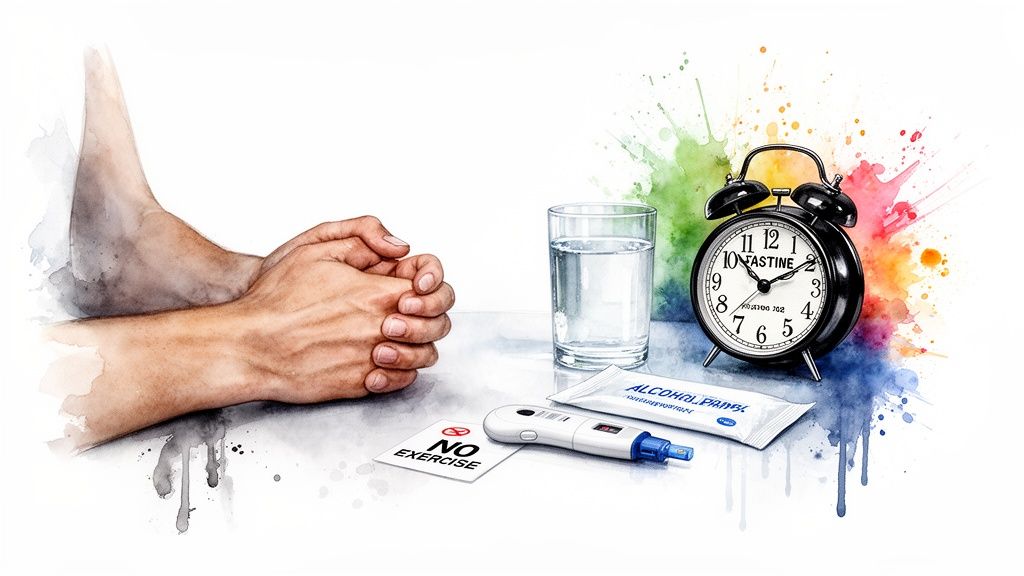
Here’s the bottom line: the data you get from an at-home cholesterol test is only as reliable as the sample you give it. If you want to make decisions that genuinely support your longevity, a clean and representative sample is completely non-negotiable.
Think of it as laying the foundation for a house. A poor sample leads to shaky data, which can misguide your entire health strategy and undermine your long-term goals.
Whether you're using a simple finger-prick kit or a professional service like Lola's, these insider tips will help guarantee your results are as trustworthy as possible.
The All-Important Pre-Test Prep
Before you even think about the test itself, there are a few things you absolutely must do. These aren't just polite suggestions; they have a direct impact on your lipid profile, especially your triglycerides and calculated LDL cholesterol.
Why Fasting Is Non-Negotiable For an accurate lipid panel, you must fast for 9-12 hours. Eating can temporarily send your triglyceride levels soaring. Because LDL cholesterol is often calculated using a formula that includes triglycerides, a false high reading will skew your entire profile and give you a distorted picture of your cardiovascular risk. For longevity planning, this baseline accuracy is essential.
Hydration Is Your Best Friend Being well-hydrated makes a world of difference, especially for a venous blood draw. Drinking plenty of water in the 24 hours beforehand makes your veins much easier to find and helps the blood flow smoothly. Steer clear of caffeine and alcohol, as they'll only dehydrate you.
Skip the Intense Workout (Just This Once) Regular exercise is fantastic for your heart and longevity, but a heavy gym session right before your test can work against you. Strenuous physical activity can temporarily throw off lipid and other biomarker levels. It’s much better to take a rest day or opt for something gentle, like a walk, the day before your sample is collected to get a true baseline reading.
Mastering the Finger-Prick
If you’re using an over-the-counter kit or a digital monitor, getting a good-quality drop of blood is often the biggest hurdle. In fact, a poor sample is the number one reason these devices can give inaccurate results.
To get the best possible sample, try these practical steps:
- Warm up your hands first. Run them under warm water for a minute or two. This simple trick boosts blood flow to your fingertips, making it far easier to get a full drop of blood.
- Aim for the side of your fingertip. Don’t prick the very centre pad of your finger. The sides of your middle or ring fingers have great blood flow but fewer nerve endings, so it’s less painful.
- Don't squeeze too hard. It’s tempting to wring your finger if the blood isn't flowing, but this is a big mistake. Squeezing can damage red blood cells and push interstitial fluid (the fluid between your cells) into your sample. This contamination, called haemolysis, can corrupt your results. Instead, gently massage your hand from your palm down towards the fingertip.
Your goal is a clean, round, freely flowing drop of blood. If you’re struggling, it’s far better to use a fresh lancet on a different finger than to force a poor-quality sample from your first attempt. For a deeper dive, have a look at our complete guide to at-home blood sampling.
What to Expect with a Professional At-Home Blood Draw
When you opt for a service that includes professional phlebotomy, the pressure is off. You don't have to worry about getting the sample right because a trained expert is doing it for you. This process is all about maximising accuracy to inform your longevity plan.
A trained and vetted phlebotomist will arrive at your home at the scheduled time. They’ll start by confirming your identity and the tests you’re having done, ensuring everything is correctly labelled from the get-go.
The draw itself is quick and professional. They will find a suitable vein (usually in the crook of your arm), clean the area, and draw the blood using sterile, single-use equipment. The whole thing usually takes less than five minutes.
Because they’re professionals, the risk of a contaminated or insufficient sample is virtually zero. This is why it’s the gold-standard method for getting the kind of high-quality data you need for serious health management.
How to Interpret Your Results for a Longer Healthspan
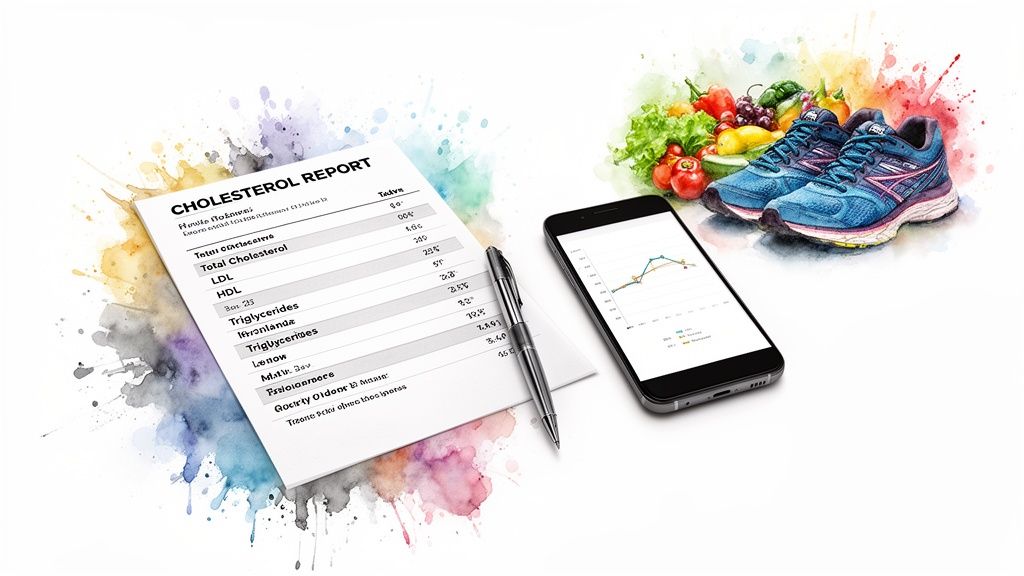
Getting your cholesterol report back is the moment of truth. You've done the test, and now you have the data—but a set of numbers is meaningless until you know what it says about your long-term health. Learning to interpret these results is how you transform that raw data into a real, actionable plan for a longer, healthier life.
It's about moving past simplistic labels like 'good' and 'bad'. A detailed lipid panel offers a much more detailed picture of your cardiovascular health, giving you the insights you need to make smart, effective adjustments to your longevity strategy. Let’s break down your report so you can read it like an expert.
The Four Pillars of Your Lipid Panel
Your report will centre on four key metrics. Understanding what each one means is the first step towards seeing the full picture of your metabolic health.
- Total Cholesterol: This is the headline figure, the sum of all cholesterol types in your blood. It gives a general overview, but on its own, it's not a very useful marker for longevity.
- LDL (Low-Density Lipoprotein): Often called the 'bad' cholesterol. LDL’s job is to deliver cholesterol to cells, but when there's too much, it can build up in your artery walls, leading to plaque formation (atherosclerosis).
- HDL (High-Density Lipoprotein): Known as the 'good' cholesterol. Think of HDL as a clean-up crew; it mops up excess cholesterol from your arteries and takes it back to the liver for disposal.
- Triglycerides: This is a type of fat in your blood that the body uses for energy. High levels are often tied to diet, especially sugar and refined carbs, and can contribute to the hardening of your arteries.
It’s no surprise that detailed testing is so popular. The Total Cholesterol Test commanded 40% of the market share in 2023 because it measures HDL, LDL, and triglycerides all at once. Diagnostic labs remain the most trusted source, accounting for over 40% of the cholesterol testing market by using advanced equipment for pinpoint accuracy.
Looking Beyond the Individual Numbers
While knowing your individual markers is a great start, the real insight for longevity comes from seeing how they relate to each other. These relationships, or ratios, give a far more accurate assessment of your cardiovascular risk than any single number. They reveal the balance between your 'good' and 'bad' cholesterol.
A common mistake is fixating only on Total Cholesterol. Someone might have a 'high' total number that's actually driven by exceptionally high levels of protective HDL. In that scenario, their risk profile is much better than the single number suggests.
This is precisely why looking at ratios is so vital for a sophisticated health strategy. They provide the context needed to make truly informed decisions. For a detailed breakdown of what the numbers mean, check out our thorough guide to cholesterol levels in the UK.
Key Ratios for Assessing Your Risk
Two of the most insightful ratios are the Total Cholesterol to HDL ratio and the Triglyceride to HDL ratio. Calculating them is simple, and the results can be incredibly revealing for your long-term health prospects.
- Total Cholesterol to HDL Ratio: Just divide your Total Cholesterol number by your HDL number. An optimal ratio is generally below 3.5, while anything over 5 is often seen as high risk. For example, if your Total Cholesterol is 5.2 mmol/L and your HDL is 1.5 mmol/L, your ratio is 3.46—which is excellent.
- Triglyceride to HDL Ratio: Divide your Triglyceride number by your HDL number. This is a powerful indicator of insulin resistance and the size of your LDL particles (smaller, denser particles are more dangerous). An ideal ratio is below 2, with many longevity experts aiming for a ratio closer to 1.
These simple calculations turn your report from a list of figures into a dynamic tool for assessing your personal risk and refining your longevity plan.
Turning Your Results into an Action Plan
Once you understand your numbers and their ratios, you can build a targeted plan. What you do next depends entirely on your specific results.
If Your Numbers Are in the Optimal Range... Fantastic news! This means your current lifestyle is effectively supporting your long-term health. The goal now is maintenance and continued monitoring.
- Action: Keep up your healthy eating and exercise habits.
- Next Test: Plan another at-home test in 6–12 months to make sure you’re staying on track.
If Some Numbers Are Borderline or Slightly High... This isn’t a cause for panic, but it is a clear signal to take proactive steps. It's your chance to make small changes that can have a huge impact on your healthspan.
- Action: Focus on specific nutritional tweaks. For high LDL, up your intake of soluble fibre (oats, beans, apples). For high triglycerides, cut back on sugar, alcohol, and refined carbs.
- Next Test: Re-test in 3–4 months to see how your changes are working. This feedback loop is key to optimisation.
If Your Numbers Are Significantly High... High results are a firm call to action. The first and most critical step is to get professional medical advice to protect your future health.
- Action: Book an appointment with your GP immediately. Share your results with them. They can provide a clinical diagnosis and discuss a full management plan, which might include more tests, major lifestyle changes, or medication.
- Next Test: Your doctor will advise on the right schedule for follow-up testing.
in practice, at-home cholesterol testing is your starting point. It equips you with the essential data you need to build a smarter, more effective strategy for a long and healthy life.
Why a Professional Blood Draw is the Gold Standard
When you're making decisions that will impact your health for decades to come, the quality of your data is everything. For anyone serious about their longevity, understanding the difference between a finger-prick sample and a professional venous blood draw is absolutely critical. While quick tests have their place, a venous draw is the undisputed gold standard for accuracy.
Think of it like this: a finger-prick test offers a snapshot, a single frame from a film. A venous blood draw, on the other hand, gives you the entire high-definition scene, full of rich detail and context necessary for long-term planning.
The blood from a finger-prick is capillary blood, which is a mix of blood from tiny vessels, tissue fluid, and cells. Its composition can vary slightly, which can introduce inconsistencies. In contrast, a venous draw collects venous blood directly from a vein, providing a much larger, purer, and more stable sample for the lab to analyse.
The Power of a Professional Sample
This is precisely why at-home phlebotomy services like Lola represent the peak of reliable home testing. The process sidesteps the variables and potential user errors that can sometimes affect finger-prick results. When precision is what you need for your longevity strategy, this method is the only way to get data you can truly trust.
Having a trained professional collect your sample guarantees that the blood sent to the lab is a true reflection of what’s happening inside your body. There’s no risk of squeezing your finger too hard and altering the sample, or not quite collecting enough blood for an accurate reading.
This isn’t just about convenience; it’s a strategic move for your health. You get results with the same level of confidence you'd expect from your GP or a hospital visit, all without leaving your home.
From Your Arm to a UKAS-Accredited Lab
Where your sample goes is just as important as how it's collected. With a service like Lola, your professionally drawn blood is sent directly to a UKAS-accredited laboratory. This is the same accreditation held by the labs used by the NHS, so you know your sample is being analysed with the most advanced equipment and under the strictest quality controls.
This end-to-end professional process ensures maximum precision for your full lipid panel:
- Total Cholesterol
- HDL (High-Density Lipoprotein) or "good" cholesterol
- LDL (Low-Density Lipoprotein) or "bad" cholesterol
- Triglycerides
You receive a complete and accurate picture, giving you the confidence to make important decisions about your diet, lifestyle, and overall health strategy.
What the At-Home Experience Looks Like
Booking a test is surprisingly simple. You choose your test online, and a vetted phlebotomist arranges to visit you at home, often within a couple of days. The blood draw itself is quick, professional, and takes just a few minutes.
Your results are then delivered securely, usually through an app, and often come with a personalised review from a doctor. This closes the loop, turning raw numbers into meaningful advice and ensuring you understand exactly what your results mean for your longevity goals.
in the end, opting for a venous blood draw is about taking your health monitoring to the next level. It shifts you from making educated guesses based on ballpark figures to building a proactive health plan based on clinical-grade, undeniable data.
Your Top Questions About Home Cholesterol Testing, Answered
Deciding to test your cholesterol at home is a great first step, but it's natural to have a few questions before you get started. From wondering about accuracy to figuring out what to do with the results, getting these details straight is what turns a simple test into a useful measure for your health and longevity.
Let's walk through some of the most common queries I hear, so you can feel completely confident in the process.
How Accurate Are These Tests Compared to My GP's?
This is the big question, and the answer really depends on which type of test you're using. They aren't all created equal.
The simple, over-the-counter finger-prick kits are fine for getting a rough ballpark figure. Think of them as a general indicator, not a precise measurement. You can expect their results to vary by as much as 15-20% compared to a proper lab test. They give you a hint, but you wouldn't want to make major health decisions based on them alone.
Digital monitors are a step up and can be quite useful for tracking your own trends over time. If you see your numbers consistently creeping up or down on the same device, that's valuable information.
However, if what you need is clinical-grade accuracy, the kind your doctor relies on, the only way to get that at home is with a service that uses a venous blood draw.
For anyone serious about managing their health for the long term, precision is everything. A professional phlebotomy service that sends your blood to a UKAS-accredited lab is the gold standard. It removes all the guesswork and gives you data just as reliable as an NHS test.
Is Fasting Really Necessary Before a Test?
In a word, yes. If you want a complete and accurate lipid panel that truly reflects your baseline health, fasting is non-negotiable. Plan to fast for 9-12 hours before your blood sample is taken.
Here’s why it matters so much: eating can temporarily send your triglyceride levels soaring. The problem is that your LDL ('bad') cholesterol is often calculated using a formula that includes your triglyceride level. So, an artificially high triglyceride reading will throw off your LDL result, painting a misleading picture of your cardiovascular risk. Without an accurate baseline, effective long-term planning is impossible.
What Should I Do If I Get a High Cholesterol Result?
First things first, don't panic. A high result from a home test is simply a piece of data, a very useful one, that signals it's time to take action.
Your immediate next step should be to book an appointment with your GP. Take your results with you. This allows them to see the full picture, offer advice tailored to you, and, if they think it's necessary, confirm the reading with their own tests.
While you wait for your appointment, you can start making smart, evidence-backed lifestyle changes that are proven to support cardiovascular health and longevity:
- Load up on soluble fibre: Things like oats, beans, apples, and citrus fruits are fantastic for helping to lower LDL.
- Switch to healthier fats: Focus on getting more monounsaturated and polyunsaturated fats from foods like avocados, nuts, seeds, and olive oil.
- Get moving: Aim for at least 150 minutes of moderate-intensity exercise, like brisk walking or cycling, each week.
How Often Should I Be Testing My Cholesterol at Home?
The standard NHS recommendation is for adults over 40 to have a cholesterol check every five years. But if you're actively managing your health for longevity, that's simply not frequent enough to be useful.
For anyone who is proactive about their wellbeing, testing every 6-12 months creates an invaluable feedback loop. It allows you to see the real-world impact of your diet and lifestyle changes. You can clearly see what's working and what isn't. This transforms health management from a guessing game into a clear, data-driven strategy for a longer, healthier life.
Take the guesswork out of your health monitoring. Lola provides professional, at-home phlebotomy services with analysis in UKAS-accredited labs, giving you the clinical-grade data you need to make confident decisions for your longevity. Get your results, including a personalised doctor review, delivered directly to our app. Explore Lola's health tests today.
At-Home Blood Testing
Check your levels from home
Professional phlebotomist visit. Doctor-reviewed results in 2-5 days. Track your health with comprehensive blood panels.
→45-70 biomarkers tested · Venous blood draw · From £130